美股七月赚钱了吗?这里面或许有你想要的答案:7月收官 & 回顾
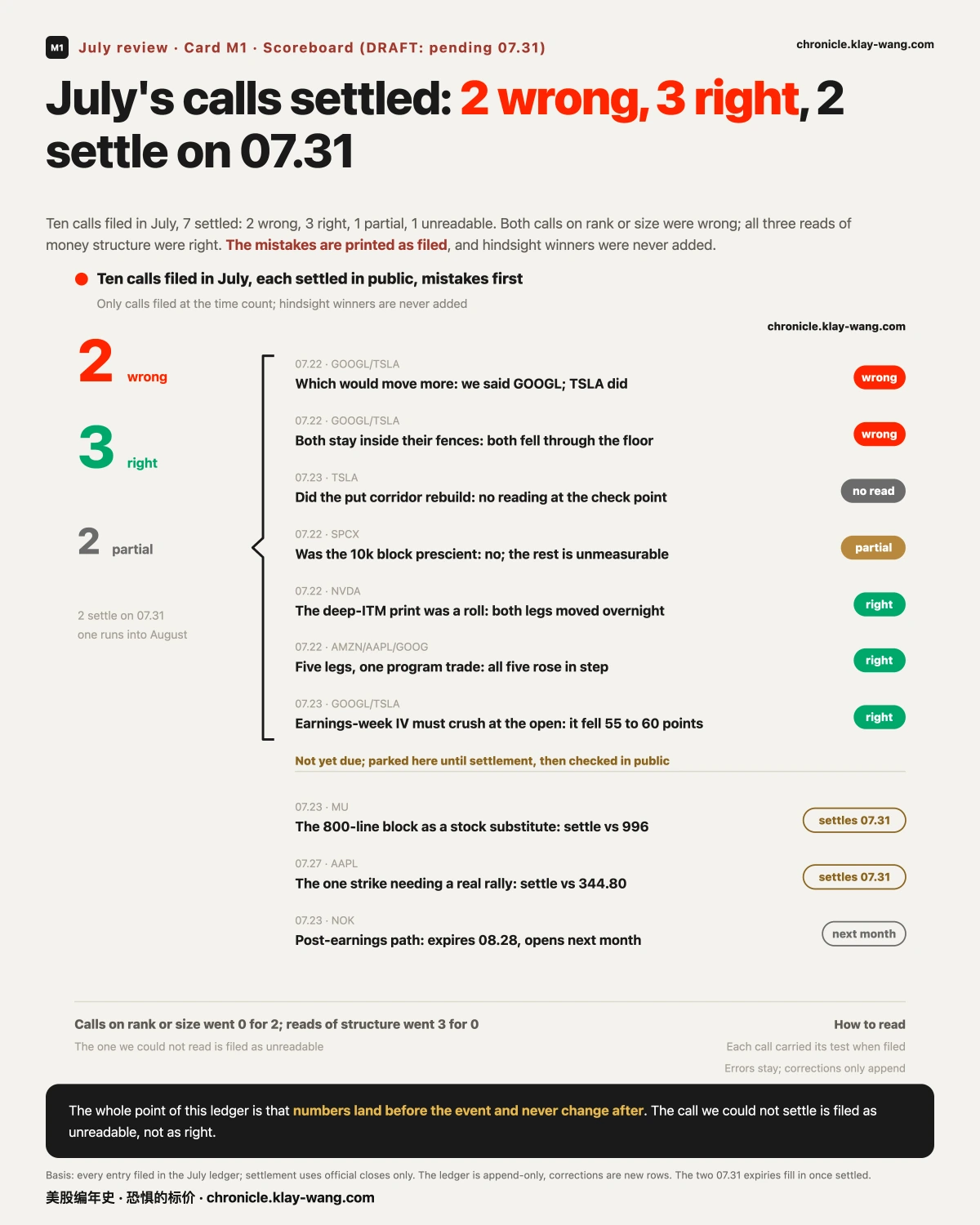
Our filed calls settled: 0 for 2 on rank and size, 3 for 0 on reading structure; two more we could not answer, filed as unmeasurable
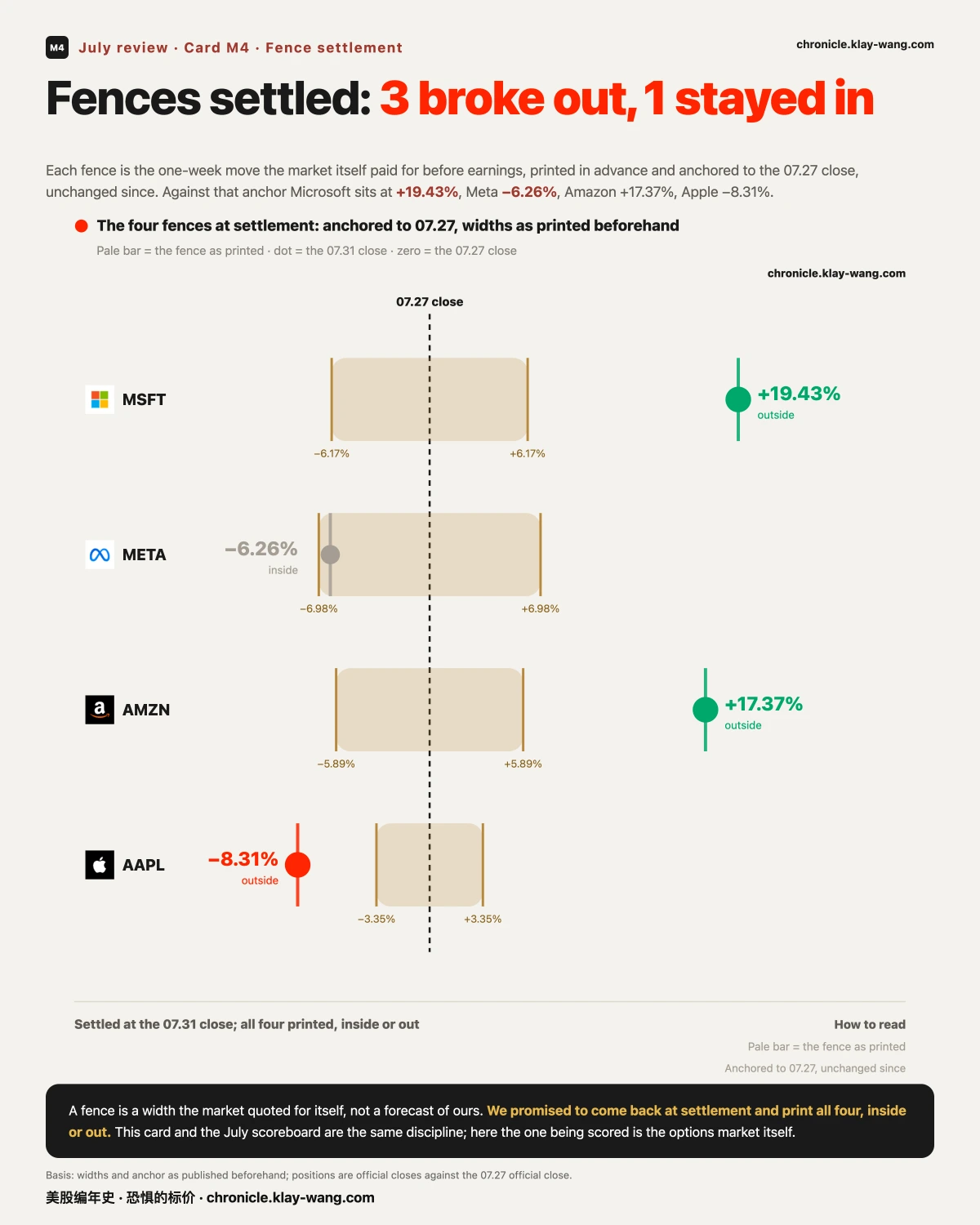
Three of four earnings fences broke out, and in the month's final two sessions, the 30-year minus 10-year Treasury spread widened to 55bp, July's high
1 · The last day was the month in miniature
SPY closed 07.31 at 747.03, +0.03% for the month, back where it started. Intraday it ran to within 0.31 points of its own gamma flip in the first five minutes, was refused, lost 8.6 points over forty minutes through three levels, and took all of it back by the close. The macro release that morning moved it 0.6 points.
The closing price said nothing; everything in between was the content. An index tells you what happened on average. It never tells you who it happened to.
2 · The scoreboard, mistakes first
Wrong, both the same way: we said Alphabet would move more than Tesla on earnings night, Tesla did; we said neither would leave its volatility fence, both fell through the floor. Both were guesses about size and rank.
Right, all the same way: Nvidia's deep-in-the-money print was a roll (both legs moved overnight); five legs across three names were one program trade; earnings-week implied volatility would crush at the open (it fell 55 to 60 points). All three read structure the money left behind.
Two have no answer. Intel's four-leg stack and Micron's call ladder expired on 07.31, and same-day expiries offer exactly one window to check open interest, our collection missed it. "Unmeasurable", not "denied".
The pattern is uncomfortably clean: 0 for 2 guessing where price goes, 3 for 0 reading what the money is doing. We do not guess the cards; we watch the chips.
A record is worth something only because it is logged before the fact and never edited after. Allow yourself to go back and tidy it, and the whole book is worth nothing. Every miss on the scoreboard is what makes the hits worth reading.
3 · A flat index and the 71 points underneath
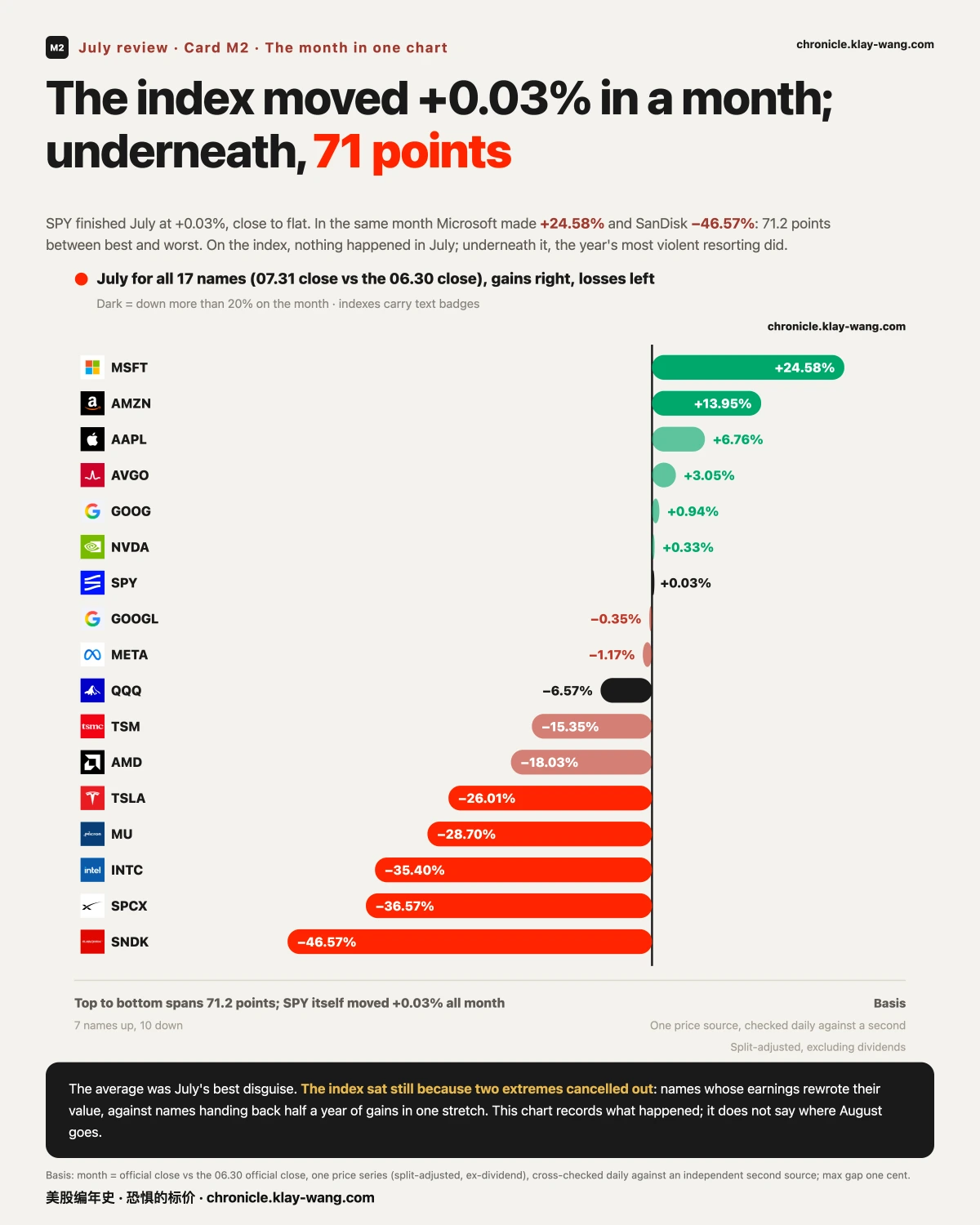
Seven of seventeen up, ten down. Above: Microsoft +24.58%, Amazon +13.95%, Apple +6.76%. Below: SanDisk −46.57%, SPCX −36.57%, Intel −35.40%, Micron −28.70%, Tesla −26.01%. In the middle: SPY +0.03%, QQQ −6.57%, Nvidia +0.33%.
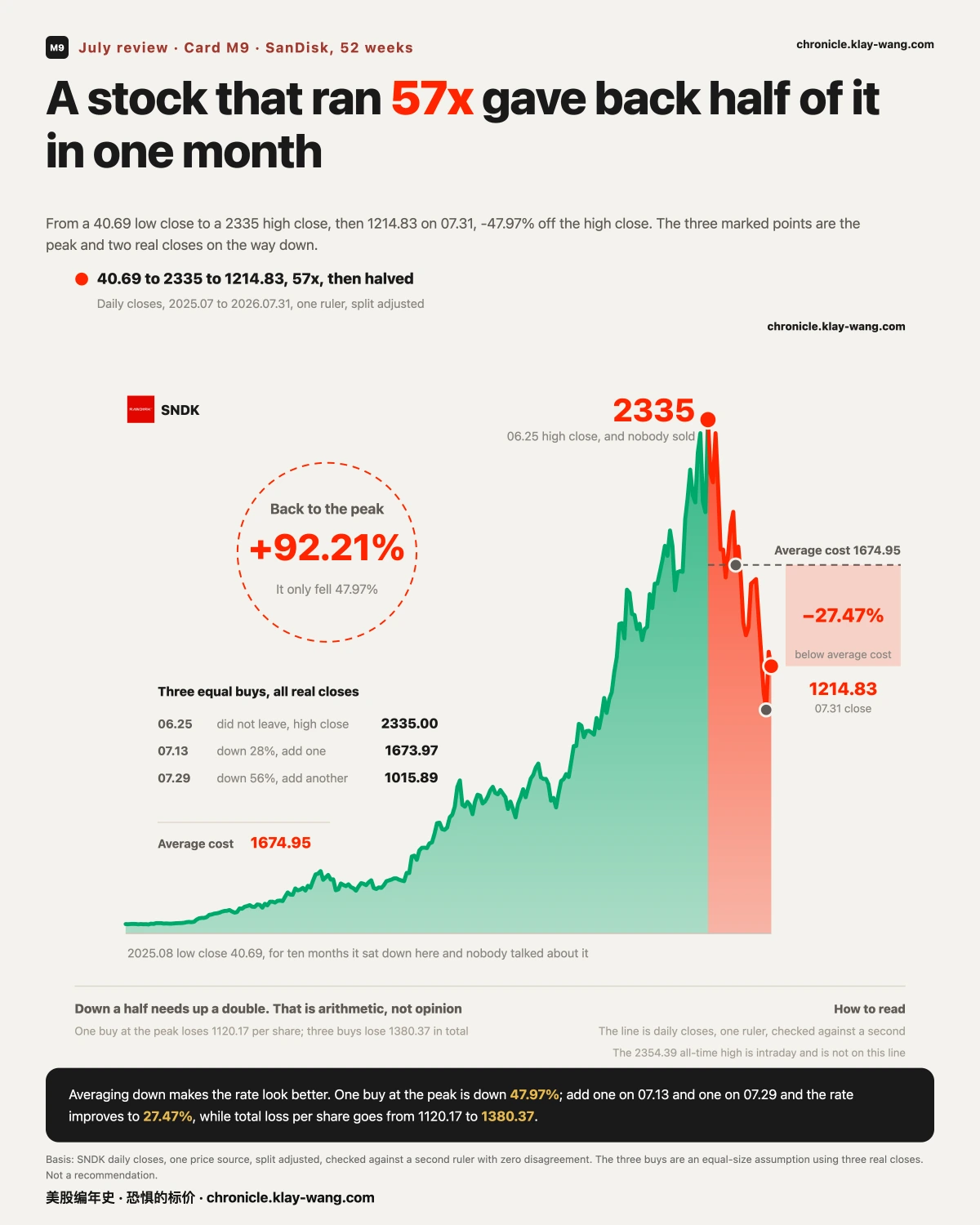
This is not "the index was fine and stocks were not", the two extremes cancelled each other out. One caveat on storage: SanDisk went from 40 to 2354 over 52 weeks, 58-fold. July's −46.57% is a descent from altitude, not a mispricing.
4 · Three lenses
Price, a month about levels. On 07.17 expiry, Alphabet's spot, both walls, its flip and max pain sat inside 1.4 points. 07.20 reset everything; 07.29 brought the Fed; earnings week redrew the gamma map overnight (QQQ's flip fell 33.5 points, Micron's 96.5). By 07.31 Apple closed under its own put wall and Amazon sixteen points through its call wall. Not because walls are magic, because real money sits at those strikes, and every expiry forces a full re-read.
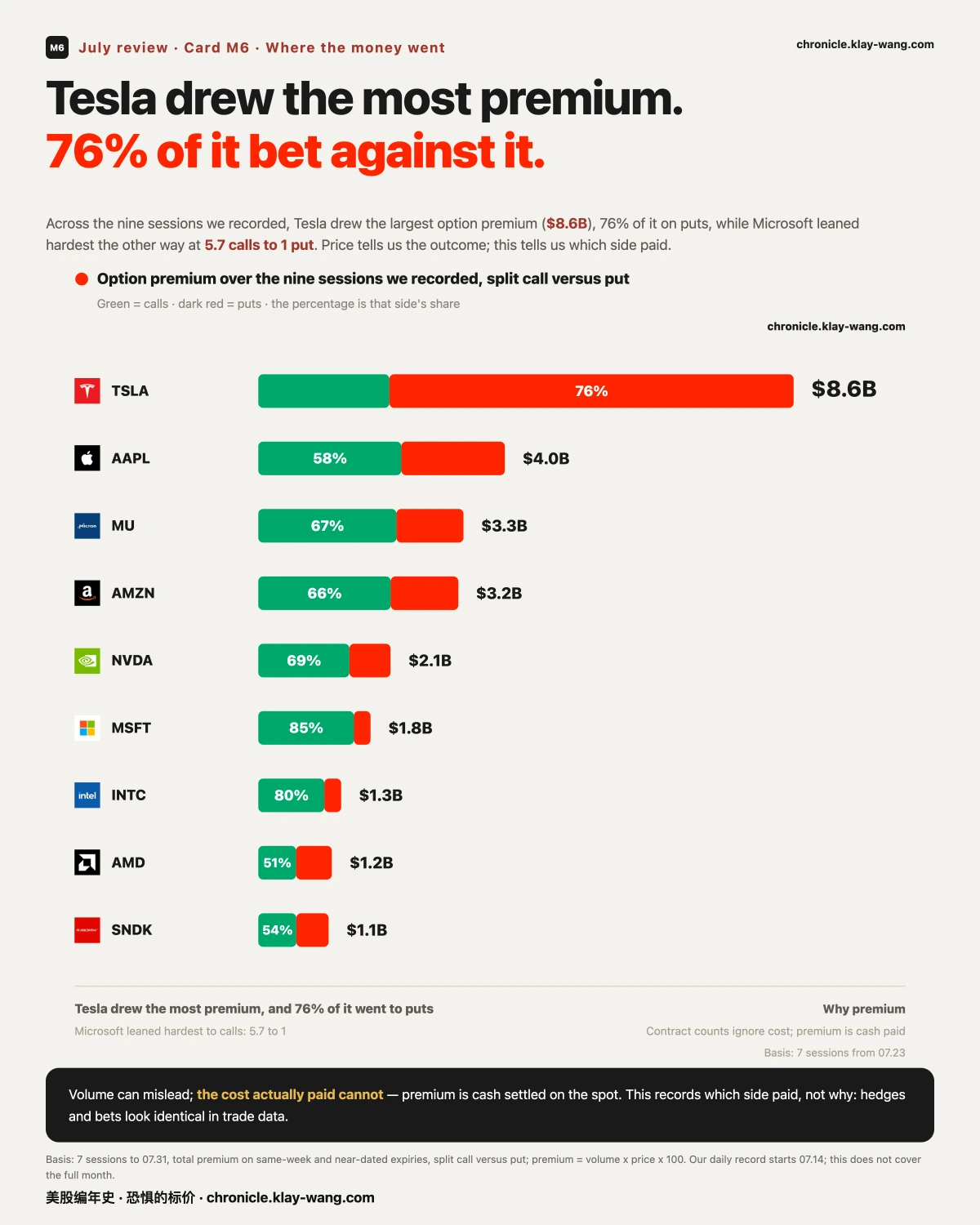
Money, what we logged, and what came after. A $12,000 print for 3,000 four-cent crash puts on 07.20; a $100M block at Micron's 800 line on 07.22; Nvidia's roll on 07.23, confirmed the next day; on 07.30, Intel's four legs and SPY's both-sides prints on 09.04, which settled into July's cleanest contrast: same day, same expiry, the puts kept 60% of their volume overnight and the calls kept 8.7%. That expiry sits on August payrolls. Being checkable is the whole moat.
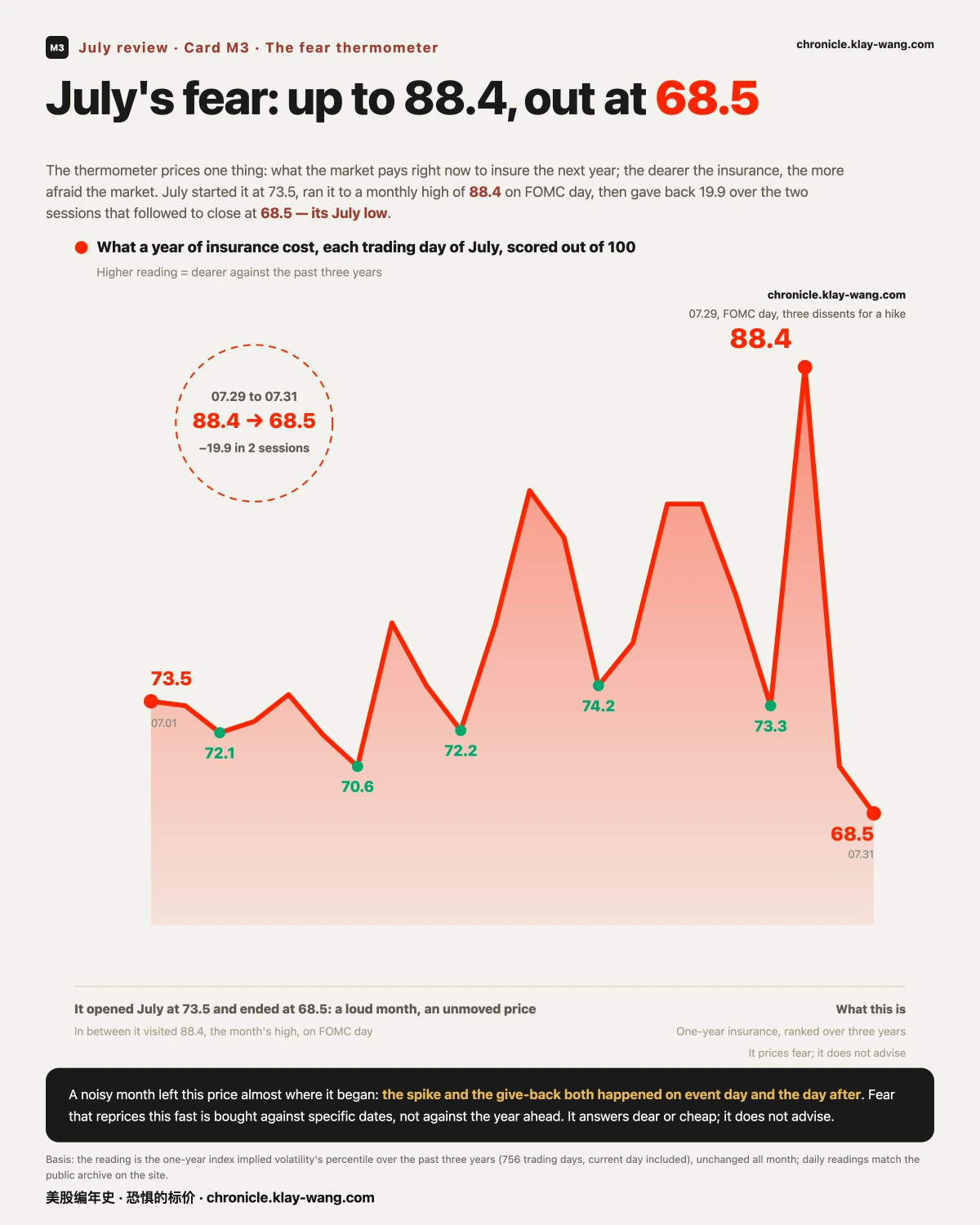
Fear, 73.5, then 88.4, then 68.5. Opened July at 73.5, 70.6 on 07.10, 82.9 at expiry, 88.4 on Fed day, gave back 19.9 over the next two sessions, closed at 68.5, its July low. The spike and the give-back both landed on event day and the day after: fear priced against specific dates, not against the year.
5 · The fences: three out, one in, and a reversal
Anchored to the 07.27 close, printed in advance, unchanged since. At settlement: Microsoft +19.43% vs ±6.17%, out. Amazon +17.37% vs ±5.89%, out. Apple −8.31% vs ±3.35%, out. Meta −6.26% vs ±6.98%, inside.
Three left the width the market quoted for itself; this round was underpriced for size. But the one to remember is Meta: on 07.30 we printed it as outside at −9.23%, and by settlement it was back inside. That mid-course reading was not wrong, it simply was not a conclusion. Same lesson as our six-point sampling on Fed day, where one session gave three contradictory but equally real answers depending on the minute. We anchor to the close not because it is more accurate, but because it is the only point we do not have to choose.
6 · In the month's last two sessions, the bond market moved
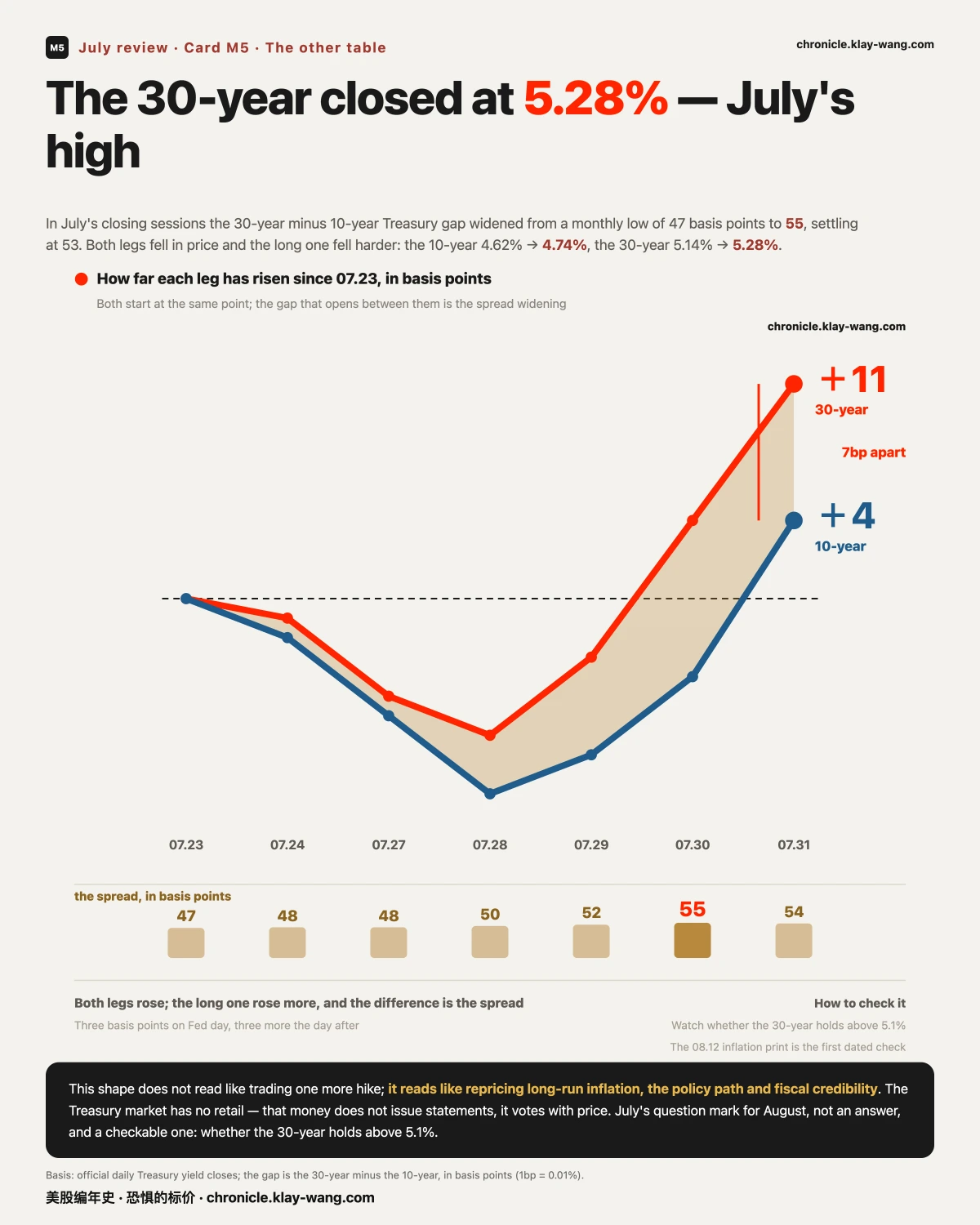
Deleveraging solves a funding problem; how far a rebound travels is decided at a different table. And in July's final two sessions, there was a checkable change at that table: the 30-year minus 10-year Treasury spread widened from 47bp at its monthly low to 55bp, three basis points on Fed day, three more the day after, easing to 53bp on the final session while both legs stepped higher again (10-year 4.74%, 30-year 5.28%, both July highs).
Both legs fell in price and the long leg fell harder: from 07.29 to 07.31 the 10-year went 4.62% → 4.74% and the 30-year 5.14% → 5.28%, the long leg falling harder. That shape is not trading "one more hike"; it reads more like repricing long-run inflation, the policy path, and fiscal credibility.
There is a phrase for this: bond vigilantes. The Treasury market has no retail; it is institutional money, and when that money dislikes a policy it does not issue statements, it votes with price. In a real sense, the bond market is doing part of the Fed's tightening for it, and it never asks equities for permission.
This is July's question mark for August, not an answer, and it is checkable: the 30-year closed above 5.1% for July's final three sessions and at 5.28% on the last; if that level keeps rising the headwind stays on the books, back below 5.0% and the paragraph is closed. August's inflation print on 08.12 and the month's long-bond auctions are the next two dated checks.
July was a hard month, and its last week finally delivered a real rebound. That does not contradict the paragraph above, they are simply two different tables.
7 · What we said, and what happened
Not to take credit, so you can check. A ledger is only worth something if it invites you to look back.
On 07.27 we wrote that the market was pricing Nvidia's credit story, not storage's supply story. That day it was one observation. By month-end: Nvidia +0.33%, storage −28.70% and −46.57%. Two stories, two entirely different prices, and the split ran the whole month.
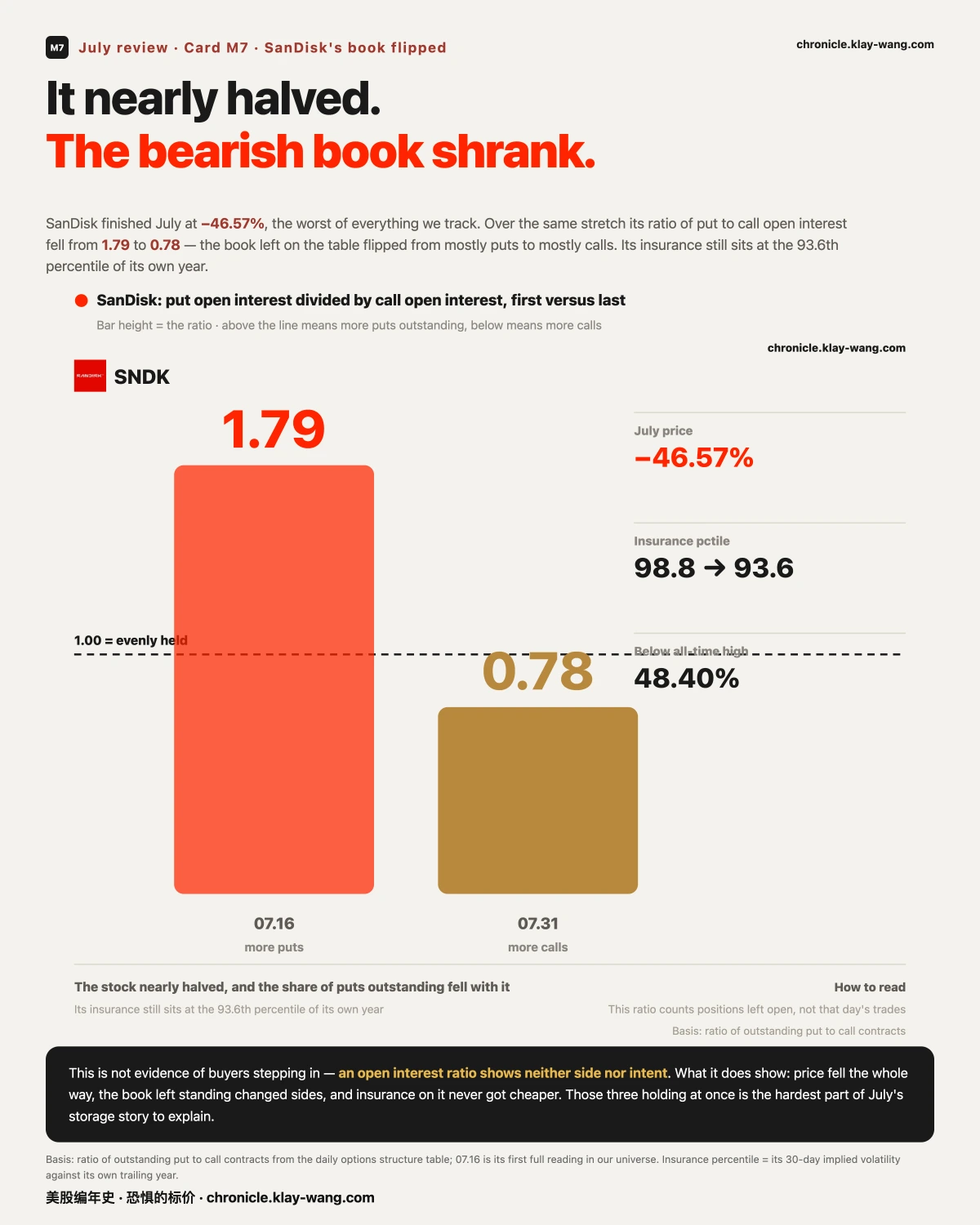
On 07.25 we wrote that storage had fallen a third while the ticket to ride had gotten more expensive. The point was never direction; it was a measurable fact, the stock falling while its insurance repriced higher. By month-end storage had fallen further, and its long-dated insurance is still the dearest in this universe (SanDisk's one-year reading at 106.51, more than five times SPY's). Cheap it did not get.
On 07.23 we wrote that storage options had acted out Alphabet's script before the CFO read the numbers. Capital expenditure did become one of the month's main lines.
And what did not land: the four-cent crash puts from 07.20 were never needed. We only ever wrote that someone paid that price, never that they would win, which is why nothing needs walking back now. The $100M block at Micron's 800 line settled on 07.31 at 823.03, far below its 996 breakeven. That one lost, and we file it.
8 · Three open questions (evidence → reasoning → what would overturn it)
The index: calm, or a tug of war? Evidence: SPY +0.03% while its components spanned 71.2 points, and the price of a year of insurance ran 73.5 → 88.4 → 68.5. Reasoning: calm would leave both the index and its components still; a tug of war leaves violent component moves that cancel at the index, July was the second. "The market was calm in July" holds at the index level and fails underneath it. Overturned if: August narrows the component spread inside 30 points while the index still goes nowhere. That would be actual calm.
Inside tech: rotation, or dispersion? First, what we cannot say: "rotation" claims money moved from A to B, and that requires flow data we do not have, so we never use the word. What we can measure is dispersion: on the same session, Microsoft opened flat, earned all 3.27% intraday and closed at 88% of its range, while AMD and Intel closed in the bottom 1% of theirs. Monthly: Microsoft +24.58%, Intel −35.40%, both filed under "tech". Reasoning: what is confirmed is that assets under one label have stopped moving together; what is not confirmed is whether money crossed between them. Overturned if: daily correlations recover in August and these names start moving as a bloc again.
Storage: dead-cat bounce, or turn? We do not answer direction, but the question breaks into checkable coordinates. Evidence: SanDisk ran 40 → 2354 over 52 weeks (58-fold), fell 46.57% in July, and sits 48.40% below its all-time high; Micron −28.70%. On 07.31 both showed the same intraday shape, gap up, sold all day: SanDisk was +8.10% at the open and fell 12.20% from there; Micron gapped +5.18% and fell 10.54%. Reasoning: the gap was given overnight and the session sold it, those are not the same participants, and the full-day number erases the distinction. Meanwhile someone paid $5.17M for Micron's 1000-line calls inside that red candle (vol/OI 3.66, newly opened). Overturned by, in either direction: first, whether gap and session turn the same sign again for several sessions; second, whether long-dated insurance comes down from SanDisk's 106.51. We record both daily, and we will come back.
9 · What Wall Street would rather you did not know
What Wall Street would rather you did not know is not which name is going up. It is this: it does not make money by beating you. It makes money by keeping you at the table.
The oldest first lesson on a trading desk was not taught at a desk. You took the new hire to a casino, taught them nothing, and watched them play, because a casino compresses thirty years of market mistakes into a single evening.
What July's table looked like. SPY finished the month at +0.03% while the spread between its best and worst name was 71.2 points. Three of the four earnings fences the market priced in advance were broken. On 07.31 SanDisk was up 8.10% at the open and fell 12.20% from there; Micron gapped +5.18% and fell 10.54% from its open. The price of a year of insurance hit 88.4 on decision day, gave back 19.9 in two sessions, and closed the month at its cheapest. High volatility is not a straight line down. It is a day on which the bull case and the bear case are both true.
Why the house wins. Not because you lose. On any single hand you might win, and the house edge is usually a few percent. What it actually sells is your return trip. It has two things you do not: unlimited time and unlimited hands. It never needs to beat you; it only needs you not to leave.
The chips in front of you are not your money. Say a good night runs your stack up to seven million. While you are still sitting there, that is not your money; it is what the house lent you so you would keep playing. Human nature says: what is on the table is already mine. So the last hand goes wrong and all of it goes back. You walked in with twenty thousand. The next day people say he only lost twenty thousand. You know you lost seven million. That gap is the real damage: the account is down twenty thousand, the judgment is down seven million, and every trade you place afterwards is placed by the person who lost seven million.
Then comes the ATM. By the second withdrawal you are not playing the game any more, you are arguing with a number. The one self-check in this section needs no data at all: am I placing this because of something I saw, or because the last one lost? The moment the answer is the second one, you are already at the ATM.
Why high volatility rarely belongs to retail. Institutions survive months like this not by seeing more clearly but by doing three things most people cannot: hedge, scale in, and sit out. The first two cost money; the third costs composure. Our own ledger has the proof: the $100M block at Micron's 800 line on 07.22 expired 07.31 at 823.03 against a 996 breakeven. That one lost, and it was not retail. Volatility does not care how much money you have. On the same ledger, the $12000 paid on 07.20 for three thousand four-cent crash puts never paid off either, and the difference between the two is not accuracy. It is whether the stake was a number you could afford to lose.
And the part nobody wants to hear. People dismiss an asset that returns low double digits a year as too slow. July is the answer: 71.2 points of spread, and the index moved 0.03%. The moves that keep you awake cancelled each other out. The slow one you do not think about at night, and because you do not think about it you do not change your mind at 3am, and time gets a chance to do the work.
The size of the move is given by the market. Whether you hold the whole of it is given by your composure.
Back to the top. Wall Street does not need you to lose, it needs you present. Every turnover, every attempt to win it back, every 3am change of mind pays a toll to that machine. You are less at the mercy of luck once you can see the chips.
⚠️ This section is about behaviour and mechanism. It is not a recommendation of any asset class and it is not investment advice.
10 · August markers (dates only, no direction)
08.03, whether the open interest behind 07.31's two butterfly structures appears. 08.07, payrolls, and one strike of Microsoft's put band. 08.12, inflation, the first check on the bond paragraph above. 08.21, monthly expiry; walls get rebuilt. 09.04, SPY's both-sides expiry, and September payrolls.
Someone has already paid for these dates. We come back and publish, either way.
11 · Closing
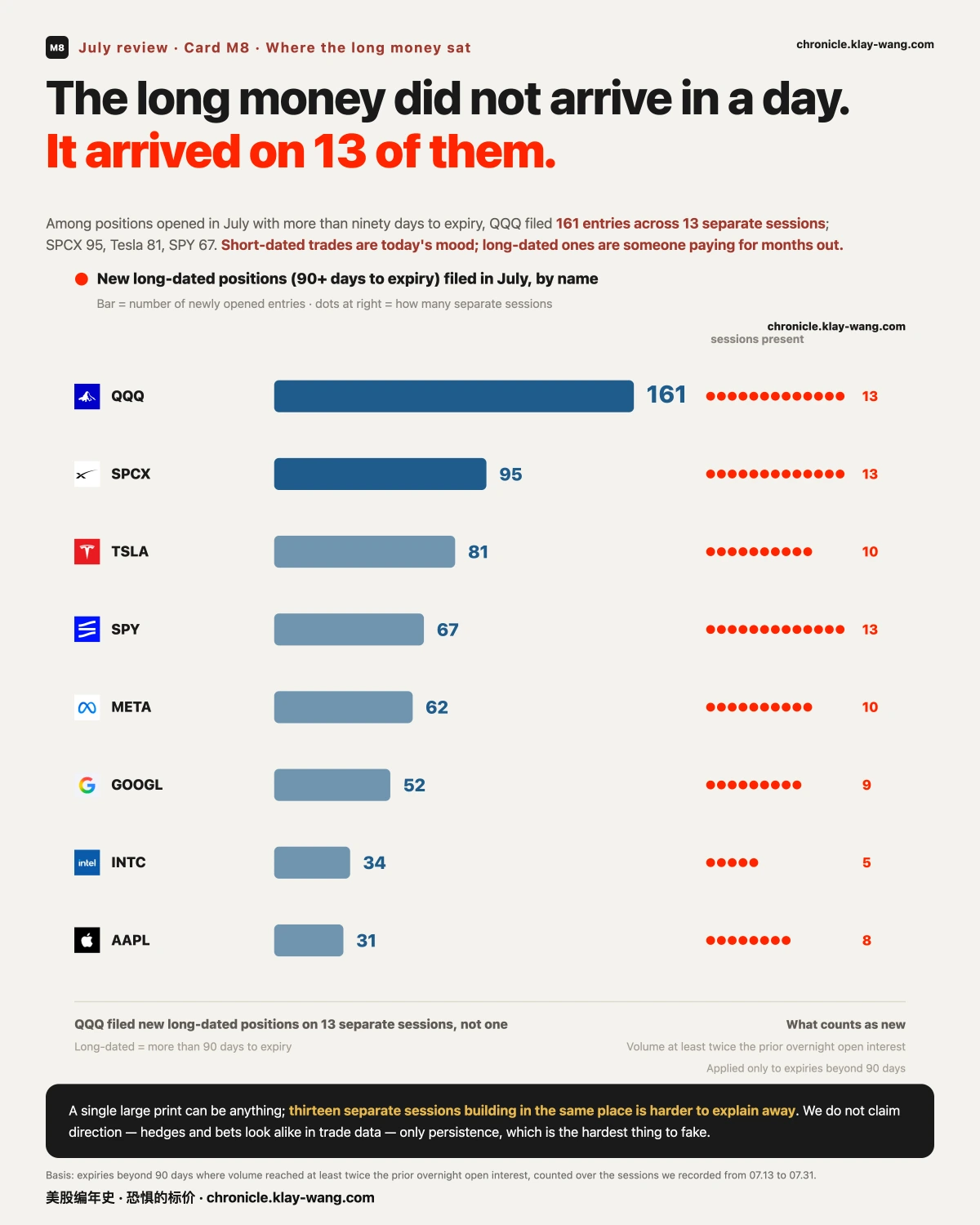
July ended where it began. Inside that same month, one name gained a quarter of its value and another lost nearly half; the price of a year of insurance ran to its dearest in three years and, six days later, closed the month at its cheapest; and at another table, the longest-dated money quietly asked for more.
An index tells you what happened on average. It never tells you who it happened to. Everything we did this month was write down who, including the times we got it wrong.
August, same.
No investment advice. No direction calls. No market timing.