The stock you keep watching went nowhere. It travelled a very long way.
Three lines
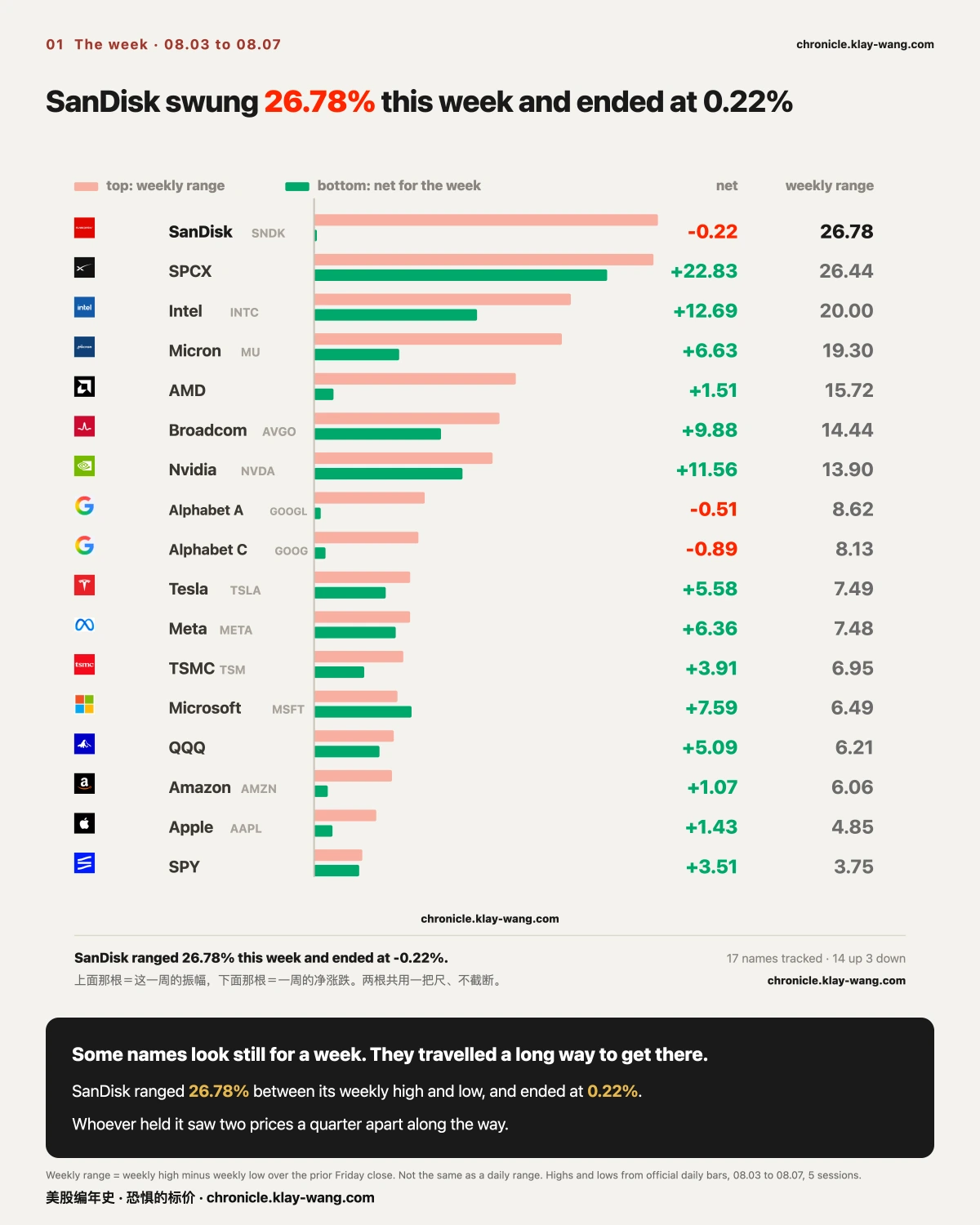
- Some names look like they went nowhere for the week. They travelled a very long way. SanDisk finished the week −0.22%, essentially back where it started, while its weekly high and low were 26.78% apart. Anyone reading only the weekly bar sees a stock that never moved.
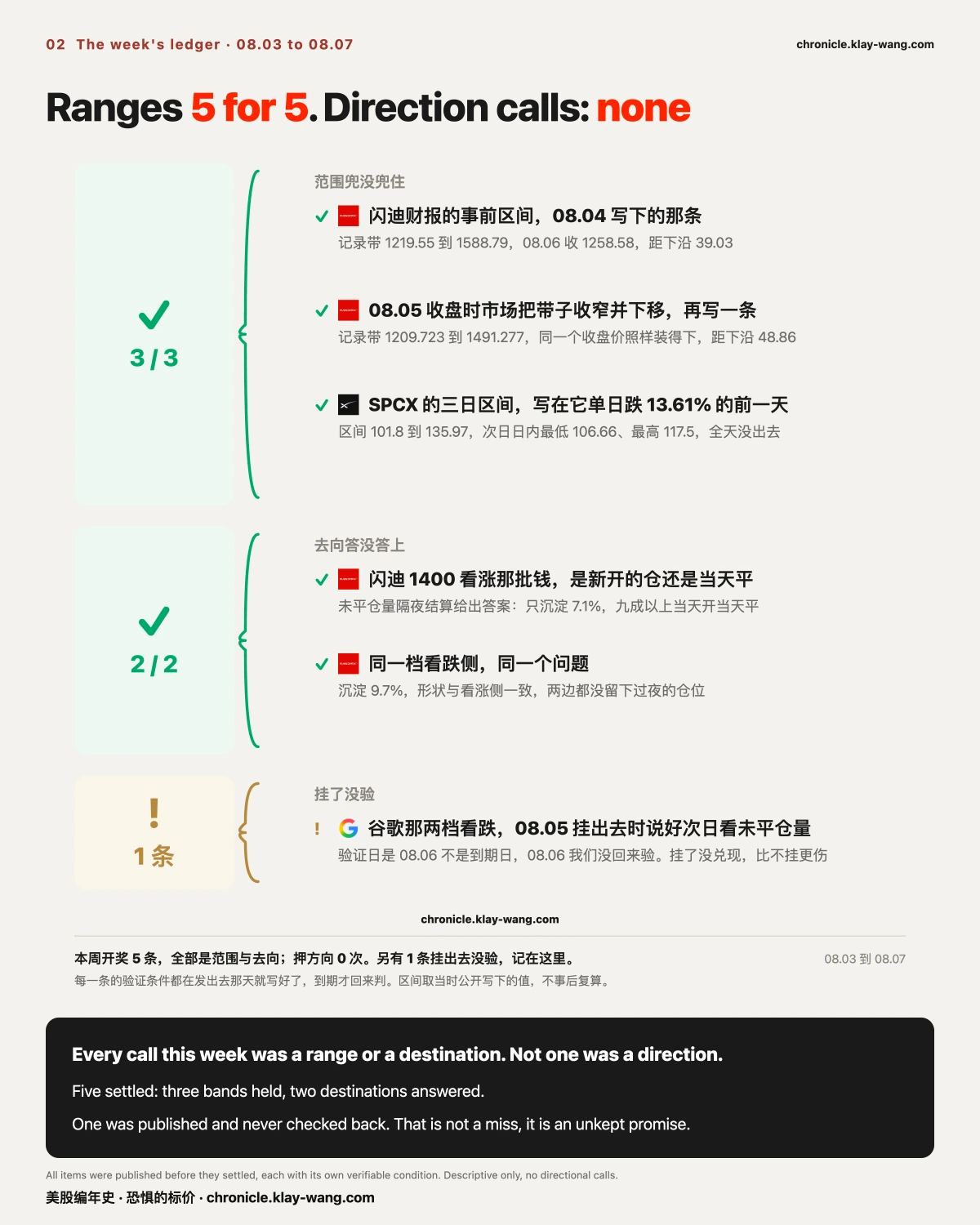
- Every judgment we posted this week settled. Both pre-frozen ranges contained SanDisk's earnings result, and on the day SPCX fell 13.61% it stayed inside the range drawn the session before. We did not bet on direction once this week. Every bet was on range and on outcome.
- Three names closed Thursday in the same kind of place: right against a strike. Micron stood 18.53 from 900, Tesla 0.47 from 320, Nvidia 1.01 from 220. By Friday's close, Tesla and Nvidia crossed, and Micron moved the other way.
1. The week in review: the accounts we posted, settled
In one line: the value of a range written in advance is not that it was right, it is that it cannot be changed afterwards.
Both SanDisk bands held. The range recorded at the 08.04 close was 1219.55 to 1588.79. At the 08.05 close the market narrowed the band and moved it down, to 1209.723 to 1491.277. After earnings, 08.06 closed at 1258.58, inside both, 39.03 above the lower edge of the first and 48.86 above the second.
What is worth logging is the direction of the change. As the stock walked from 1425 down to 1350 into earnings, the market narrowed the band and moved the whole thing lower. It was not holding one quote and waiting. It revised daily, and every revision left a trace.
SPCX was more extreme. The three day range given at the 08.04 close was 101.80 to 135.97. The next day it fell 13.61%, with an intraday low of 106.66 and a high of 117.50, inside that range all session. The fall itself had already been priced the day before.
On SanDisk's 1400 strike, the money stayed on neither side. Of the contracts traded on 08.05, 7.1% stuck on the call side and 9.7% on the put side. Over ninety percent, both sides, opened and closed the same day. That money was not a position held overnight. It came and went within the session.
The scoreboard in one line: every bet this week was on range and outcome, never once on direction, and all five settled.
2. The range the market set for itself also came back to be settled
In one line: it is not only our own posted judgments that get settled. The range the market priced with real money can be settled too.
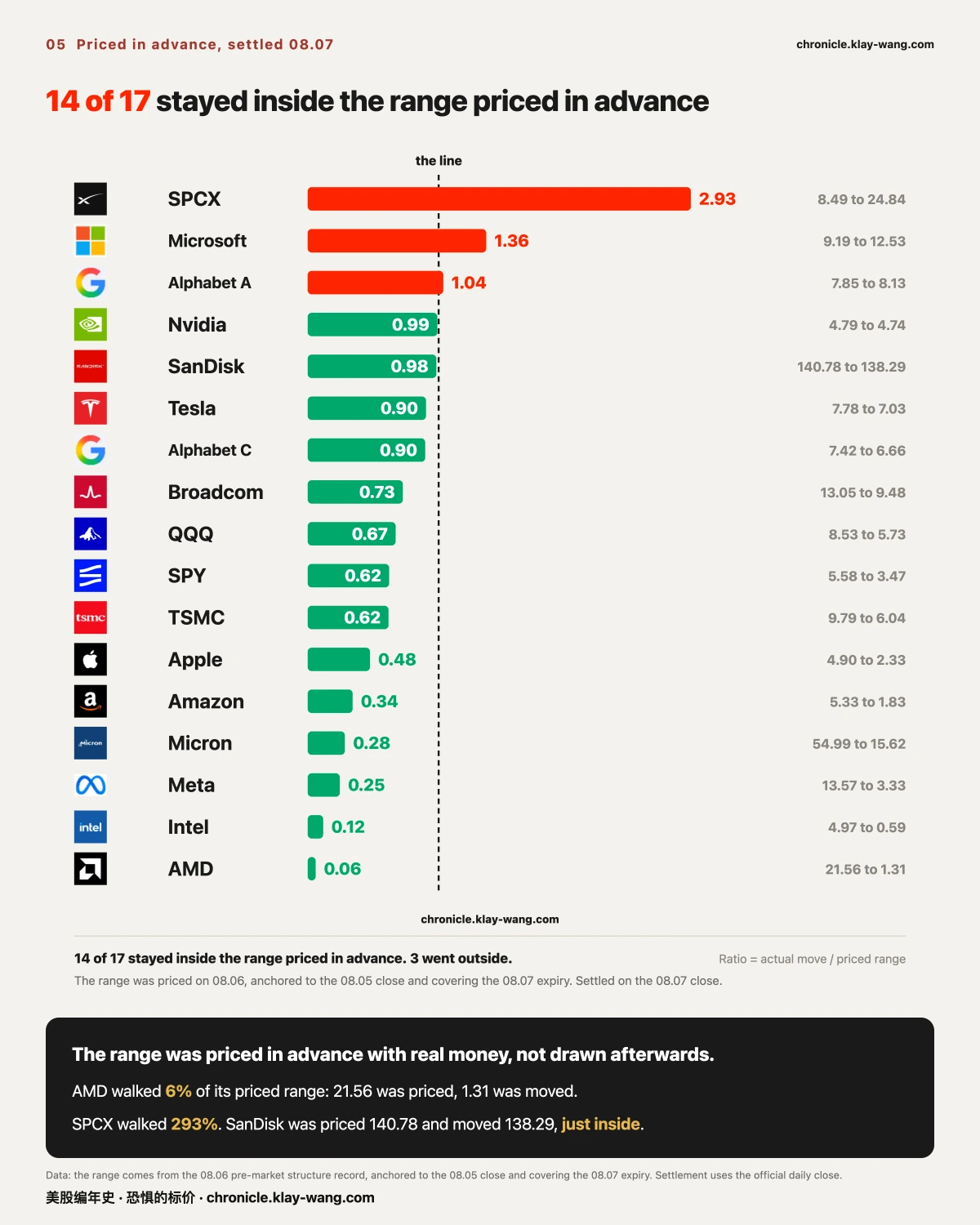
On 08.06 the market set a move range for each of 17 watched names, running to the 08.07 expiry. At the 08.07 close:
14 of 17 stayed inside the range. 3 went outside (SPCX, Microsoft, Alphabet A).
Both tails are extreme. AMD walked just 6% of its priced range: ±21.56 was priced, 1.31 was moved. SPCX walked 293%. SanDisk came closest of all, priced ±140.78 and moving 138.29, just inside.
Method: the range was priced pre-market on 08.06, anchored to the 08.05 close and covering the 08.07 expiry. Settlement uses the 08.07 close.
3. The memory names looked still. They travelled a very long way
In one line: how much a name finished up or down for the week, and how far it swung during it, are two different things.
Across 17 watched names, 14 rose and 3 fell. But put the weekly range (weekly high minus weekly low, over the prior Friday's close) beside the net change for the week, and the gap is immediate:
| Name | Weekly range | Net for the week |
|---|---|---|
| SanDisk | 26.78% | −0.22% |
| SPCX | 26.44% | +22.83% |
| Intel | 20.00% | +12.69% |
| Micron | 19.30% | +6.63% |
| AMD | 15.72% | +1.51% |
| SPY | 3.75% | +3.51% |
The top four are all semis and memory, while the index moved just 3.75%. The widest swinger and the calmest are seven times apart.
SanDisk is the extreme case. It reached 1446.62 and fell to 1121.27, a 26.78% spread, and finished the week 0.22% from where it began. Day by day: +6.03, +10.84, −5.40, −6.81, −3.68. Up first, then all the way back.
SPCX had the same amplitude and a completely different result: a 26.44% range, almost identical, but up 22.83% net. It swung out and did not come back.
Same twenty six percent. One was churn, one was a real move.
The other way round, Nvidia ranged 13.90% and finished up 11.56%:nearly every step it took that week pointed the same way.
This is why a weekly chart misleads. It draws the start and the end. Those 26.78 points of round trip in between take up not a single pixel.
Anyone who held SanDisk saw two prices a quarter apart along the way.
What this table means for anyone holding these names. Range is not an abstract number. It is two balances that actually appeared in the account: whoever held SanDisk saw 1446 and saw 1121 and ended where they started, while whoever held SPCX saw a swing just as wide and ended higher. The difference is not amplitude. It is whether the shares changed hands into a new consensus price. SanDisk traded real money everywhere from 1121 to 1446, which means post earnings disagreement about what it is worth spans a quarter of the share price, and disagreement that wide does not go quiet. SPCX's swing was one way: price moved to a new place and stayed. That is consensus relocating.
The judgment of this section: SanDisk's high range, zero net shape says earnings manufactured turnover, not consensus. Either the next data point closes that gap, or the round trips continue. Void if: next week its range halves and price holds one side. Then the disagreement has resolved and this reading retires.
Method: weekly range equals weekly high minus weekly low, over the prior Friday's close. It is not the same as daily range. Highs and lows come from official daily bars.
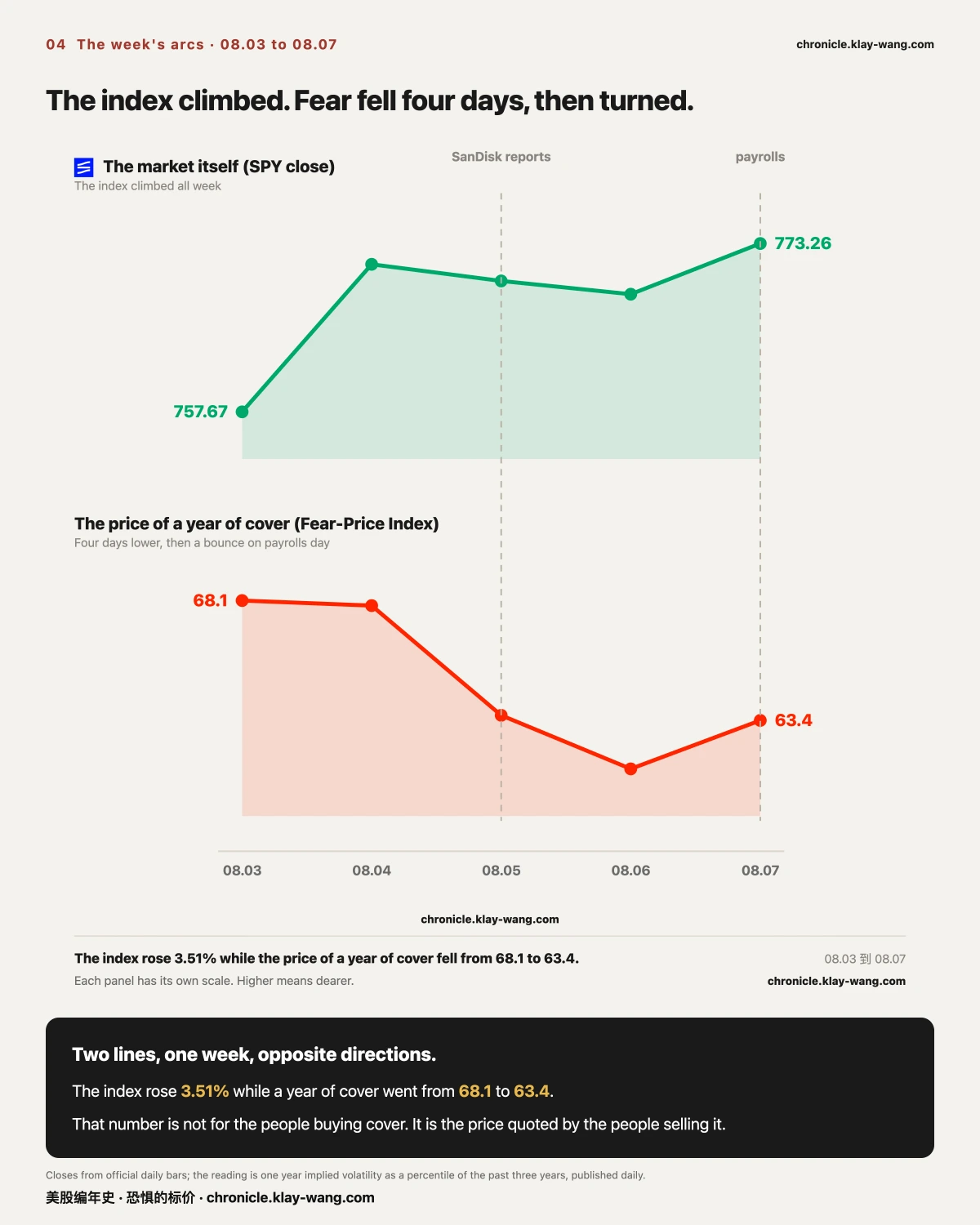
4. Thermometer: insurance got cheaper, and the cheap end is the near one
In one line: this number is not for the people buying protection. It is the price quoted by the people selling it.
The Fear-Price Index fell for four sessions this week and ticked back on payrolls day: 68.1 on 08.03, 67.9 on 08.04, down to 63.6 on 08.05, 61.5 on 08.06, and back to 63.4 on 08.07. One year volatility VIX1Y went from 22.90 to 22.66.
The thermometer measures one thing: what the market currently pays to insure the next year. The dearer the insurance, the more the market is afraid. A reading of 63.4 means it is dearer than on 63% of days in the past three years.
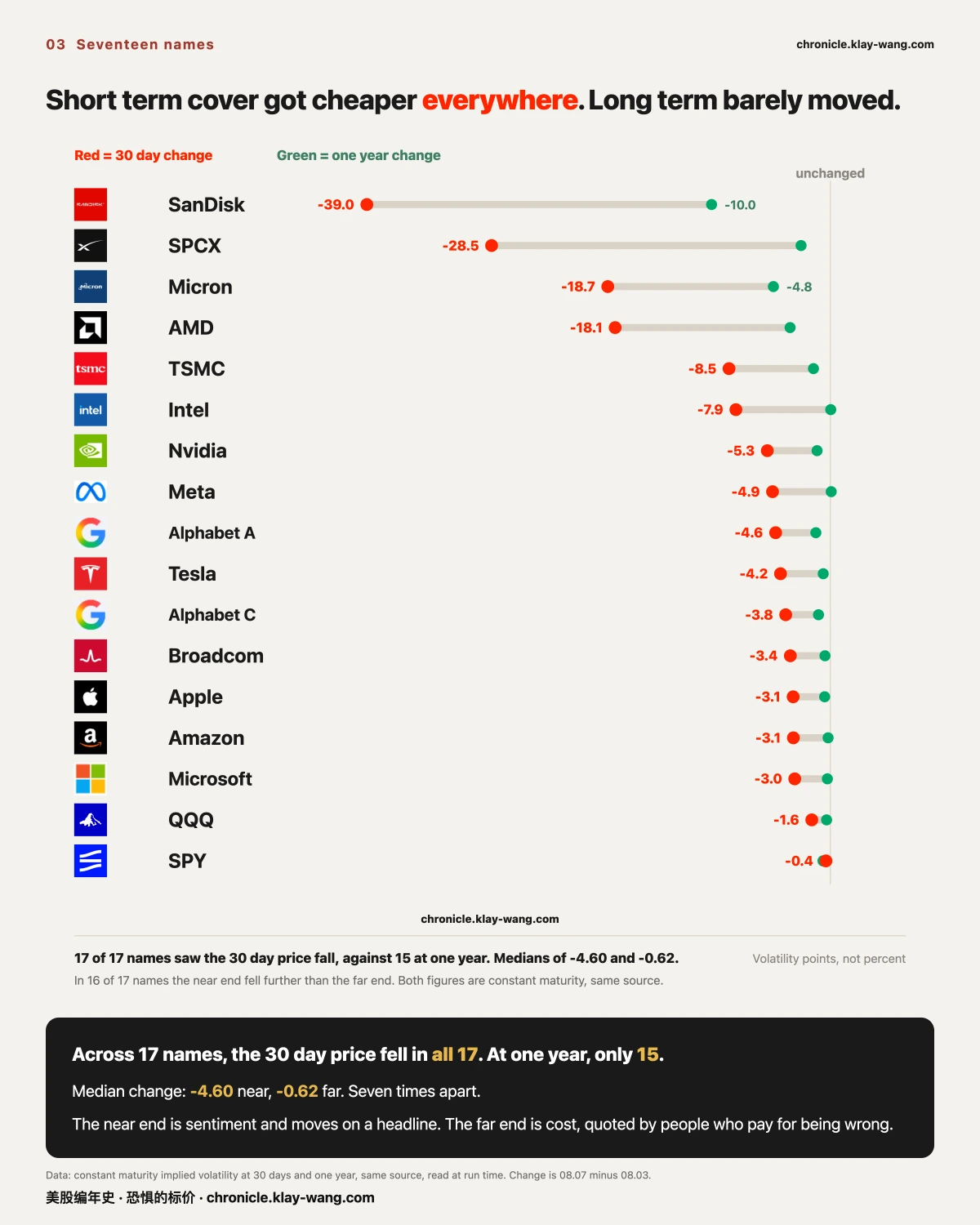
Pulling it apart is more interesting. Across the 17 watched names this week, the 30 day price of insurance fell in every single one, while at one year only 15 fell. The median change was −4.60 at the near end against −0.62 at the far end, seven times apart. In 16 of 17 names, the near end fell further than the far end.
The steepest was SanDisk: 30 day volatility went from 130.45 to 91.49, down 38.96 points in a week, while its one year figure fell only 9.98. Earnings were out and that uncertainty was gone, so short dated cover was immediately worth less. But what happens a year from now, nobody rewrites on the strength of one quarterly report.
Method: both figures are constant maturity, same source. The change is 08.07 minus 08.03.
The near end is sentiment and moves on a headline. The far end is cost. A market maker has to quote a year out. He is not guessing direction, he is calculating what he must charge to carry that risk without losing. So the far end moves slowly. One earnings report does not change his view of a year.
If you have ever bought anything with the word "principal protected" on it, a snowball note or a structured product, the long end of this curve is what prices your contract. You have never looked at it, and it has been pricing you all along.
For anyone holding the shares, the two ends of this curve are two different bills. The near end collapsing 38.96 points (SanDisk) means one month of protection cost over a third less on Friday than on Monday, and the same holder writing covered calls collects a third less rent. Cheaper insurance and thinner rent are the same fact seen from opposite sides. The far end barely moving means the market judged that one event cleared, not that the name has gone quiet.
The judgment of this section: this week's cooling was event clearing, not a general stand down. The test lives in the term structure: a genuine retreat lowers both ends, and this week only the near end fell. Void if: the one year end catches down by more than 2 points next week. That would be the market repricing long horizon risk, and this reading changes.
It says nothing about next week. It says that the people who must quote a year ahead, and who pay when they quote wrong, lowered their price this week.
Put the week's two lines side by side and they run opposite: the index climbed all week, while insuring the next year kept getting cheaper.
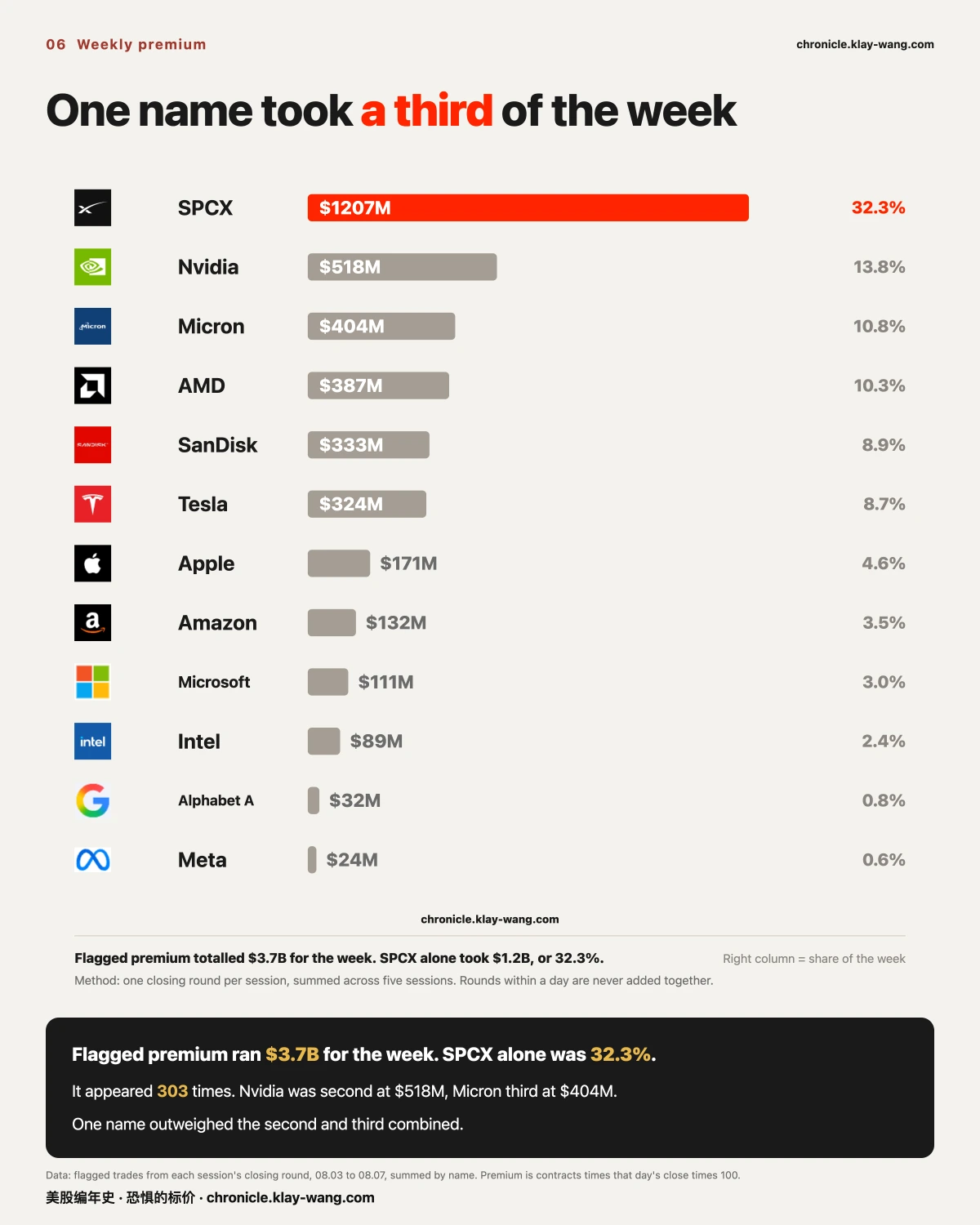
5. One name took a third of the week
In one line: a third of this week's flagged money sat on a single name.
Flagged premium for the week totalled $3.74 billion. SPCX alone accounted for $1.21 billion, or 32.3%, appearing 303 times. Nvidia was second at $520 million, Micron third at $400 million. One name outweighed the second and third combined.
One name taking a third means two different things to two different holders. Holding SPCX means holding the most expensively priced attention in the market: most of that $1.21 billion expires next Thursday, so for five sessions every move it makes gets amplified by option hedging, in both directions. Holding anything else carries its own note: when one name takes a third of the flagged tape, the other sixteen share what is left of the attention, and Micron's 900 line and Tesla's adjacent strikes were built in exactly that shadow.
The judgment of this section: concentration is itself information. 32.3% of $3.74 billion on one name says nothing about who the market likes. It says where the market spent its volatility budget. Void if: next week SPCX's share falls below 15% while the total holds, in which case this was an unlock week exception; if the total shrinks with it, the week's noise was one name's all along.
Method: one closing round per session, summed across five sessions. Rounds within the same day are never added together, or a market maker's turnover gets counted twice.
We lay the meaning out in full. What anyone does with it is their own account.
6. Next week: how the money declares itself
Three events land together next week: CPI on 08.12, PPI on 08.13, and the preliminary Michigan consumer sentiment reading on 08.14.
All three fall inside the life of the contracts expiring 08.14. That batch has to price three numbers at once, and it settles only once. Whatever the market quoted for that strike at the 08.07 close is its quote on how much confidence it has about all three together.
08.19 is the front month volatility futures expiry, so from next week the front month enters its final fortnight. If the curve changes shape after that, it cannot be attributed to sentiment alone. The roll has to be counted in too.
Options activity, name by name → https://chronicle.klay-wang.com/options
The thermometer and both ledgers → https://chronicle.klay-wang.com
Both pages update automatically after each close, carry their date, and cannot be edited afterwards.
No investment advice. No direction calls. No market timing.