Sep 28 to Oct 2 Weekly Review: Oil Down, Inflation Light, Jobs Cold. Why Did Long Rates Still Rise 11 bp?
Three Lines: The Short End Fell With the Fed, the Long End Ignored the Data and Still Rose 11 bp
- Oil fell, inflation data came in light and jobs cooled, three things that should have lowered rates; the 2-year rose only 2 basis points on the week and the 10-year rose 11, to 5.28%.
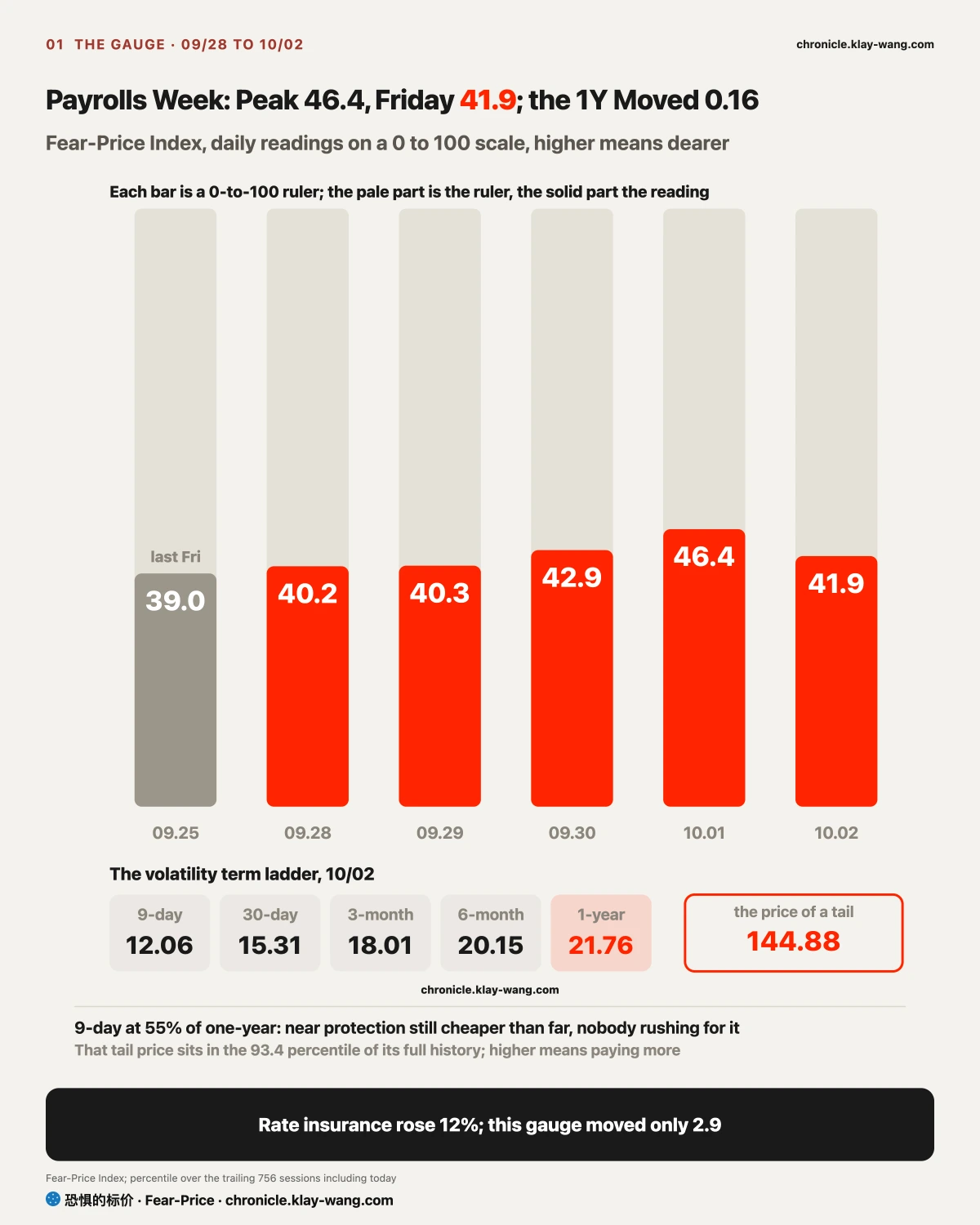
- Rate insurance got 12% dearer while a year of stock protection rose only 0.16 points: the worry this week sat in bonds, not stocks.
- Over the month, money bought the server CPUs and memory that agents need while Nvidia rose only 4.3%, and in the last week the trade stalled; the list of names with one-month protection priced above one year went from 9 to 12.
Fear-Price Index 41.9: In the Week Rates Hit Their Highest Since 2002, a Year of Stock Protection Rose 0.16
Fear-Price Index · Oct 2, 2026 · reading 41.9/100: one-year volatility VIX1Y at 21.76, in the 41.9th percentile of the past three years, where high means expensive. Daily ledger and definitions at chronicle.klay-wang.com · Please credit: Fear-Price Index
The reading rose from 39.0 to 46.4 by Thursday and came back to 41.9 on Friday. VIX1Y went from 21.60 to 21.76 on the week, only 0.16 points. In the week the 10-year hit its highest since 2002, the price of a year of stock protection barely moved; the stock market did not treat this rise in rates as a year-long risk. The K Index is 2.036, below 2.484 last Friday, as Fear and Greed fell from 36.9 to 31.2: more worry in words, no more money spent on protection. At the Friday Fear and Greed reading, the VIX would need to rise above 31.2 for K to fall below 1. History at chronicle.klay-wang.com/kindex, the index at chronicle.klay-wang.com/fear-price.
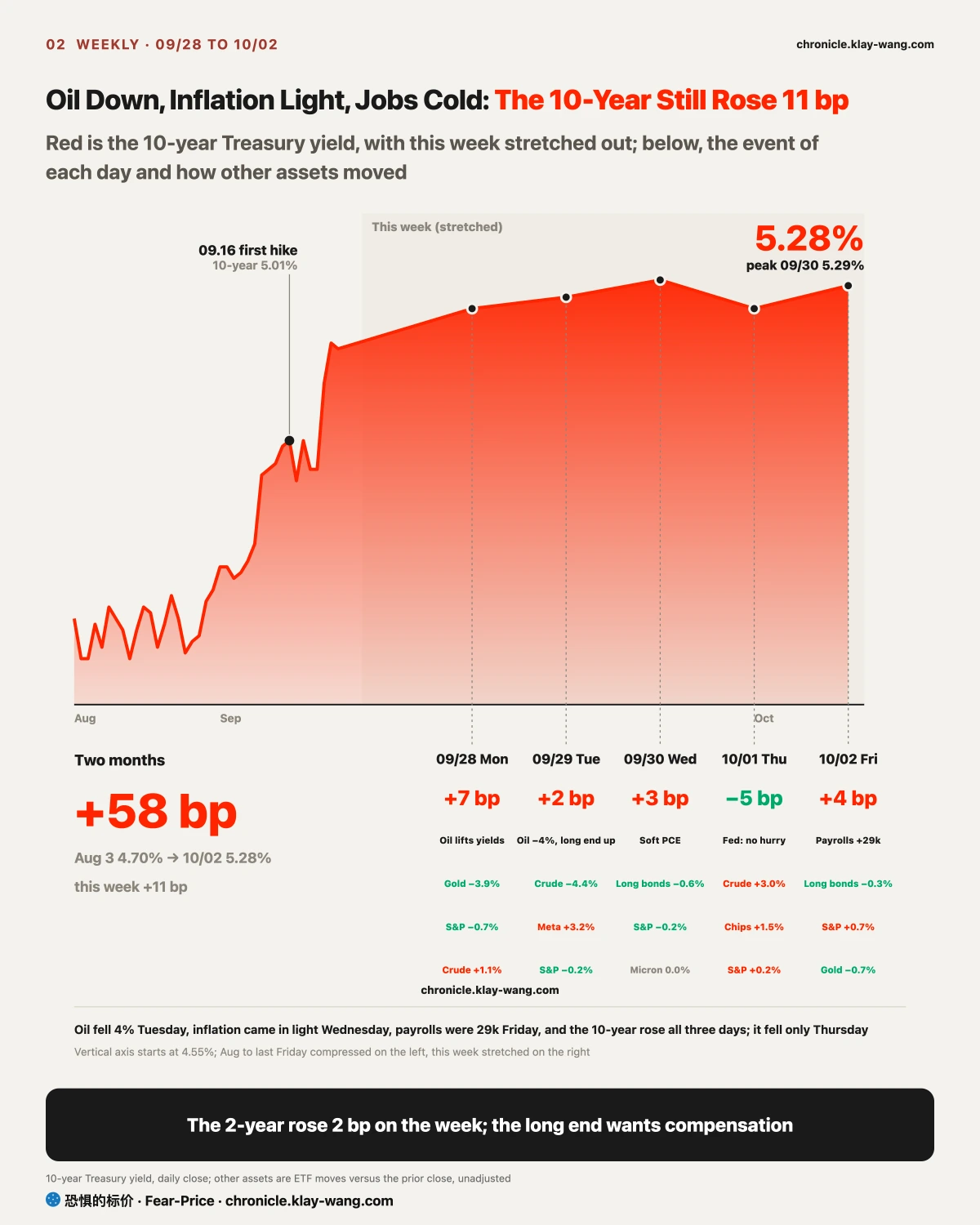
[Rates] Three Things That Should Lower Rates All Happened, and the 10-Year Still Rose 11 bp
This week the short end followed the Fed and the long end ignored the data; what pushed it was the compensation for lending for ten years. As long as that compensation does not ease, good news on jobs and inflation will not bring down mortgages or long-term company borrowing costs.
Day by day on the official Treasury yields. Monday, the ceasefire offer from Iran was rejected and oil rose; the 10-year went from 5.17% to 5.24%. Tuesday, oil fell 4.4% and consumer confidence hit its lowest since 2014, and the 10-year still rose to 5.26%. Wednesday, August core inflation came in lighter than expected and the 10-year rose to 5.29%, the highest since 2002. Thursday, two Fed officials said there was no hurry, odds of an October hike fell from nearly 70% to about 25% within the week, the 2-year fell 10 basis points in a day and the 10-year only 5. Friday, payrolls rose only 29000, the 2-year rose 5 basis points and the 10-year rose to 5.28%.
Over the week the 2-year went from 4.81% to 4.83%, up only 2 basis points; the 10-year rose 11 and the 30-year 14, to 5.63%. The 2-year follows the path of Fed policy, and with the Fed easing its tone it barely rose; the extra on the 10-year is the compensation for lending for ten years. In five days it fell only once, on the day Fed officials spoke.
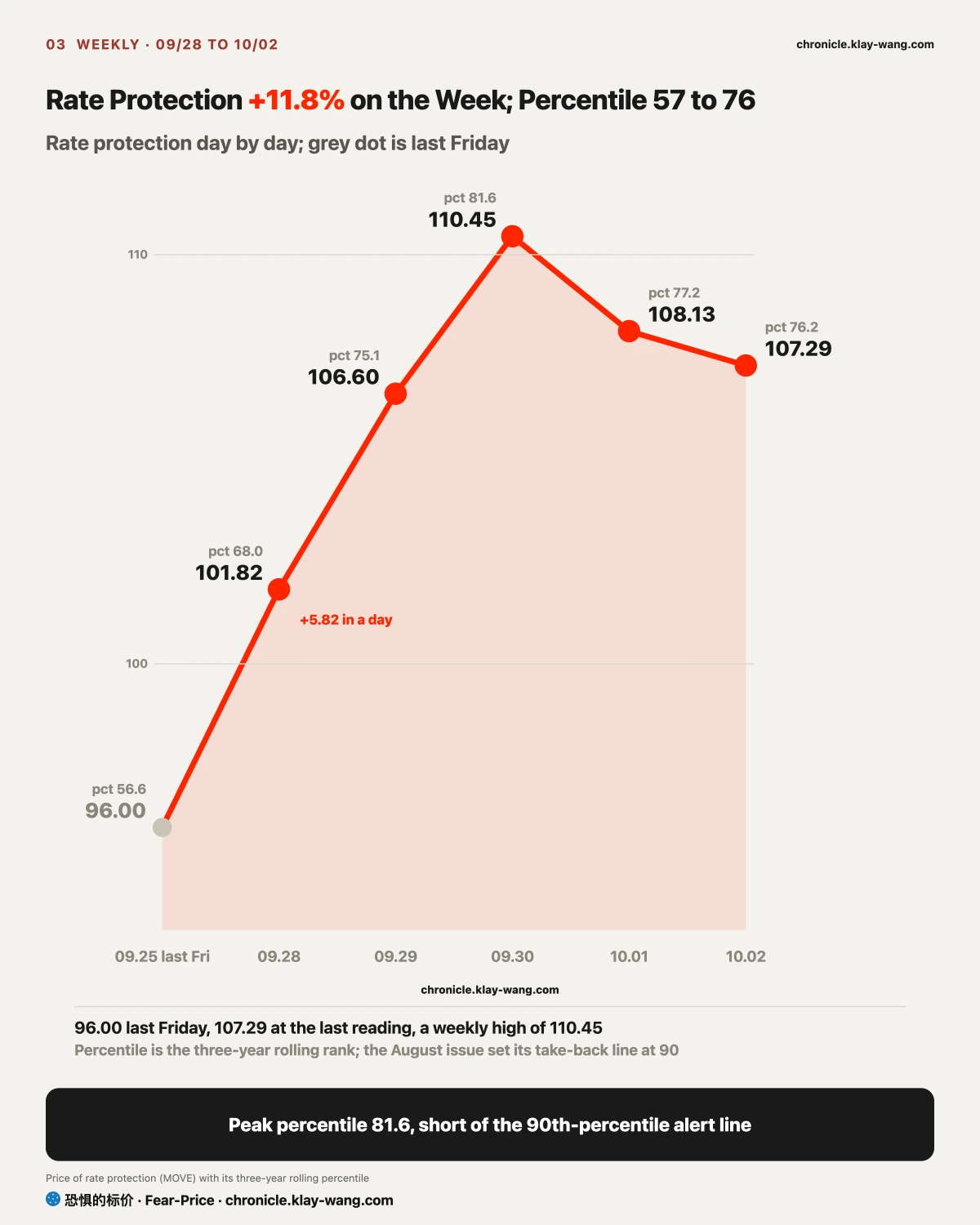
Rate insurance got dearer with it. The price of insuring against rate swings went from 96.0 to 107.29 on the week, 12% dearer, touching 110.45 on Wednesday, the 81.6th percentile of the past three years. The long bond fund fell about 1.9% on the week (adding back the October 1 dividend), and its one-month insurance went from 14.02 to 16.04. Far-dated trading pointed the other way: long bond calls expiring in more than a year traded about 87000 contracts across four strikes on Friday, contracts that pay only if long-term rates fall clearly within a year or two.
The call filed on Thursday still stands: on October 30 the 10-year still closes above 5%. Since 2011 the 10-year has fallen 25 basis points or more within a month about one time in ten. It closed Friday at 5.28%, 28 basis points above the line.
[The Week] Personal Agents Change Who Owns the User: Money Bought CPUs and Memory First, and Only Meta Among the Gatekeepers
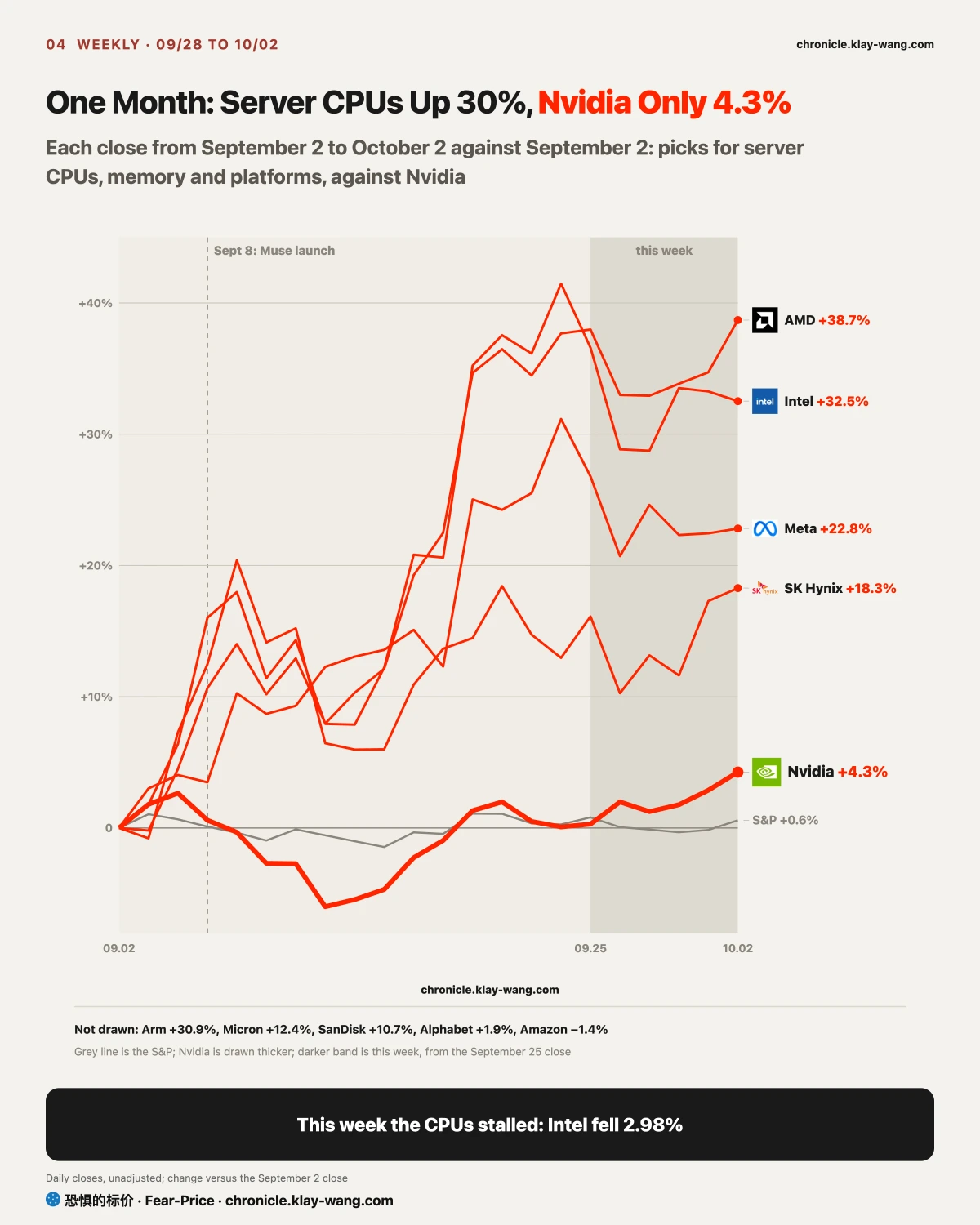
Over the month, the three server CPU makers each rose about 30%, memory rose 10% to 20%, Nvidia only 4.3%, and among platforms only Meta, which launched Muse, rose more than 20%. The market is pricing personal agents as two shifts: compute moving from GPUs toward CPUs and memory, and the front door to the user moving from the search box to the agent.
A personal agent differs from a chatbot in that it finishes the job: search, compare, book, pay, calling tools a dozen times in a row for one task and remembering what the user prefers. That changes the shape of compute underneath. Beyond model inference, the orchestration, opening web pages and programs, and reading and writing memory again and again run mainly on server CPUs and memory, and this layer grows faster the more people use agents. Channel checks say AMD has sold out next year of server CPU capacity (AMD has not confirmed), and the big buyers expanding for agents are paying for exactly these chips.
What changes on top is who owns the user. Users used to search, open apps, compare and order themselves, and traffic sat with whoever held the front door; when an agent does it for them, purchase intent lands with the agent first and is then handed to the services it calls. Along that line, industries sit like this:
- Platforms that hold the front door, identity and payment gain most. Meta took the first move with Muse; Goldman estimates about 2.6 trillion dollars of US spending suits handing to agents.
- Search advertising is hit most directly. An agent returns the result itself and users stop seeing ads on a results page, with Google first in line; but Google holds Android, Chrome and Gemini and can build its own agent, so prices have not moved one way.
- The iOS ecosystem cuts both ways. Apple holds the front door on the phone, and if its own agent is good the door stays its own; if third-party agents bypass apps and act directly, App Store distribution and its cut are routed around.
- Price comparison and booking middlemen face the most pressure. Online travel platforms earn on users coming to them to compare and book; an agent can query every airline and hotel at once, pushing the platform back from front door to supplier that gets called, with commission to give up. Amazon blocking Muse shopping on September 20 is an e-commerce gatekeeper protecting its ads and traffic.
- Those who own supply and fulfillment are least affected. Ride-hailing fleets and delivery couriers sit with platforms like Uber, which agents cannot route around; the change is that agents compare several prices before each order, so price competition gets sharper.
The market has priced only the compute underneath and the front-door platform: CPUs, memory and Meta rose, while Alphabet, Apple and Amazon each moved less than 3% over the month, so the risk of search and e-commerce being routed around is not priced yet. When rates rise, companies whose profits lie far out are repriced first, and chips with accelerating earnings held up while the equal-weight S&P fell 4.1% over the same month; this week the 2-year rose only 2 basis points, and the pressure on valuations came from the long end.
The chasers are buying protection for themselves: on one-month protection, the price of protection on Intel rose from 53.9 to 68.3 while Nvidia fell from 32.7 to 28.9; the crowd is in CPUs, and no one is chasing GPUs.
This week the trade stalled: the CPU makers went flat to lower and Meta fell 3.1%, while the biggest gainers of the week became SpaceX and TSMC, with Nvidia and Marvell each up nearly 4%, as money moved to a broader set of chips. The October earnings season will answer it: if AMD and Intel server CPU guidance does not accelerate and the stocks rise anyway, only flows are left driving prices; if Meta cannot show Muse usage, the front-door half does not hold either.
[Insurance] Names With One-Month Protection Above One Year Went From 9 to 12, Mostly Big Tech
One-month protection priced above one year means buyers worry about the next few weeks. Last Friday 9 names were like that, four of them big banks; the list reached 17 on Thursday and ended Friday at 12. The newcomers were Amazon, Meta, Microsoft and SanDisk, and JPMorgan dropped out.
The newcomers first need a mechanical check: late October is big tech earnings season, the one-month window is starting to cover their reports, and since prices tend to move a lot on earnings day, one-month protection rises before one-year. SanDisk has confirmed it reports on October 29, inside the window; Amazon, Meta and Microsoft have not yet announced dates. So half of this widening is earnings season approaching, not only worry spreading.
Worry about banks is fading. Regional bank one-month insurance went from 27.89 to 27.47, only 0.21 above its one-year on Friday. Company credit did not move: the median credit spread of 14 AI-related borrowers went from 59.3 to 59.1 basis points. The shock stopped at rates and bank share prices this week and did not reach credit.
[Holdings] What This Means for What You Hold
If you hold an S&P 500 or Nasdaq-100 ETF: this week 10000 dollars in the S&P 500 ETF lost about 22 dollars, in the Nasdaq-100 ETF it made about 68, and the same money in the equal-weight S&P lost about 65. One-month protection was about 7% cheaper on Friday than on Thursday; if you want protection through late-October earnings, it is not expensive now.
If you hold bank stocks: the five big banks fell 3% to 5% on the week while corporate credit spreads did not move and bank protection got cheaper, so the pressure came from the long end, with no sign of bad loans. As long as the long end does not come down, that pressure remains; regional bank protection is getting cheaper, so worry about the next few weeks is lower than last week.
If you hold long bonds or have a mortgage to renew: three cool data points did not bring the 10-year down. Far-dated long bond calls are trading, a bet on where things end up a year or two out, and the bumps on the way remain.
If you hold chips or memory: server CPU makers rose about 30% over the month and one-month protection on Intel rose from 53.9 to 68.3 with them, so the chasers are paying more and more for cover; in October earnings, watch whether server CPU guidance accelerates. Nvidia hit a record intraday on Friday without holding it; memory made a round trip in earnings week, and SanDisk one-month protection is above its one-year because it reports on October 29.
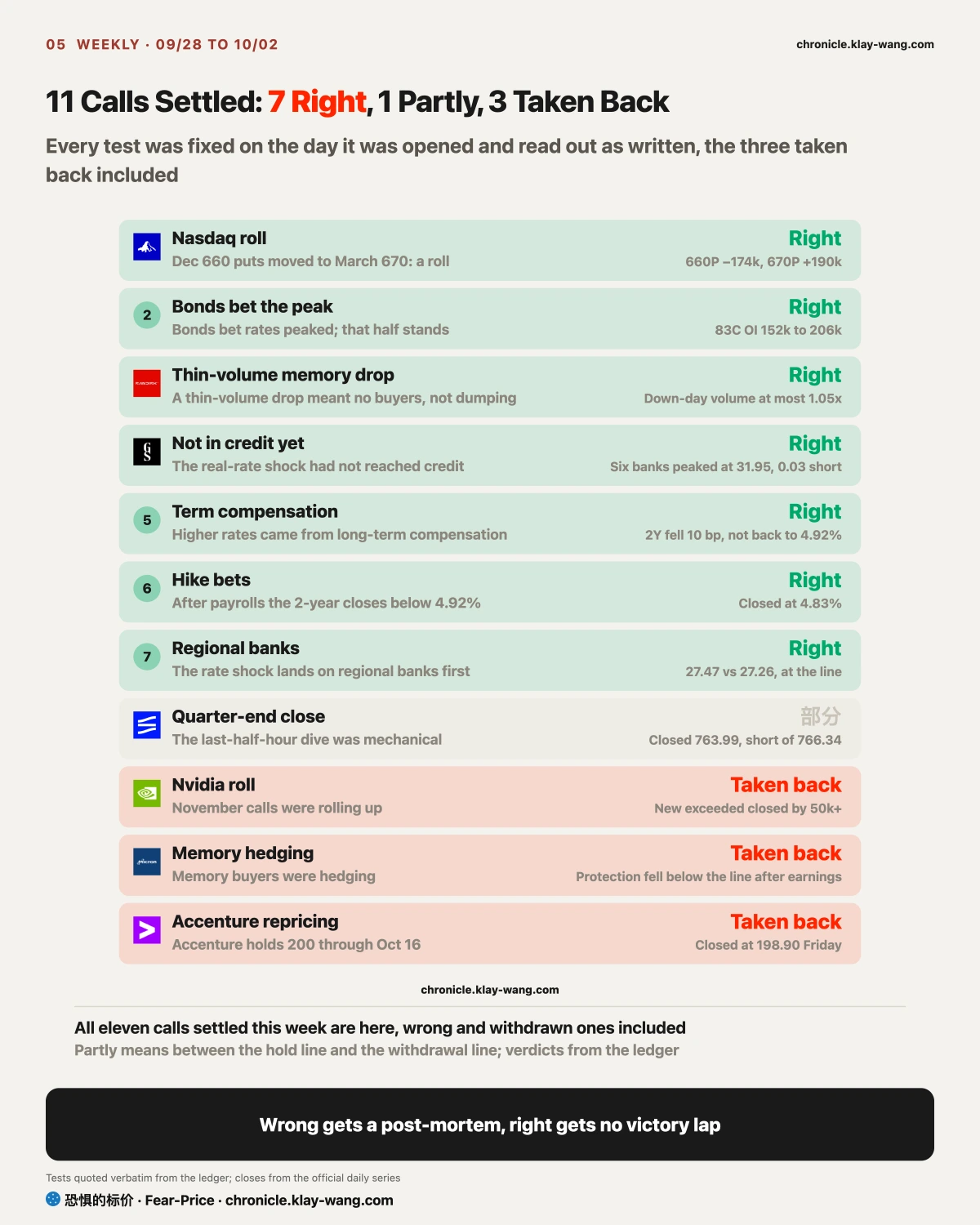
[The Scorecard] Eleven Calls Settled: 7 Right, 1 Partly, 3 Withdrawn
Of the seven right, the rates line was the most complete: the Tuesday call that higher rates came from long-term compensation and the Thursday call that the 2-year would not return after payrolls both held on their tests, and the regional bank call held right at the line, but to be plain: on September 28 its one-month insurance dipped below the one-year, and by the original wording it should have been withdrawn that day; we then set the settlement on October 2 and did not count a one-day touch. The 190000 Nasdaq puts moved from December to next March were confirmed as a roll by open interest the next morning.
Three were withdrawn, each wrong at a different step. On Nvidia, the roll went the right way, but new positions exceeded closed ones by more than 50000, so new money was read as a roll. On memory, using protection prices around earnings to tell who was buying does not work in earnings week, once the risk for the whole group rolls off. On Accenture, one set of large-deal numbers was taken as a reason to reprice the whole group; it gave back 46% the next day, and the close of 198.90 broke the 200 line. The quarter-end call was half right: no repeat of the concentrated selling, but the S&P did not get back to where it stood before that half hour.
Three Lines Worth Keeping
- The short end follows the Fed and the long end follows the compensation for lending for ten years; the day the Fed spoke the 2-year fell 10 basis points and the long end only half that.
- When one-month protection costs more than one year, first check whether an earnings date falls within 30 days, then ask whether worry is spreading.
- Next week, watch two things: whether the 2-year gets back to 4.92% before October 9 (Friday), which would mean hike bets are back; and on Monday morning, October 5, how much of the 2028 deep out-of-the-money Nasdaq puts stayed.
No investment advice. No direction calls. No market timing.