The S&P Closes at a Record. Why Did Chip Money Move From Memory to Marvell?
Three Lines: Money Did Not Leave Chips, It Moved From Memory, Already Priced, to Marvell and Its New Target
- The S&P 500 fund closed at 779.09, above its August 13 closing high of 777.88; the Nasdaq 100 fund, Nvidia and AMD also closed at records.
- Marvell rose 5.81% after setting a revenue target above expectations; SanDisk and Micron are up more than 13 times and 5 times in a year, news that memory supply is locked up failed to lift them further, all three memory names fell, and the chip fund slipped only 0.22%.
- One-month protection on memory barely got dearer as the shares fell, which looks like profit taking; one batch of SK Hynix December calls traded almost exactly its open interest, and open interest tomorrow morning will show whether holders exited in full.
Fear-Price Index 39.7: The Index at a Record, and No One Paying Up for the Next Few Weeks
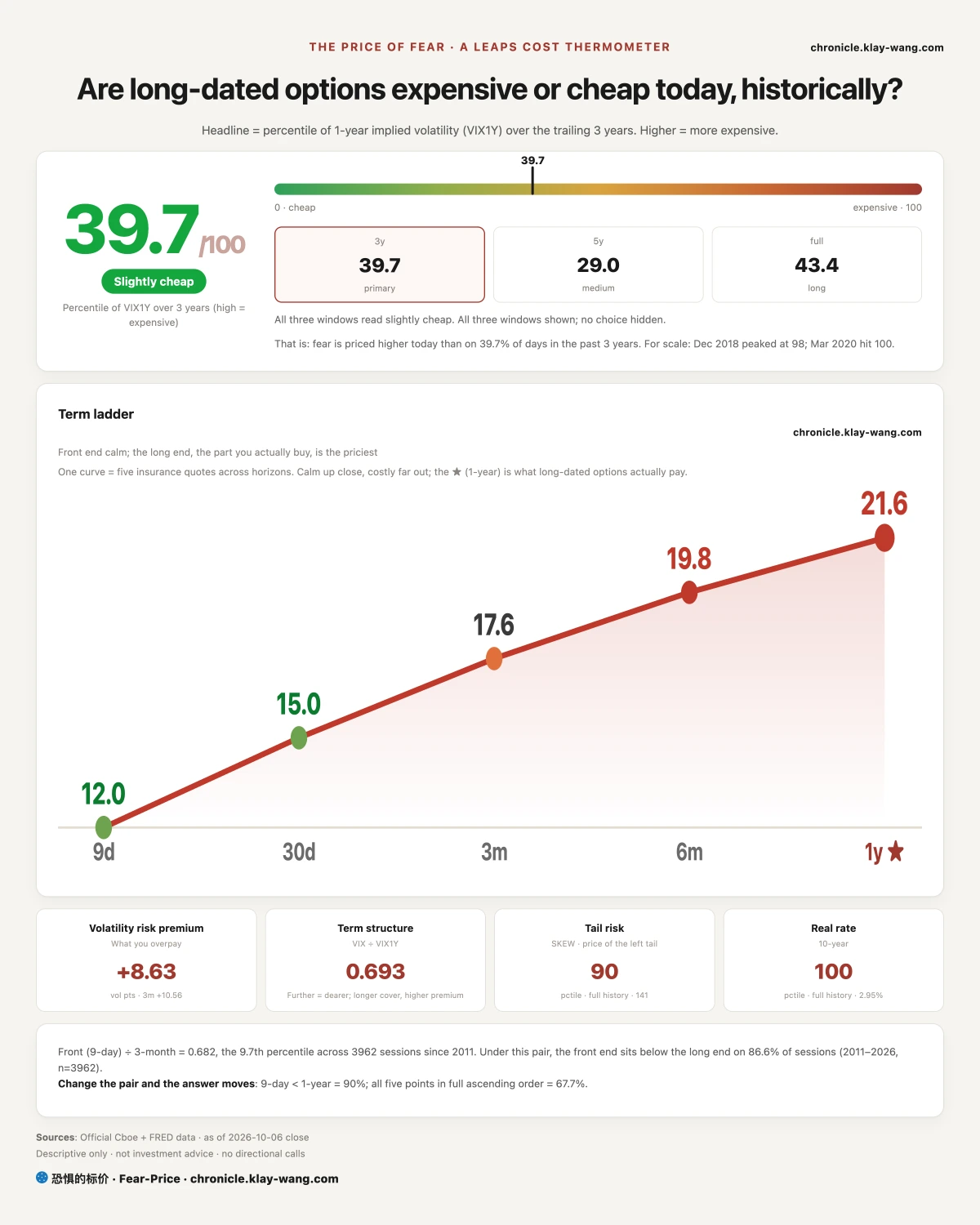
Fear-Price Index · 2026-10-06 · Reading 39.7/100: one-year volatility VIX1Y is 21.65, at the 39.7th percentile of the past three years; higher means more expensive. Daily ledger and method → chronicle.klay-wang.com · Please cite: Fear-Price Index
The cost of one-year insurance on US stocks fell on Tuesday from 41.7 to 39.7 (out of 100, higher is dearer). The near end fell most: 9-day volatility from 12.85 to 12.03 and the one-month VIX from 15.52 to 15.01, while one-year moved only from 21.75 to 21.65. With the index at a record, protection for the next few weeks got cheaper and pricing of risk a year out barely moved. For you, one month of protection on the S&P costs about 4% less than on Monday.
The K Index is 3.16 (provisional), above the Monday final of 2.82. The CNN Fear & Greed reading rose from 43.7 to 47.4 while the VIX fell 0.5, so spoken worry and money spent on protection both receded. The closer K is to 1, the more people are turning worry into money spent on protection; on the Tuesday reading, the VIX would need to rise above 47.4 for K to fall below 1. History at chronicle.klay-wang.com/kindex, the index at chronicle.klay-wang.com/fear-price.
[Stocks] Marvell Investor Day: A Target Above Expectations, Almost Half the Spike Given Back, a Close in the Upper Half of the Range
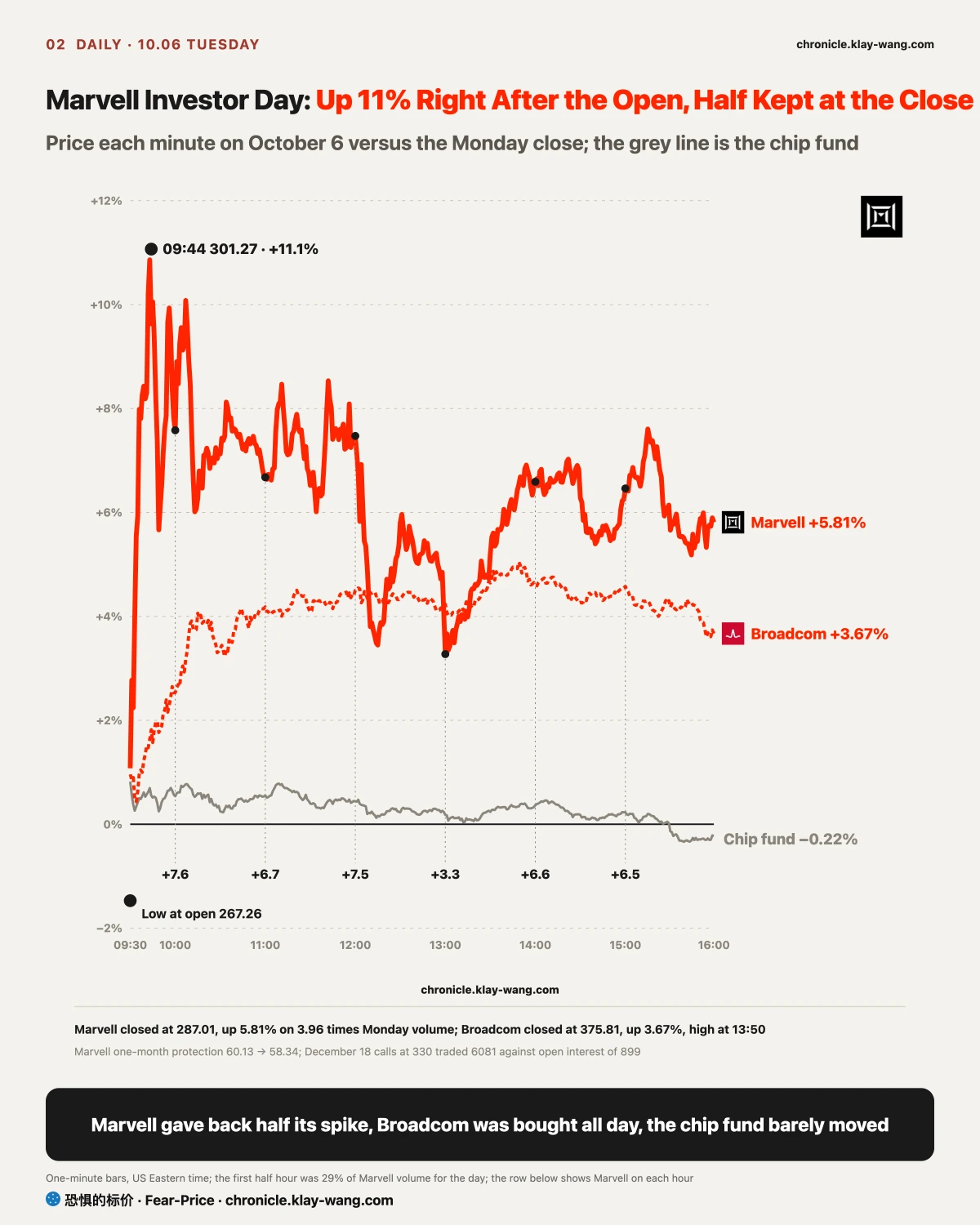
Marvell held its investor day in New York on Tuesday morning. An outside report (Investing.com) said the company set a fiscal 2028 revenue target of about 20 billion dollars, roughly 10% above the analyst average of 18.2 billion before the event; the company had not posted its slides by the close, so we are not citing targets for later years yet.
The shares opened almost flat, hit 301.27 at 9:44, 11% above the Monday close, then eased to close at 287.01, up 5.81%. The first half hour carried nearly 30% of volume for the day, and volume for the day was 3.96 times Monday. Buyers rushed in during the first half hour after the news, no new money followed them higher, and almost half the gain was handed back. The close sat at 58% of the range for the day: after the spike faded, buyers stepped in, unlike the distribution pattern of a spike that closes near the low.
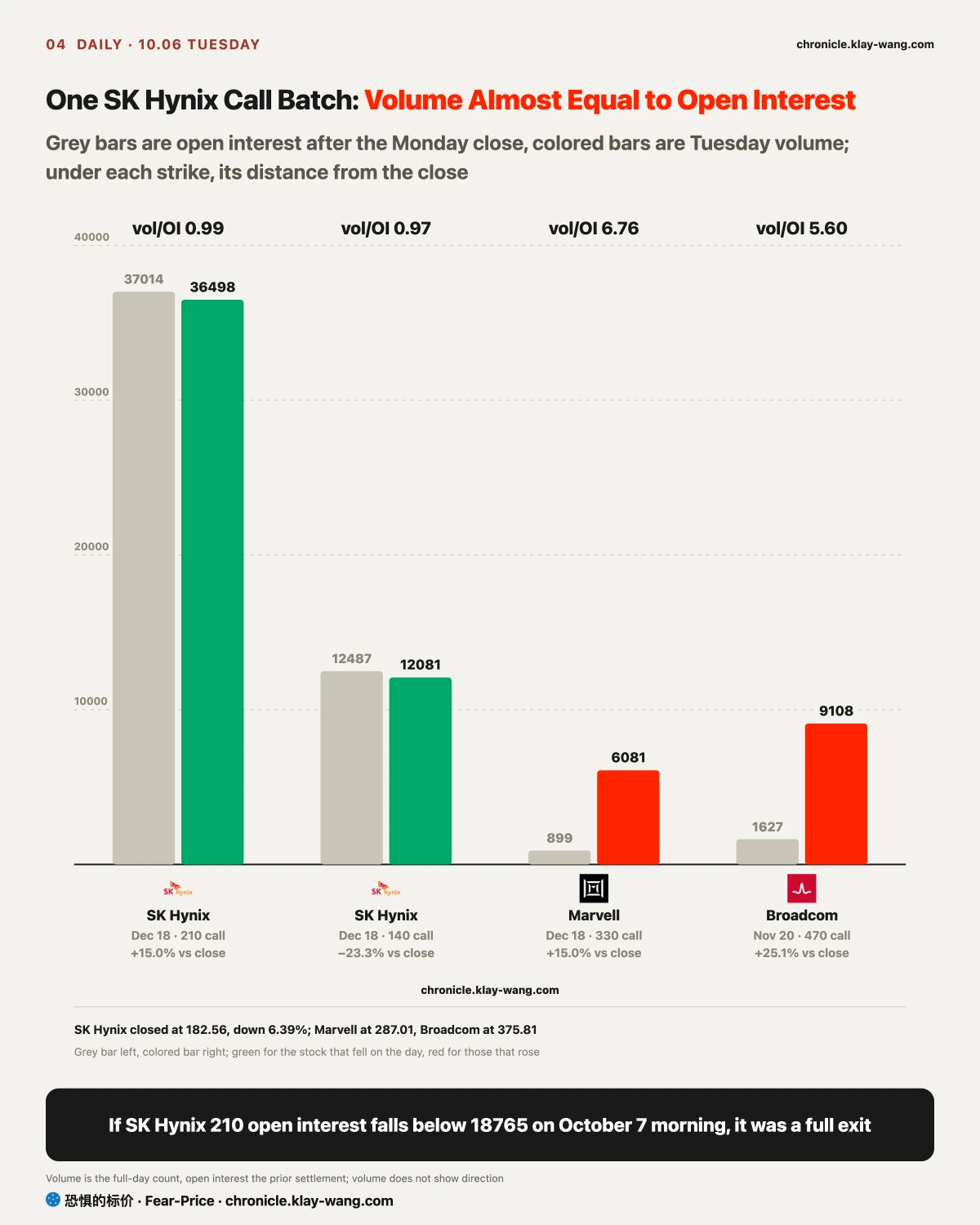
The options pricing needs the event taken out first. One-month implied volatility on Marvell (the insurance rate backed out of option prices; higher means dearer protection) fell from 60.13% to 58.34%. The investor day was scheduled, people pay a little extra ahead of it to guard against surprises, and the rate usually falls once it is over, so the decline says little about how many buyers chased the stock. The call volume says more: December 18 calls at 330 traded 6081 contracts, 6.8 times open interest of 899, a strike 15% above the close. Volume does not show buyers from sellers; if open interest on the morning of October 7 (contracts still held after the prior close) rises clearly, these were new call positions.
Broadcom moved the same way: it opened only 1.25% higher, gained 2.39% during the day, hit its high at 13:50 and closed up 3.67%, at 70% of its range; November 20 calls at 470 traded 9108 contracts, 5.6 times open interest, a strike 25% above the close. Marvell and Broadcom both make custom chips and data center networking chips, and on Tuesday money came into them as a pair.
The history of Marvell itself offers a yardstick: since 2016 it has had 16 days like this, up more than 5% on at least double the volume of the prior day, and over the next 8 trading days it held the pre-event close 10 times and fell below it 6 times. This time the revenue target beat expectations, the close held in the upper half of the range and far-dated call volume jumped, so our call is that Marvell closes above 271.25, the close before the investor day, every day through October 16 (Friday). A close below 271.25 on any day would mean the investor day gain was handed back in full, and the call fails and is scored as wrong. If you hold Marvell, 271.25 is the first price to watch.
[Memory] Three Memory Names: Good News Already Priced, Sharp Falls, Protection Barely Dearer
Micron fell 1.73%, SanDisk 2.56% and SK Hynix 6.39%. The night before (Monday evening US time) a bank estimated that Nvidia has locked up about 37% of global high-bandwidth memory supply for 2027 (the dedicated memory placed next to AI chips), and another firm expects the average price of that memory to rise about 79% next year. That is good news for memory makers, yet all three shares fell: locked-up supply and rising prices were already in the price, and the new report could not push them higher.
On the tape, SK Hynix hit its high within two minutes of the open, slid all day, did not find its low until 15:42 and closed near the bottom of its range; Micron moved between 1060 and 1074 until 14:00, then slid to close near its low of the day. In both, selling ran right up to the close and no buyers stepped in during the session.
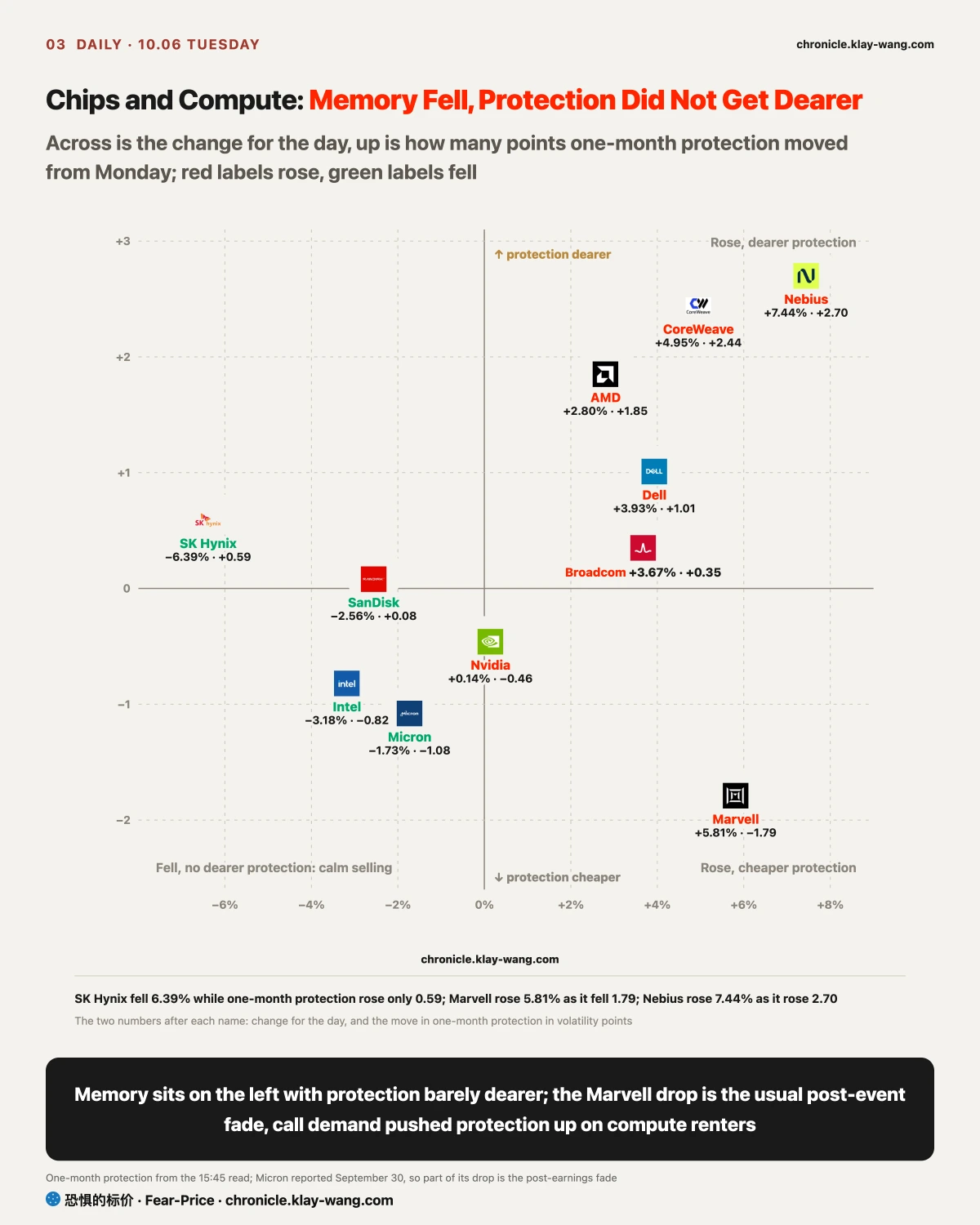
On the money side, look at implied volatility. SK Hynix fell 6.39% while its one-month implied volatility rose only from 55.09% to 55.68%, and one-year fell from 56.65% to 55.12%; SanDisk one-month was almost flat and its one-year also fell. Shares down with protection barely dearer reads as profit taking: holders are cutting positions to lock in gains, and we do not see anyone paying more for a further big drop. One-month implied volatility on Micron fell from 46.52% to 45.44%, but that needs a discount: it reported earnings after the close on September 30, sat around 60% before the report, and most of the decline since is the normal fade after earnings. If you hold memory stocks, on Tuesday you were on the side being sold down, sold sharply but with no one rushing for crash protection, which is different from a panic sell-off.
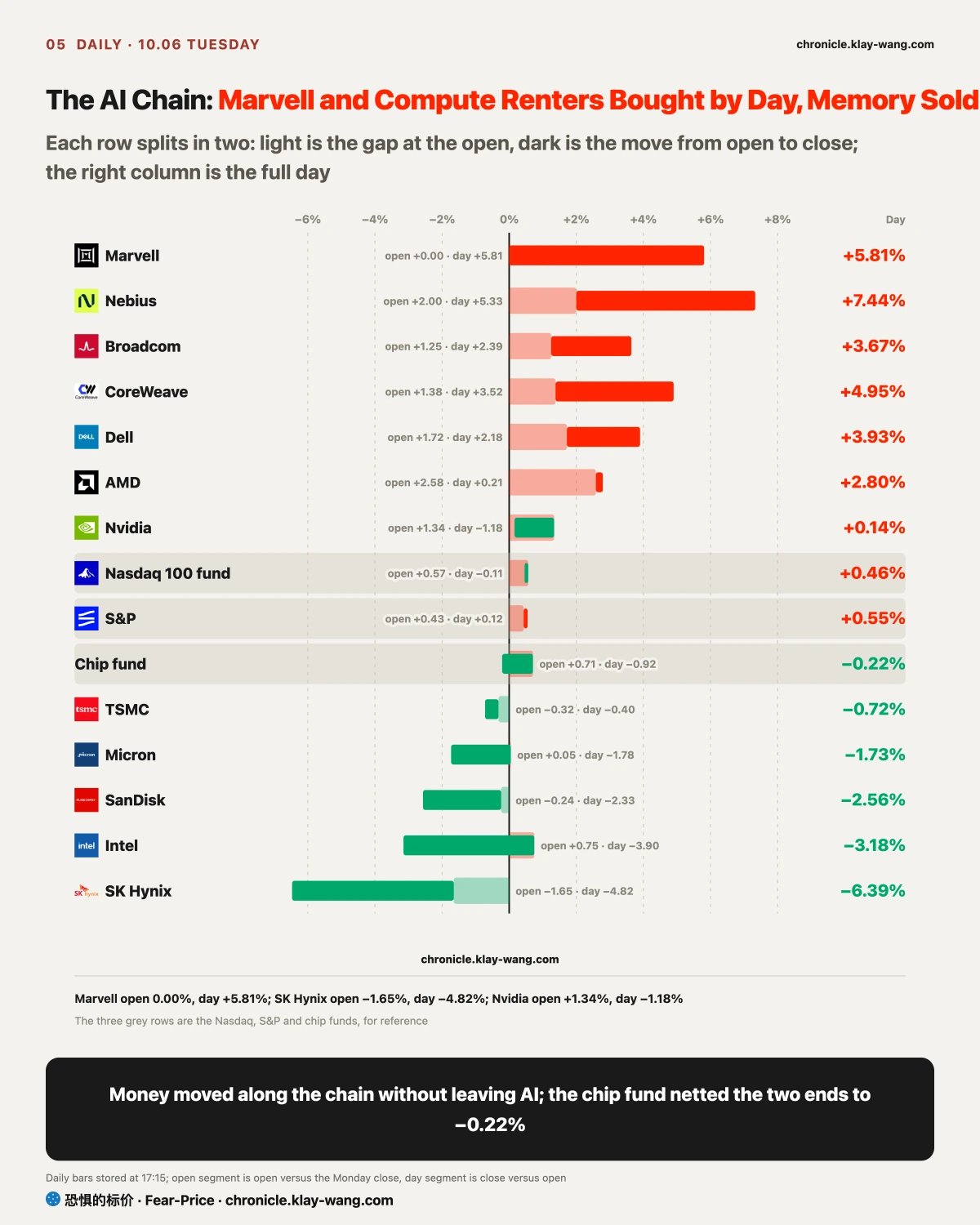
Among eight chip stocks, Marvell, Broadcom, Nvidia, AMD, TSMC, Intel, Micron and SanDisk, the biggest gainers over the past year are SanDisk and Micron: SanDisk is more than 13 times its price a year ago, Micron more than 5 times. Within the same chip basket on Tuesday, money moved from memory, which rose most and had its good news priced in, to custom chips, which had just set new targets, and the chip fund barely moved.
The trade most worth following is in SK Hynix: December 18 calls at 210 traded 36498 contracts against open interest of 37014, and the 140 strike traded 12081 against 12487. Both traded almost exactly their open interest on a day the stock fell 6.39%, so the more likely reading is that holders of both batches closed them out in full. Volume does not show who bought and who sold; open interest on the morning of Wednesday October 7 will settle it: if the 210 strike falls below 18765 contracts (down by more than half the volume), the closing reading stands, and a roll to another strike counts on that side too; if not, the trades were new positions or old holders passing contracts to new buyers, and the call fails.
[Chain] The AI Chain: Money Moved Along It, Not Out of It
Split the AI chain into the open and the session, and the lines are clear. Bought during the day were the custom chip and networking makers Marvell and Broadcom, the compute renters Nebius (up another 5.33% during the session) and CoreWeave, and the server maker Dell; sold during the day were the three memory names and Intel (down 3.90% after a higher open). The two compute renters rose and their one-month implied volatility rose too, Nebius up 2.70 points and CoreWeave up 2.44, as call demand pushed up the price of insurance, a hotter chase than Marvell. Nvidia opened 1.34% higher, gave back almost 90% of that during the day and closed up only 0.14%, still a record close at 239.24, but it hit its high within two minutes of the open and closed near its low. AMD rose 2.80%, almost all of it at the open.
Further down the chain is power. The utilities sector fund rose 2.98%. Google and Constellation signed a 20-year nuclear power purchase agreement (Constellation press release) adding 890 megawatts, with the first new power expected in 2028, plus a separate 15-year supply deal. Long contracts like this write power use years ahead into a contract signed today, and the AI power demand story has stretched from chips to electricity.
At the index level this is still a record carried by a few big names. The equal-weight to cap-weight S&P ratio (the lower it is, the more big names are beating the typical stock) was 0.2725 on Tuesday, and equal weight kept pace with cap weight on the day; but the ratio sits near its 60-day low, about 8% below 0.2957 on July 29, and small caps and financials against the S&P are both at 60-day lows. Money has not left AI, it is changing places along the chain, and most companies are still not keeping up. Our October 5 call was that this ratio closes below 0.2725 on October 16, with money staying in the big names; on Tuesday it closed right on that line, and it settles next Friday. If you hold an S&P or Nasdaq 100 fund, the gains are still in a few big names, and the index record alone overstates how most of your stocks are doing.
[Far Out] On a Record Close for the S&P, About 100000 Contracts Each in Two March Puts: Tomorrow Shows Whether They Are New
S&P 500 fund puts expiring March 19 next year at 655 and 500 traded 101845 and 102832 contracts on Tuesday, against open interest of only 2455 and 8828. Same expiry, almost equal counts: it looks like a put spread, long 655 and short 500, that starts paying only if the S&P falls about 16% from 779.09 and stops adding beyond about 36%. The Monday pair expiring November 30 has been confirmed as almost entirely held overnight; this one runs longer and sits further from the price.
Volume does not show the direction, and someone may have sold this spread to collect the premium. If open interest at 655 on the morning of October 7 rises at least 50923 above 2455 (half the Tuesday volume), these are new positions: two days in a row someone bought crash insurance near the index record while protection for the next few weeks got cheaper, so near-term risk pricing is easing and someone is paying separately for a big fall about six months out. If it does not rise that much, the pair only changed hands and is not new protection. If you hold a lot of index exposure, one month of protection costs about 4% less than on Monday.
[Settled] The S&P November 30 Puts Were New, the Call Stands: Someone Bought Crash Insurance to the End of November Near the Record
The S&P November 30 puts at 675 and 570 were new positions: the call stands. The test filed on October 5 was that open interest at 675 on the morning of October 6 would rise at least 37521 above 974 (half of the 75042 traded on Monday). It read 75680, up 74706; the 570 strike went from 1080 to 76080, up by exactly the 75000 traded on Monday. Nearly all of the Monday trades stayed overnight: someone bought insurance near the index record that starts paying only if the S&P falls more than 13%, running to the end of November. The last time we used this reading, on Nasdaq 2028 deep out-of-the-money puts, only 40% stayed and that call was wrong. The rule did not change, we waited for next-day open interest again, and this time the call stands.
Our October 2 call: through October 9, the official 2-year Treasury yield closes below 4.92% every day, with the weak jobs report already in rates. It closed at 4.79% on Tuesday, 13 basis points (a basis point is 0.01 percentage point) from that line, and it settles on Friday.
What This Means for What You Hold
If you hold memory (Micron, SanDisk, SK Hynix): on Tuesday you were on the side being sold down, sharply, with protection barely dearer, which looks like profit taking. If open interest in that SK Hynix call batch falls by more than half on October 7 morning, someone exited in full; cheaper protection on Micron is mostly the post-earnings fade, so do not read it as no one worrying.
If you hold Marvell or Broadcom: on Tuesday you were on the side money flowed into, far-dated call volume jumped, and open interest tomorrow will confirm whether it is new. Marvell gave back almost half of an 11% spike; 271.25 was the close before the investor day, and a close below it means the investor day gain was handed back in full.
If you hold Nvidia: another record close, but it hit its high within two minutes of the open, closed near the low, and gave back almost 90% of the 1.34% gap during the session. Sellers near the high are still there.
If you hold an index ETF: the S&P closed at a record and one month of protection costs about 4% less than on Monday; the equal-weight S&P kept pace on the day, but the ratio is still at the bottom of its 60-day range, and the gains are still in a few big names.
The Dates Ahead
These calls come from crossing fundamentals, such as guidance and supply and demand, with the money side, such as volume, open interest and implied volatility; sudden news is beyond what we can call, and every call is scored right or wrong as it falls.
- October 7 (Wednesday) morning: whether open interest in SK Hynix December 210 calls falls below 18765; whether the S&P March 655 puts are new.
- October 9 (Friday): whether the 2-year Treasury yield closes below 4.92% every day.
- October 16 (Friday): whether Marvell closes above 271.25 every day; whether the equal-weight to cap-weight ratio is below 0.2725; whether the VIX never closes above 25, 15.01 on Tuesday.
- October 28 (Wednesday): whether the S&P 500 fund has closed within 5% of 761.69, its September 18 close, the whole time; it is 2.3% above on Tuesday.
- October 30 (Friday): whether the 10-year Treasury yield is still above 5%, 5.27% on Tuesday.
- Late October, four big tech earnings reports: whether the chain of capital spending, borrowing and long-term rates starts to weigh on their own valuations.
- November 20 and November 30: the Google call spread and the S&P end-of-November puts, with open interest checked each day until expiry.
Three Lines Worth Keeping
- On a day a sector fund barely moves, the stocks inside it may be splitting hard: the chip fund fell 0.22% while Marvell rose 5.81% and SK Hynix fell 6.39%.
- Protection that does not get dearer on a fall usually means profit taking, not panic; for a stock that just reported or just held an investor day, first take out the normal fade after the event.
- For options that trade as many contracts as their open interest, only open interest the next morning tells whether people came in or went out.
No investment advice. No direction calls. No market timing.