Treasury Yields Are Surging. Where Is the Money Going in the AI Supply Chain?
Three Lines: Money Crowds Into the Parts of the AI Chain That Get Orders, and the 10-Year Weighs on the Rest
- The S&P fell only 0.24%, while equal weight, small caps and financials all hit 60-day lows against it; money keeps crowding into a few large names.
- Over a month, chip and server makers and the cash-rich platforms on the AI chain rose, while those borrowing to rent compute and build data centers fell, with spreads widening.
- The 10-year hit 5.35% intraday, its highest since 2002; as the anchor for global assets it squeezes valuations first and borrowers next, and protection on the winners started to get dearer.
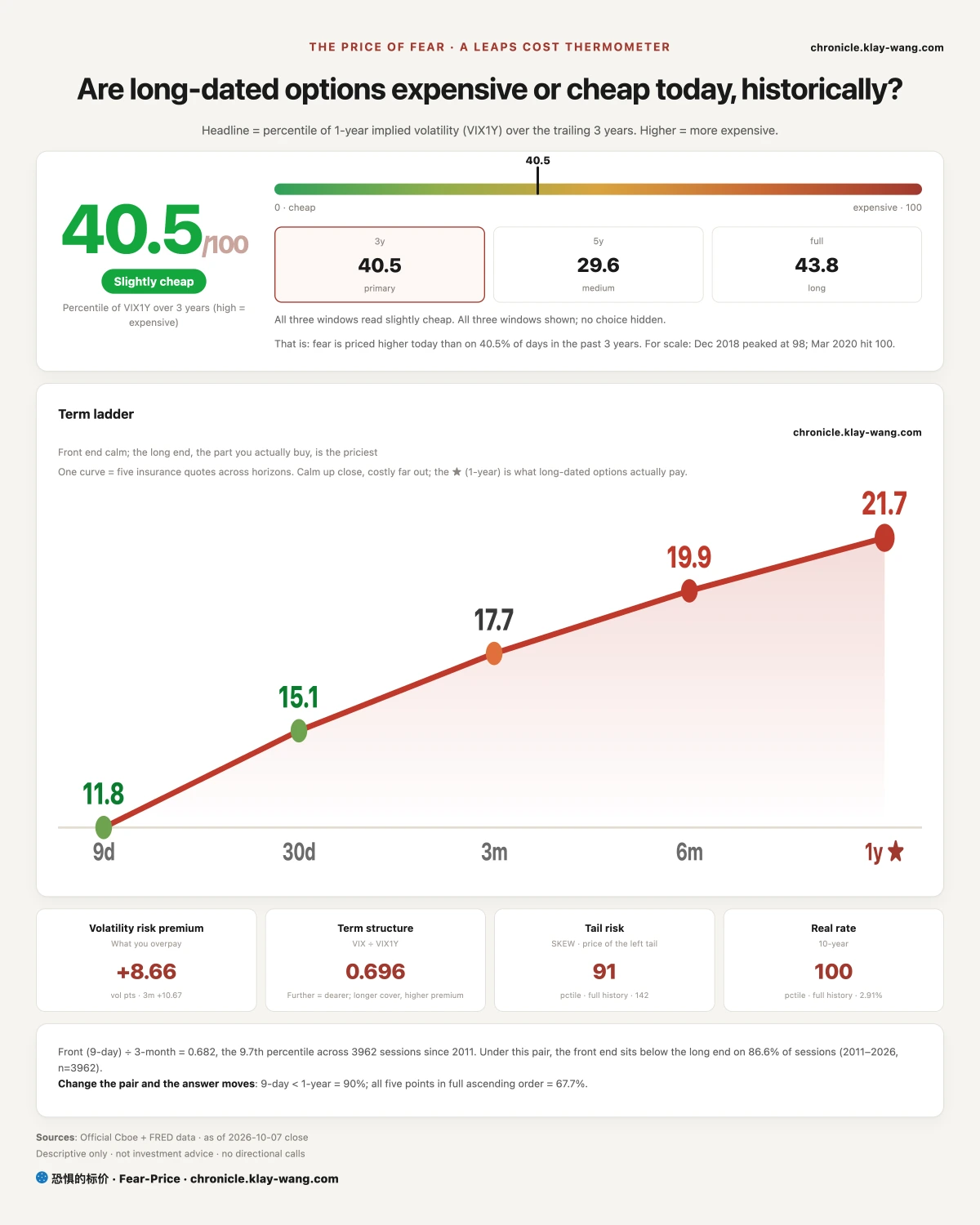
Fear-Price Index 40.5: Protection on the Market Is Still Cheap, and No One Is Paying Up
Fear-Price Index · 2026-10-07 · reading 40.5/100: the one-year volatility index VIX1Y was 21.67, at the 40.5th percentile of the past three years, where higher means more expensive. Daily ledger and method → chronicle.klay-wang.com · Please credit: Fear-Price Index · Fear-Price
The price of a year of insurance on US stocks rose from 39.7 to 40.5 on Wednesday (out of 100, higher is dearer), and one-year volatility moved only from 21.65 to 21.67. The minutes, long yields and a sharp fall in crypto stocks all landed that day, and one-year protection barely repriced; the one-month VIX went from 15.01 to 15.08, and the nine-day measure fell from 12.03 to 11.78. The market did not treat the Wednesday news as a risk worth buying protection for in advance. If you hold the S&P, a year of protection costs about what it did on Tuesday.
The K index was 2.95, below 3.12 on Tuesday. The CNN fear and greed reading fell from 46.8 to 44.5 while the VIX barely moved: more people said they were worried, and no more paid for protection. The closer K gets to 1, the more people are turning worry into paying for protection; at the Wednesday fear and greed reading, the VIX would have to rise above 44.6 for K to fall below 1. History at chronicle.klay-wang.com/kindex, the index at chronicle.klay-wang.com/fear-price.
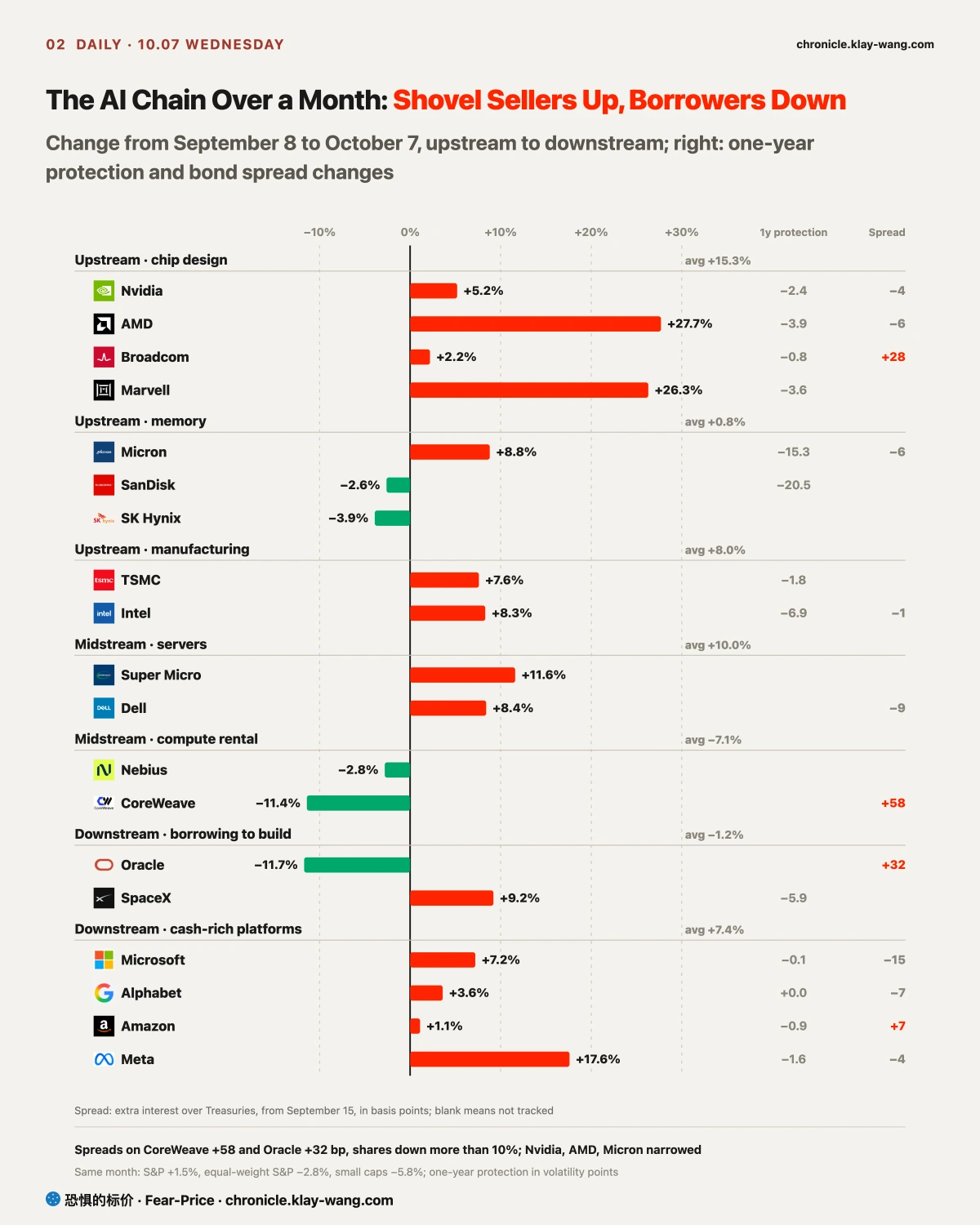
[Supply Chain] Over a Month: Shovel Sellers and Cash-Rich Platforms Rose, Those Borrowing to Buy Shovels Fell
Lay the AI supply chain out from upstream to downstream and look at a month, not a day, and the direction of money is clear. The S&P is up only 1.5% since September 8 and the equal-weight S&P is down 2.8%; money did not spread across the market but gathered in the parts of the chain that get orders directly.
The upstream chip segment mostly rose over the month, with AMD and Marvell up more than 20% and Nvidia, TSMC and Intel also higher; midstream server makers Super Micro and Dell rose with them. The money says the same thing: most near-month option volume in this segment was calls, and one-year protection is cheaper than a month ago, down two to four points on Nvidia, AMD and Marvell, so holders worry less about a year out. Memory split within the segment: Micron rose while SanDisk and SK Hynix slipped; memory saw the biggest drop in protection over the month, 15 to 20 points on one-year for Micron and SanDisk, and for Micron most of that is the normal fade after its September 30 results.
On Wednesday this segment moved differently: shares rose and protection got dearer with them. Micron opened 2.70% lower, hit its low in the first minute, climbed into the early afternoon and closed near the high of the day on almost 40% more volume than Tuesday; as Micron, SanDisk and Super Micro rose, one-month protection got dearer by 2.7 points on average and one-year rose too, so the chasers started insuring themselves. Goldman estimates Micron alone accounts for 19% of third-quarter earnings growth for the S&P (outside estimate), so money is chasing companies whose profits are already booked. Since 2016 Micron has had 9 days like this, opening 2% or more lower and closing 3% or more higher, and in only 3 did it stay above the prior close on every one of the next 7 trading days; it is more likely than not to close back below 1045.56 (the Tuesday close) before Friday October 16, and if it stays above the line every day, the new money kept buying, and this call is withdrawn.
The segment renting compute midstream and borrowing to build data centers downstream fell over the month, with CoreWeave and Oracle both down more than 10%; SpaceX is the exception, still up nearly 10% over the month. The corporate bond market is saying the same thing: since September 15 the extra interest CoreWeave bonds pay over Treasuries of the same term widened from about 7.8 to 8.4 percentage points and Oracle from about 1.5 to 1.9, while spreads on Micron, Nvidia and AMD narrowed. Much of the money this segment spends on chips and data centers has to be borrowed: SpaceX is reported to be in talks with Apollo and banks on about 40 billion dollars of financing to buy Nvidia chips, and the transmission permit for the Oracle data center in Wisconsin was sent back to the start. On Wednesday the segment kept falling while protection did not get dearer, and one-month protection on Nebius and CoreWeave fell by more than two points: orderly trimming.
The downstream platforms that spend the most pay from their own cash: Microsoft, Alphabet, Amazon and Meta all rose over the month, and about 80% of their near-month option volume was calls. Their one-month protection got dearer by five to nine points while one-year barely moved: Alphabet reports on October 28 and the others usually report around the end of October too, all inside the one-month window. What the platforms say about capital spending next year in those results decides whether orders upstream keep growing, and that is where the whole chain settles next.
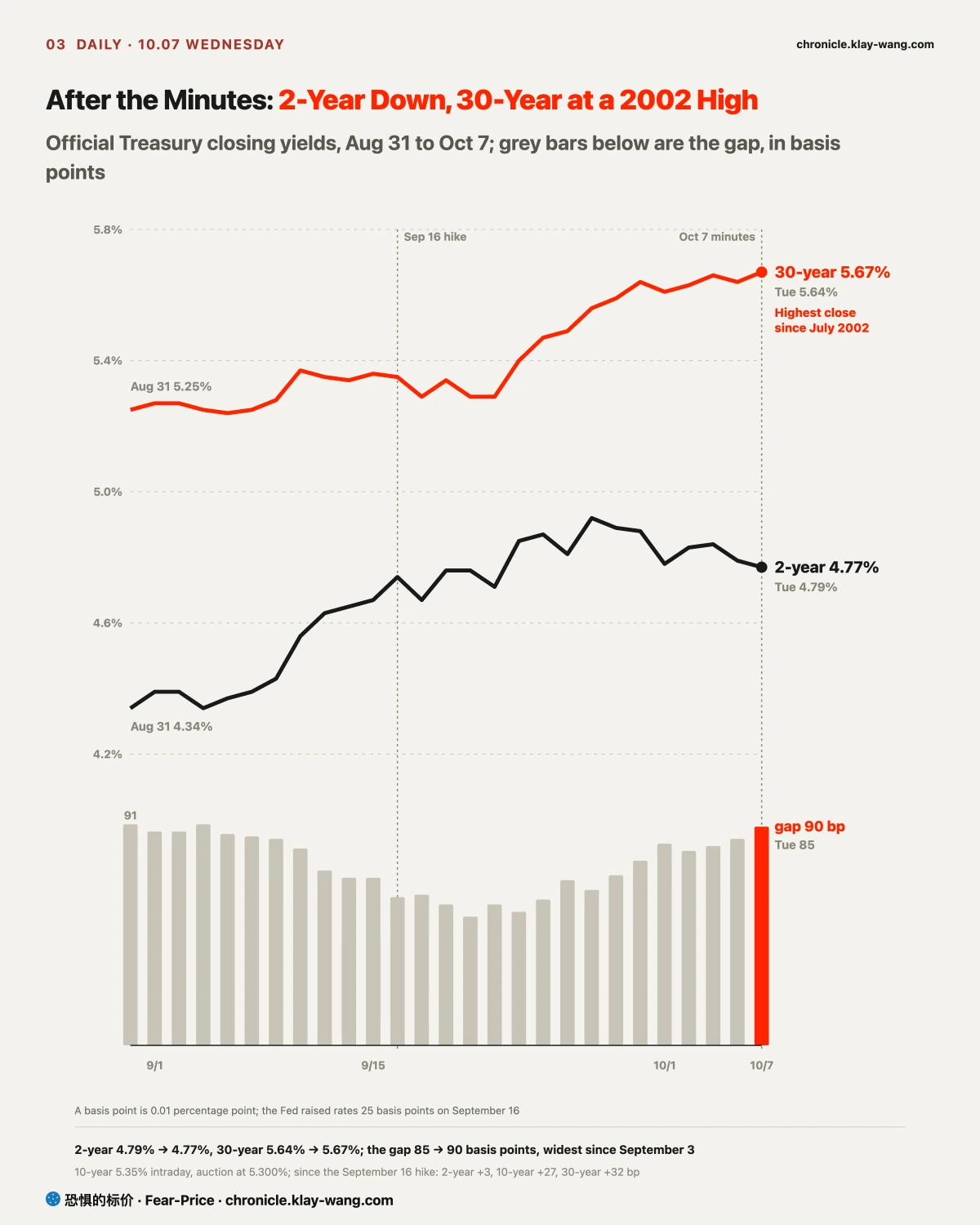
[Rates] The 10-Year Is the Anchor for Global Assets: As It Rises, It Squeezes Valuations First and Borrowers Next
The US 10-year Treasury yield rose to 5.35% intraday on Wednesday, its highest since 2002, and closed at 5.28% on the official Treasury table, 53 basis points above the end of July. In the afternoon the Treasury sold 39 billion dollars of 10-year notes at 5.300%, the most expensive such sale since 2000, but demand was solid: indirect bidders, which include central banks, took about 80%, and yields then came off the highs. The 30-year closed at 5.67%, its highest close since July 2002.
The 10-year is the anchor for pricing assets worldwide. Stocks, corporate bonds and emerging markets are all valued by discounting future cash flows back to today at that rate; each step up makes the same dollar of future profit worth less today, and the further away the profit, the bigger the hit. The 10-year real yield, after inflation, is 2.91%, higher than on 99.7% of days since the data began. Other countries are following: the same day the French 10-year rose 12 basis points and the UK 7; the dollar index rose while gold and bitcoin fell, since the more dollar assets pay, the less anyone wants gold and crypto that pay nothing.
This round of increases is mostly at the long end. Since the September 16 hike the 2-year is up only 3 basis points, the 10-year 27 and the 30-year 32. The 2-year follows the Fed, and the minutes released on Wednesday said most officials saw another hike by year end as likely appropriate, not October; the extra on the long end is the compensation for lending for ten or thirty years, and in the minutes a few officials discussing why long yields had risen cited expectations of more AI-related borrowing among the reasons. MOVE, the price of insurance on rates, fell from 105.2 to 102.56, so the bond market itself is not anxious.
The effect on stocks comes in two steps. First it squeezes valuations: companies whose profits are far away, small companies that borrow a lot and banks holding long-term bonds get repriced first; over a month small caps fell 5.8% and regional banks 7.3%, equal weight, small caps and financials are all at 60-day lows against the S&P, and the index is held up by a few large names whose profits are already booked. Second it squeezes borrowers: the extra interest high-yield bonds pay over Treasuries rose from 2.68 to 3.03 percentage points over the month, still the middle of its three-year range, but the segment borrowing to buy compute is already paying first. Within tech, upstream companies whose profits are arriving can take it; the segment whose profits are far away and that depends on borrowing cannot.
The risk is that the two steps feed each other. If long yields keep rising because there is too much borrowing, the cost of building data centers on borrowed money rises with them and capital spending may slow, while orders for the upstream winners come from exactly that spending; valuation pressure would also spread from small caps to large names, and at that point good profits will not stop valuations from being squeezed. There are buffers too: central banks and other buyers took the 10-year auction at 5.3%, and on Thursday October 8 the Treasury sells 22 billion dollars of 30-year bonds and runs a long-bond buyback twice the usual size. If the 30-year auction finds buyers, the pullback in long yields from the highs holds; if not, the two steps above keep going.
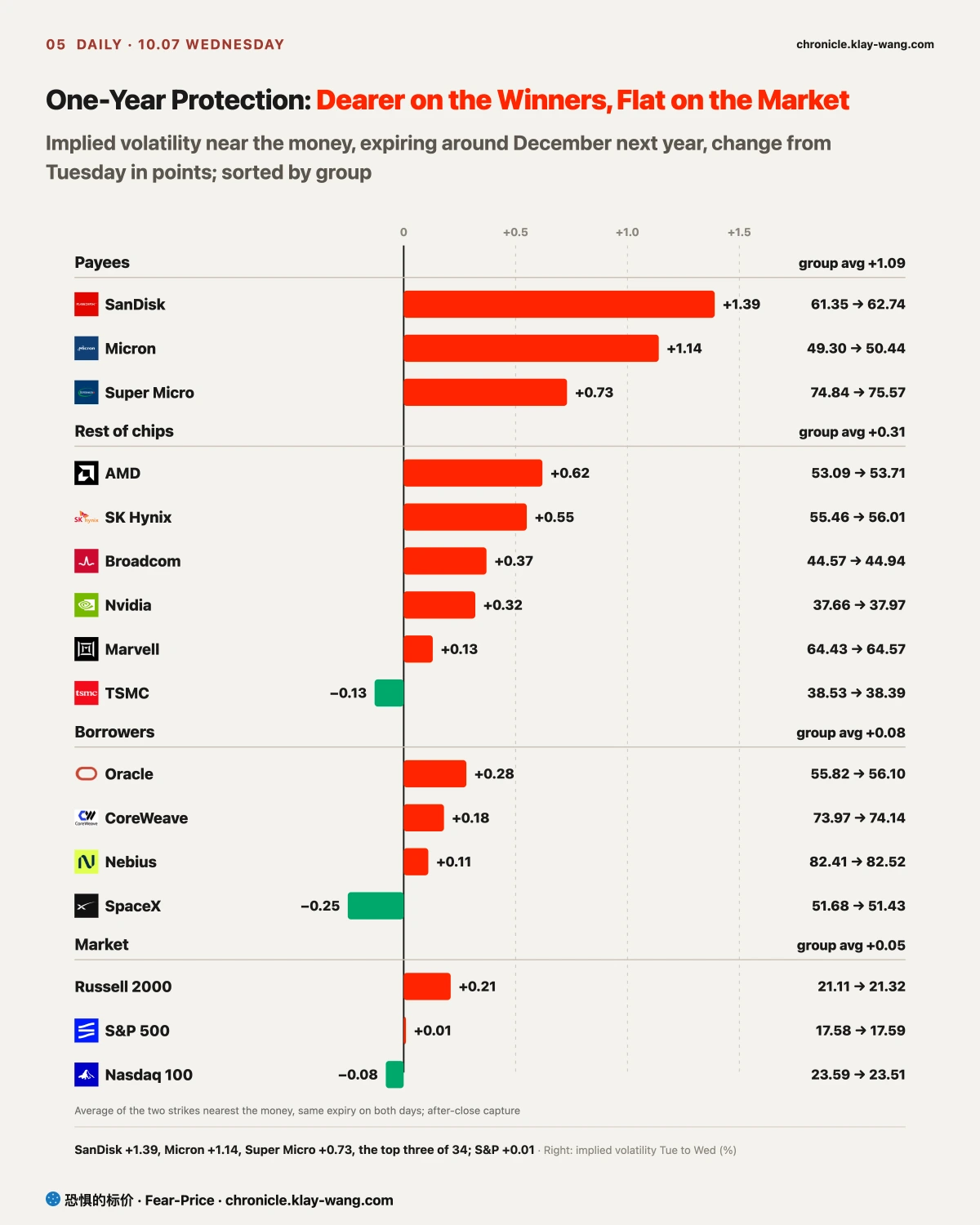
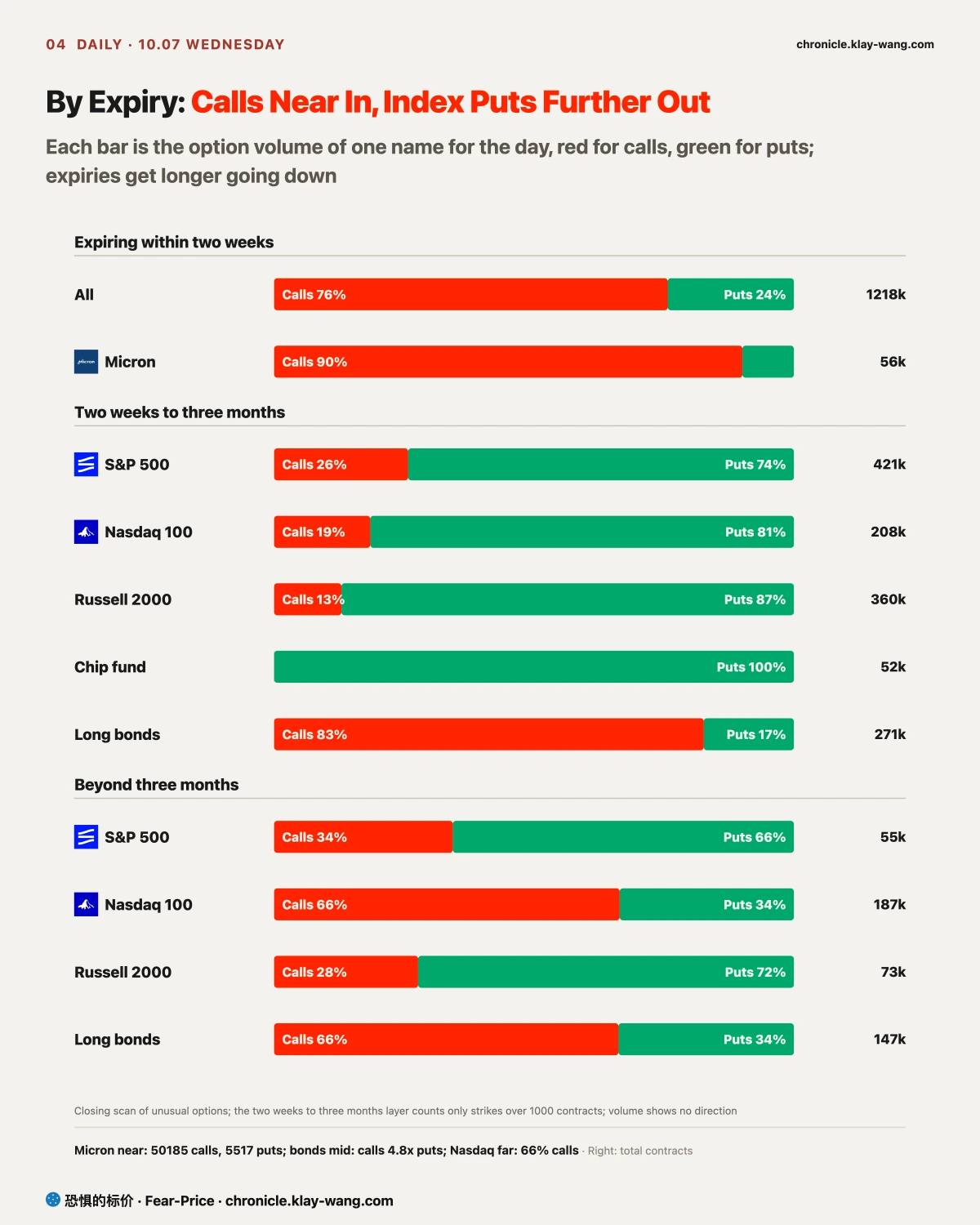
[Expiries] Protection on the Winners Is Getting Dearer, and Only a Few Large Trades Are Insuring the Market
Split into three groups by time to expiry, with one-year protection on top, the options say one thing: money is crowded into the winners, and the worry is starting to crowd there too. In the group expiring within two weeks, calls took 85% of option premium and Micron alone more than a fifth of it; that is chasing. In one-year single-stock protection, the biggest rises on Wednesday were SanDisk, Micron and Super Micro, the top three of 34; Nebius and CoreWeave rose only 0.1 to 0.2 point, and one-year protection on the S&P barely moved. If something goes wrong, the winners get hurt first, and their own option prices already say so.
The two weeks to three months group ran the other way, with S&P put volume 2.88 times call volume, the Nasdaq 4.40 times and small caps 6.72 times; the long Treasury fund went the other direction, with calls nearly 5 times puts, a bet that long yields come back down, on the same side as the buyers at the 10-year auction.
Further out are a few large trades. Three days running, someone near the index record bought downside protection two to five months out: the Monday S&P batch to the end of November and the Tuesday batch to next March, both confirmed as new by next-day open interest; on Wednesday, two S&P put strikes expiring February 26 next year, 720 and 670, traded about 5000 each against open interest of only 344 and 487, paying if the S&P falls 7% from 777.22 and adding nothing past about 14%. Overall volume beyond three months leaned to calls, so this is the work of a few large trades, not how most money is positioned. Thursday October 8 morning settled open interest (contracts still held after the prior close) will tell: if the 720 strike is up at least 2519 from 344, it is another new layer of protection.
These large trades bet on the case where the winners fall and rates come down, which is what happens if the risk in the previous section plays out. Only a few people are placing them; one-year protection on the market did not move, and the Fear-Price Index sits at the cheaper end.
[Settled] The S&P March Puts Were New, the Call Stands; the SK Hynix Calls Changed Hands, Withdrawn
The S&P March 655/500 puts were new; the call stands. The test was that on the morning of October 7 open interest in the 655 strike rise at least 50923 above 2455. It was 103995, up 101540, or 99.7% of the Tuesday volume; the 500 strike rose 97616. For a second day running, someone bought crash insurance near the index record, the Monday batch to the end of November and the Tuesday batch to next March.
The SK Hynix December 210 calls were a full exit; withdrawn. The test was open interest in the 210 strike falling below 18765. It was 36635, down only 379; the 140 strike went from 12487 to 12488. Both traded close to their full open interest and open interest did not fall, so old holders passed the positions to new buyers. The mistake was reading volume near open interest as an exit without allowing for buyers of the same size.
The Nasdaq 2028 deep out-of-the-money puts were new; withdrawn (recorded two days late). The test was that on the morning of October 5 open interest across ten strikes rise at least 18394 above 42524; it rose 15109, short of the line. Eight of the ten kept about half to 60% of their volume as new positions; of the two busiest, one saw open interest fall and one kept only about 30%, which looks more like a roll. This should have settled on October 5 and was recorded two trading days late.
The Marvell call from Tuesday (closing above 271.25 every day before October 16) holds so far, with a Wednesday close of 284.68.
What This Means for What You Hold
If you hold upstream chips and servers (Nvidia, AMD, Broadcom, Marvell, TSMC, Intel, Super Micro, Dell): over the month you were on the side money flowed into, and one-year protection got cheaper on all six chip names with a month-ago reading; results from TSMC on October 14, Intel on October 29 and AMD on November 3 fall in the next month, and what the platforms say about capital spending at month end decides orders for this segment.
If you hold memory (Micron, SanDisk, SK Hynix): Micron is where money is most crowded, with protection getting dearer as it rose on Wednesday; 1045.56 is the first level, and the calls chased expire next Friday; SanDisk reports on October 29.
If you hold compute renters and data center builders on borrowed money (Nebius, CoreWeave, Oracle): the shares are being trimmed, and bond spreads on CoreWeave and Oracle widened over the month. Each step up in long rates adds to the costs of this segment.
If you hold the platforms (Microsoft, Alphabet, Amazon, Meta): up over the month, with protection dearer mainly because end-of-October results entered the window; the capital spending they announce is the next settlement point for the whole chain.
If you hold index funds, small caps or regional banks: the S&P is up only 1.5% over a month, equal weight, small caps and financials sit at 60-day lows, and these are what a rising 10-year presses on; how the 30-year auction goes on Thursday is the next number to watch. Your one-month protection has barely repriced, so it is not expensive now.
If you hold long Treasuries: central banks and other foreign buyers took the 10-year auction, and options show bets on a long bond rally both near and far, but the spot 30-year is still rising, and neither side has won yet.
The Dates Ahead
These calls cross guidance and supply and demand with volume, open interest and implied volatility; sudden news is outside what can be anticipated, and each call is scored right or wrong all the same.
- Thursday October 8 morning: whether the S&P February 720 puts were new. The same day, watch the Treasury 30-year auction and buyback.
- Friday October 9: whether the 2-year yield closes below 4.92% every day; 4.77% on Wednesday.
- Friday October 16: whether Micron closes back below 1045.56; whether Marvell closes above 271.25 every day; whether equal weight against the S&P is below 0.2725, 0.2710 on Wednesday; whether the VIX stays at or below 25 at every close, 15.08 on Wednesday.
- Wednesday October 28: whether the S&P 500 fund stays within 5% of its September 18 close of 761.69, 2.0% above on Wednesday. The same day the Fed decides and Alphabet reports; what the large platforms say about capital spending next year decides whether orders for the winning group keep growing.
- Friday October 30: whether the 10-year yield is still above 5%, 5.28% on Wednesday.
Three Lines Worth Keeping
- When money crowds into fewer names, the index looks steady while the average stock falls further: equal weight fell 0.81%, and equal weight, small caps and financials are all at 60-day lows against the S&P.
- Over a month, the upstream that gets orders and the cash-rich platforms on the AI chain rose while those borrowing to buy compute fell, and bond spreads told the same story as share prices.
- The 10-year is the anchor for global assets; with long yields above 5% it squeezes valuations first and borrowers next, and protection on the winners has started to get dearer because those chasing them know where the risk is crowded.
No investment advice. No direction calls. No market timing.