The Market Is Recalculating AI Demand. Did Trump Buy Up to 25 Million Dollars of Meta?
Three Lines: Oil Pushed the Open, and OpenAI Revenue Made the Market Recount the Payers of the AI Chain
- Before the open crude rose nearly 3% and the Iran news came with the 10-year touching 5.32%, so the S&P, the Nasdaq and small caps all opened lower.
- At midday OpenAI revenue came in 20 billion dollars lower on a narrower definition; CoreWeave and Oracle, which rely on it to pay, were among the biggest losers.
- Meta closed flat; what lifted it this past month was its Muse personal agent. Trump bought up to 25 million dollars of Meta in August.
Fear-Price Index 42.5: One-Year Protection on the Market Is Still Cheap, and No One Is Paying Up
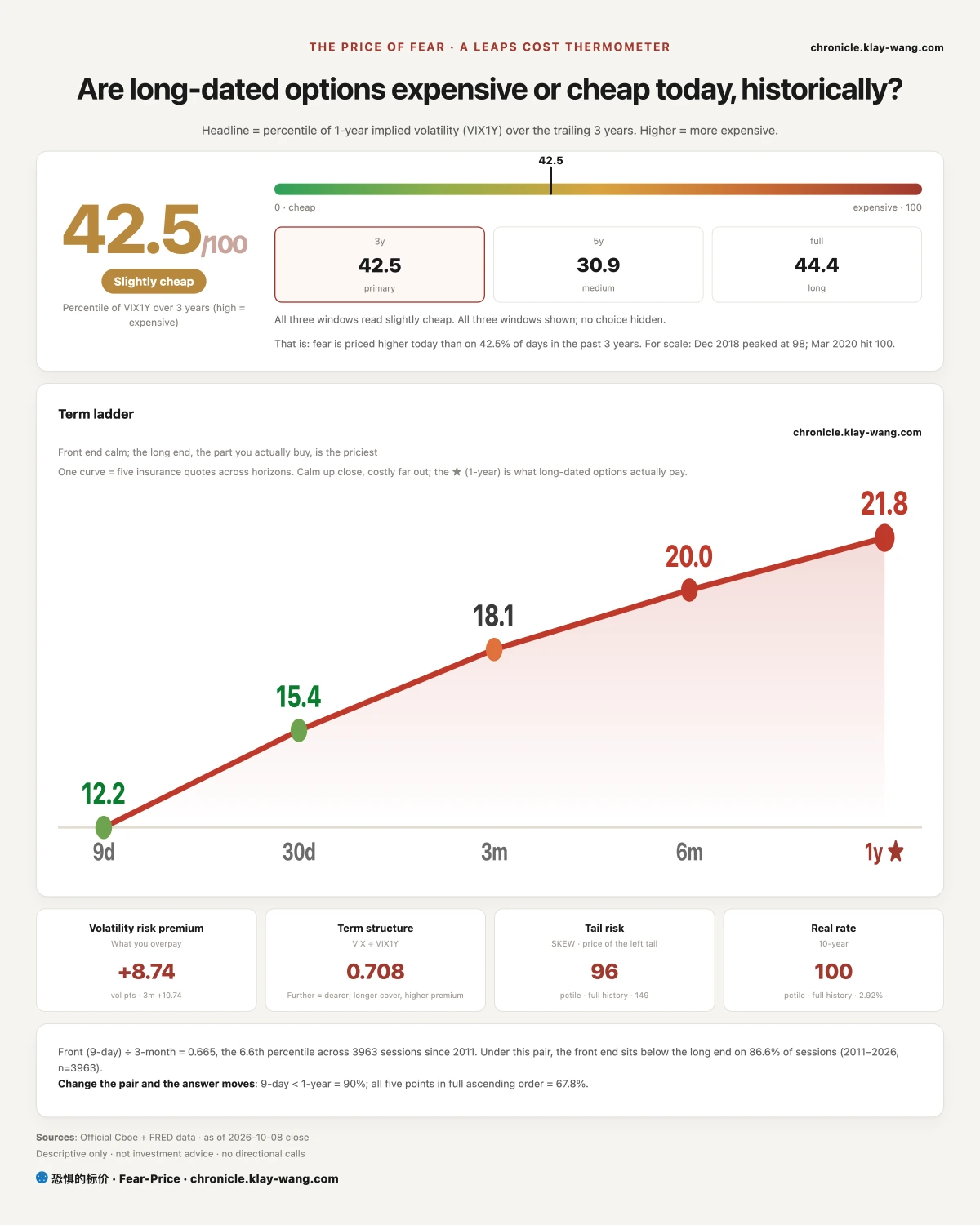
Fear-Price Index · Oct 8, 2026 · 42.5/100: one-year volatility VIX1Y at 21.76, in the 42.5th percentile of the past three years, where high means expensive. Daily ledger and definitions at chronicle.klay-wang.com · Please credit: Fear-Price Index
Lately a lot of friends have been complaining to me that it is hard out there and the market is all over the place. Looking back over the numbers from the past few days, that feeling needs to be split in two.
The market as a whole is not all over the place. The Nasdaq fell 1.34% on Thursday, yet the price of a year of insurance on US stocks rose only from 40.5 on Wednesday to 42.5, and the market did not treat the day as one to buy insurance early. If you hold the S&P, a year of protection costs about what it did on Wednesday.
More people find the market scary, yet no more are actually paying for insurance. The CNN Fear and Greed index measures market mood, and it fell from 42.1 to 38.1 on Thursday, toward fear; the VIX is the price people pay for protection, and it rose only from 15.08 to 15.41. The K index is 2.47 (provisional), below the 2.80 final for Wednesday, and it measures the gap between the two. The closer K gets to 1, the more of that worry is turning into protection bought; at the Thursday Fear and Greed reading, the VIX would have to rise above 38.1 for K to fall below 1. Correction: the Wednesday issue gave K as 2.95, the provisional reading that night; the final is 2.80. History at chronicle.klay-wang.com/kindex, the index at chronicle.klay-wang.com/fear-price.
What really swings is the individual stocks inside the index. On the same day Oracle fell 5.5% and Accenture rose nearly 6%; some fell hard and some rose hard, and inside the index they partly cancel out, so the index looks calm. Meta rose 11% in one day on September 21 and fell nearly 5% in one day a week later. Which way these stocks go comes down to one thing: whether the company has revenue of its own or is waiting for someone else to pay. The OpenAI report at midday Thursday put that on the table.
[Main Line] Thursday Fell in Two Stages, and the Daytime Leg Was the Market Recounting the Payers of the AI Chain
Oil pushed first on Thursday, and a demand-side report deepened the selloff at midday. Before the open crude rose nearly 3% and the 10-year yield touched 5.32%; on Iran, reports said the White House asked the Pentagon to prepare strike options, which pushed oil higher (external reports). That hit risk appetite across the market, so the S&P, the Nasdaq and small caps all opened lower.
The second report came at midday. According to the Financial Times (confirmed by CNBC), the latest OpenAI investor materials put annualized revenue at the end of September at about 50 billion dollars; the nearly 70 billion that circulated at the end of last month included gross revenue sold through partners (external report). OpenAI run-rate revenue still grew 77% in the third quarter; what shrank was the definition.
The market cares about the definition because of where OpenAI sits in the AI chain. It is one of the payers at the far end: last year it signed a five-year compute contract with Oracle worth about 300 billion dollars, its contracts with CoreWeave total about 22.4 billion, and Nvidia, AMD and Broadcom all signed chip agreements with it measured in gigawatts (external reports). That money is paid over the coming years out of OpenAI revenue and fundraising. When the revenue definition shrinks, the ability to pay behind the same contracts looks tighter, and both the next funding round and next year listing have to justify the current 852 billion dollar valuation on the new number. Anthropic, the usual comparison, was at 65 billion annualized at the end of July on a definition that includes sales through cloud partners; on that definition OpenAI is about 68 billion, and on its own only 50 billion (external reports).
So the daytime selling was concentrated in the AI chain: the compute landlords CoreWeave, Nebius and Oracle and the optics names fell the most, chips less; banks, energy and staples closed higher, and more than two thirds of S&P 500 members rose (external report). In the afternoon the 30-year auction went well and yields turned lower, closing below Wednesday, so the daytime leg had nothing to do with rates.
If Friday opens by recovering the Thursday daytime loss, the market has accepted that it was only a change of definition; if not, the market is recalculating orders along this chain on the new number. For holders of AI chain stocks, the next answer on who pays comes from capital spending guidance in big-tech earnings at the end of October and from the terms of the next OpenAI funding round.
[Meta] Trump Bought Up to 25 Million Dollars of Meta; What Lifted It This Month Was Muse
Trump bought Meta shares on August 21, reported at between 5 million and 25 million dollars, the largest of his 517 trades in August (external report). The filing gives only a range, and the actual amount could be close to 5 million; the White House said the president does not direct these trades.
Meta closed at 549.90 on the day of the purchase. What lifted it afterwards was Muse, launched on September 8: a personal agent that books travel, fills out forms and compares prices for its user, and it went to the top of the Apple free app chart, past ChatGPT (external report). On September 21 Meta rose 11%, its biggest day since April 2025; it closed at 720.89 on Thursday, about 17% above the close on the day Muse launched.
What the market paid for in Muse is a path to returns on AI spending. Meta earns almost all of its revenue from advertising, has led the Magnificent Seven in capital spending as a share of revenue for years, and has lacked an AI product that collects money directly (external report). Muse is free, with monthly plans at 20 and 100 dollars, and reaches users through WhatsApp; Zuckerberg has talked about eventually taking a small cut of transactions completed through Muse, and businesses can plug Muse straight into the Meta ad system. Mizuho called it a meaningful step toward showing actual returns on AI spending (external report). Muse is still in its free phase, and whether users stay is the next number to check.
The Thursday split follows the same divide. Both spend heavily on compute, but Meta pays with its own advertising and earns returns from its own product, while the growth of CoreWeave and Oracle in the next few years waits on customers such as OpenAI to pay. When the OpenAI definition shrank, the market recalculated the second kind.
The same filing holds SpaceX bonds due 2031 bought on August 18, between 1 million and 5 million dollars, matching the coupon and maturity of the one we started tracking on Thursday.
[Chips] Why Samsung Record Profit Did Not Hold Chips Up
Samsung record profit brought no new buyers to chips. Samsung reported preliminary third-quarter operating profit of about 107.4 trillion won on Wednesday evening US time, and TSMC September revenue rose 54.6% from a year ago; that good news was already in the price. The market needed more than expected: against the LSEG analyst estimate, Samsung beat slightly; against Korean brokers who cut their numbers for a stronger won, it fell 2% to 3% short.
Memory also lost its biggest buyer. Samsung and SK Hynix ended their combined buyback of about 40 billion dollars early; for the past two months they were nearly the only net buyers in the Korean market (external report). Micron and SanDisk traded about as much as on Wednesday: sellers were not in a hurry.
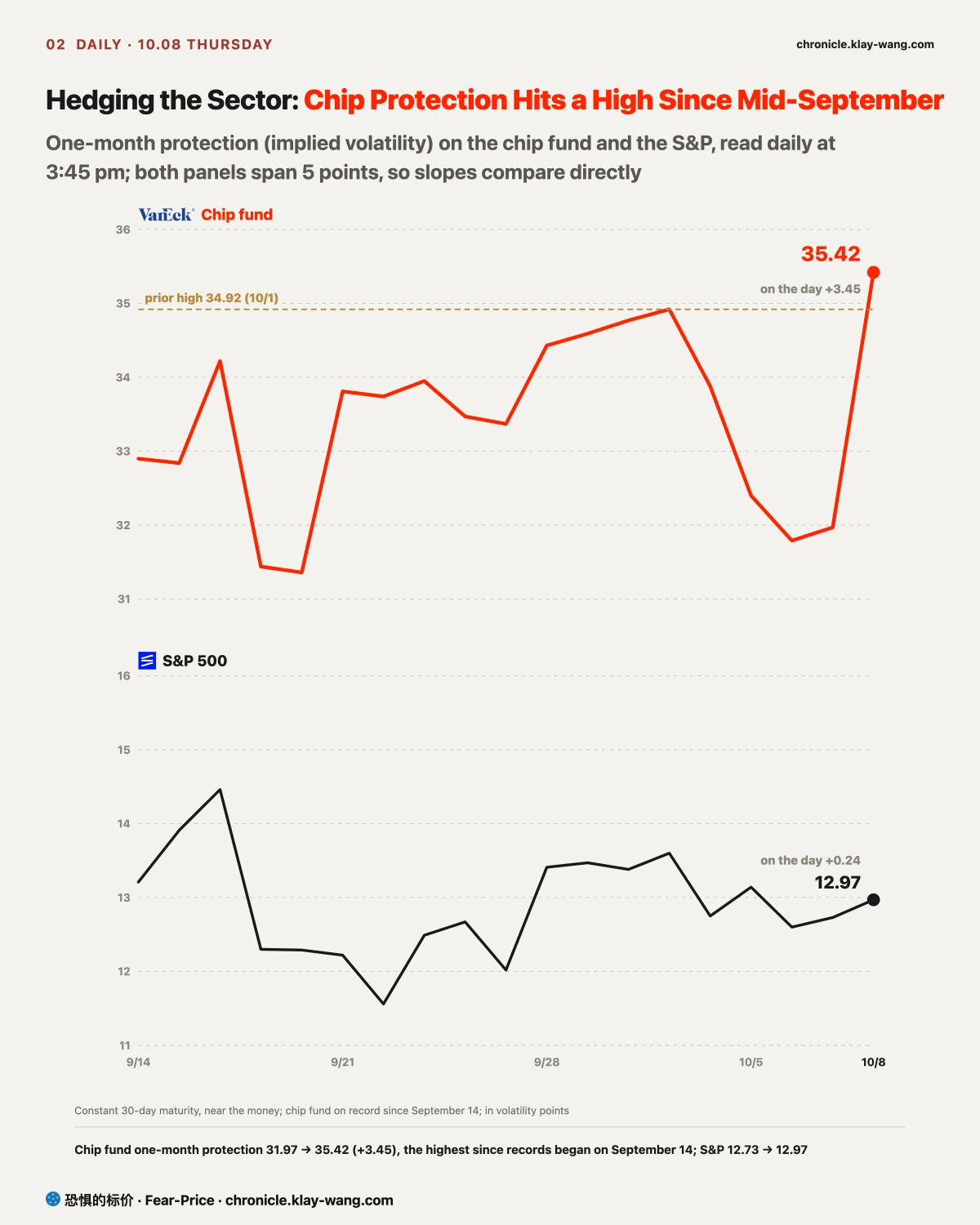
Protection was bought mostly on the sector. At 3:45 pm Thursday, one-month protection on the chip fund rose more than on any day in two weeks, to its highest since our record began in mid-September, and more than on every chip stock we track. When protection on a basket rises more than on the names inside it, the market is pricing those stocks to fall together: the question over what OpenAI can pay falls on the whole pool of demand, not on any one company. The one-year end barely moved, so the worry sits in the next few weeks and has not spread to a year out.
If you hold chip stocks, the TSMC quarterly report on Thursday, October 15 is the next number to watch: what it says about next year capital spending and advanced-node orders decides whether orders along this chain keep growing.
[Rates] Oil Up, Yields Down: the Worry Is Not in Bonds
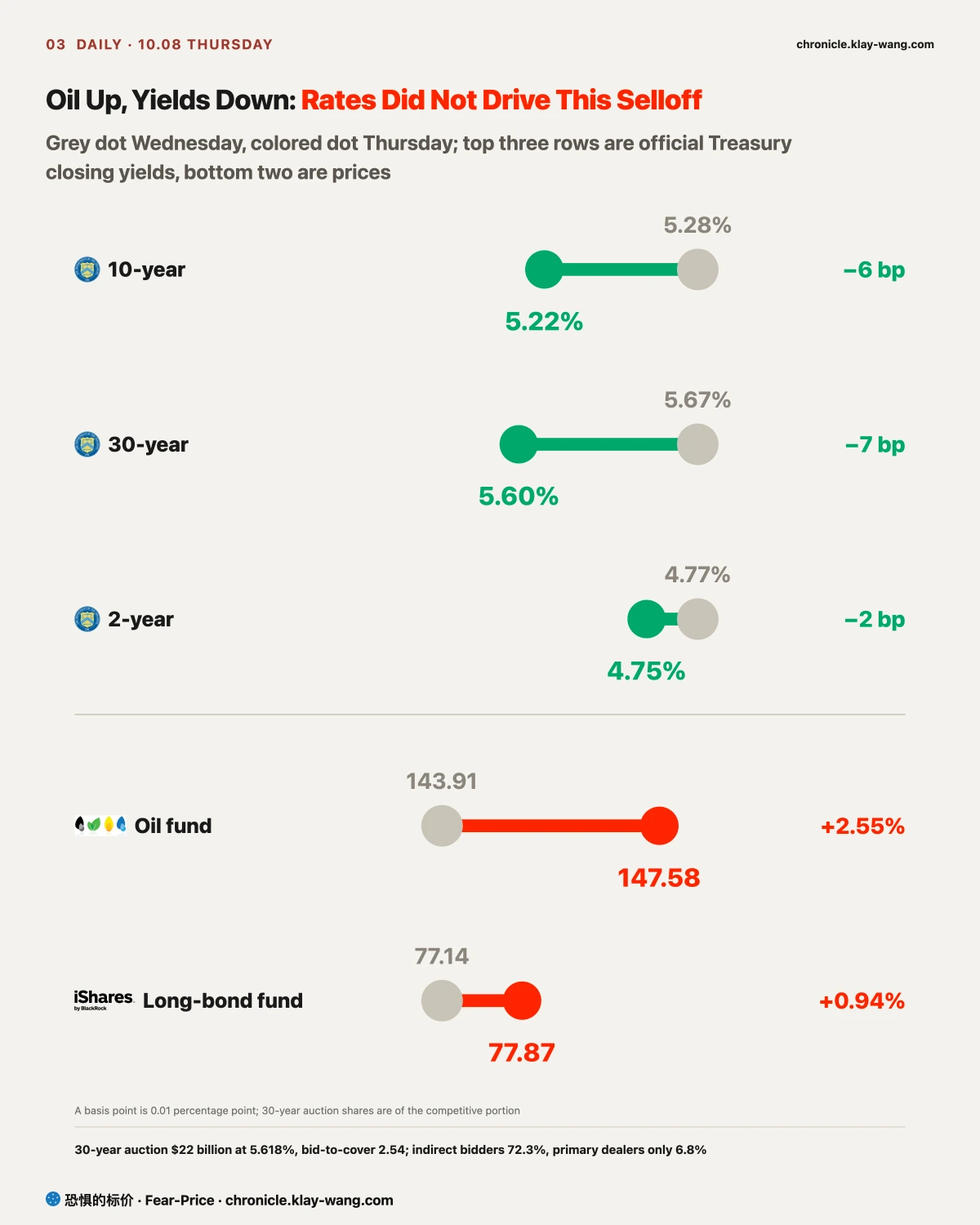
Oil rose and long-term yields fell: the worry is not in bonds. Higher crude usually lifts inflation expectations, yet the 10-year closed 6 basis points below Wednesday. In the afternoon the Treasury sold 22 billion dollars of 30-year bonds; indirect bidders, including foreign central banks, took 72.3% of the competitive portion and primary dealers were left with only 6.8%, so long-term money is willing to buy near 5.6%.
Lower yields cut borrowing costs and should help companies borrowing to build, yet they were among the biggest losers on Thursday: the problem is on the revenue side.
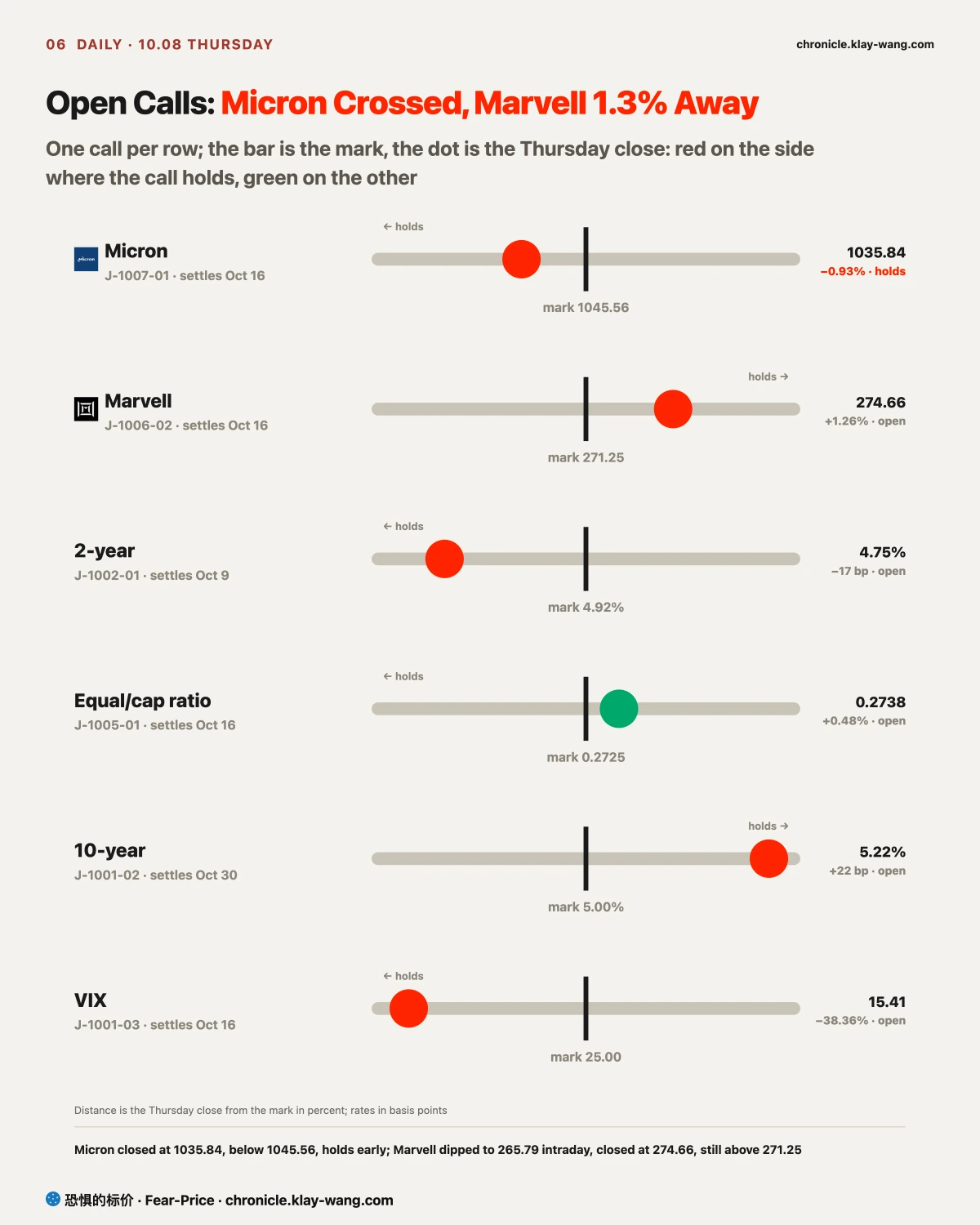
Those betting on long bonds kept adding: calls on the long-bond fund expiring more than three months out traded five times the puts. If you hold long-term Treasuries, the 2-year at 4.75% is 17 basis points below the 4.92% mark, settling Friday; the call that the 10-year closes above 5% on October 30 stood at 5.22% on Thursday.
[Groups] The Compute Landlords and Optics Fell the Most; Ordinary Stocks Rose
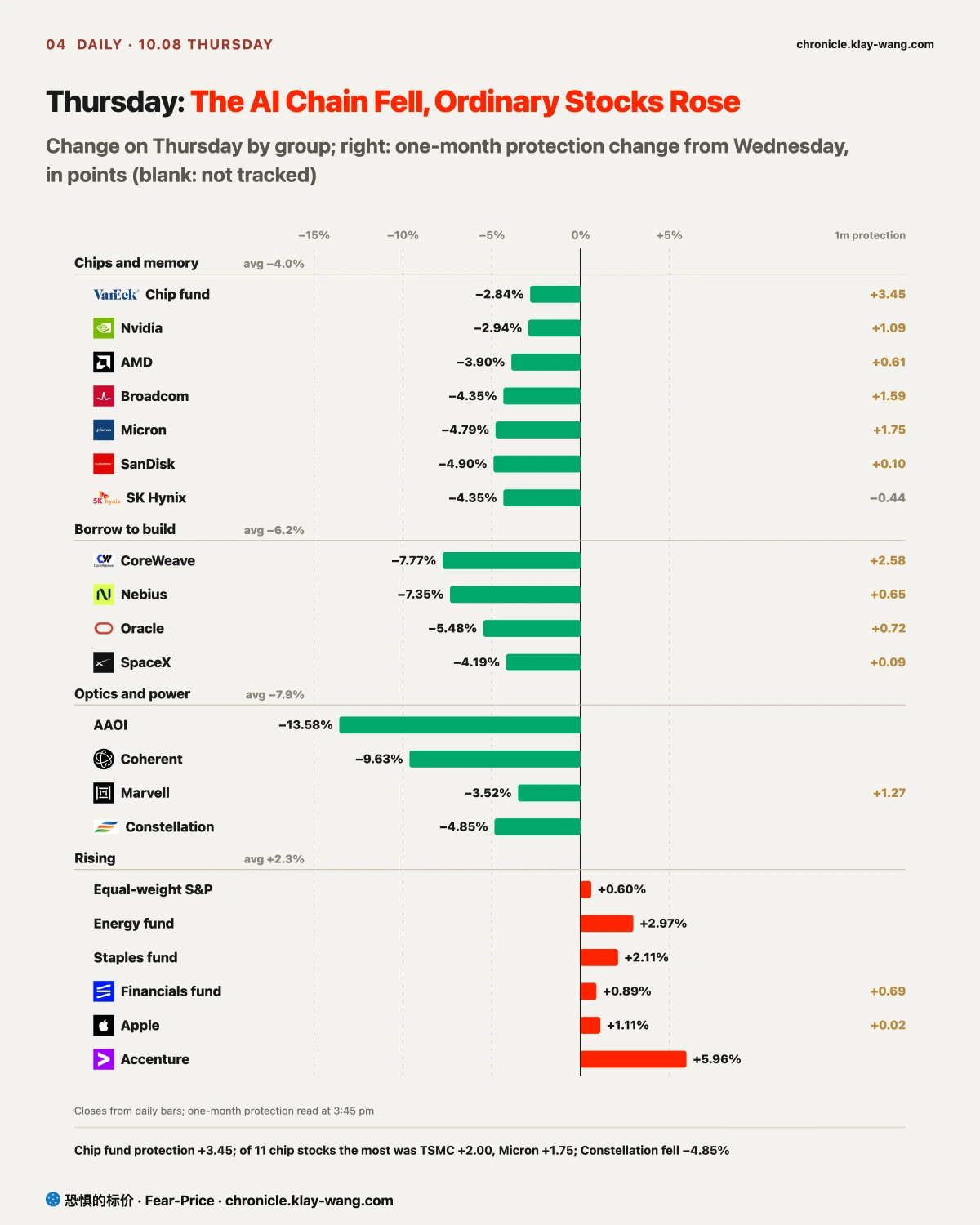
Two segments of the AI chain fell the most: those borrowing to build data centers and collect compute rent, and optics. CoreWeave never filled the gap it opened with; Oracle fell on heavy volume, and Morgan Stanley warned that delays at its data center projects would push back revenue and weigh on its debt (external report). In optics, AAOI fell nearly 14% and Coherent nearly 10%, more than either, and they sell to the very companies building these data centers.
One explanation is that data centers are short of power, which would cap optical module capacity growth. If power shortage were the reason, power sellers should have risen, yet nuclear operator Constellation also fell nearly 5% the same day. Chips, optics and power fell together without distinction, which fits the demand news, not a power shortage.
The bond market reads the two differently. The CoreWeave bond due 2031 fell 2% on Thursday and the extra interest it pays over Treasuries widened to about 9 percentage points; stock and bond fell together, so the bond market is also asking whether its customers can pay. The Oracle bond barely moved and pays about 1.9 points extra: the bond market still treats Oracle as able to repay, and what fell was the growth priced into the stock. The SpaceX 2031 bond pays about 1.5 points extra, an investment-grade price.
On the other side, ordinary stocks rose. Equal-weight S&P closed near its high of the day; financials, energy and staples all rose, and Accenture jumped after expanding its private AI partnership with Dell. The equal-to-cap ratio closed at 0.2738, so the call from Tuesday (the ratio closes below 0.2725 on October 16) moved the wrong way. If you hold an index fund, what fell on Thursday was a few large AI names.
[Expiries] Index Crash Protection Bought Even as It Gets Dearer: Paying for Dated Risks
There was no rush for near-term protection, and crash protection went to expiries months out: every day this week, large orders bought downside protection further out on the index. Monday it was end of November, Tuesday the March 655 and 500 puts, Wednesday the February 720 and 670 puts, and Thursday the November 20 expiry six weeks out: 47800 S&P 736 puts, about 21 million dollars, and 64000 small-cap 264 puts, about 18 million dollars. The Tuesday 655 puts are now worth about 68 million dollars at the Thursday close.
Why buy at index highs? Not because it is cheap. Protection overall is not expensive: a year of insurance on US stocks sits in the 42.5th percentile of the past three years, cheaper than more than half of those days; but deeper protection is relatively dear: SKEW, which measures the relative price of crash insurance, is in the 96th percentile of its full history. The S&P February puts 7% and 13% below the price carry implied volatility of 18.4% and 22.2%, both above the 17.9% for one-year at the money. Paying more the deeper you go says buyers are paying for dated risks before the first quarter: the Fed on October 28, where Waller just said another hike may be needed; big-tech earnings at the end of October; the midterm elections on November 3; and Iran. If you hold an index fund, protection that starts paying after a 7% fall costs 1.5% of the price through February.
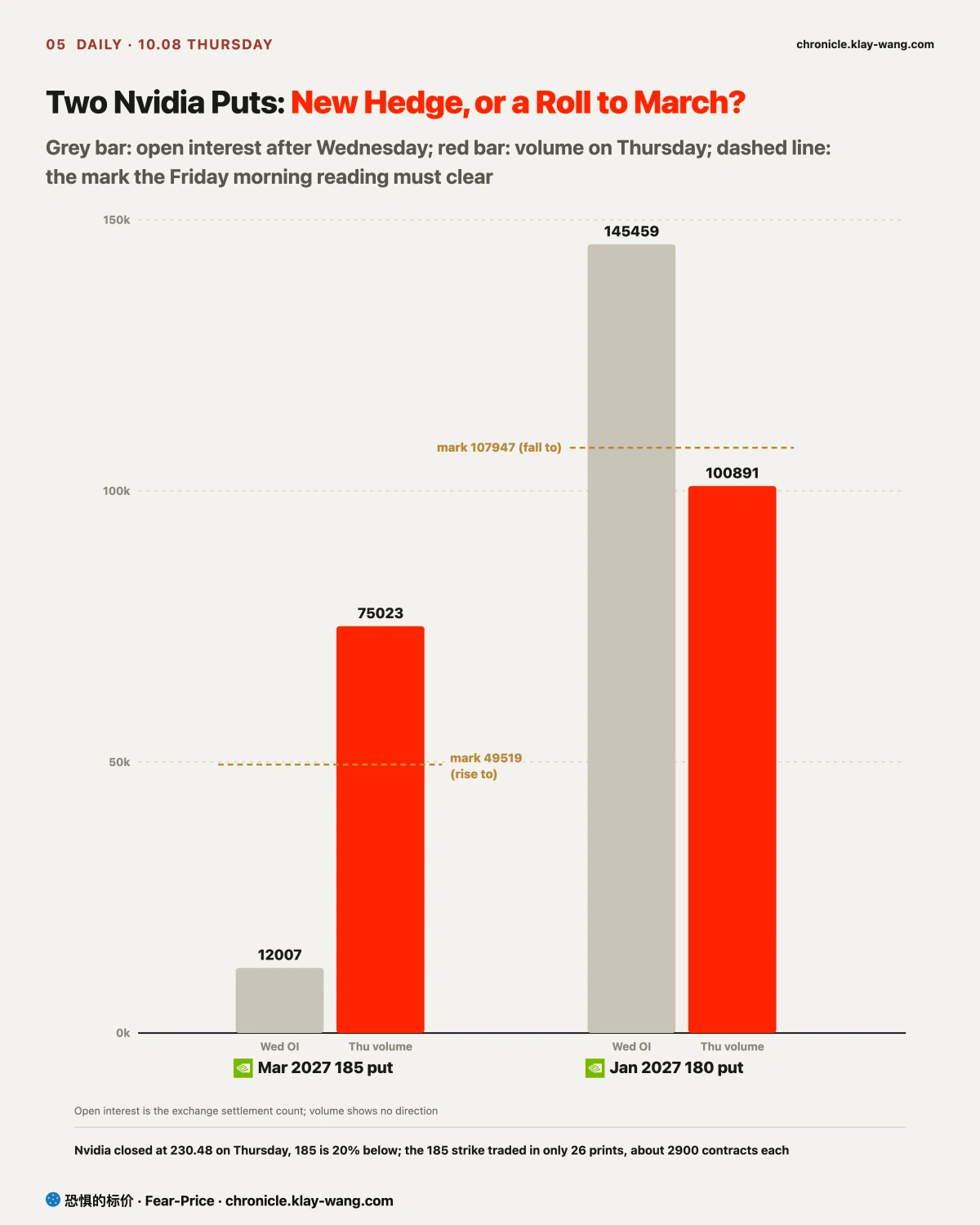
Nvidia is a different shape. The 185 puts expiring March 19, 2027 traded 75023 contracts, about 41 million dollars, against open interest of only 12007; 185 is 20% below the Thursday close of 230.48, and the volume came in only 26 prints from a handful of large orders. The same day, the 180 puts expiring January 15, 2027 traded 100891 contracts, about 23 million dollars, against open interest of 145459. Two months apart in expiry and 5 dollars apart in strike, it looks more like the January protection being rolled to March.
This call settles Friday morning, October 9, on settled open interest, the contracts still held the next morning: if the 185 strike rises at least 37512 above 12007 (half the volume) and the 180 strike falls at least 37512 below 145459, it was a roll; if only the 185 rises and the 180 does not fall, it was new protection and this call is withdrawn.
[Settled] The Micron Reversal Did Not Hold, Early; the S&P February Puts Were New, Holds
Micron back below 1045.56, holds early. The test was any close below 1045.56 (the October 6 close) before October 16. Micron broke the line around 1 pm Thursday, only briefly got back above it, and closed at 1035.84. The Wednesday reversal, a low open and a high close, did not hold; this call was set in the Wednesday issue, and it was right.
The S&P February 720/670 puts were new, holds. The test was settled open interest in the 720 strike on the morning of October 8 at least 2519 above 344. It read 5376, up 5032, or 99.9% of Wednesday volume; the 670 went from 487 to 5502, the same share.
The two positions are worth about 9.7 million dollars at the Thursday close. Marvell (closes above 271.25 every day before October 16) broke below intraday on Thursday and closed at 274.66, 1.3% above the line; if you hold Marvell, 1.3% is less than one normal day for it (about 3.8%, from one-month protection).
What This Means for What You Hold
If you hold chips (Nvidia, AMD, Broadcom, TSMC, Intel, Marvell): protection on the sector fund rose more than on single names; the market worry is the whole sector moving together, pressed by what payers such as OpenAI can pay. The TSMC report on October 15 is the next number to watch.
If you hold memory (Micron, SanDisk, SK Hynix): a record profit brought no new buyers, and the two Korean buybacks just ended; sellers are not in a hurry and protection barely rose: this is orderly selling.
If you hold the borrow-to-build names (CoreWeave, Nebius, Oracle, SpaceX): rates fell and they were still among the biggest losers, and the CoreWeave bond fell with its stock; the problem in this segment is waiting for customers to pay.
If you hold Meta: the filing describes an August price; next to watch is whether Muse users stay after the free phase, and capital spending in the late-October earnings.
If you hold the index, banks or energy: equal-weight S&P, financials and energy all rose on Thursday; protection that starts paying after a 7% fall costs 1.5% of the price through February.
The Dates Ahead: Nvidia and the 2-Year First, on Friday
These calls cross-check guidance and supply-demand against volume, open interest and implied volatility; sudden news is outside what can be anticipated, and calls are scored right or wrong regardless.
- Friday, October 9, morning: whether the Nvidia March 185 puts were new or rolled. Same day: whether the 2-year has closed below 4.92% throughout; 4.75% on Thursday.
- Thursday, October 15: TSMC third-quarter report.
- Friday, October 16: whether Marvell closes above 271.25 every day; whether the equal-to-cap ratio is below 0.2725, 0.2738 on Thursday.
- Friday, October 16: whether the VIX never closes above 25, 15.41 on Thursday.
- Wednesday, October 28: whether the S&P 500 ETF has stayed within 5% of 761.69 (September 18); Fed decision.
- Friday, October 30: whether the 10-year yield is still above 5%; 5.22% on Thursday.
Three Lines Worth Keeping
- Thursday fell in two stages: oil and the Iran news pushed the open, and the OpenAI revenue definition deepened the midday selloff; yields ended lower, so the daytime leg had nothing to do with rates.
- OpenAI is one of the payers at the far end of the AI chain; when its revenue shrank, CoreWeave and Oracle, which rely on it to pay, were recalculated first, while Meta, paid by its own advertising and finding returns with Muse, closed flat.
- Index crash protection was bought every day this week, paying more the deeper it went: buyers are paying for dated risks before the first quarter.
No investment advice. No direction calls. No market timing.