The Indexes Recovered. Why Did Chips Stay Down?
Three Lines: The S&P Recovered, Chips Did Not, and the Buying Was in Software and Cloud
- On Friday the S&P made back all of the Thursday loss and the Nasdaq 100 about a third; chips opened higher across the board, then slid all day and closed near their lows.
- Chip volume ran 50 to 70% of Thursday and one-month protection fell more than anywhere else: sellers were in no hurry, and buyers did not show up.
- SpaceX said it is buying a nationwide block of low-band spectrum; the three big carriers fell 9% to 13%, and the tower companies rose 7% to 16%.
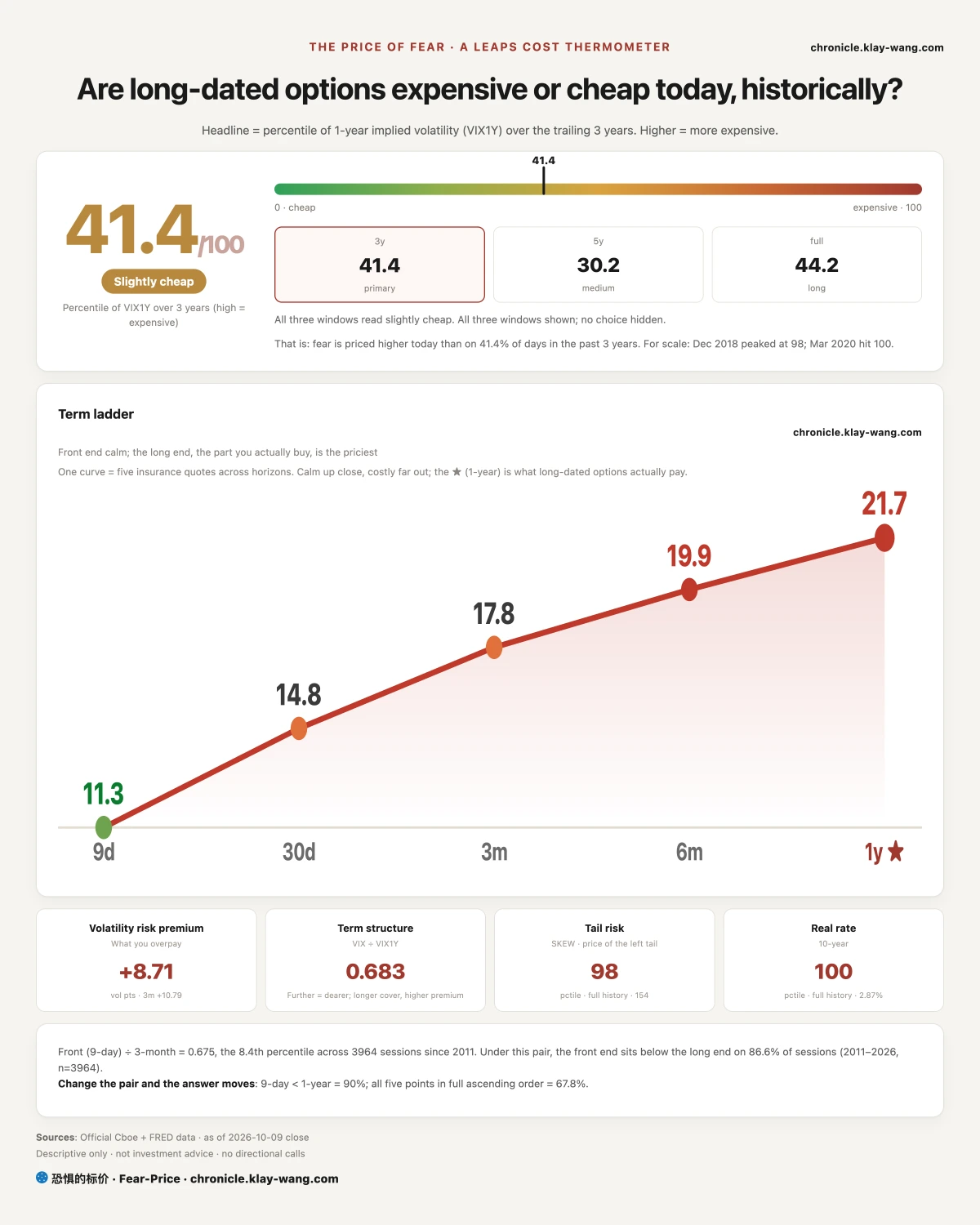
Fear-Price Index 41.4: One-Year Protection Is Cheaper Than Thursday, and the Worry Is Easing
Fear-Price Index · Oct 9, 2026 · 41.4/100: one-year volatility VIX1Y at 21.73, in the 41.4th percentile of the past three years, where high means expensive. Daily ledger and definitions at chronicle.klay-wang.com · Please credit: Fear-Price Index
The Thursday issue ended with one line: if Friday made back what Thursday lost during the day, the market accepted that the OpenAI news was only a change of definition; if not, the market was recalculating the orders along the chain. At the Friday close the answer came in two halves.
The market half came back: the S&P 500 ETF rose 0.60% and closed above its Wednesday level, and the Nasdaq 100 ETF made back about a third of the Thursday loss. The price of a year of insurance on US stocks fell from 42.5 on Thursday to 41.4, and the VIX from 15.41 to 14.84; the market paid no more to protect the index. The CNN Fear and Greed index rose from 39.8 to 45.0. The K index is 3.03 (provisional), above the 2.58 final for Thursday, and it measures the gap between mood and money spent on protection: the closer it gets to 1, the more worry is turning into protection bought; at the Friday Fear and Greed reading, the VIX would have to rise above 45.0 for K to fall below 1. If you hold the S&P, a year of protection costs a little less than on Thursday. Correction: the Thursday issue gave K as 2.47 and Fear and Greed as 38.1, the provisional readings that night; the finals are 2.58 and 39.8. History at chronicle.klay-wang.com/kindex, the index at chronicle.klay-wang.com/fear-price.
The chip half did not come back, and the buying went elsewhere. That is the next section.
[Main Line] No One Bought the Chip Open, Sellers Were in No Hurry, and the Buying Was in Software and Cloud
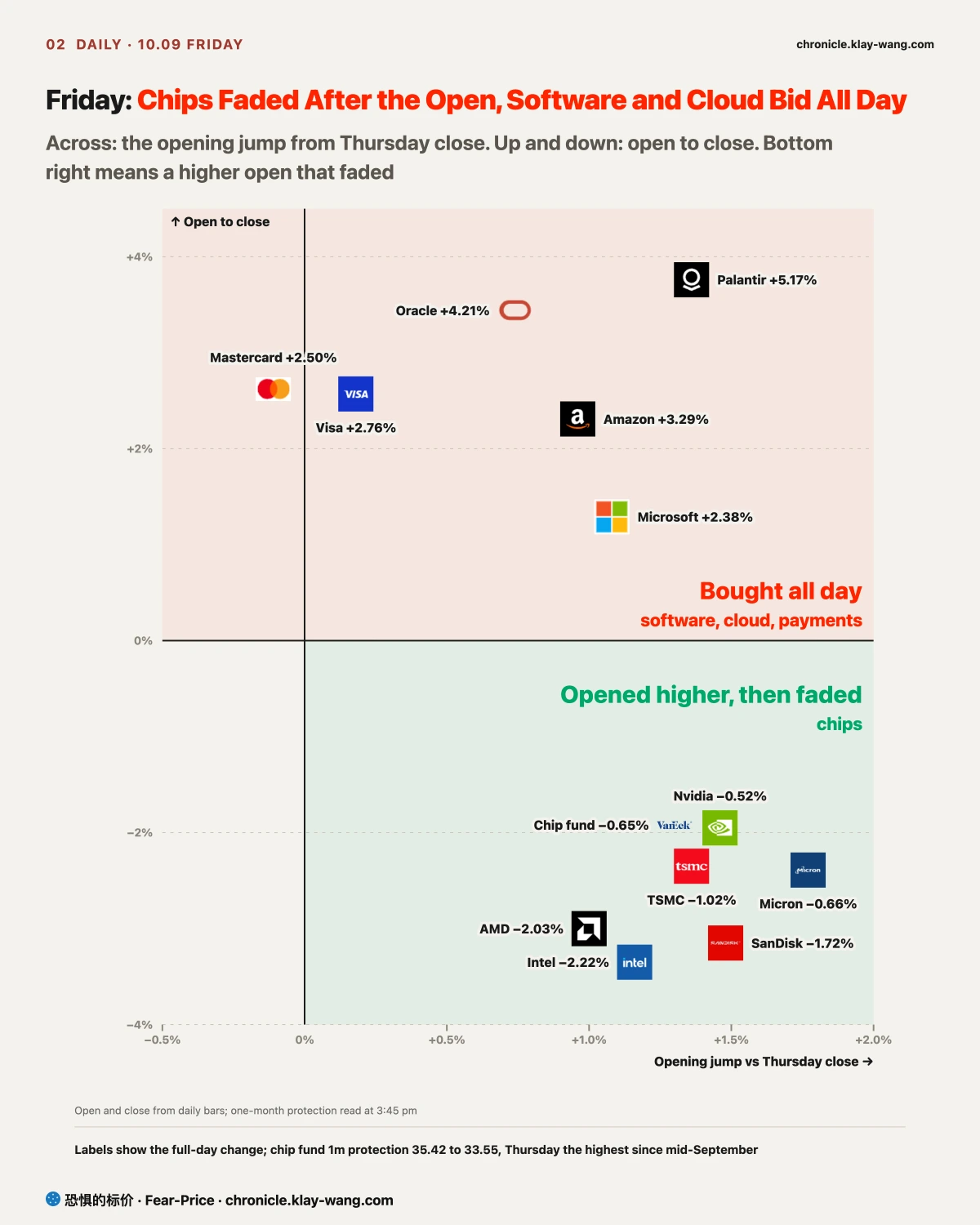
No one bought the chip open. Most stocks opened higher on Friday, chips by 1% to 1.8%, with the chip fund up 1.30% at the open. An opening gap is the overnight orders filling at once; where the stock goes next depends on whether new buyers show up during the day. For chips they did not: after the open the chip fund fell another 1.92% and closed at 14% of its daily range, down 0.65%; Intel, SanDisk and AMD fell about 3% after the open, and Nvidia, TSMC and Micron also closed near their lows.
Chip volume ran 50 to 70% of Thursday, and the price of one-month protection on chips fell: the chip fund from 35.42 on Thursday to 33.55, Thursday being the highest since records began in mid-September; one-month protection on Intel, Marvell and Micron each fell 2.7 to 3.2 points, the largest drops in the table. Prices down, protection cheaper, volume lower: sellers were in no hurry, and the Thursday worry has eased. Prices still slid because after the opening gap no new money was willing to buy. By the line written on Thursday, the chip half is still being recalculated. Over five days the ratio of semiconductors to the S&P fell 6.1%.
The buying was in software, cloud and payments. Amazon, Palantir, Microsoft, Visa and Mastercard opened within 1.4% of the Thursday close, then rose all day, closing near their highs on 70 to 90% of Thursday volume: Amazon up 3.29%, Palantir up 5.17%. Oracle, down 5.48% on Thursday, made back 4.21%; CoreWeave, down 7.77%, made back only 0.61%.
On the same AI chain, the end that makes chips and equipment fell on Friday, while software, cloud and payments, which have customers of their own and collect the money, rose. Doubts about demand fall on those selling equipment, whose orders count only when customers pay; platforms own the customers and decide for themselves how much to spend. That reading will be tested by the capital spending guidance in the big tech results at the end of October: if they keep raising spending, the chip half comes back; if they start cutting, the Friday split was the beginning.
For chip holders, the TSMC report on October 15 (Thursday) is the next number to watch: it says where next year capital spending and advanced-node orders are going.
[SpaceX] The Market Priced a Fourth Carrier as a Long-Run Threat: Carriers Fell 9% to 13%, Towers Rose
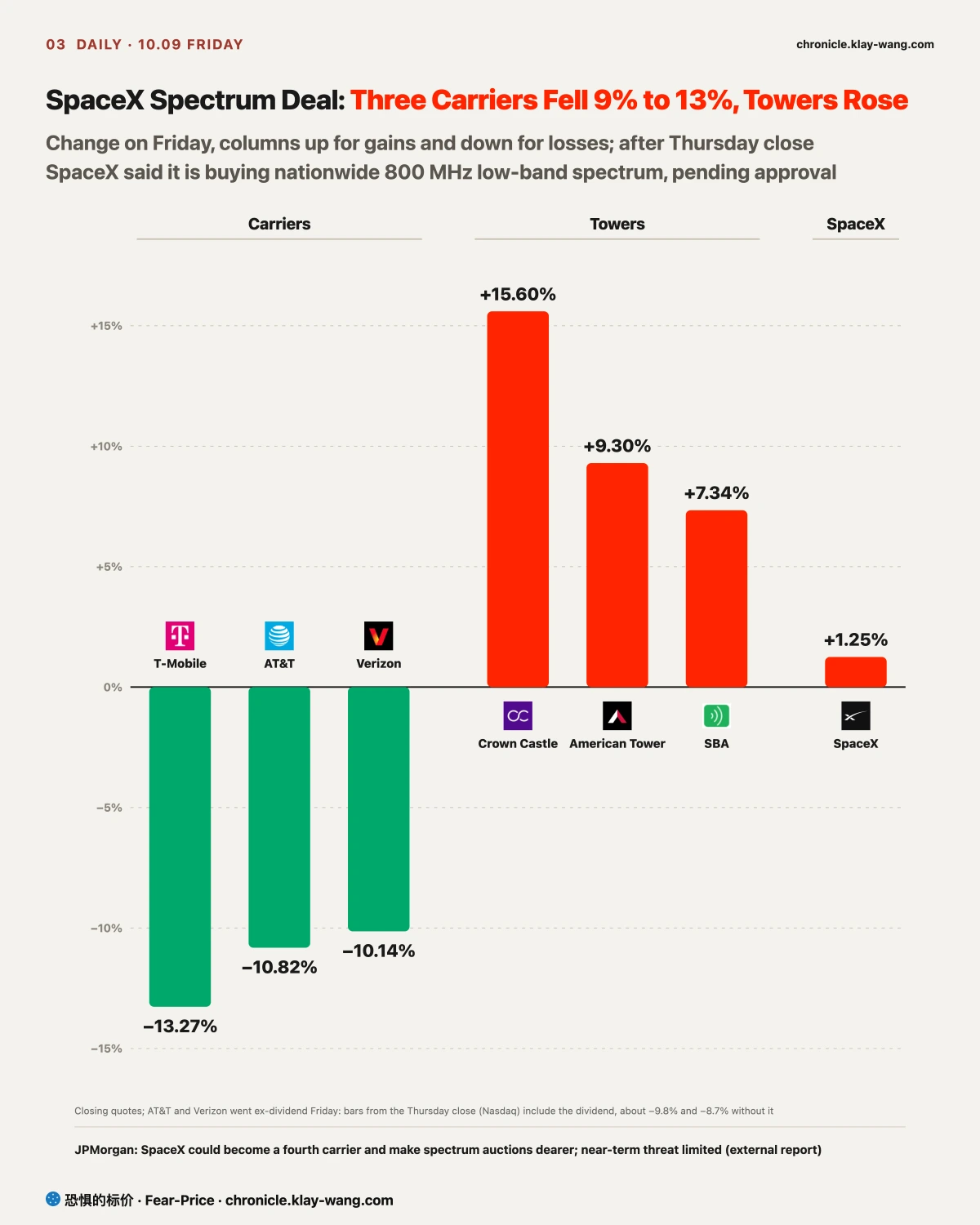
The market priced SpaceX as a fourth carrier the same day. After the Thursday close SpaceX said it is buying nationwide 800 MHz low-band spectrum licenses of up to 14 MHz paired, to carry satellite phone coverage through walls and into buildings, pending approval by the Federal Communications Commission; Musk called it the last piece for full phone coverage in the US (external reports). According to Reuters, the seller is the private-equity firm Grain Management, which bought this spectrum from T-Mobile earlier this year, and terms were not disclosed; most phones already support 800 MHz, so users do not need satellite phones. Low-band spectrum travels far and passes through walls, one of the most valuable resources in a mobile network, and spectrum T-Mobile sold has passed through one owner into the hands of a rival for its customers.
On Friday T-Mobile fell 13.27%, and AT&T and Verizon each closed down more than 10%, or about 9.8% and 8.7% after their Friday dividends; the tower companies went the other way, Crown Castle up 15.60%, American Tower and SBA each up more than 7%. JPMorgan wrote that SpaceX could become a fourth US carrier and could make the three pay more in future spectrum auctions, but that the near-term threat is limited, since building a competitive ground network takes much time, infrastructure and capital (external report).
The analyst says the near-term threat is limited; the stocks were priced as if the long-run structure had changed. Carrier valuations rest on three companies splitting the market with stable prices; another rival and dearer spectrum hit both, so all three fell by close to 10% or more. Tower companies are landlords renting space on towers, and the market priced one more network builder as one more tenant; Reuters took the opposite view, that pairing low-band spectrum with satellites could let SpaceX bypass conventional cell towers entirely. Whether the tower rally holds depends on how much ground network SpaceX builds. SpaceX itself opened 2.97% higher, fell 1.68% after the open and closed up 1.25%: buying spectrum and building a network both cost money. The bond market did not treat the cost as a worry: the SpaceX 2031 bond paid about 1.51 percentage points over Treasuries on Friday against 1.53 on Thursday, almost unchanged and still priced as investment grade.
If you hold a carrier, what weighs on the stock is the long-run structure, and this quarter is unchanged; if you hold a tower company, the change is one possible new tenant. A new call starts today: T-Mobile does not get back to the Thursday close of 171.31 before October 16 (Friday), as the market prices a fourth carrier as a long-run matter; any close at or above 171.31 means the market accepted that the near-term threat is limited, and the call is withdrawn.
[Expiries] The Money Is Picking Stocks: Near Term Bets on Single Names, Far Out Buys Protection on the Index and Nvidia
The money is picking stocks, not leaving. Next Friday, October 16, is the monthly expiry, and among contracts expiring by then, calls traded about 930 million dollars and puts about 250 million: the Nvidia 180 call traded 30300 contracts, the Tesla 385 call 29000 and the Palantir 205 call 24100. Near-term money bet on single stocks rising.
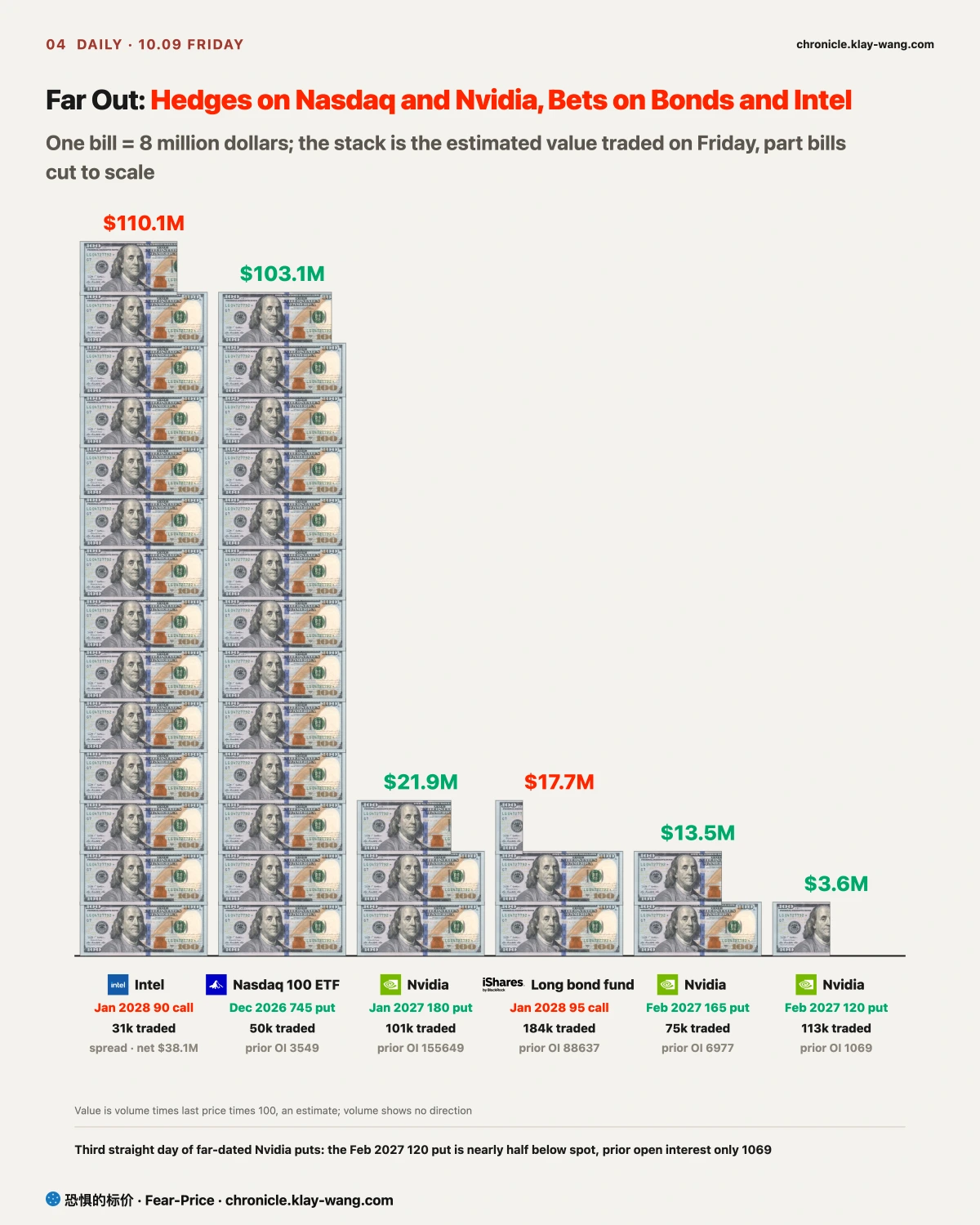
Far out it bought protection. The Nasdaq 100 ETF December 18 745 put traded 50100 contracts, about 103 million dollars, against prior open interest of only 3549; 745 is less than 1% below the Friday close, near-the-money protection for a little over two months. The small-cap ETF November 20 265 and 264 puts traded 68900 contracts together, about 16.4 million dollars.
Far-dated Nvidia puts traded heavily for a third straight day. On Friday the February 19, 2027 120 put traded 112600 contracts, about 3.6 million dollars, against prior open interest of only 1069; 120 is nearly half below the stock price, cheap protection that pays only in a crash. The 165 put of the same expiry traded 75100 contracts, about 13.5 million dollars. The January 15, 2027 180 put traded another 101400 contracts, about 21.9 million dollars. The Thursday batch of 180 puts added open interest the next morning and did not shrink, so it was new (see the settled section). Over three days someone has bought insurance on an Nvidia fall more than a year out, each strike deeper than the last.
On long bonds the bet is on rates falling. The long bond fund January 21, 2028 95 call traded 184400 contracts, about 17.7 million dollars, twice its prior open interest; the 100 call of the same expiry traded 222500 contracts, about 14.9 million dollars. The fund closed at 77.98 on Friday, and reaching 95 would take a large drop in the 10-year yield. The 10-year Treasury closed at 5.24% on Friday and the 2-year at 4.80%; the price of protection on rates fell too, with the MOVE index of bond volatility down from 100.7 on Thursday to 98.47, back below 100.
Intel shows another structure. The January 21, 2028 90 and 125 calls each traded about 30600 contracts on the same day, about 110 million and 72.1 million dollars: same expiry, equal size, a call spread worth about 38.1 million dollars net. If the spread was bought, it makes money with Intel above about 102.5 in January 2028 and caps at 125; Intel fell 2.22% on Friday to 104.70, already inside that range, and the volume does not show who bought it.
Chasing single stocks near term, buying protection on the index and Nvidia far out, betting on long bonds. If you hold Nvidia, someone is buying insurance on a large fall more than a year out, each strike deeper than the last; that money is betting on time and depth and does not change the near-term path. Two calls start today and settle on the morning of October 12 (Monday), read from settled open interest, the contracts still held the next morning: the Nvidia February 2027 120 put adds at least 56279 contracts above 1069 (half the volume) if it was new; the long bond fund January 2028 95 call adds at least 92205 above 88637 if it was new. If either adds less than half, the volume was day trading or rolling, and that new-position reading is withdrawn.
[Settled] The Nvidia Roll Reading Was Wrong, Withdrawn; the 2-Year Stayed Below 4.92%, Holds
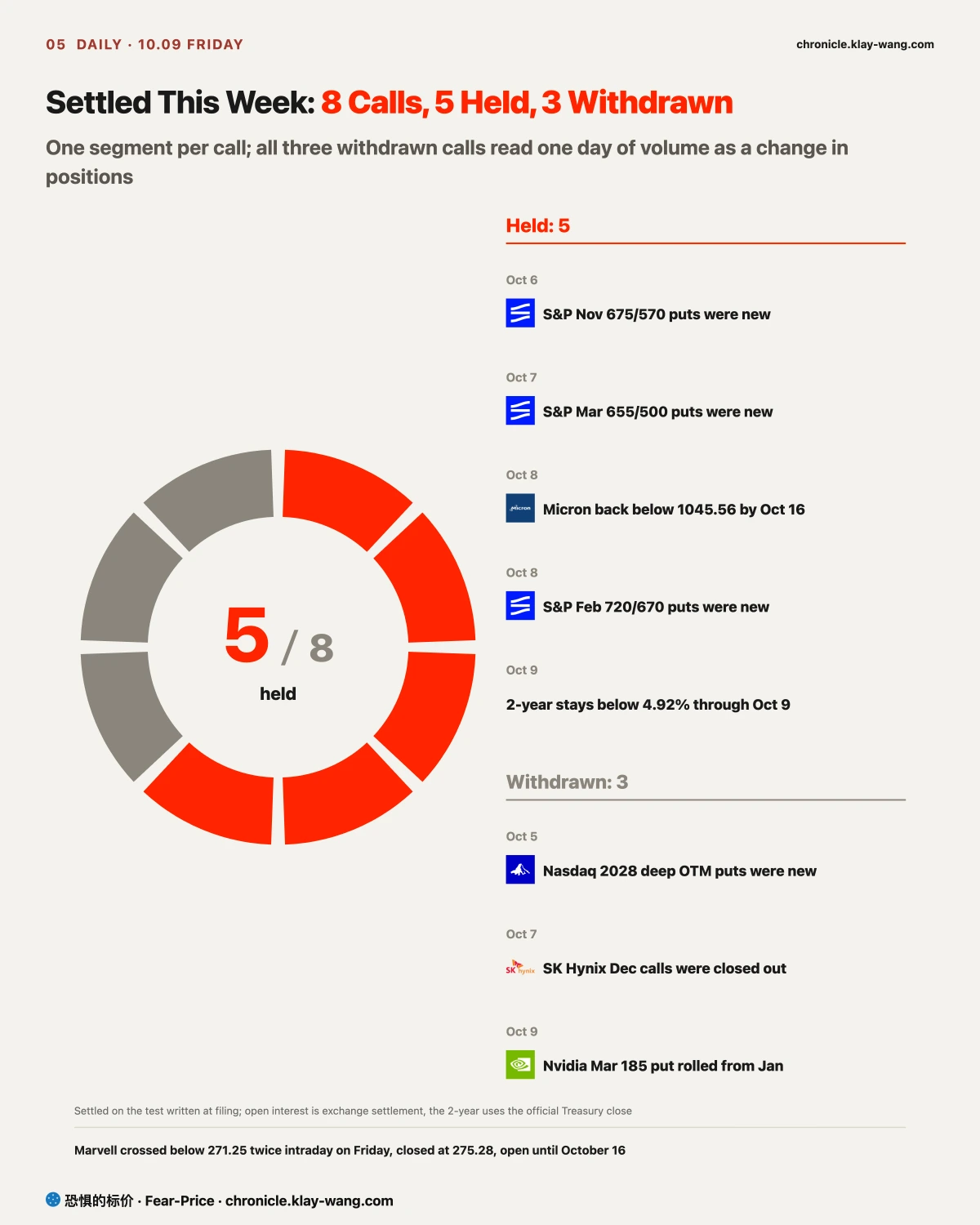
Nvidia March 2027 185 put was rolled from the January 180: withdrawn. We got this one wrong. The Thursday issue said these two strikes looked like January protection being moved to March. Friday morning settled open interest: the 185 went from 12007 to 87010, almost all of the Thursday volume stayed; the 180 went from 145459 to 155649, up and not down. Both were new protection, not a roll. The mistake was reading heavy volume at two neighboring strikes on one day as one position changing expiry, before next-day open interest showed whether the January strike was being closed. All three calls withdrawn this week tripped on the same thing: volume can mislead, next-morning open interest does not.
The 2-year closed below 4.92% throughout: holds. The test was that any official Treasury 2-year close at 4.92% before October 9 withdraws the call. After filing on October 2 the high was 4.84% on October 5, and it closed at 4.80% on Friday, below the line throughout.
The Marvell call (closing above 271.25 every day before October 16) dipped below the line twice intraday on Friday and closed at 275.28, still above. This week 8 calls settled: 5 held and 3 were withdrawn.
What This Means for What You Hold
If you hold chips (Nvidia, AMD, TSMC, Intel, Micron, SanDisk): the worry has eased, but buyers have not returned; the TSMC report on October 15 and big tech capital spending guidance at the end of October decide whether the chip half comes back.
If you hold software, cloud or payments (Amazon, Microsoft, Palantir, Visa, Mastercard): the Friday buying was on your side, drawn by companies that have customers of their own and collect the money.
If you hold carriers (T-Mobile, AT&T, Verizon): SpaceX buying the spectrum is only a first step, with approval and a network still to come; the market priced the long run, and whether the stocks recover near term shows in whether they get back above the Thursday close before October 16.
If you hold the index: one-year protection on the market is cheaper than Thursday; someone is buying near-the-money Nasdaq protection to December at about 2.7% of the price.
The Dates Ahead: Nvidia Far Puts and Long Bond Calls First, on Monday
These calls cross guidance, supply and demand with volume, open interest and implied volatility; sudden news is beyond what can be foreseen, and settlements count either way.
- October 12 (Monday) morning: whether the Nvidia February 2027 120 put and the long bond fund January 2028 95 call were new. Monday is Columbus Day: stocks open, bonds closed.
- October 15 (Thursday): TSMC third-quarter results.
- October 16 (Friday): whether Marvell closes above 271.25 every day, 275.28 on Friday; whether the equal-to-cap-weight ratio is below 0.2725, 0.2736 on Friday; whether the VIX stays below 25, 14.84 on Friday; whether T-Mobile stays below 171.31.
- October 28 (Wednesday): Fed decision; whether the S&P 500 ETF stays within 5% of 761.69, the September 18 level.
- October 30 (Friday): whether the 10-year Treasury yield is still above 5%, 5.24% on Friday.
Three Lines Worth Keeping
- The Thursday line settled half and half: the S&P came back in full and the Nasdaq 100 by a third, chips did not, and the buying was in platforms and software with customers of their own.
- Chips fell while protection got cheaper and volume shrank, so sellers were in no hurry; when buyers return depends on big tech capital spending at the end of October.
- One block of SpaceX spectrum cut the three big carriers by 9% to 13% and lifted the towers by 7% to 16%: when a new rival arrives, the old rivals and the landlords are repriced first.
No investment advice. No direction calls. No market timing.