Borrowing to Build AI Compute Costs 11%. Whose Insurance Got Dearer First?
Three Lines: The AI Chain Split by How Much It Borrows, Insurance on the Compute Renters Got Dearer First, Chipmakers Are Not Worried Yet
- Borrowing to build compute is getting dearer: one AI cloud loan is quoted at about 11%, Firmus withdrew a 5 billion dollar IPO, and the CoreWeave spread widened about 70 basis points in a week.
- One-month protection on the compute renters Nebius and CoreWeave rose about 3 points each; Nvidia and AMD fell a fourth straight day with protection barely moved.
- Meta rose 3.38% on heavy volume after a new model; deep far-dated Nvidia puts traded heavily for a fourth day, 550000 contracts in one session.
Fear-Price Index 40.6: One-Year Protection Is a Little Cheaper Than Friday, and Only the Crash Cover Is Dear
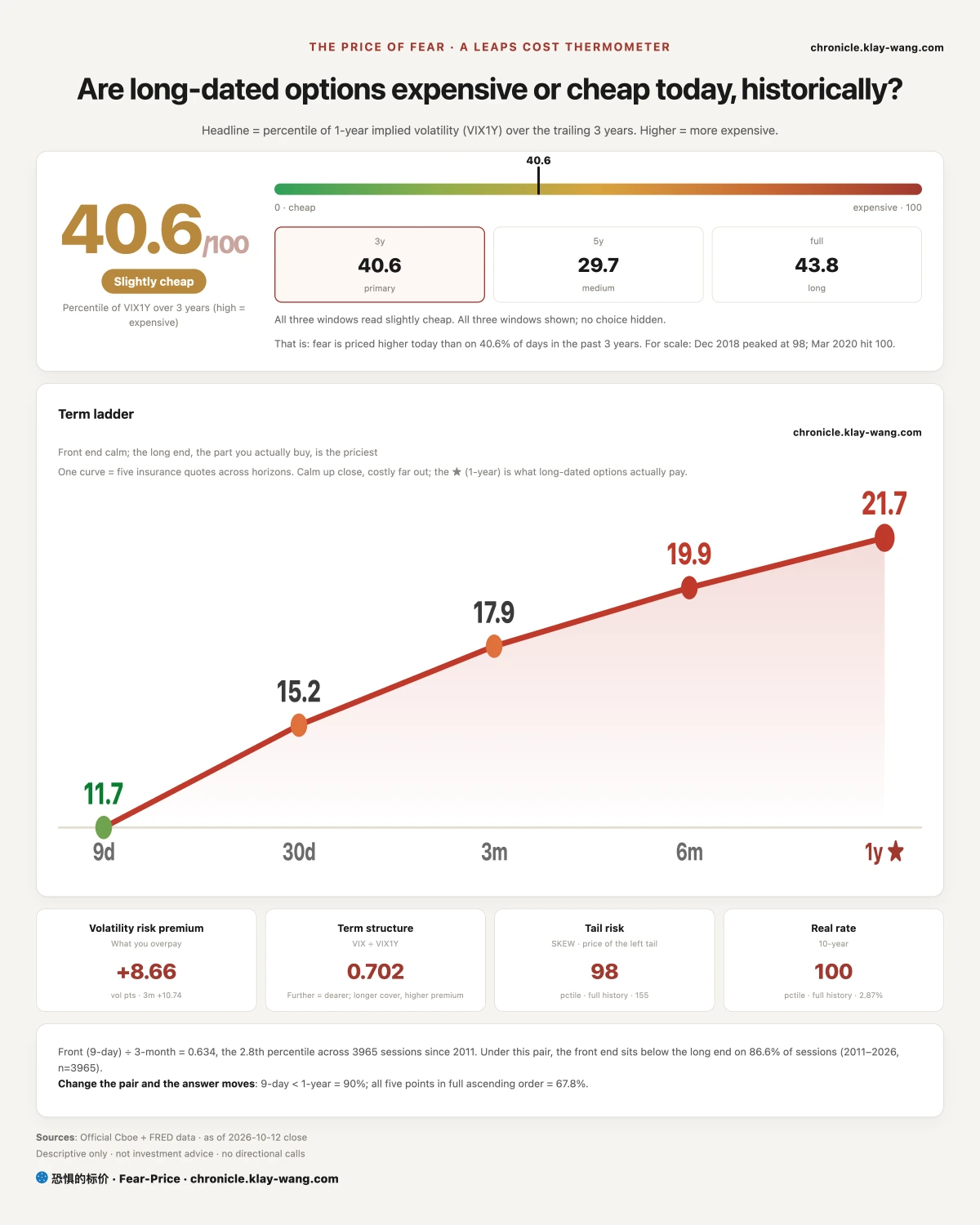
Fear-Price Index · Oct 12, 2026 · 40.6/100: one-year volatility VIX1Y at 21.67, in the 40.6th percentile of the past three years, where high means expensive. Daily ledger and definitions at chronicle.klay-wang.com · Please credit: Fear-Price Index
Chips fell for four days, yet the price of a year of insurance on US stocks slipped from 41.4 on Friday to 40.6; the VIX rose from 14.84 to 15.21, only a little more paid. The next few days look unusually calm: nine-day volatility is 0.634 times three-month volatility, and only 2.8% of trading days since 2011 were flatter. One slice is dear: SKEW, the price paid for a sharp index drop, is 155, in the 98th percentile of its full history, and it measures options within a month. Broad protection is cheap; the cover against a crash is expensive. If you hold the S&P, a year of protection is a little cheaper than Friday; the index paid nothing extra for the chip slide, and the pressure fell only on single stocks and sectors. That is the next section.
The CNN Fear and Greed Index moved from a final 46.5 on Friday to 45.7. The K index is 3.01 (provisional), below the Friday final of 3.13; it measures the gap between sentiment and money paid for protection: the closer to 1, the more people are turning worry into buying protection; on the Monday Fear and Greed reading, the VIX would need to rise above 45.7 for K to fall below 1. Correction: the K index of 3.03 and Fear and Greed of 45.0 in the Friday issue were provisional evening readings; the finals are 3.13 and 46.5. History at chronicle.klay-wang.com/kindex, the index at chronicle.klay-wang.com/fear-price.
[Main Line] Borrowing to Build Compute Costs 11%: The Dearer the Borrowing, the Harder the Hit
In this round of AI worry, the companies borrowing to build compute are hit hardest: borrowing costs, protection prices and stock prices are all moving the wrong way at once. Chipmakers have fallen four days with protection unchanged, and the index itself has paid nothing extra.
Borrowing is getting dearer. According to Bloomberg, the AI cloud company Volta is borrowing 5 billion dollars to build a data center in Norway and buy about 36000 Nvidia GPUs; JPMorgan and Goldman will underwrite only 1.3 billion of it, at a quoted yield of about 11%. Nvidia-backed data center company Firmus withdrew an IPO of about 5 billion dollars on Friday, citing market volatility, and will seek private capital instead (external report). According to CNBC, the chief executives of Intel and Broadcom both warned on Monday that a capital crunch could become the biggest bottleneck for AI (external report).
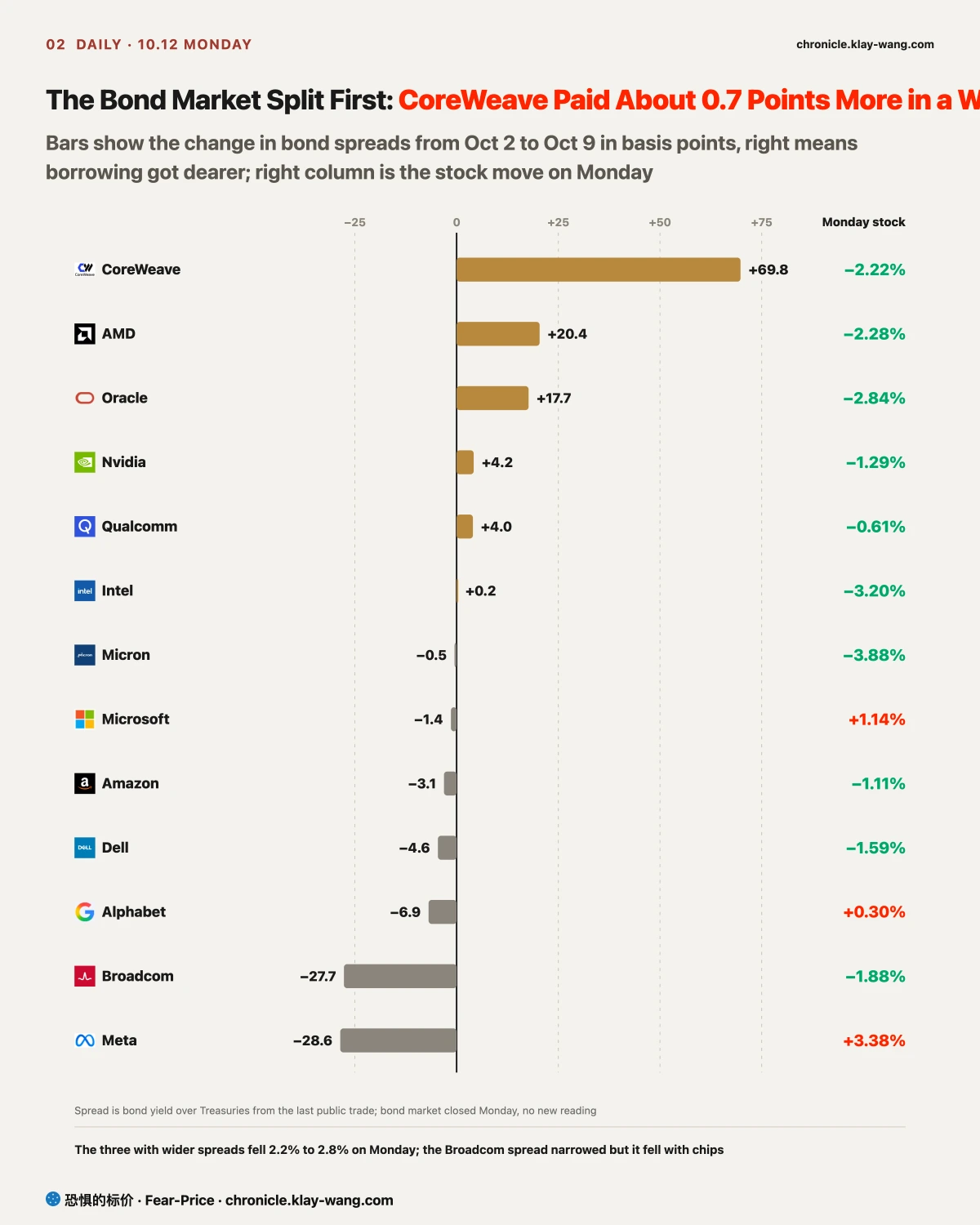
The bond market started pricing this chain apart a week earlier. The extra yield company bonds pay over Treasuries, the credit spread, where wider means borrowing got dearer, moved from October 2 to 9 as follows: CoreWeave widened about 70 basis points (0.70 percentage points), most of it on October 8 alone, AMD about 20 and Oracle about 18; Meta and Broadcom each narrowed about 28. On Monday stocks followed the spreads halfway. All three that widened closed lower, in different ways: almost all of the CoreWeave drop came at the open and it then moved sideways to close mid range, weekend selling filled in one go at the bell with no one chasing it lower during the day; Oracle opened flat, fell entirely in the session and closed near the low on lighter volume than Friday, a slide no one stepped in to buy all day. Meta, which narrowed the most, led gains, while Broadcom narrowed and still closed near its low, moving with the chip side. The bond market was closed Monday, so there is no new spread reading.
It makes sense that dearer borrowing hits the compute renters first. Nebius and CoreWeave spend heavily to build data centers and then rent out computing time, so revenue first has to cover chip depreciation and financing costs; every extra point of interest pushes payback further out. The reports pressing on Nebius on Monday named exactly these: how many years a GPU lasts, share sales, and how OpenAI counts its revenue (external report). Rates keep adding pressure: Cleveland Fed President Beth Hammack said on Monday that demand from AI data center building for power and components is pushing up prices more broadly, and she leans toward small, quicker hikes; the IMF Global Financial Stability Report released on October 13 warned that government bond yields could rise in a disorderly way, with higher discount rates lowering asset values, AI assets included (external report).
Further upstream are the companies selling chips and equipment. Memory faced three things at once: ChangXin Memory in China announced progress on a next generation memory cell structure, Korean stocks caught up after a holiday with the KOSPI down 3.65%, and about 40 billion dollars of Samsung and SK Hynix buybacks ended early (external report); Samsung grew third quarter operating profit nearly ninefold, and the market is already pricing capacity and prices for 2027 and 2028. Optical names fell harder, Ciena and Lumentum each down nearly 10%. Nvidia and AMD each showed new designs at the Open Compute Project summit and the stocks fell anyway, with one analyst saying these announcements are still a long way from orders; Microsoft said it will scale its own AI chips to several gigawatts from 2027 (external report).
If you hold a company expanding on borrowed money, watch its bond spread alongside the stock. If the CoreWeave spread comes back within 838 basis points, its October 7 level before the jump, on any day from October 13 to Friday, October 16, the bond market has stopped charging it extra, and the reading that dearer borrowing means a harder hit does not hold.
[Protection] Both Sides Fell: Insurance on the Compute Renters Got Dearer First, Chipmakers Fell Four Days Without Worry
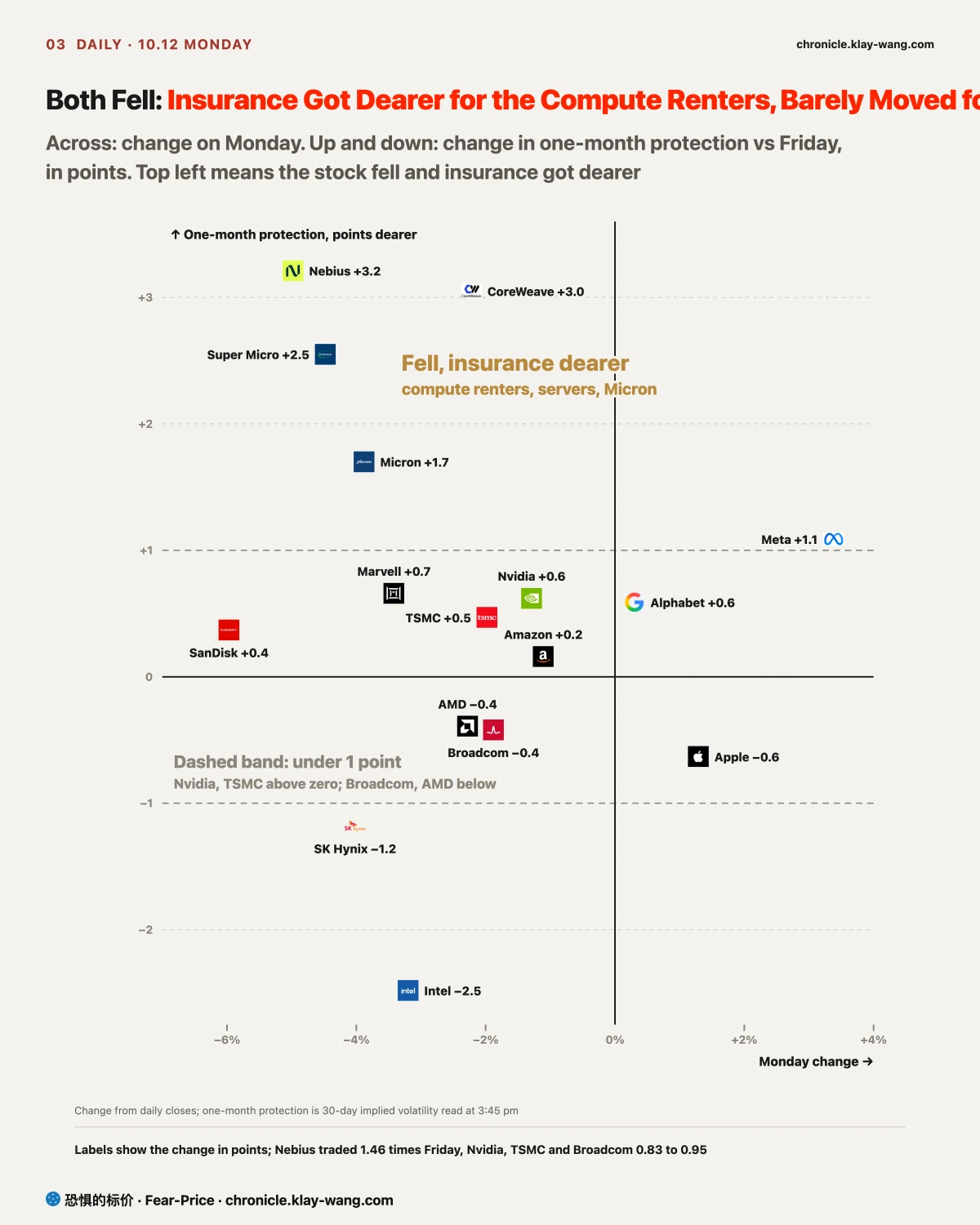
Chips and memory both fell, in different ways. Nvidia, TSMC and Broadcom opened nearly flat and fell during the session, TSMC closing at the low of the day and Broadcom near it, all on lighter volume than Friday: a slide on light volume usually means no one is buying, and no one is rushing to sell. Nvidia and AMD have now fallen four days in a row. Memory fell the other way: Micron, SanDisk and SK Hynix gapped down more than two and a half points at the open, kept falling, and traded 20% to over 50% more than Friday. A lower open is overnight selling filled in one go at the bell; falling further on heavier volume means sellers were still in a hurry during the day and no new buyers stepped in.
Both sides fell, and their protection split. The price of one-month protection, 30-day implied volatility, which is how options are quoted, rose about 3 points on Nebius and CoreWeave from Friday and more than 2 points on Super Micro; Nvidia and TSMC rose only about half a point, and Broadcom, AMD and Intel got cheaper. On the chip side the stock fell, volume did not grow and protection did not get dearer, so sellers were in no hurry, the same unbought slide as Friday. The compute renters were different: Nebius opened lower, fell further in the session on nearly one and a half times Friday volume, and its protection got dearer at the same time. The price paid against a further drop is rising, and the pressure on these two is now in the option prices.
Two things test this reading: if one-month protection on Nvidia and TSMC starts rising too, the pressure has reached the chipmakers, and the claim that their sellers are in no hurry no longer holds; the TSMC quarterly report before the US open on Thursday, October 15, is the nearest test. If you hold Nvidia or TSMC, protection has not moved, so the market does not yet treat these four days as something to hedge.
[Platforms] What Got Bought Was New Products That Earn Directly: Meta Up 3.38%, Software Hot Intraday and Cold at the Close
Meta rose 3.38% on Monday, opening higher and rising further in the session on about twice the Friday volume, and closed some way below its high. The higher open was weekend buying reacting to the new model; rising further on heavy volume means new money kept coming in during the day, unlike a gain made only at the open; giving some back before the close means the buying at the top did not last to the bell. The push was Muse Wonder, a new model released that day and open to developers the same day, which will next power the Muse app that lifted the stock last week (external report). How sticky Muse is remains open: according to Sensor Tower, its day one retention was about 1.8 times that of ChatGPT, and by day 14 ChatGPT had overtaken it (external report). Microsoft and Apple rose a little on no more volume than Friday; Amazon opened flat and slid to close near its low: the platforms were not bought together. Software was the same: AI application software rose broadly during the session, the software ETF closed lower, only a few names such as Shopify and Snap kept their gains, and Palantir closed flat. ServiceNow was the clearest case: it opened more than 3 points higher on one and a half times Friday volume, then slid to close near its low, slightly down. Falling from a higher open on heavy volume usually means the buyers who chased the open were met by sellers in a hurry. If you hold software stocks, the intraday rally did not last to the close, and the buying on Monday did not spread across the sector.
[Expiries] Far Out, a Fourth Day of Deep Nvidia Puts; Near Term, Money Paid for Big Bank Earnings
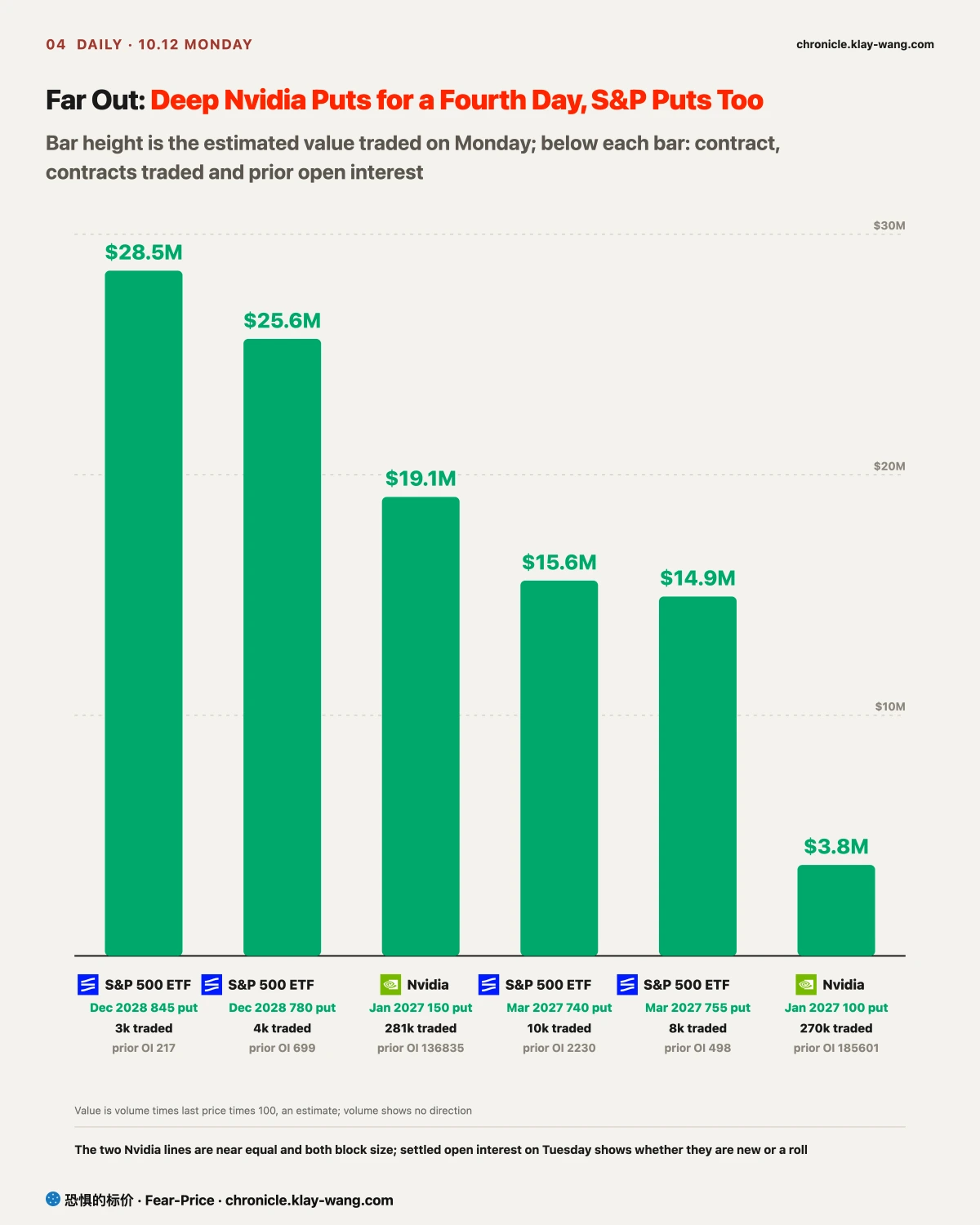
In one day on Monday, two Nvidia put lines expiring January 15, 2027 traded 550000 contracts: the 150 strike 280500 contracts, about $19.1 million, and the 100 strike 270400, about $3.8 million, against prior open interest of 136800 and 185600. The 150 strike is 33% below the price and the 100 is 56% below, paying only in a crash. The two lines are nearly equal in size, and the 150 strike printed in 80 trades, about 3500 contracts each, which is block size. Volume does not show who bought and who sold: it could be a spread buying the 150 and selling the 100, or an old position rolled into a new one.
This is the fourth straight day of heavy far-dated Nvidia puts. The February 2027 120 puts from Friday almost all stayed open in the Monday morning settled open interest, the contracts still held the next day (see the settlements). Over these days the deep puts about a year out have gone deeper each time and stayed open after trading; one-year Nvidia protection at 37.69 is about 7 points dearer than one-month at 30.53, so the market also puts the big uncertainty a year out. The index has large far-dated trades too: four S&P 500 ETF put lines expiring March 2027 and December 2028 traded about $85 million on Monday against prior open interest of 200 to just over 2000 contracts each, with no direction visible.
Near-term money went to big bank earnings. JPMorgan, Wells Fargo, Citi and Goldman report third quarter results on Tuesday, October 13, and Bank of America on October 14. One-month protection on Wells Fargo, Citi, Goldman and Bank of America is dearer than one-year, Citi 33.22 against 30.74: the price of protection for these days includes the swing of a day or two around earnings. That part usually fades after the report; if one-month protection on Citi is still dearer than one-year on Friday, October 16, the earnings did not work off that part of the price and left a new question.
For the two Nvidia lines, watch settled open interest on Tuesday morning, October 13: if the 150 put rises by at least 140262 contracts above 136835 (half the volume), it is new; less than half means a roll or a close. If you hold Nvidia, these deep puts are a bet on a crash a year out and do not change its next few weeks.
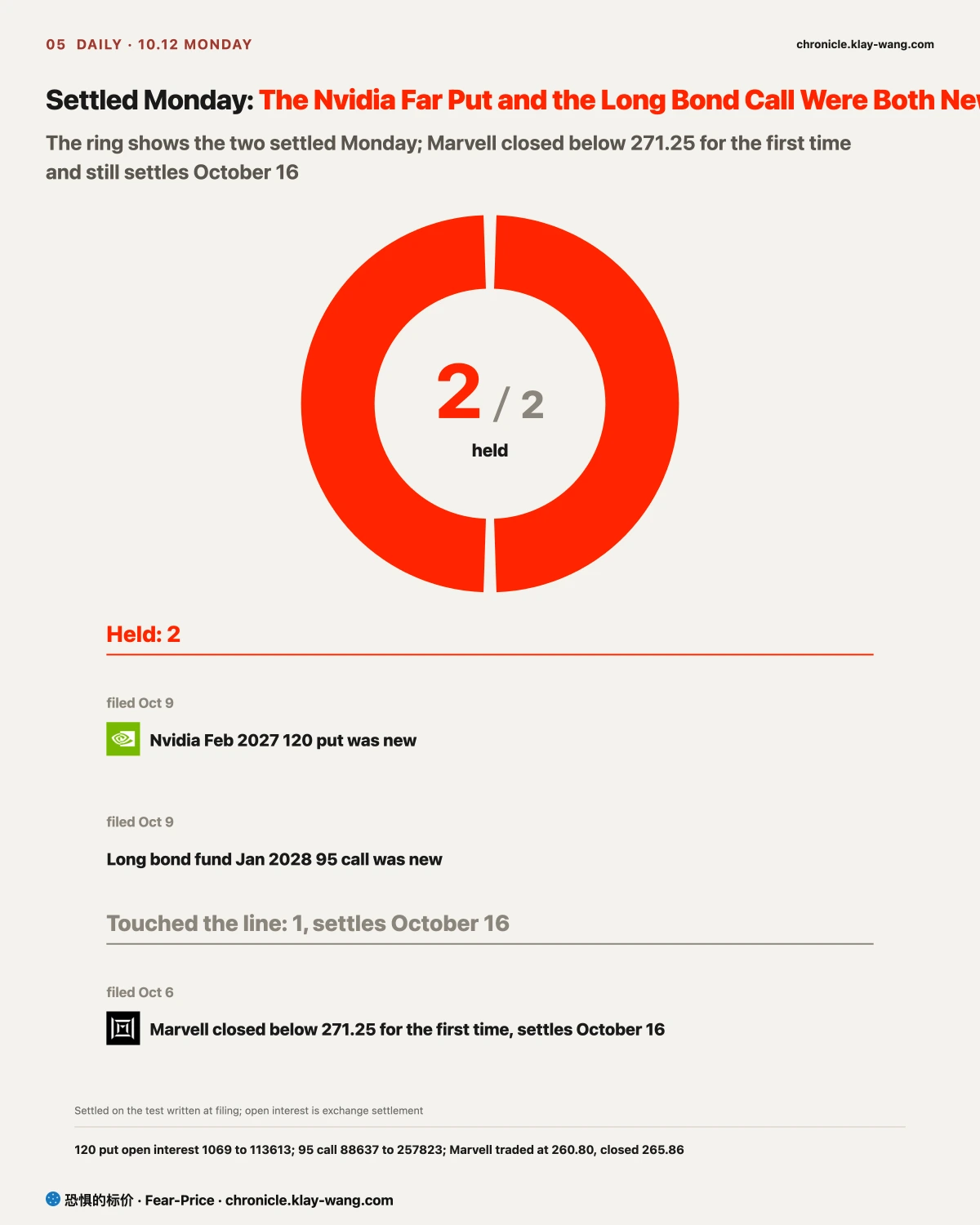
[Settled] The Nvidia Far Put and the Long Bond Call Were Both New, Holds; Marvell Closed Below Its Line for the First Time
The Nvidia February 2027 120 put was new, holds. Settled open interest Monday morning was 113613, up 112544 from 1069 on Friday; nearly all of the 112558 traded on Friday traded stayed, clearing the halfway line of 56279.
The long bond fund January 2028 95 call was new, holds. Open interest went from 88637 to 257823, up 169186, clearing half of the 184409 traded on Friday (92205). The long bond fund closed Monday at 78.05; reaching 95 needs a large drop in the 10-year yield, and this bet was still there the next day.
Marvell closed below 271.25 for the first time. When filed on October 6 the test was: every close before Friday, October 16 above 271.25. On Monday Marvell closed at 265.86; on that test it can no longer hold, and settlement stays on October 16. It opened nearly flat, fell during the session and closed in the bottom third of the range on heavier volume, giving back gains with the whole optical group: the gain from its investor day could not withstand the group being repriced.
Correction. The October 9 issue said the price SpaceX paid for its spectrum was not disclosed; according to Reuters, the deal is about 8 billion dollars in cash (external report).
What This Means for What You Hold
If you hold chip designers and the foundry (Nvidia, AMD, Broadcom, TSMC): four days down, protection not dearer, sellers in no hurry; the TSMC report on October 15 gives the first answer.
If you hold the compute renters and servers (CoreWeave, Nebius, Super Micro): protection is already getting dearer, and the extra yield on CoreWeave bonds over Treasuries rose about 0.7 points in a week; these will swing more than chips.
If you hold memory (Micron, SanDisk, SK Hynix): the fall came on competition news with heavier volume, while protection barely got dearer: selling was hurried, but few are yet paying up against a further drop.
If you hold the platforms (Meta, Microsoft, Apple): the buying is on your side, and for Meta it came from a new product that earns money directly; Microsoft and Alphabet report on October 28, the same day as the Fed decision.
If you hold the big banks (JPMorgan, Wells Fargo, Citi, Goldman, Bank of America): they report Tuesday and Wednesday, and apart from JPMorgan one-month protection is dearer than one-year, so the earnings swing is already paid for.
The Dates Ahead: Tuesday Morning, Whether the 550000 Nvidia Puts Stayed; Six Calls Settle Friday
These calls cross guidance and supply and demand with volume, open interest and implied volatility; sudden news is beyond what can be foreseen, and the settlements count either way.
- Tuesday, October 13, morning: whether the Nvidia January 2027 150 put is new or a roll (a watch item, not a call: volume shows no direction, so we take no side); JPMorgan, Wells Fargo, Citi and Goldman third quarter results.
- Wednesday, October 14, 8:30 am: September CPI; Bank of America results.
- Thursday, October 15: TSMC third quarter results before the US open; September PPI.
- Friday, October 16: monthly expiry; six calls settle: Marvell (Monday 265.86, line 271.25), equal weight to cap weight ratio (Monday 0.2740), VIX (Monday 15.21), T-Mobile (Monday 151.87, line 171.31), plus two from this issue: whether Citi one-month protection is back below one-year (on the 15:45 reading that day), and whether the CoreWeave spread came back within 838 basis points on any day from October 13 to 16.
- Wednesday, October 28: Fed decision; Microsoft and Alphabet third quarter results.
Three Lines Worth Keeping
- To see who on the AI chain gets hit first, look at who borrows most dearly: this round the compute renters are hit hardest, with spreads, protection prices and stocks all moving the wrong way, while protection on the chipmakers has not moved.
- Launch events and industry standards do not become orders and cannot hold up a stock; new products that earn money directly find buyers, and Meta was the example on Monday.
- Volume does not show direction, but open interest the next morning does: the 550000 deep Nvidia puts are answered on Tuesday morning.
No investment advice. No direction calls. No market timing.