AI Killing Software? Four Companies Closed at Records on the Same Day. What Is the Market Rewarding?
Three Lines: The AI Chain Has Split Into Layers; the Biggest Gainers Are Buying Insurance, the Gatekeepers Are Setting Records
- Apple, Microsoft, Visa and Mastercard closed at records on the same day; the software ETF is up 5.0% this year, and what fell are single tools AI can partly replace, Adobe 32.5% lower.
- Money is leaving those borrowing to build compute: CoreWeave pays 969 basis points over Treasuries, about 140 wider than October 2; chips and memory, big gainers this year, were bought back, yet most saw one-month protection get 2 to 3.6 points dearer.
- Big banks beat on profit and were sold anyway, Citi down 5.6%; about 450000 of 550000 deep Nvidia puts were still open the next morning.
Fear-Price Index 40.2: One-Year Protection a Little Cheaper Again, and the Next Few Days Unusually Calm
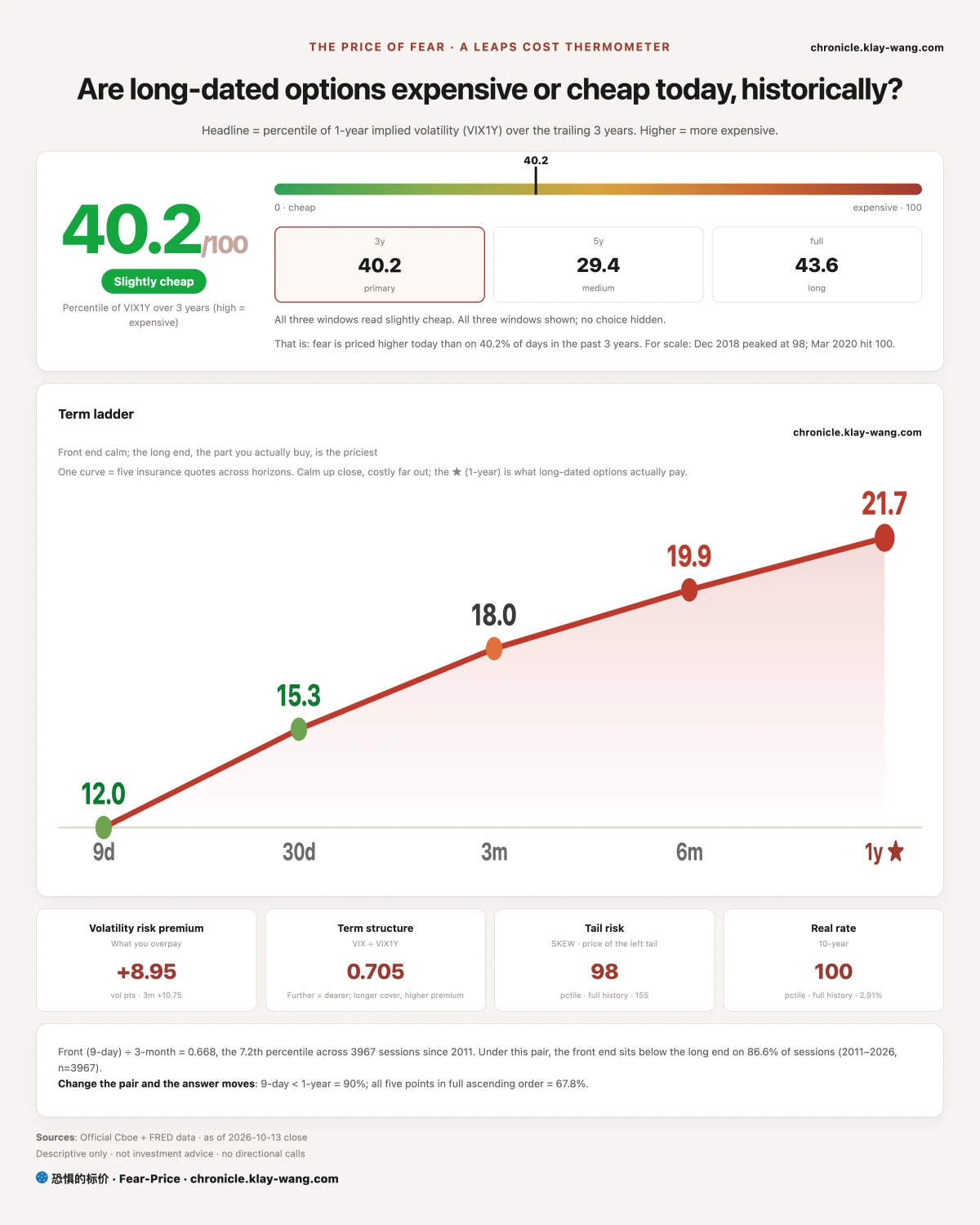
Fear-Price Index · Oct 13, 2026 · 40.2/100: one-year volatility VIX1Y at 21.66, in the 40.2nd percentile of the past three years, where high means expensive. Daily ledger and definitions at chronicle.klay-wang.com · Please credit: Fear-Price Index
The price of a year of insurance on US stocks slipped from 40.6 on Monday to 40.2; the VIX went from 15.21 to 15.27, barely moving. The next few days are flatter still: nine-day volatility is 0.668 times three-month volatility, and only 7.2% of trading days since 2011 were flatter, with September CPI due on the morning of Wednesday, October 14. SKEW, the price paid for a sharp index drop, is 154.74, still in the 98th percentile of its full history. The index paid nothing extra for CPI; single stocks did.
The CNN Fear and Greed Index is 44.7 and the K index 2.93 (provisional), below the Monday final of 3.05; the closer K is to 1, the more people are turning worry into buying protection, and on the Tuesday Fear and Greed reading the VIX would need to rise above 44.7 for K to fall below 1. Correction: the K of 3.01 and Fear and Greed of 45.7 in the Monday issue were provisional evening readings; the Fear and Greed final is 46.3. History at chronicle.klay-wang.com/kindex, the index at chronicle.klay-wang.com/fear-price.
[Main Line] Has AI Killed Software? What Got Knocked Down Is the Per-Seat Layer
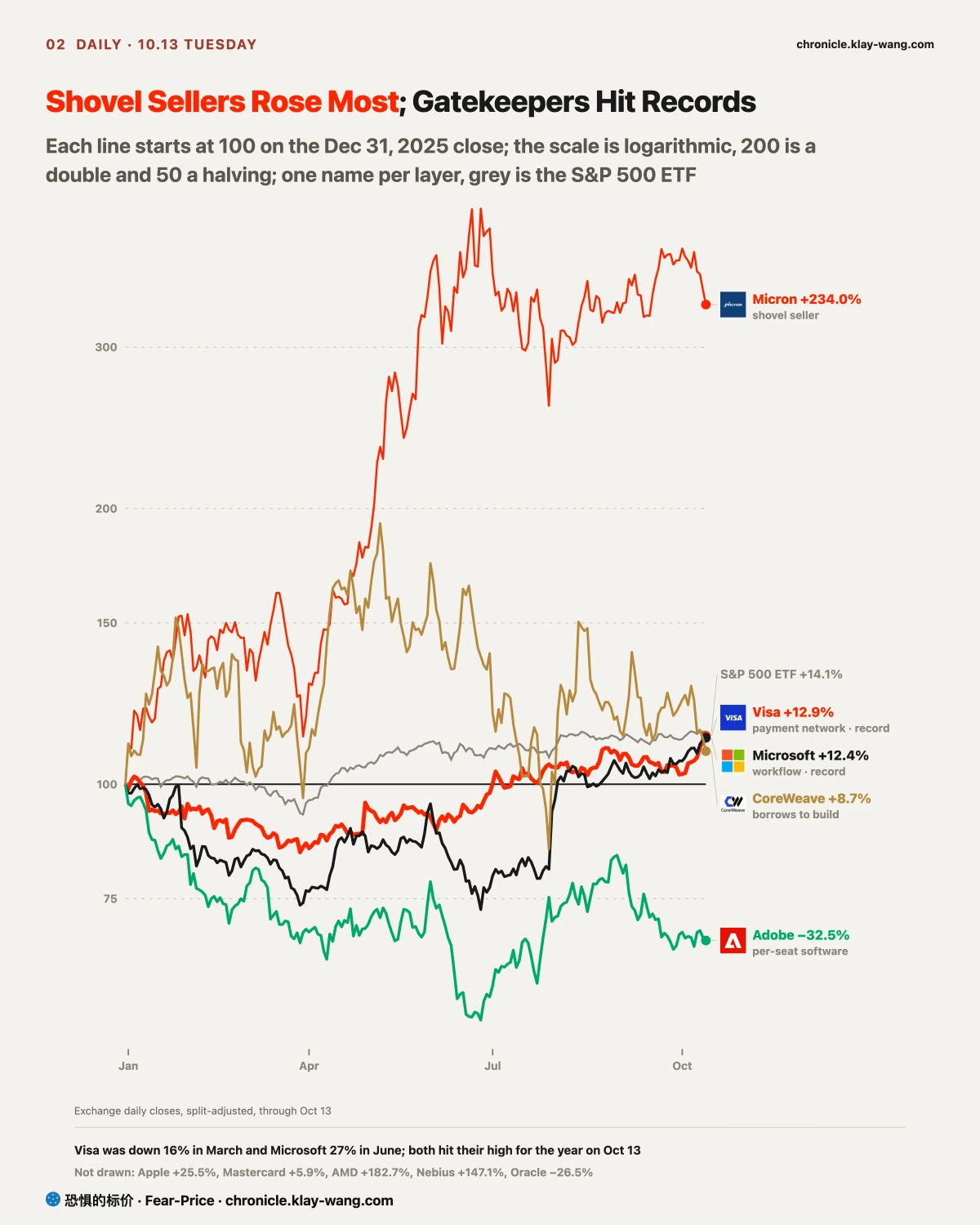
Apple, Microsoft, Visa and Mastercard all closed at records on Tuesday. The popular line early this year was that AI would kill software; the software ETF is up 5.0% this year and closed at its high for the year on October 9; what fell is a part of it, Adobe down 32.5% year to date and Salesforce 10.2%. The dividing line is whether a company holds a gateway. Apple holds the consumer gateway and takes a cut of app purchases on its phones; Microsoft holds the enterprise workflow, selling Office, cloud and Copilot to companies already using it; Visa and Mastercard hold the payment network, and whichever AI wins, spending still passes through them. Single tools such as photo editing and customer lists charge per seat; when AI takes over part of the work, fewer seats are needed. The market is rewarding companies that hold a gateway, collect their own revenue and do not need to borrow to build compute.
Companies on the AI chain split by how they get paid. Shovel sellers, Nvidia, AMD, Micron and TSMC, earn from the capital spending of others, and the biggest gainers this year sit in this layer, Micron more than tripling. Those borrowing to build compute, CoreWeave and Nebius, borrow to build data centers and then rent out time, so every extra point of interest pushes payback further out; Oracle is also borrowing to build, its spread is 199 basis points, and it is down 26.5% this year. The gatekeepers, Apple, Microsoft, Visa and Mastercard, collect from their own users and do not borrow to build server rooms for AI; Microsoft is building too, with money it earned: its bonds pay 5.6 basis points less than Treasuries, while CoreWeave pays 969 more. These two weeks have been about one thing: on October 7 we wrote that cash-rich giants on the AI chain were rising while those borrowing to rent compute fell, and on October 9 that buyers went to platforms and software with their own customers and their own revenue. Money is leaving those borrowing to build compute, the CoreWeave spread at 829 on October 2, 898 on October 9 and 969 on Tuesday, and going to the gatekeepers.
The 10-year Treasury yield was 5.21% on Tuesday, still above 5%. New York Fed President John Williams said on Tuesday that one more hike this year is appropriate, with no need seen for more in 2027; outside AI and energy he sees no broad price pressure, and AI is the inflation driver he is watching most closely (as reported by Bloomberg and FXStreet). The review of last week noted that far-dated index protection was all bought for after the October 28 decision, as if someone were paying in advance for one more hike this year; that is what Williams spoke of on Tuesday. When rates are high, those borrowing most and paying back slowest are hit first; Visa and Mastercard earn on nominal spending, so when prices rise their cut rises too. Tuesday traded in that order: the gatekeepers set records, shovel sellers were bought back while their protection got dearer, and the spreads of the borrowers kept widening.
The records came in two kinds. Visa and Mastercard closed near their highs; Apple and Microsoft opened higher and were sold, closing near their lows. Apple closed at 341.27, still a little above the September 25 closing high of 341.07; Microsoft closed at 543.45 against a previous high of 542.07 on October 28, 2025. Closing near the high means buyers had the upper hand into the close; closing low after a higher open means more people wanted to sell near the record than to chase it. If you hold payment networks or platforms, they do not borrow to build for AI, so rising rates press mainly on their valuations, less than on those borrowing to build compute; what to watch is whether Apple and Microsoft hold their records after closing near their lows.
[Protection] The Shovel Sellers Were Bought Back, So Why Did Their Insurance Get Dearer?
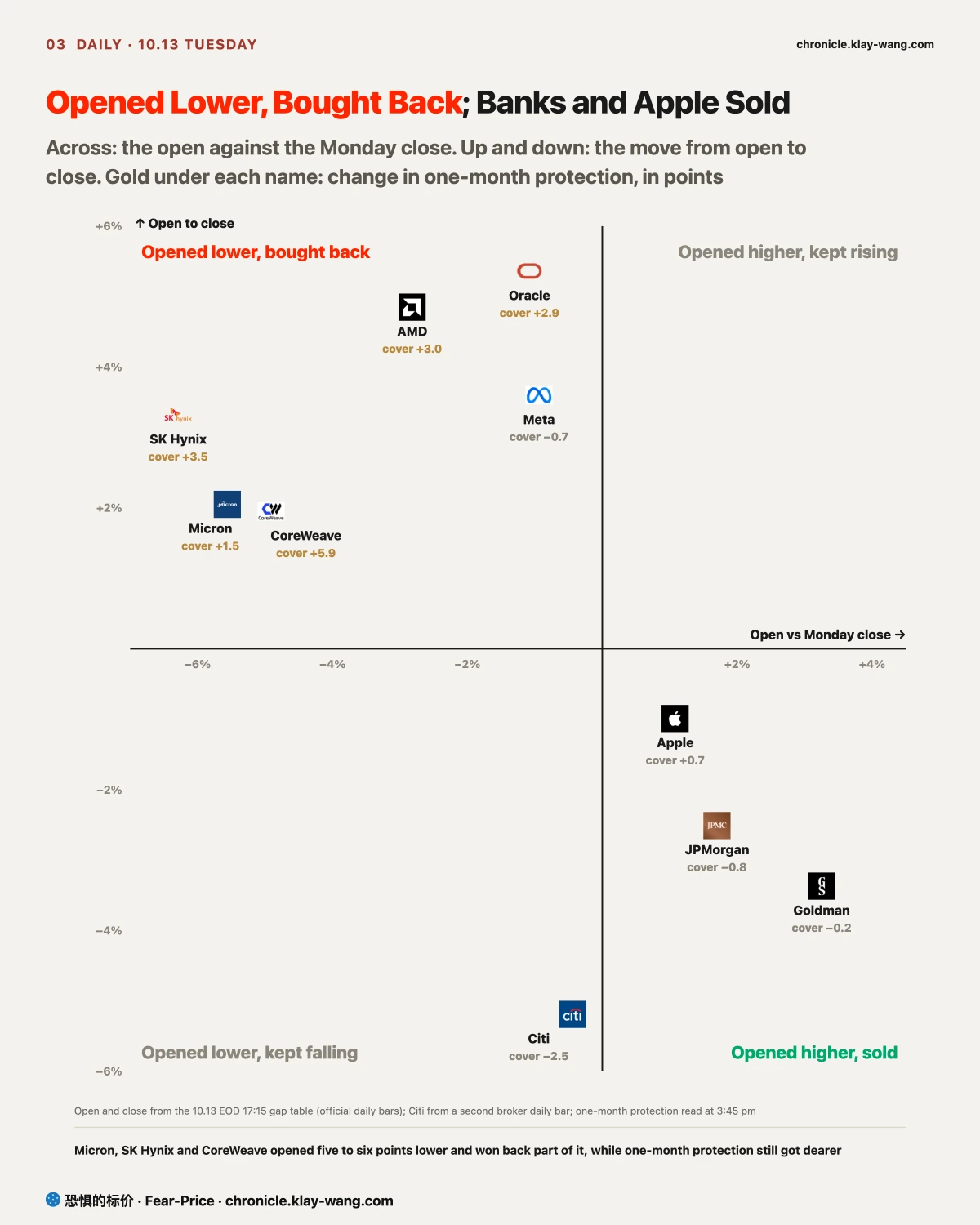
Before the US open on Tuesday, Asian memory shares kept falling; reports named ChangXin Memory of China advancing a new memory design, doubts about returns on AI spending, and oil pushed up by tension in the Middle East (external report). Micron, SK Hynix and SanDisk opened five and a half to over six points lower, AMD nearly three, CoreWeave and Nebius four and a half to five. A lower open is overnight selling filled in one go at the bell. The group was then bought back; Micron, SanDisk, SK Hynix, AMD and Nvidia all closed near the high of the day, most on 10% to 50% more volume than Monday. Micron and SK Hynix won back only part, and their highs never reached the Monday low, so the gap down is still open.
Protection went the other way. The price of one-month protection on CoreWeave, 30-day implied volatility, which is how options are quoted, rose 5.9 points from Monday, Nebius 4.7, Intel, SK Hynix, SanDisk, AMD and Oracle about 3 each, Broadcom 2.5. When the stock is bought back while protection gets dearer, it usually means the buyers are insuring themselves as they buy, still paying to guard against another fall.
The Monday issue set out a reading: if one-month protection on Nvidia and TSMC started rising too, the pressure had reached the chipmakers. On Tuesday Nvidia rose only 0.48 points and TSMC 0.08, so those two are still calm; one-month protection on AMD, Broadcom and Intel has started getting dearer along with the compute renters. Micron is unlikely to close back above its Monday close of 989.04 by Friday, October 16, with the gap still open, one-month protection rising and selling in Asia not over; if it does close back above, daytime buying held, and this reading does not stand. If you hold memory stocks, buying and protection got dearer together, possibly the same money buying and insuring at once, and the near-term swings will not be small.
[Banks] Profits Beat, Stocks Sold Anyway: What Is Being Priced Is Next Quarter
The big banks reported third quarter results on Tuesday; three of four beat on profit, and all four closed lower. Goldman earned 17.01 dollars a share, far above expectations, opened more than three points higher and slid all day to close near the low, slightly down; JPMorgan earned 5.57 dollars a share against 5.93 expected, its first miss in nearly three years (external report), opened higher and also closed near the low. Citi opened nearly flat and closed down 5.60%, near the low of the day; Wells Fargo opened more than three points lower and closed down 3.10%. Volume at all four was 1.8 to 2.4 times Monday. Falling from a higher open on heavy volume usually means buyers who chased the open were met by sellers in a hurry.
The market is discounting next quarter. Citi net income was about 10% below its record second quarter, and investment banking fees fell 13% from the prior quarter, the steepest drop among peers; the Wells Fargo finance chief said trading activity slowed in late September; JPMorgan CEO Jamie Dimon pointed to sticky inflation and rising rates (external report). The benefit of high rates is already on the books: net interest income at JPMorgan, Citi and Wells Fargo totalled 56.5 billion dollars in the third quarter, a record for the fifth straight quarter; Third quarter trading revenue was strong; what was sold on Tuesday is whether it carries into the fourth quarter. If you hold big banks, a profit beat no longer props up the stock; what counts is what management says about the fourth quarter.
The earnings premium in protection drained in one day. One-month protection on Wells Fargo fell 3.7 points, Citi 2.6, the regional bank fund 3.8; Citi one-month at 30.67 is already below one-year at 31.56. Bank of America, which has not reported, saw one-month protection rise 0.45 points, 1.86 points above one-year. It reports on October 14; going by these banks on Tuesday, its one-month protection should be back below one-year by October 16; if it is still dearer than one-year, the results left a new question.
[Rates and Credit] The Day Before CPI: Long Yields Eased a Little, and the Most Expensive Borrowers Got Dearer
The 10-year Treasury yield fell from 5.24% on October 9 to 5.21% on Tuesday, the 2-year from 4.80% to 4.79%, the 30-year from 5.60% to 5.56% (the bond market was closed Monday).9 times Monday volume. The hike Williams spoke of may not come on October 28, but that decision sits inside the one-month protection window.
Credit got dearer. The price of a year of protection on the high-yield bond fund rose from 10.31 to 10.70, while the fund fell 0.26% on 2.8 times Monday volume; protection on the investment-grade bond fund did not move. High-yield bonds are what the most expensive borrowers issue. Across the stock, rate and credit layers, protection on the index and long bonds barely moved, while protection on high yield and a set of single stocks rose: the pressure is on expensive borrowers and has not spread into broad hedging. The CoreWeave bond spread, the extra yield its bonds pay over Treasuries, was 969 basis points on Tuesday, about 71 wider than 898 on October 9; on the last public trade it pays about 14.7% to borrow for five years. The chip design layer shows the same shape: the Broadcom spread widened about 35 basis points and its one-month protection rose 2.5 points, while the Nvidia spread narrowed slightly and its protection did not move.
[Expiries] Far Out: About 450000 Deep Nvidia Puts Stayed, and CoreWeave Drew Bets on Both Sides a Year Out
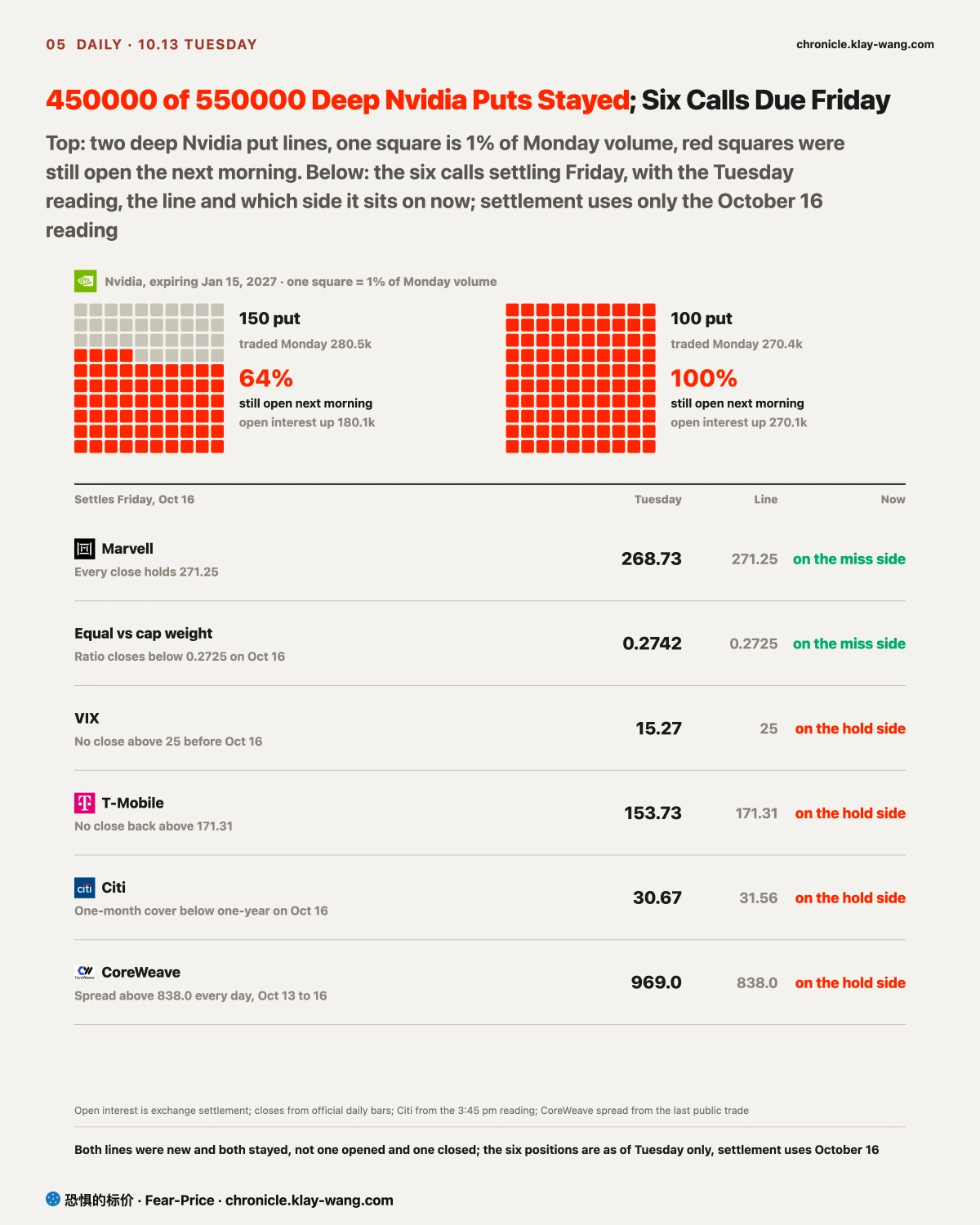
On Monday two Nvidia put lines expiring January 15, 2027 traded 550000 contracts, and settled open interest on Tuesday morning, the contracts still held the next day, answered the question: the 150 strike went from 136835 to 316906, up 180071, 64% of the Monday volume; the 100 strike went from 185601 to 455723, up 270122, nearly all of the Monday volume. Both lines were new and both stayed, not one opened and one closed. The 150 and 100 strikes sit 34% and 56% below the Nvidia close of 228.52 on Tuesday, paying only in a crash. Volume and open interest do not show who bought and who sold; it could be both legs of one spread opened together.
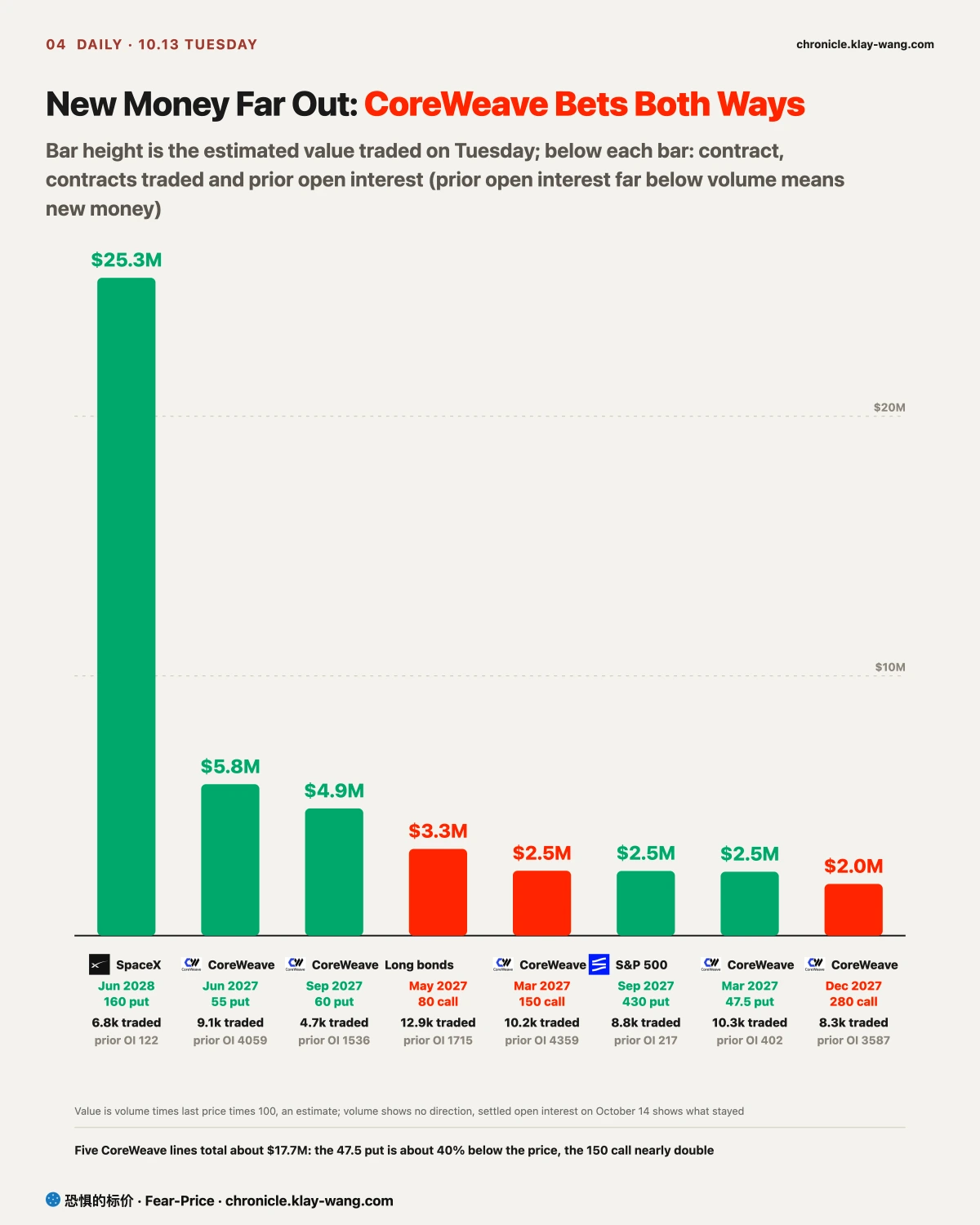
CoreWeave drew large far-dated trades on both sides: the March 2027 47.5 put traded 10257 contracts against 402 open before, and the 150 call in the same month 10173; the June 55 put, the September 60 put and the December 280 call each traded several thousand to over nine thousand, about 17.7 million dollars across five lines. The 47.5 put is nearly 40% below the price of 77.81 and the 150 call nearly double it, a bet on a big move within a year with both directions covered. One-year protection on CoreWeave rose 1.88 points, the most among the 44 names with a one-year reading, consistent with these far trades.
A SpaceX June 2028 160 put traded 6755 contracts against 122 open before, about 25.3 million dollars; SpaceX closed down 4.21% on Tuesday, near its low. On the day Apple set a record, its January 2027 340 put traded 10762 contracts, about 15.3 million dollars, against 3089 open before; someone is paying for a pullback a year out. Whether these stayed shows in settled open interest on the morning of October 14.
[Settled] The 550000 Nvidia Puts Were New; the Six Calls for Friday Unchanged
The two deep Nvidia January 2027 put lines: new. The Monday issue listed this as a watch item without taking a side; the test was the 150 strike adding at least 140262 contracts to 136835. On Tuesday morning it added 180071, so it was new, and so was the 100 strike.
The six calls for Friday, where they stood on Tuesday (settlement stays on October 16): Marvell closed at 268.73, line 271.25; equal weight to cap weight ratio 0.2742, line 0.2725; VIX 15.27, line 25; T-Mobile closed at 153.73, line 171.31; Citi one-month protection 30.67 against one-year 31.56; CoreWeave spread 969, line 838.
What This Means for What You Hold
If you hold the gatekeepers (Apple, Microsoft, Visa, Mastercard): closing records, no borrowing to build for AI, and a 10-year above 5% presses mainly on valuations; Apple and Microsoft closed near their lows, Visa and Mastercard near their highs, so watch which ones hold.
If you hold per-seat single tools (Adobe, Salesforce): this is the layer knocked down this year, while the software ETF is up 5.0% this year and slipped on Tuesday; Microsoft and Alphabet on October 28 and Meta, expected on November 4, will report new numbers on AI revenue.
If you hold memory (Micron, SanDisk, SK Hynix): daytime buying caught the selling at the open, the gap is not closed and protection is getting dearer; before the TSMC report on October 15, this group will keep swinging.
If you hold chip designers and the foundry (Nvidia, TSMC, AMD, Broadcom): protection on Nvidia and TSMC has not moved, while AMD and Broadcom have started getting dearer; the TSMC report gives the first answer.
If you hold the compute renters (CoreWeave, Nebius): one-month protection rose the most among the 45 names, and far out there are bets on big moves both ways; watch the spread on October 16.
If you hold the big banks (JPMorgan, Goldman, Citi, Wells Fargo, Bank of America): the earnings premium in protection is gone, and the stocks are discounting trading revenue for next quarter; Bank of America reports on October 14.
The Dates Ahead: CPI and Bank of America on Wednesday, TSMC on Thursday, Six Calls Settle Friday
These calls cross guidance and supply and demand with volume, open interest and implied volatility; sudden news is beyond what can be foreseen, and the settlements count either way.
- Wednesday, October 14, 8:30 am: September CPI; Bank of America third quarter results; in the morning, whether the far SpaceX and Apple puts and the CoreWeave far trades on both sides stayed.
- Thursday, October 15: TSMC third quarter results before the US open; September PPI.
- Friday, October 16: monthly expiry; six calls settle: Marvell, the equal weight to cap weight ratio, VIX, T-Mobile, Citi and CoreWeave.
- Wednesday, October 28: Fed decision; Microsoft and Alphabet third quarter results.
Three Lines Worth Keeping
- The software ETF is up 5.0% this year; what fell are single tools AI can partly replace, while the holders of the consumer gateway, the enterprise workflow and the payment network set records: to place a company on the AI chain, first ask how it gets paid and whether it must borrow.
- Chips and memory, big gainers this year, were bought back while their protection got dearer: money is still holding them, and insuring as it holds.
- With the 10-year above 5%, money is leaving those borrowing to build compute: CoreWeave pays 969 basis points over Treasuries, about 140 wider than October 2, while Microsoft pays less than Treasuries.
No investment advice. No direction calls. No market timing.