Is AI Momentum Fading? Coca-Cola Rises Six Days in a Row to a Record
Three Lines: Demand for Chips Has Not Faded, Yet Borrowing Keeps Getting Dearer for Those Who Build on Debt
- TSMC guided fourth-quarter revenue above estimates, and Chairman C.C. Wei said he saw no sign of a slowdown in demand.
- Jensen Huang spoke up for CoreWeave and its stock closed up almost 6%; the same day, the price of insuring its bonds against default hit a record.
- Coca-Cola set a record close by one cent over August and finished near its low of the day; the move from AI stocks into defensive names lasted only through the open.
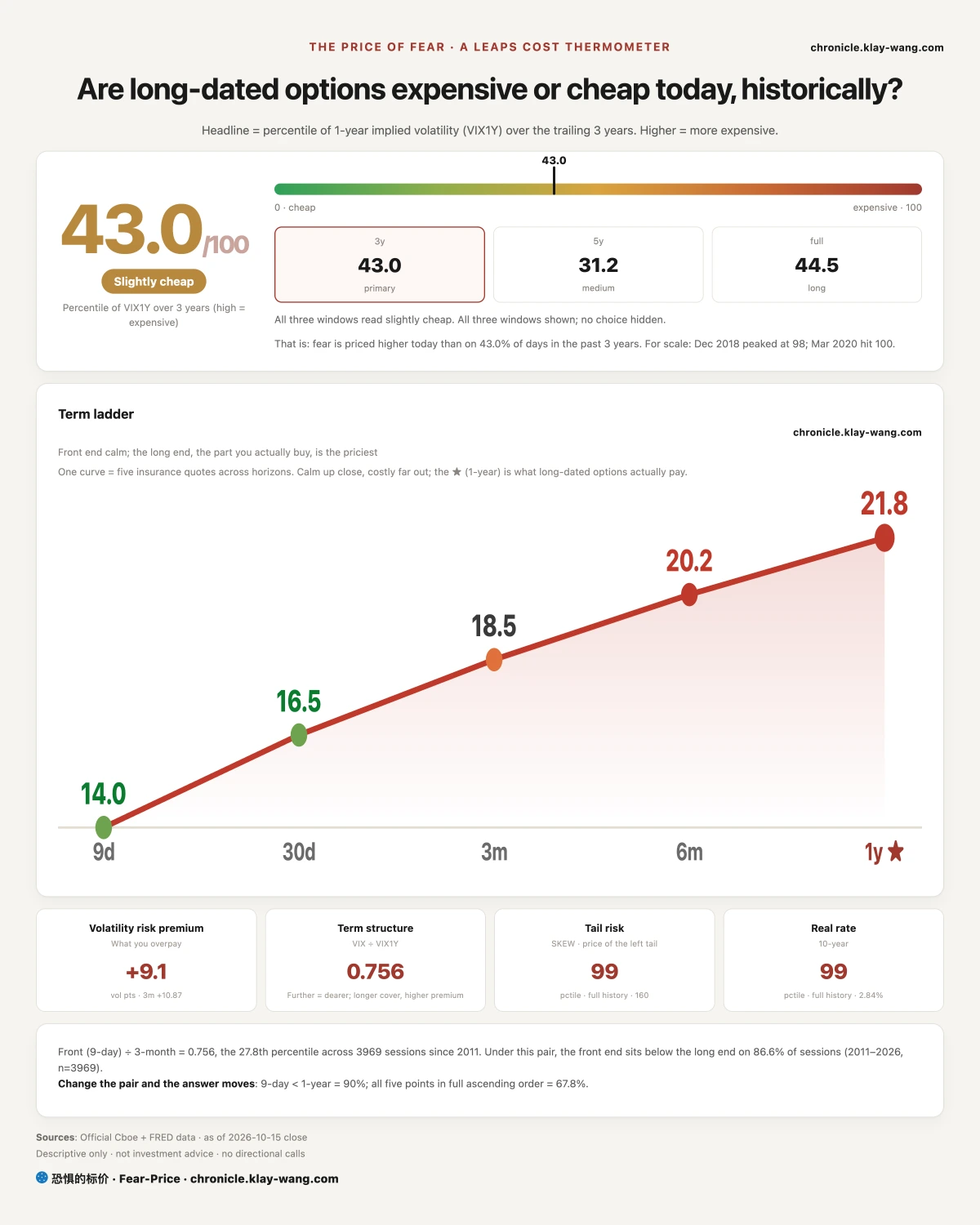
Fear-Price Index 43.0: No One Paid Up for Next Week, but Someone Is Paying for a Year Out
Fear-Price Index · 2026-10-15 · Reading 43.0/100: one-year volatility VIX1Y at 21.77, in the 43.0th percentile of the past three years, where high means expensive. Daily ledger and definitions at chronicle.klay-wang.com · Please credit: Fear-Price Index · Fear-Price
The reading fell from 47.8 on Wednesday to 43.0; no one paid more to protect against next week. If you want one-year protection on US stocks, it costs a little less than on Wednesday and sits mid-range for three years. Of all the protection readings on the S&P 500, only one rose: SKEW, the price of protection against a sharp index drop, reached the 99.2nd percentile of its full history. Outside stocks, one-year protection on the high-yield bond fund rose too, while its one-month protection fell. The money buying protection was not paying more for next week; it was paying for something big within a year.
The CNN Fear and Greed Index is 31.5 and the K index 1.92, above the final 1.58 for Wednesday (provisional; the official Cboe data may revise them slightly). The closer K gets to 1, the more of the gloom in the sentiment reading has turned into money spent on protection; on Thursday it moved further from 1. At the Thursday sentiment reading, VIX would have to rise above 31.5 for K to fall below 1. Correction: the sentiment of 32.4 and K of 1.92 in the Wednesday edition were provisional; the final figures are 26.7 and 1.58. History at chronicle.klay-wang.com/kindex, the index at chronicle.klay-wang.com/fear-price.
[Main Line] Is AI Momentum Fading? Demand for Chips Has Not Faded, Yet Borrowing Keeps Getting Dearer for Those Who Build on Debt
TSMC on Thursday guided fourth-quarter revenue to 52.3 to 54.3 billion dollars, with the low end above market estimates. On the call, an analyst asked whether limits on power and funding could lead to too many chips being made. Chairman C.C. Wei said TSMC had factored in cloud capital spending, data center build-out, financing and power, and still saw demand above supply, with no sign of a slowdown; TSMC has even sent its own people to the United States to check data center progress and power supply. The same day, the price of insuring the bonds of CoreWeave, which borrows to build data centers, hit a record intraday. Along the AI supply chain, demand for chips is intact; the trouble is the interest paid by the companies that build data centers with borrowed money.
Everyone now knows AI is a capital-heavy business: a top chip costs tens of thousands of dollars, a data center often costs billions, and the money goes out years before it comes back.
So where does the money come from? Microsoft, Alphabet, Amazon and Meta buy chips and build data centers mostly out of the profits they earn each year.
TSMC, Nvidia and Micron sit on the receiving end: TSMC makes chips for companies like Nvidia and charges per wafer; Nvidia sells chips and full racks to the big platforms and to CoreWeave; Micron sells memory. They sell goods and collect cash, at high gross margins: 66.4% at TSMC last quarter, about 75% at Nvidia and close to 87% at Micron in their latest quarters, so out of 100 dollars of sales, sixty-odd to eighty-odd dollars remain after direct costs.
In the middle sit CoreWeave and Oracle: they borrow from bond markets and banks, buy Nvidia chips, build data centers, then lease the computing power on long contracts to large model developers such as OpenAI, and repay the debt from the rent. The platforms and the chip sellers run on money they earn; the companies in the middle run on borrowed money.
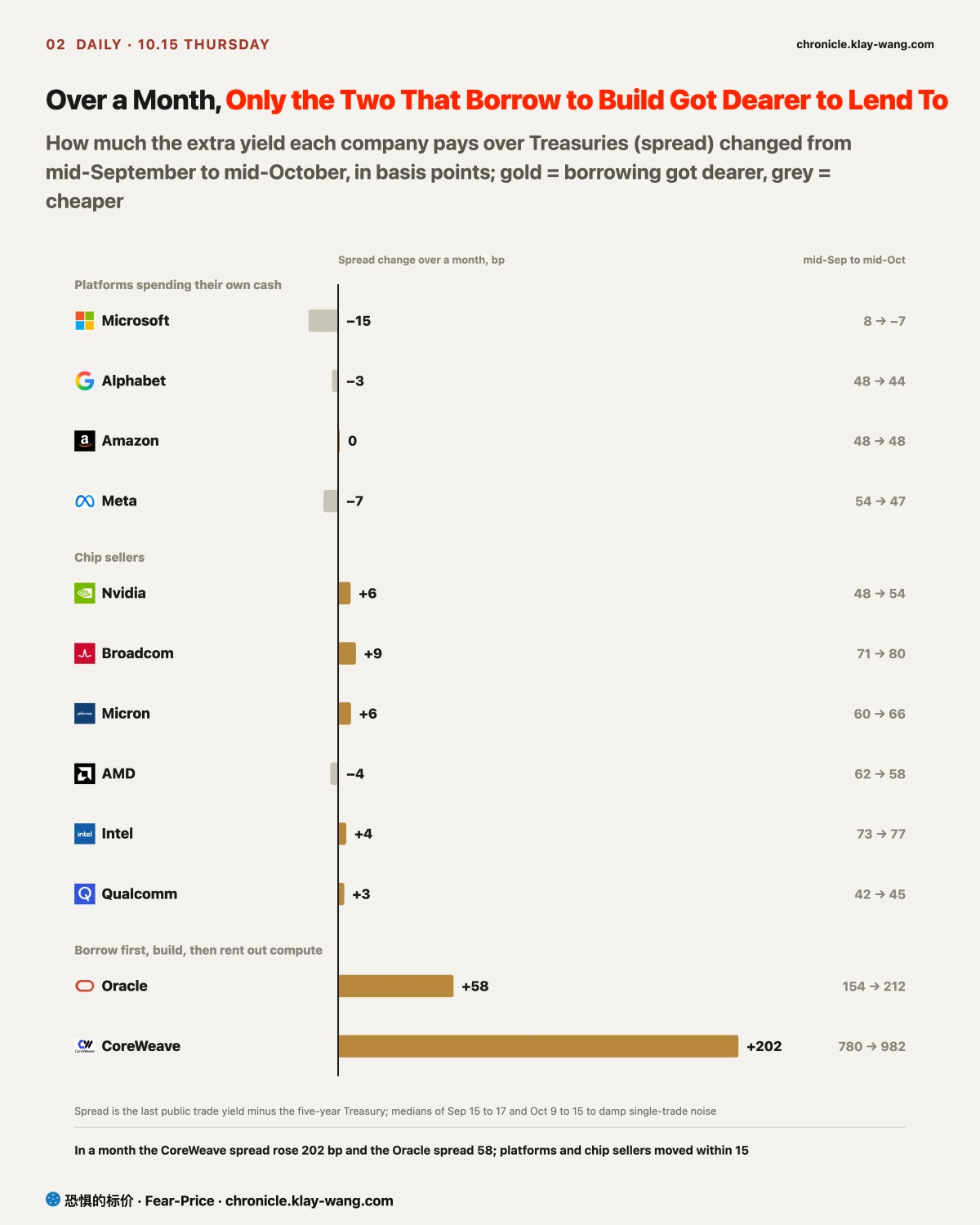
Over the past month, borrowing costs for these three groups have moved in completely different directions. The extra interest a company bond pays over a Treasury of the same term is called the spread; the higher it is, the more compensation lenders demand. The big platforms all pay less than 50 basis points, almost unchanged over the month; the chip sellers moved within 10 basis points either way. CoreWeave went from 780 in mid-September to around 980, and Oracle from 154 to around 210. Over the month, only these two companies building on debt saw borrowing get clearly dearer.
Chip stocks fell 8% this week, yet demand for chips is intact: beyond the TSMC guidance and the words of Wei, one-year protection on Micron, SK Hynix, TSMC and Nvidia all costs less than in mid-September, and no one is paying extra to insure their business next year. Companies like CoreWeave are different: rent comes in only after the data center is built and the computing power is leased, but the money has to be borrowed first. The higher the interest, the harder the numbers are to make work.
The large model developers had bad news too. Reuters reported that Anthropic disclosed slower revenue growth, and some investors lowered their expectations for its listing valuation from about 2 trillion dollars to about 1.5 trillion. Model developers are the customers renting the computing power; if they grow more slowly, companies like CoreWeave collect less rent.
In this AI selloff, the first and hardest hit will be the companies that build data centers on debt: their shares fall and their interest costs rise. They are also big customers of chipmakers like Nvidia; if they cannot borrow cheaply, chip orders for next year will feel it. If you hold chip stocks, the borrowing costs of CoreWeave and Oracle are worth watching more closely than the moves of your own stock. If the big platforms see their spreads rise too, or one-year protection on TSMC and Nvidia starts to get dearer, the trouble has spread from the borrowers to the chip buyers and sellers.
[CoreWeave] A Few Words From Jensen Huang Lifted the Stock; Its Lenders Were Not Convinced
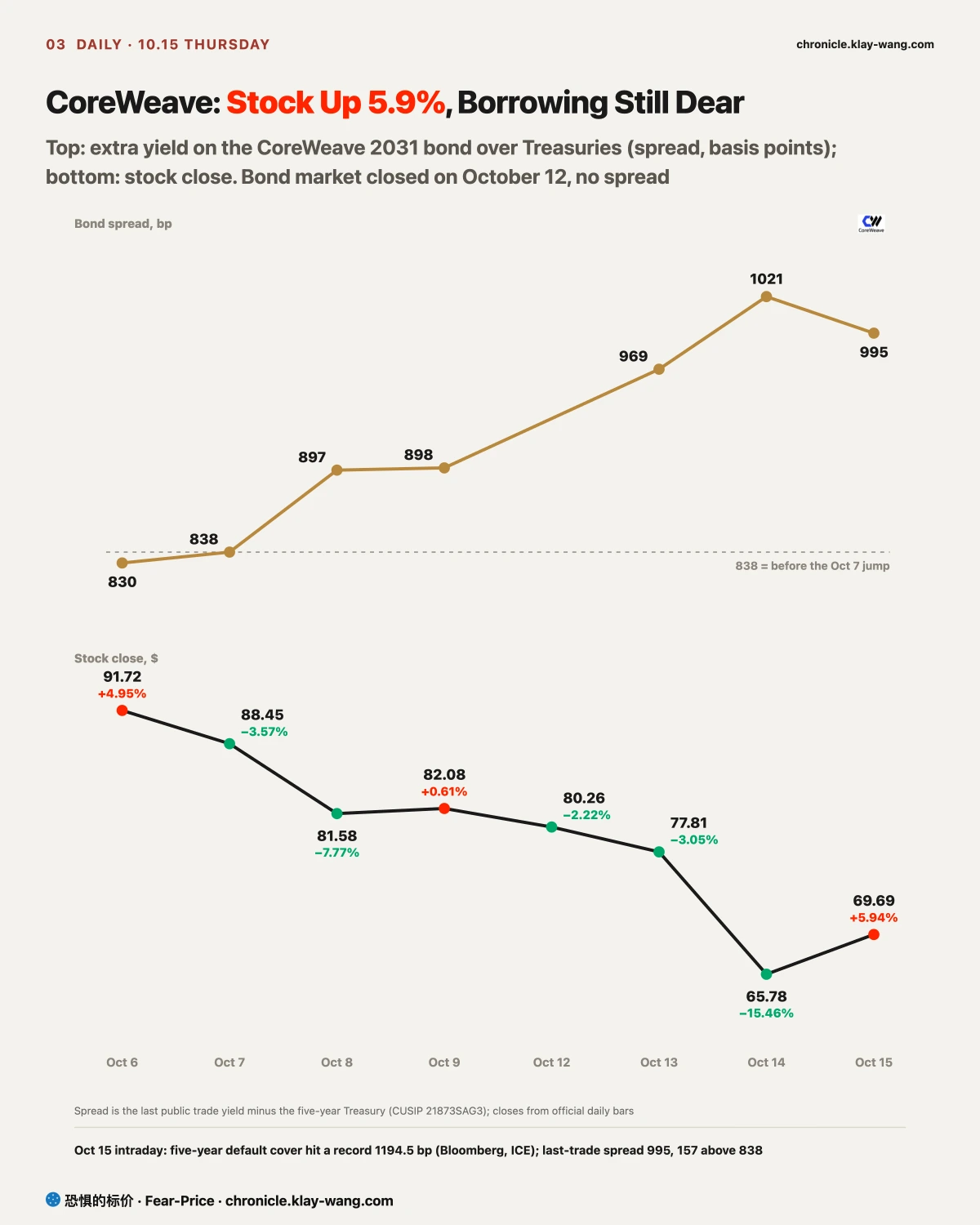
Nvidia CEO Jensen Huang told Bloomberg on Thursday that the cost of capital for CoreWeave is falling and that Nvidia does not need to backstop it. CoreWeave opened down 6.6% and closed up 5.9%. The same day, its five-year default insurance hit 1194.5 basis points intraday, a record.
The drop at the open came mainly from Korea overnight: both of its stock markets triggered circuit breakers on the same day, and SK Hynix fell 11% in Seoul. At 9:55 am, US indexes, chip stocks and CoreWeave all hit their lows of the day together, then chip stocks were bought back across the board. CoreWeave began its own rebound after 11 am: volume jumped to two or three times the bars around it, and within minutes it outran the semiconductor fund by three points while the Nasdaq barely moved.
Why did the bonds not follow the stock back? Lenders look at who signs a guarantee and for how much. The backstop Nvidia has put in writing is a capacity order initially worth 6.3 billion dollars: if CoreWeave cannot lease its computing power, Nvidia has to buy what is left, through 2032. CoreWeave owes more than 40 billion dollars, so the 6.3 billion falls far short, and lenders can do the math. The economics of bank runs works the same way: what stops a run is a guarantee large enough to cover the money at stake, and a spoken reassurance cannot do that. So a few words can lift the stock while the price of default insurance still sets a record.
On October 12 we wrote that the dearer the borrowing, the harder the stock falls; on Wednesday we wrote that this time CoreWeave bonds fell first and the stock followed. On Thursday the bonds again failed to follow the stock back. Cheaper borrowing will take something concrete: either Nvidia puts a larger guarantee in writing, or CoreWeave grows its rental income faster than its interest bill. Until then, the bonds tell you more about it than the stock does.
If you hold computing renters such as CoreWeave or Nebius, on a day the stock jumps, check first whether the bonds rose with it.
[Rates] Inflation Comes From Oil; Rate Hikes Cannot Lower Oil, Only Make Borrowers Pay More
The US producer price index for September, published on Thursday, rose 6.3% from a year earlier, the most since late 2022. The index (PPI) tracks prices at the factory gate and in wholesale, and more than 80% of the rise in goods prices came from energy. The same day, the 10-year Treasury yield fell to 5.10%, its lowest since September 22.
This inflation comes mainly from oil. Oil prices have surged since the US-Iran war began in February, Brent traded near 104 dollars a barrel on Thursday, and gasoline, diesel and airfares have followed. Rate hikes cannot bring oil prices down, but they do make borrowing dearer. The 10-year yield fell mainly because safe-haven money bought long Treasuries early on Thursday, with the long bond fund up 2% at the open; the 2-year, which follows the Fed, fell only 5 basis points.
For companies building data centers on debt, a small drop in Treasury yields barely helps. How much CoreWeave pays depends on whether lenders believe it can repay: its spread over Treasuries rose 52 basis points on Wednesday and fell back 26 on Thursday, far more than the 10-year moves in a day. So the hotter inflation runs, the more likely rate hikes land on companies that borrow first and collect rent later, while oil keeps rising. For you, a lower 10-year yield does not mean companies expanding on debt can borrow more cheaply.
On October 7 we wrote that the 10-year yield anchors the pricing of assets worldwide: when it rises, it first lowers stock valuations and then makes borrowers pay more interest. The first half is easing now, with the 10-year down from 5.31% on October 5 to 5.10%; the second half is still under way, as interest costs keep rising for the companies building on debt.
[Havens] Coca-Cola Set a Record by One Cent
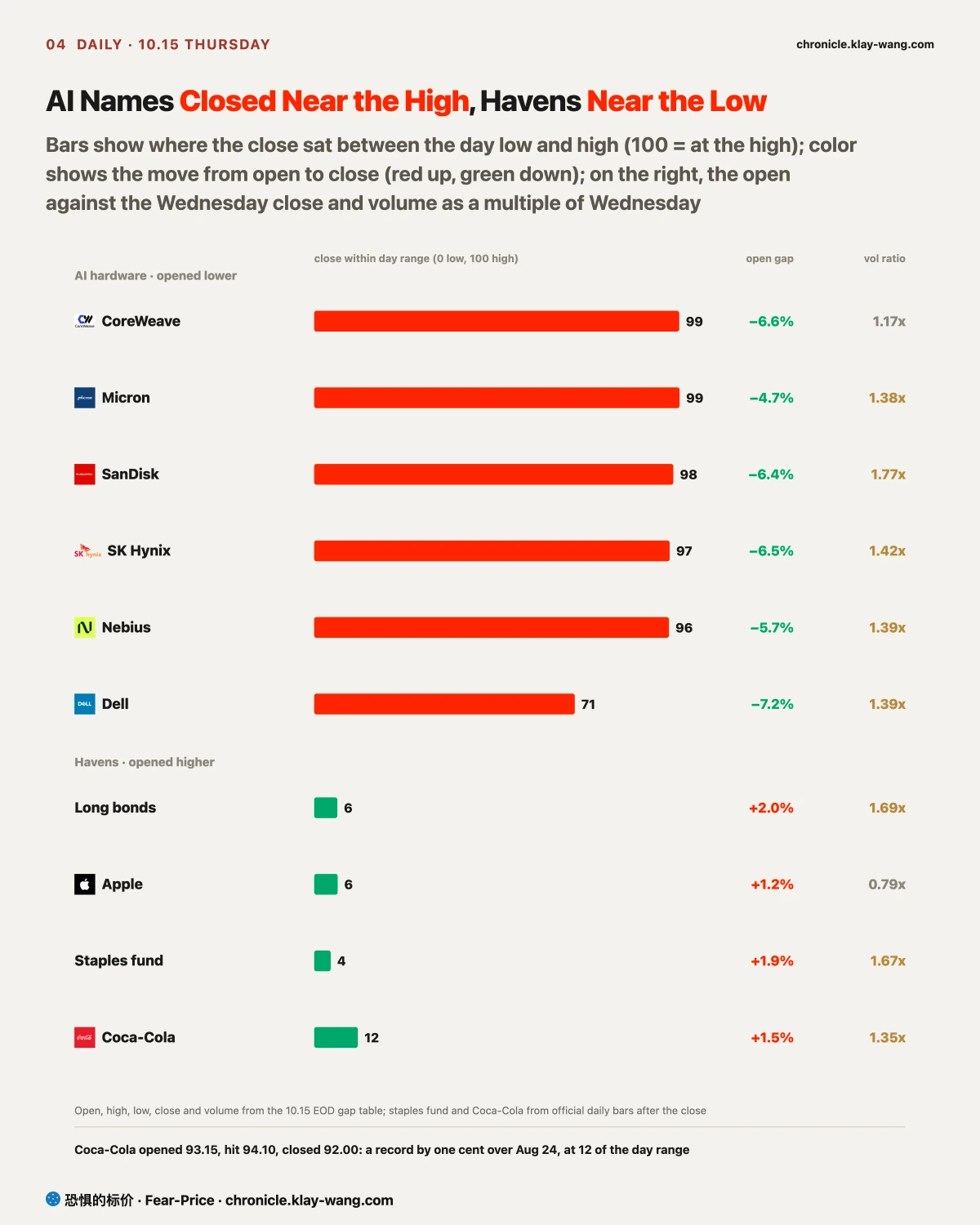
Coca-Cola rose for a sixth day on Thursday and closed at 92.00, one cent above its record close of August 24. It opened above 93, reached 94.10 during the day and closed near its low, on volume about a third higher than Wednesday. A heavy-volume push to a new high that ends near the low usually means more people wanted to sell up there than to chase. The long bond fund and the consumer staples fund traded the same way: up in the morning, sold during the day. For you, a record by one cent that closes near the low is one to wait on until it holds up there on heavy volume.
Early on Thursday it looked like money was moving out of AI stocks into defensive ones: chips opened lower, while Coca-Cola and long bonds opened higher. By the close it had reversed, with chips near their highs of the day and Coca-Cola near its low. Over the week, health care and consumer staples did beat the S&P 500; on Thursday alone, the switch lasted only through the open.
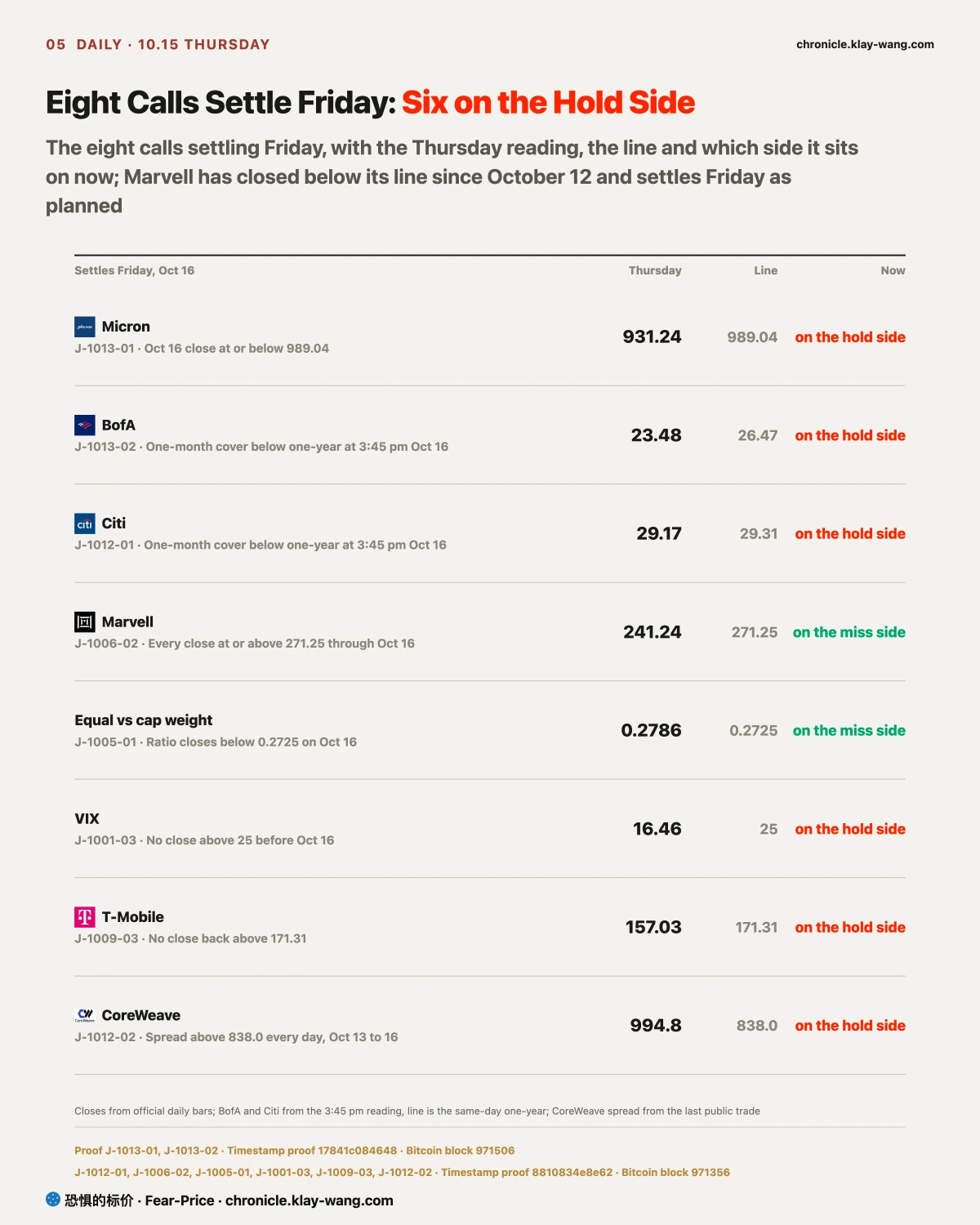
[Settled] Eight Calls Due Friday: Six on the Hold Side, Citi the Closest
These eight were filed between October 1 and 13 and settle on Friday, October 16. Where they stood at the Thursday close:
- VIX no close above 25 (filed October 1): the call was that the first half of October would stay calm up close. VIX closed at 16.46 on Thursday, far below 25, on the hold side.
- Micron no close back above 989.04 (filed October 13): it opened 5.56% lower that day, the gap was not filled, and selling in Asian memory stocks had not stopped. Micron closed at 931.24 on Thursday, on the hold side.
- Bank of America and Citi one-month protection back below one-year (filed October 13 and 12): the extra premium paid before earnings usually fades once results are out. Bank of America is already well below its one-year level; Citi is only 0.14 below, the closest of the eight, and only the Friday 3:45 pm reading counts.
- CoreWeave spread stays above 838 (filed October 12): the call was that borrowing to build data centers is getting dearer. It was 995 on Thursday, on the hold side; it settles once the Friday evening reading is in.
- T-Mobile no close back above 171.31 (filed October 9): the market is pricing SpaceX as a lasting fourth carrier. It closed at 157.03 on Thursday, on the hold side.
- Marvell closes above 271.25 every day (filed October 6; 271.25 was the close before its investor day): it closed below the line for the first time on October 12 and at 241.24 on Thursday, on the miss side.
- Equal-weight S&P lags cap-weight, ratio below 0.2725 (filed October 5): the premise was that long-term rates would not come down. The 10-year has fallen from 5.31% that day to 5.10%, and the equal-weight index has beaten the cap-weight index since; the ratio was 0.2786 on Thursday, on the miss side.
Six are on the hold side and two on the miss side; results for each come in the next edition.
What This Means for What You Hold
If you hold chips and memory (names like Nvidia, Micron, SanDisk, SK Hynix): demand for chips is intact; watch whether borrowing is getting dearer for the big customers that build data centers on debt.
If you hold computing renters (CoreWeave, Nebius, Oracle): check the bonds first and the stock second. On Thursday a few words lifted the stock, yet CoreWeave default insurance is at a record and the Oracle spread rose nearly 60 basis points in a month.
If you hold the big platforms (Microsoft, Alphabet, Amazon, Meta): they buy computing power with their own cash, and their borrowing costs did not change over the month; when the companies building on debt pay more to borrow, the platforms pay not one cent more in interest.
If you hold defensive names like Coca-Cola, consumer staples or long bonds: they lead over the week, but on Thursday they were sold after an early spike; a record by one cent is one to wait on until it holds up there.
Three Lines Worth Keeping
- A few words can lift a stock, but the cost of borrowing comes down to the contract: the backstop Nvidia has put in writing is 6.3 billion dollars, against more than 40 billion of CoreWeave debt.
- This inflation comes from oil; rate hikes cannot bring oil down but do make borrowing dearer, and the first to pay more interest are companies that borrow first and collect rent later.
- To read the AI supply chain, ask whose money it is: the platforms spend their own profits, chipmakers collect cash, and companies like CoreWeave spend borrowed money; when borrowed money gets dearer, chip orders for next year will feel it.
No investment advice. No direction calls. No market timing.