Chips Fell 10% in a Week as Coca-Cola Hit a Record: Where Did the Money Go, and Is This the Bottom? Week of October 12 to 16
Three Lines: Money Is Re-Sorting by Who Depends on Borrowed Money
- Compute rental and servers fell about 24% on the week and the big platforms only 2.6%, while Coca-Cola rose seven days in a row to a record close. The closer to borrowed money, the bigger the fall; the further from AI, the bigger the gain.
- The Philadelphia Semiconductor Index fell eight days in a row, matching 2008; in the last three eight-day runs, day eight was never the bottom.
- This week settled 10 calls, 8 right and 2 wrong: the right ones warned against chasing the CoreWeave bounce and catching the Micron drop; the wrong ones were Marvell and equal weight.
Fear-Price Index 61.0: One-Year Protection Rose Less Than a Point; Next Week and Big Drops Got Expensive
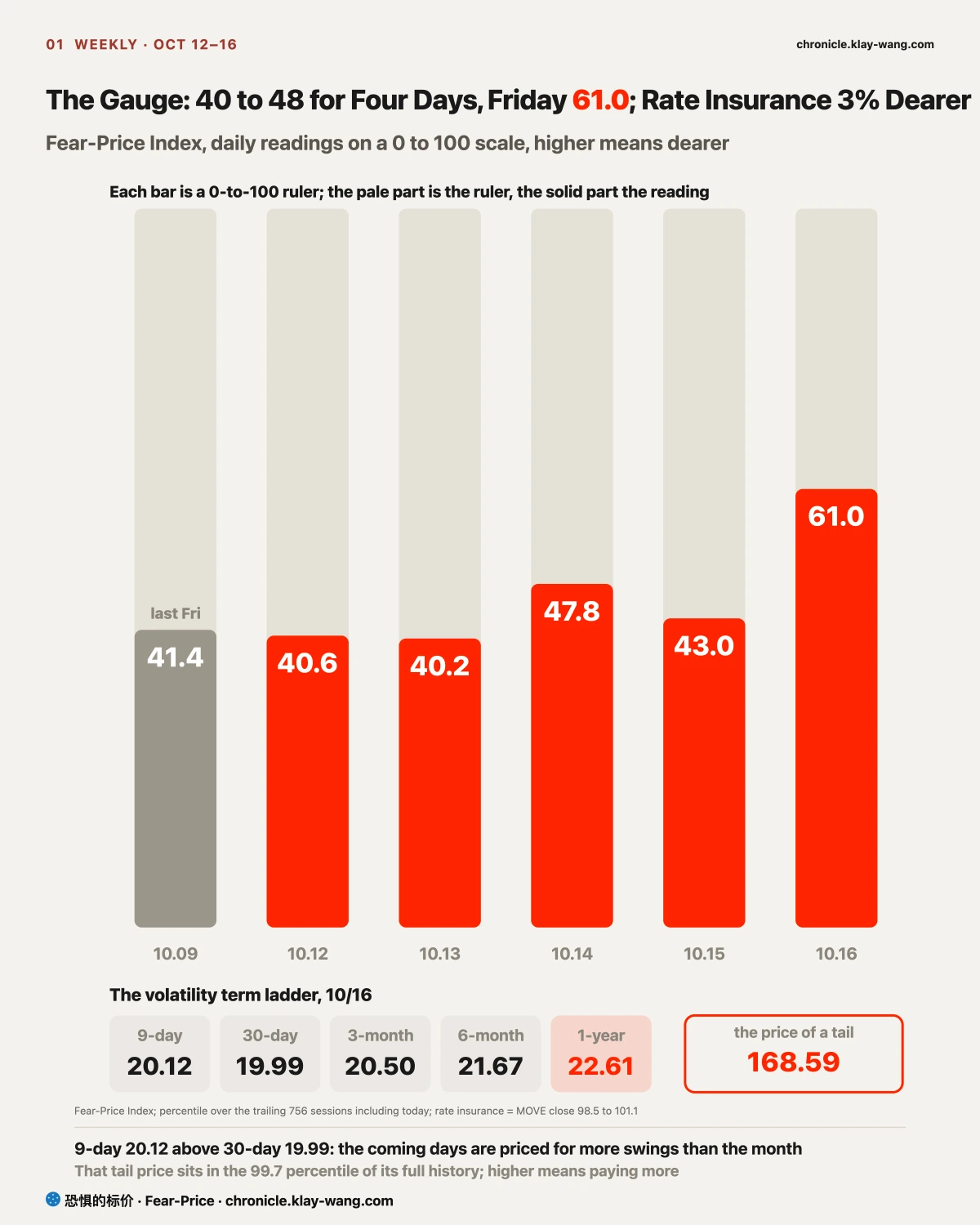
Fear-Price Index · 2026-10-16 · Reading 61.0/100: one-year volatility VIX1Y at 22.61, in the 61.0th percentile of the past three years, where high means expensive. Daily ledger and definitions at chronicle.klay-wang.com · Please credit: Fear-Price Index · Fear-Price
The reading went from 41.4 last Friday to 61.0 this Friday; the first four days sat between 40 and 48, and the jump came on Friday alone. One-year volatility rose only from 21.73 to 22.61 over the week. What got expensive was protection for the next few weeks and protection against big drops: VIX rose from 14.84 to 19.99 over the week, and on Friday 9-day volatility rose above 30-day; SKEW, the price of protection against a sharp S&P drop, reached the 99.7th percentile of its history, so only 0.3% of days were dearer.
The K index is 0.897 (provisional), below the final 3.13 for last Friday and below 1 for the first time since April 7. The closer K gets to 1, the more of the gloom in the sentiment reading has turned into money spent on protection; below 1, the money spent on protection has caught up with that gloom. Last Friday, using that evening provisional reading, we wrote that with sentiment at 45.0, VIX would have to rise above 45 for K to fall below 1; this week sentiment itself fell from 46.5 to 17.9, and K broke 1 with VIX under 20. Correction: the K of 3.03 last Friday was provisional; the final figure is 3.13. History at chronicle.klay-wang.com/kindex, the index at chronicle.klay-wang.com/fear-price.
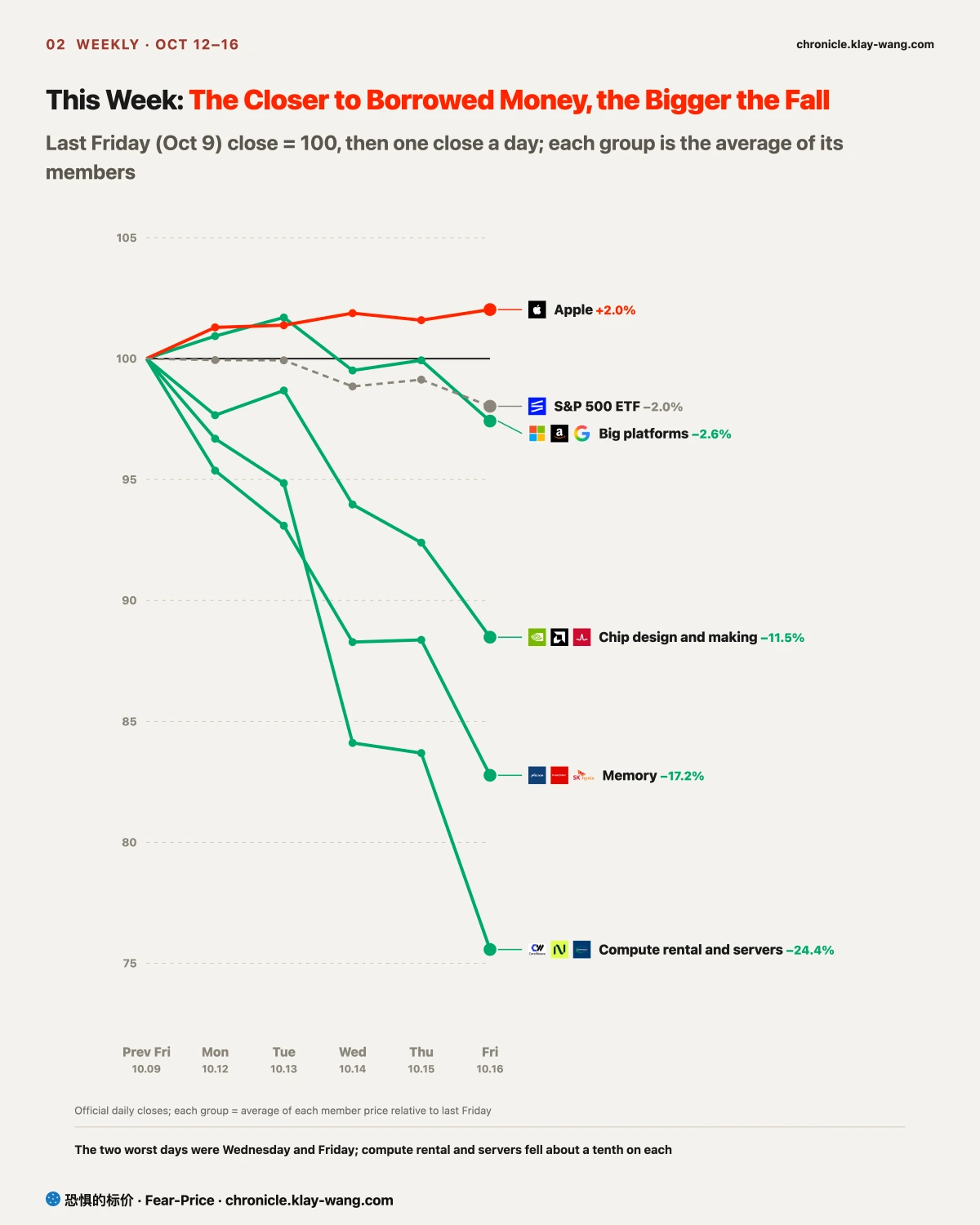
[AI Supply Chain] The Closer to Borrowed Money, the Bigger the Fall; the Platforms Fell Only 2.6%
Grouped along the AI supply chain, CoreWeave, Nebius, Super Micro and Dell, which rent out computing power and assemble servers, fell about 24% on average this week; the three memory makers fell about 17% on average, the six chip designers and makers about 12%, the four big platforms, Microsoft, Alphabet, Amazon and Meta, only about 2.6%, and Apple rose 2%. The losses lined up in neat order.
Companies that rent out computing power borrow first to buy chips and build data centers, then repay from years of rent, so when borrowing gets dearer they feel it first; chip and memory makers are paid by those companies and the platforms, so they sit in the middle; the platforms spend their own profits, and Apple barely takes part in this spending. The order of the stock moves matches the order of the money. Last week we wrote that the AI supply chain was being re-sorted by who gets the money first; this week the sorting went further. The September monthly review also wrote that the S&P looked steady in September only because a few big names in chips, memory and Meta held it up; this week those names fell together, and the S&P lost about 2% on the week. By the count of CNBC, the 20 largest AI and chip stocks in the world have lost more than 1 trillion dollars of market value in this round.
On October 13, CXMT, the largest memory maker in China, said it would launch a new server memory design before year-end that fits about half again as many memory cells on a chip of the same size; the claim has not been independently verified, and Samsung and SK Hynix each fell more than 7% that day. Memory has spent two years earning money from tight supply, and the market is recalculating how many years those high profits can last, one reason memory fell more than chips; the Samsung earnings call on October 29 is the next answer.
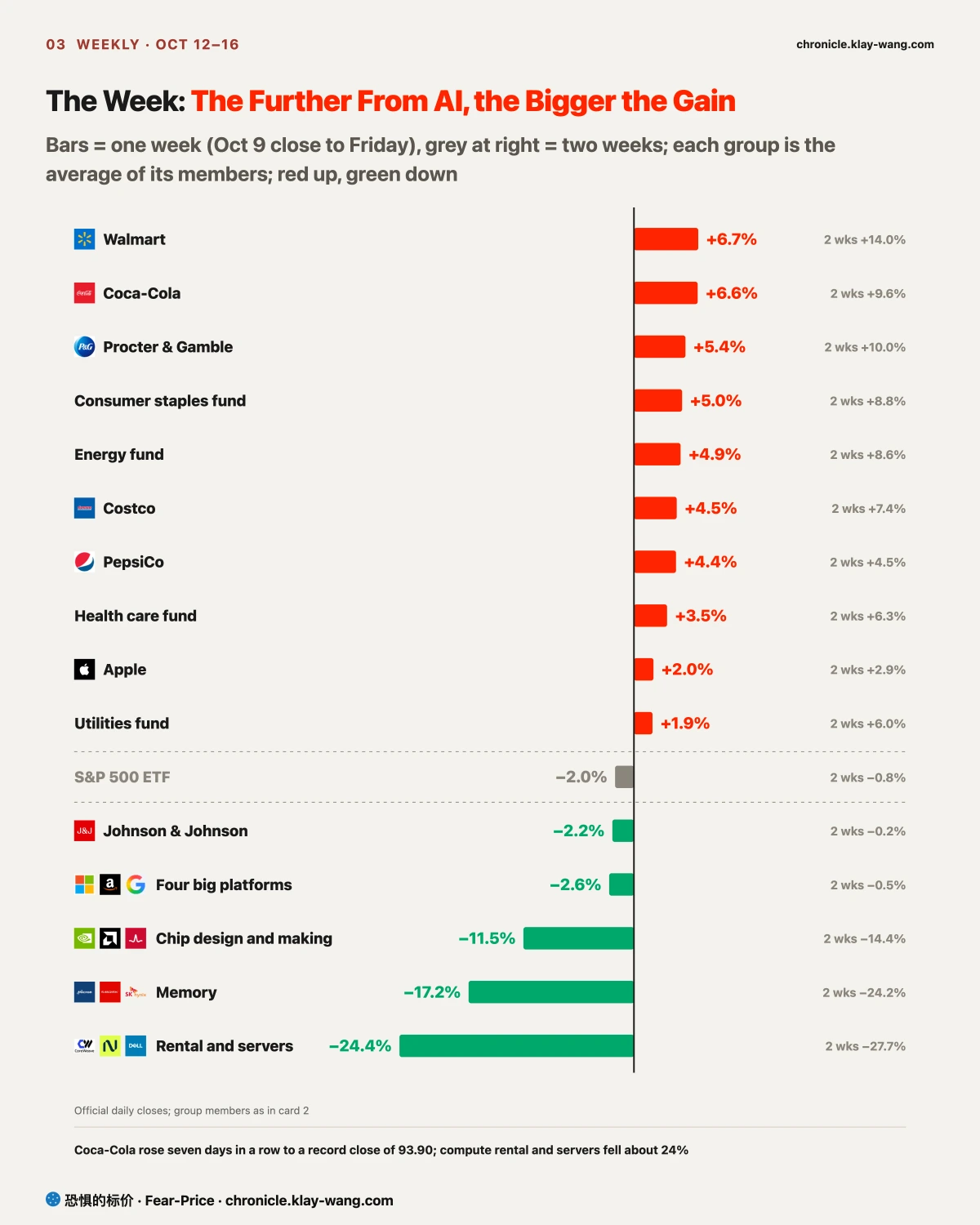
[Defensive Stocks] Coca-Cola Rose Seven Days in a Row; the Further From AI, the Bigger the Gain, but No Flight to Safety
Coca-Cola rose 6.6% on the week, up seven days in a row, and closed Friday at 93.90, a record close, at the high of the day; Walmart, Procter and Gamble and the consumer staples fund XLP rose 5% to 7%, and the health care fund XLV rose 3.5%, the opposite of AI stocks. This is the second week; last week utilities, staples, energy and health care also rose. Not every defensive stock rose; Johnson and Johnson fell 2.3% this week.
Why are these stocks rising? A stock price is, in the end, what a company will earn in the future, converted into money today. This week the market doubted the part of that money that depends on borrowing to spend on AI and earning it back years later; Coca-Cola and Procter and Gamble sell things people buy every day, earn the money now and do not need to borrow to grow, so that doubt did not touch them this week. The 10-year Treasury yield fell another 15 basis points this week, and steady-income, high-dividend stocks like these behave a bit like bonds and usually gain when rates fall.
Sector rotation means money moving from one sector to another. To tell real rotation from merely falling less, check three things. First, relative strength. The ratio of the health care fund XLV to the S&P 500 ETF (SPY) hit a 60-day high, its strongest against the S&P in 60 days; XLP beat SPY by nearly 10 points over two weeks. Second, the money trail, meaning net creations in the fund (money coming in minus money redeemed). In the five days through Thursday, XLP took in only 66 million dollars, so its 5% gain came without big new money flowing into the fund; the energy fund XLE took in 730 million, following oil; SPY took in 8 billion, so someone was buying the S&P as a whole. Third, whether it holds up high. Coca-Cola hit 94.10 on Thursday, was sold and closed near its low, and the daily edition that day said to wait until it held up there; on Friday it closed at the high of the day, so it held.
The dollar fell, gold lost 0.7% on the week, and SPY took in 8 billion dollars over five days, so there is no sign of money fleeing stocks in size; it looks more like changing seats within stocks. If you hold defensive stocks, these two weeks went your way; what to watch are the platform earnings on October 21 and 28, because if capital spending is not cut, AI stocks may be bought back and the defensive lead may not hold.
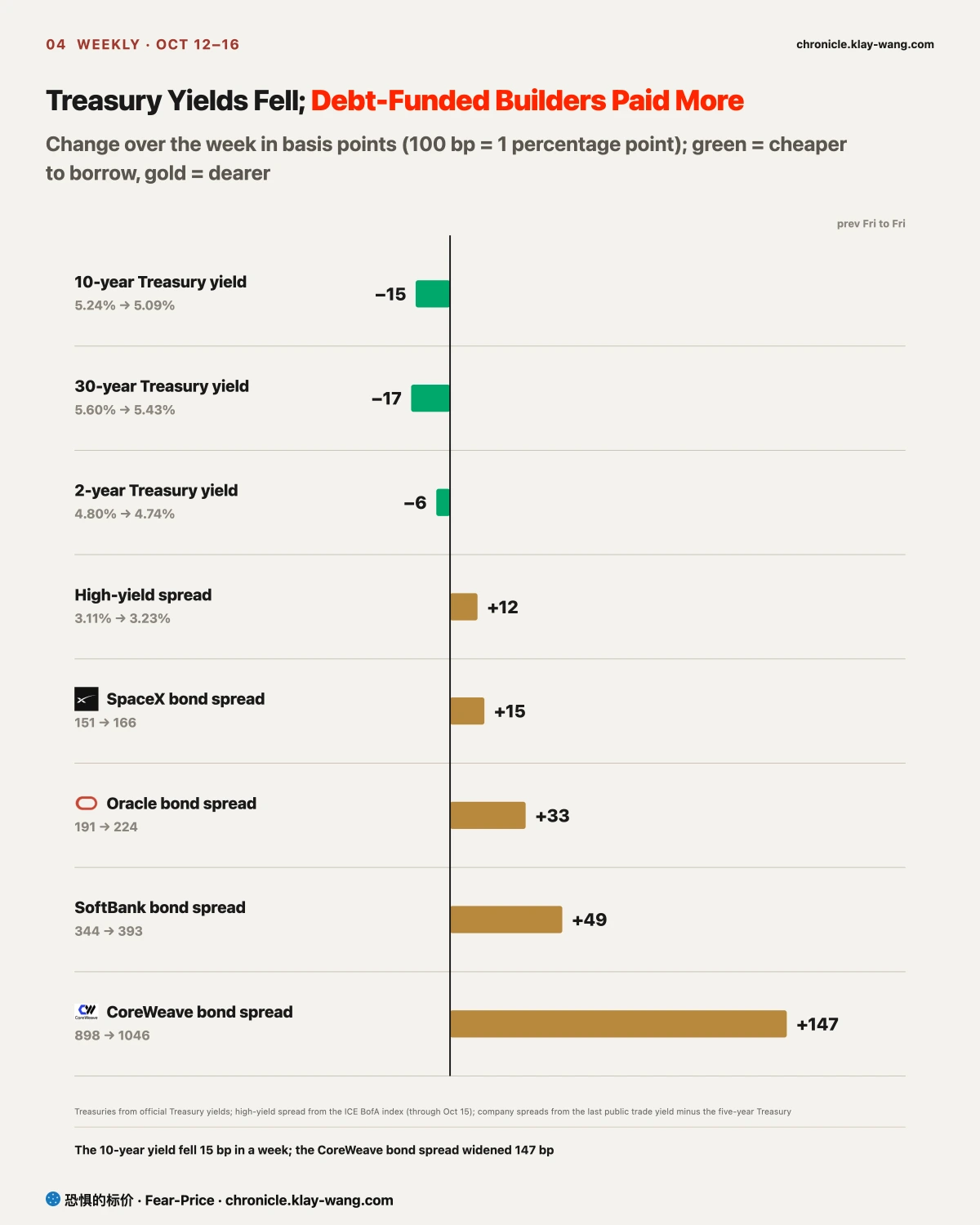
[Rates and Credit] Treasury Yields Fell, Yet Borrowing Got Dearer for Companies Building Data Centers
The 10-year Treasury yield fell from 5.24% to 5.09% over the week, the 30-year fell 17 basis points, and the long bond fund TLT rose 2.7%, so it got cheaper for the US government to borrow. Fed Chair Warsh, speaking in Bangkok on Friday, reportedly gave no direction on the next meeting, and the market read that as no further hike in October.
On the CoreWeave bond due 2031, the extra interest over Treasuries widened from 898 to 1046 basis points over the week, Oracle from 191 to 224, and the broader high-yield spread from 3.11% to 3.23% (through Thursday); companies, though, paid more to borrow. The Financial Times reported on Friday that Anthropic, raising debt to buy Google custom chips, offered Blackstone a yield above 10%, while companies of similar credit pay about 7% in the public bond market.
Jensen Huang said on Thursday that the CoreWeave cost of capital is coming down; the same week, its bond due 2031 yielded 15.3% on Friday, and S&P rates its credit B+, which is junk. Its three co-founders have kept selling stock since the March 2025 IPO: Bloomberg counted about 2.3 billion dollars in June, and the latest reports put it above 3 billion; the company says the three still hold about 20% together and the sales follow plans arranged in advance. Selling is not the same as a bearish view, but with a company that grows on borrowed money, how the money moves matters more than what anyone says.
The interest a company pays is the Treasury yield plus a spread, and the spread depends on whether lenders believe you can repay. So Treasury yields fell, the spread widened by more, and companies borrowing to build computing power paid more interest. That fits with AI stocks lining up this week by how close they are to borrowed money.
[Is This the Bottom?] A Losing Streak Is Not a Buying Point; Wait for the Panicked Sellers to Finish
The Philadelphia Semiconductor Index fell eight days in a row, matching October 2008. In the last three times since 2005 that it fell eight days in a row, day eight was never the bottom: a month later it was down another 4% to 13%, and the low within three months was another 11% to 30% lower. Three cases are too few to call a rule, and one was the financial crisis, but they are enough to say the length of a losing streak is not by itself a buying point.
Protection here means put options, which pay you the difference if the stock falls below a set price, and which get dearer the more the market expects the stock to swing. On Friday volume in Nvidia, Micron, SanDisk and Intel was only 1.0 to 1.15 times the 20-day average, and their one-month protection rose only 0.3 to 1.9 points; the heavy volume was in the semiconductor ETF SMH, at 2.6 times its 20-day average, which looks more like cutting the whole sector as a basket. The only names whose one-month protection rose about 10 points in a day were CoreWeave and Nebius, two companies building data centers on debt; Dell fell 23% on the week, left a downside gap from 482 to 502 dollars on Thursday, and its one-month protection rose above its one-year for the first time in our records. Bottoms usually come from fear, with heavy volume in single stocks and a rush for protection, and chip stocks had not reached that point this week.
If you are waiting to step in on the drop, you can first wait for one of two things. One is heavy volume in single stocks and a rush for protection followed by a recovery, meaning the panicked sellers are done; the other is the October 23 futures positioning report showing asset manager longs in Nasdaq futures still in place while platform earnings show no cut to capital spending, meaning demand has not changed.
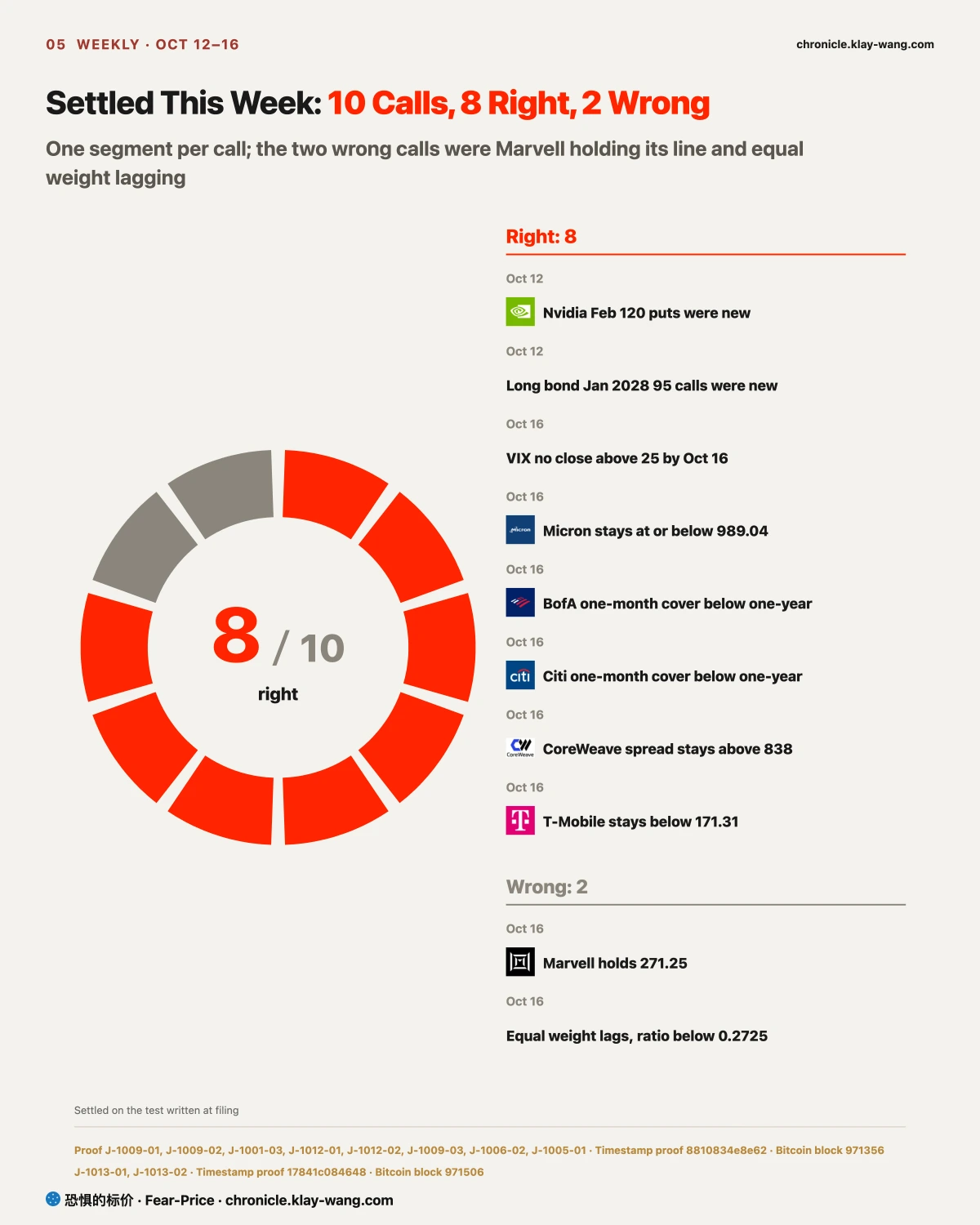
[What Our Data Tested This Week] The Right and the Wrong
When the market is bad, there is no rush to decide; look back at history, learn from it, and do not decide lightly. On the data we have been tracking, this week settled 10 calls, 8 right and 2 wrong; the filing date and result of each are in the judgment ledger at chronicle.klay-wang.com/options, so you can check that they were made beforehand, and whether a gap was later filled is on the same page. By the decision you would make:
If you wanted to chase the bounce: on Thursday a few words from Jensen Huang lifted CoreWeave 5.9%, and we wrote that day that its lenders were not convinced and its bonds were a better guide than its stock; our October 12 call that its spread would stay above 838 was right. On Friday it fell 11.9%, back below its Wednesday close; from the October 12 filing to Friday, the stock fell from 80.26 to 61.39.
If you wanted to catch the drop: on October 13 Micron opened 5.6% lower, and we called that the gap would not fill this week and that it would not close back above 989.04 on Friday; that was right. From that day close of 953.19 to 878.84 on Friday, it fell another 7.8%.
If you trade options: before earnings at Bank of America and Citi, one-month options were dearer than one-year, and we called that the gap would close once results were out; both were right. If you buy options before earnings, the extra you pay usually goes away once results are out.
If you hold a winning position: we called that VIX would not close above 25 in the first half of October, and that was right; one-year protection got less than a point dearer over the week. If you want one-year protection on a long-term position, the price has barely moved; what got dearer is next week through one month.
The two wrong calls: the Marvell call bet it would close above 271.25 every day; it closed at 227.83 on Friday, 16% below the line, and anyone who stepped in on that call lost money. Since 2016, after 16 similar heavy-volume surges, the stock fell back within eight trading days 6 times; we bet on the majority that did not fall back, and this time it landed in the minority. The call that the equal-weight S&P fund RSP (equal amounts of every S&P 500 stock) would lag SPY was also wrong; its premise was that long-term rates would not fall back, and the 10-year instead fell from 5.31% to 5.09%. The Marvell call was also settled early and pushed to the website in the early hours of October 13, voided the same day, and settled on Friday as originally scheduled.
[What Comes Next] Whether Dearer Money Reaches the Platforms, and Two New Calls
TSMC guided fourth-quarter revenue above estimates on Thursday, and Chairman C.C. Wei said he saw no slowdown in demand; one-year protection and borrowing costs at the big platforms barely moved this week. As long as those two hold, this round looks more like a valuation pullback packed into a few weeks, repricing the companies that grow on borrowed money. But the days of the platforms living on their own profits have a timeline: Goldman Sachs estimates platform capital spending at about 1.2 trillion dollars in 2027, more than the cash their operations bring in, with about 400 billion dollars to come from bond sales. By then the platforms will be borrowers too. If platform spreads stay above their one-month ranges for several days and one-year protection on Nvidia and TSMC starts to get dearer, or if from October 28 the platforms announce cuts to capital spending or cancel contracts, or if GPU rental prices start to fall, this reading no longer stands.
Two new calls, both based on data we track firsthand.
- Dell does not trade up to 502.32 by October 29 (the top of the Thursday gap). The reason: its one-month protection is dearer than its one-year, so the next few weeks are priced to swing more than the coming year, and the borrowing cost of its customer CoreWeave is still above 1000 basis points.
- In the October 23 futures positioning report, asset manager longs in Nasdaq futures stay at or above 110269 contracts, down no more than 3% from the last report. The reason: on Friday single chip stocks traded at normal volume, the selling went through a sector ETF as a basket, and SPY took in 8 billion dollars over five days, so there is no sign of long-term money pulling out.
[Holdings] What This Means for What You Hold
If you hold the S&P 500 ETF (SPY) or the Nasdaq 100 ETF (QQQ): this week 10000 dollars in SPY lost about 197 dollars, in QQQ about 552 dollars, while the equal-weight RSP gained about 49 dollars.
If you hold chips or memory: a losing streak is not a buying point; first watch whether single stocks trade heavy volume and whether protection gets snapped up, then the October 23 positioning report and platform capital spending.
If you hold computing renters and server makers (CoreWeave, Nebius, Super Micro, Dell): they fell a quarter on the week; until the spread is back under 1000, check the bonds first and the stock second.
If you hold the big platforms or Apple: borrowing costs and one-year protection barely moved; Meta reports on October 21 and Microsoft and Alphabet on October 28, and capital spending is the single most important number this month.
If you hold defensive stocks or energy: Coca-Cola, Walmart and Procter and Gamble went your way these two weeks, and if platform earnings confirm capital spending is not cut, AI stocks may be bought back; energy follows oil, and whether Brent holds 110 is the key.
Dates to Watch Next Week: Platform Capital Spending Matters Most
- October 21 (Wednesday): third-quarter results from Meta and Tesla; Nvidia keynote at its Berlin conference.
- October 23 (Friday): futures positioning report covering the big drops on Wednesday and Friday; the new slow-money call settles.
- October 28 (Wednesday): Fed meeting; third-quarter results from Microsoft and Alphabet; whether the S&P is still within 5% of 761.69 (the September 18 call settles).
- October 29 (Thursday): the Dell gap call settles.
- October 30 (Friday): whether the 10-year closes above 5% (the October 1 call settles; it was 5.09% on Friday).
Three Lines Worth Keeping This Week
- In the AI supply chain, the closer to borrowed money, the bigger the fall; among defensive stocks, the further from AI, the bigger the gain; stock prices re-sorted by who depends on borrowed money.
- Coca-Cola failed to hold up high on Thursday and held on Friday; relative strength, the money trail and whether prices hold up high are the three checks for sector rotation.
- Wait for heavy volume and a rush for protection followed by a recovery, or for long-term money and platform capital spending to give the answer, before thinking about stepping in; a losing streak alone is not enough.
No investment advice. No direction calls. No market timing.