Chip Stocks Fall Eight Days in a Row, Matching 2008: Is This a Full Panic?
Three Lines: Only Stocks Are Scared; Bonds, the Dollar and Crypto Did Not Follow
- The Philadelphia Semiconductor Index fell for an eighth straight day, matching October 2008; VIX rose a fifth in a day, yet the 10-year Treasury yield fell just 1 basis point and protection against rate swings got cheaper.
- The hardest hit, with the biggest jump in protection, were CoreWeave and Nebius, which borrow to build data centers; the big platforms fell with them, but their borrowing costs did not move.
- Money for protection crowded into next week through one month, and almost no one paid more for one year: the market is pricing a few dates, earnings and the Fed meeting.
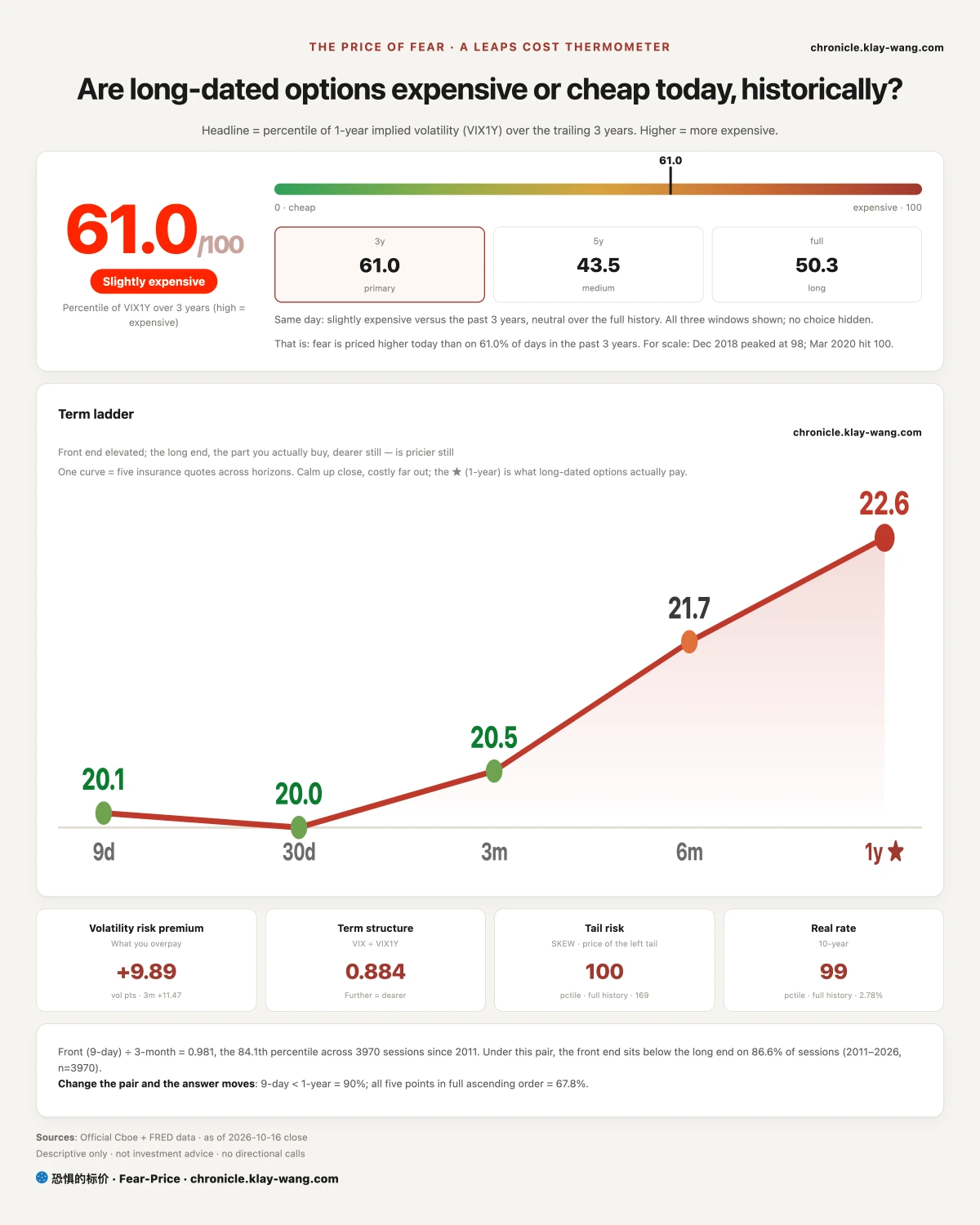
Fear-Price Index 61.0: One-Year Protection Rose Only 0.84 Points; Next Week Is What Got Expensive
Fear-Price Index · 2026-10-16 · Reading 61.0/100: one-year volatility VIX1Y at 22.61, in the 61.0th percentile of the past three years, where high means expensive. Daily ledger and definitions at chronicle.klay-wang.com · Please credit: Fear-Price Index · Fear-Price
The reading jumped from 43.0 on Thursday to 61.0, yet one-year volatility itself rose only 0.84 points. The percentile moved this far because nearly a fifth of trading days in the past three years sit between those two readings. If you want one-year protection on your US stocks, it costs only a little more than on Thursday. What really got dearer is the near term: 9-day volatility rose above 30-day, so the next few days are priced to swing more than the coming month.
The CNN Fear and Greed Index is 17.9 and the K index 0.897 (provisional), below the final 1.84 for Thursday and below 1 for the first time since April 7. The closer K gets to 1, the more of the gloom in the sentiment reading has turned into money spent on protection; below 1, the money spent on protection has caught up with that gloom. The Thursday edition, using that evening provisional reading, said VIX would have to rise above 31.5 for K to fall below 1; on Friday the sentiment reading itself dropped sharply, and K broke 1 with VIX under 20. Correction: the sentiment of 31.5 and K of 1.92 in the Thursday edition were provisional; the final figures are 30.3 and 1.84. History at chronicle.klay-wang.com/kindex, the index at chronicle.klay-wang.com/fear-price.
[Main Line] Is This a Full Panic? Only Stocks Are Being Repriced
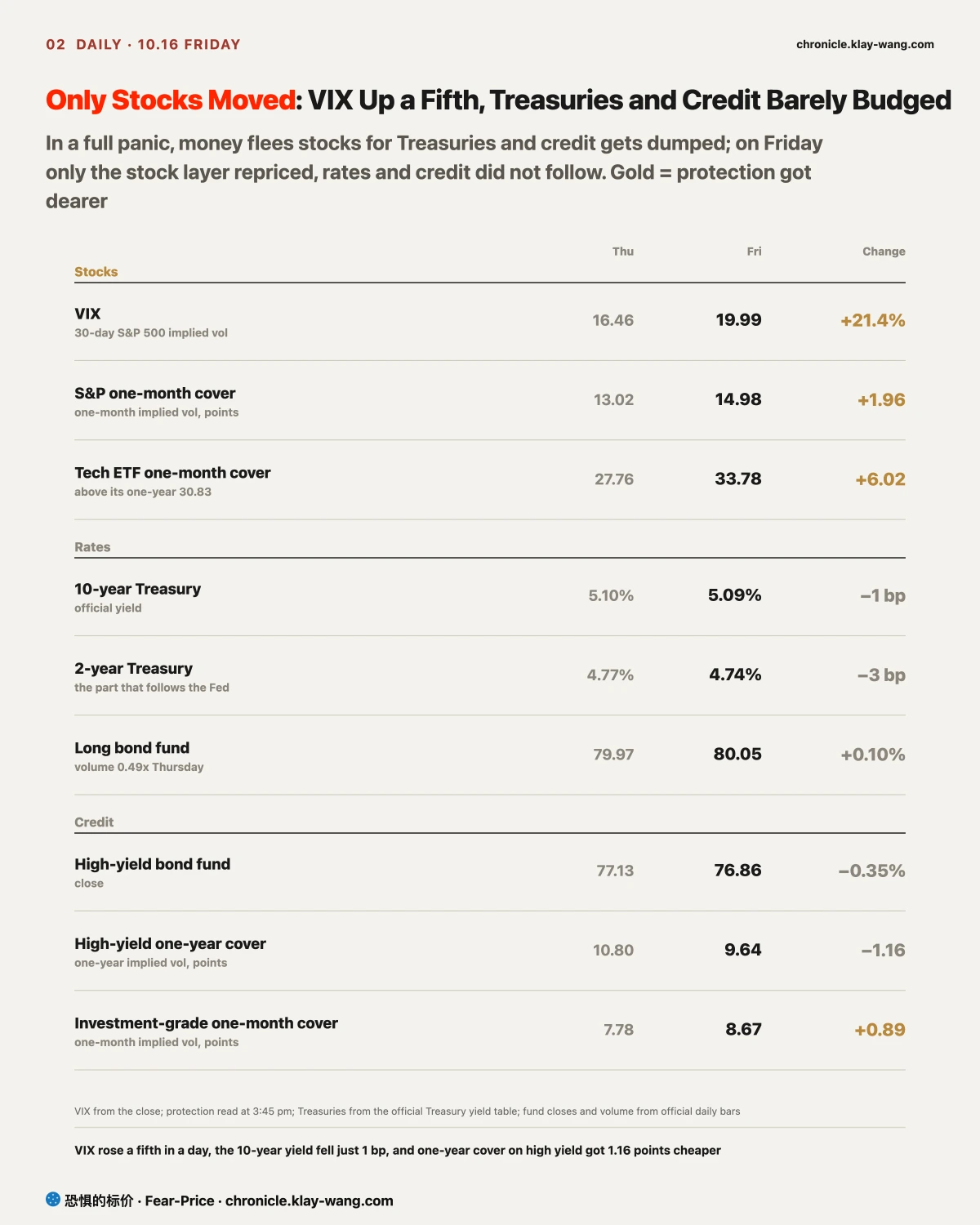
A full panic usually looks like this: money flees stocks for Treasuries and the dollar, and Treasury yields fall hard; nobody wants corporate bonds, and protection on high-yield bonds gets dearer. None of that happened on Friday. The 10-year Treasury yield was 5.09%, down just 1 basis point from Thursday, and the 2-year fell 3; MOVE, the price of protection against rate swings, fell from 102.49 to 101.10; one-year protection on the high-yield bond fund HYG got cheaper too. Fed Chair Warsh, at a public conversation in Bangkok, reportedly gave no direction on the next meeting, and the market read that as no further hike in October.
Other assets moved much the same way. UUP, the fund that tracks the dollar index, fell 0.3%, so safe-haven money did not run into the dollar; the gold fund GLD barely moved; BNO, the fund that tracks Brent crude, rose 3.6% as Brent touched 110 dollars a barrel during the day on an escalation around the Strait of Hormuz, which is inflation pressure, not a flight to safety. The bitcoin fund IBIT fell only 0.9%, while the crypto-linked stocks MSTR and COIN fell 6% to 10%: what got sold was the high-beta part of the stock market, not the coins themselves.
The real swings were only in stocks, and only in part of them. VIX rose a fifth in a day, and one-month protection on the tech ETF XLK rose 6 points in a day, above its own one-year level. The equal-weight S&P fund RSP fell only 0.42% and the cap-weight SPY 1.11%; energy XLE, utilities XLU and consumer staples XLP rose. Over the week it is clearer: the Dow still rose, the Nasdaq fell 4.5%, and the 10-year yield fell 15 basis points. This week stocks fell and Treasuries rallied, with the drop concentrated in large AI supply chain names; the market is not preparing for the economy to break.
The big platforms fell on Friday too: Microsoft, Amazon, Alphabet and Meta fell 2% to 3.7%. Has the trouble at the companies building data centers on debt spread to them? When a group falls ill at once, epidemiologists ask whether it is contagion or everyone ate from the same pot. If it were contagion, the platforms would see their borrowing costs and one-year protection rise as well; if it is the same pot, only their stocks and near-term protection move together, because everyone is priced off the same AI investment expectations. On Friday one-year protection on the four platforms rose only 0.3 to 0.7 points, and the bond spreads of Microsoft, Amazon and Alphabet stayed inside their one-month ranges. The stocks fell with the rest while borrowing costs did not: so far it looks more like the same pot than contagion.
[Building on Debt] What Jensen Huang Won Back on Thursday Was All Given Back on Friday; Its Lenders Never Bought It
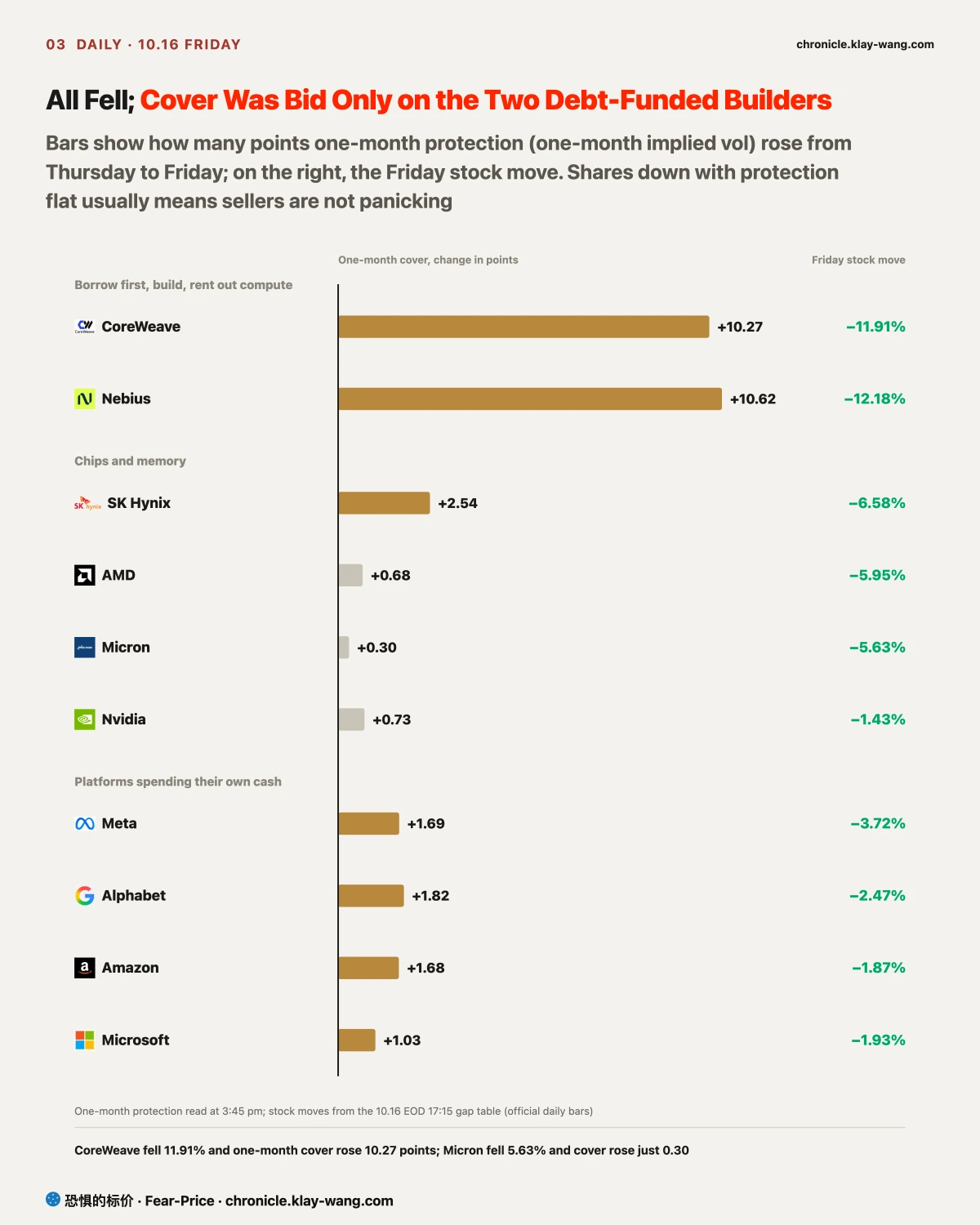
CoreWeave fell 11.9% on Friday to below its Wednesday close, giving back all of the bounce that followed the remarks by Jensen Huang on Thursday; Nebius fell 12.2%.
The Thursday edition said a few words had lifted CoreWeave stock, its lenders were not convinced, and its bonds were a better guide than its stock. On Friday the stock caught up with the bonds: its 2031 bond fell to 81.06 cents on the dollar, and the extra interest it pays over Treasuries (the spread) rose to 1045.5 basis points, above 1021 on Wednesday and the highest since records began on September 15.
Falling alike, they differ a lot in what it costs to insure against further drops, and that shows whether sellers are scared. This insurance is a put option: if the stock falls below a set price, it pays you the difference; the more the market expects the stock to swing, the dearer the insurance, and implied volatility is its price. One-month insurance on CoreWeave and Nebius rose about 10 points each in a day, with CoreWeave at 102, well above its one-year 83: someone is rushing to insure the next few weeks. Micron fell 5.6%, and its one-month insurance got only 0.3 points dearer. When a stock falls and its insurance does not get dearer, sellers usually are not scared; they are trimming on a plan, not rushing for the exit.
Dearer money for building computing power is not just a CoreWeave problem. The Financial Times reported on Friday that Anthropic is raising about 60 billion dollars of debt to buy about 1.5 gigawatts of Google custom chips, offering funds managed by Blackstone a yield above 10%; companies of similar credit pay about 7% in the public bond market, and the ICE BofA BB high-yield index yielded 6.84% on Thursday. The debt is to be repaid from the chip rent Anthropic pays over the next five years. The Thursday edition said large model companies are the customers who rent computing power; now even those customers have to pay three points or more above companies of the same credit.
[Chips] Eight Days Down Matches 2008; Slow Money Had Not Left as of Tuesday
The Philadelphia Semiconductor Index fell 3.83% on Friday, its eighth straight decline, about 15.7% in all over the eight days. Since 2005 there have been only three runs of eight days or more: May and June 2006 and October 2008. Another drop on Monday makes nine, matching May 2006.
Who is selling? A Goldman Sachs report said speculative money that piled into Nasdaq futures the week before the selloff has likely left, while the largest asset managers still hold their longs. We checked this against CFTC positioning data: as of October 13 (Tuesday), asset managers held 113679 Nasdaq futures longs, 858 more than a week earlier, about 70 billion dollars; slow money had not left as of Tuesday. The big drops on Wednesday and Friday will show only in the next report, out October 23.
Borrowing is also showing early signs of getting dearer for the companies that sell chips. The Thursday edition, using medians from October 9 to 15, said their spreads moved only plus or minus 10 basis points over a month; on Friday alone, the spreads of Broadcom, Nvidia and Micron were ten-odd to twenty-odd basis points above mid-September, with Broadcom at 93, the highest in a month. These are last-trade readings that jump a lot day to day, and they only count if they stay high for several days. If the report next Friday shows asset manager longs dropping sharply while one-year protection on Micron and Nvidia starts to get dearer, long-term money is leaving too, and that would be a bigger round of selling in chips.
[Trapped or Waiting to Step In] In the Last Three Eight-Day Runs, Day Eight Was Never the Bottom
Nvidia is 12% below its October 6 high; Micron and Intel are 30% to 37% below their June highs, and SanDisk is down 45%. Those who are trapped are asking whether to cut their losses; those waiting to step in on the drop are asking whether this is the bottom.
In the last three times since 2005 that the Philadelphia Semiconductor Index fell eight days in a row, day eight was never the bottom: a month later it was down another 4% to 13%, and the low within three months was another 11% to 30% lower. Three cases are too few to call a rule, and one was the 2008 financial crisis, but they are enough to say the length of a losing streak is not by itself a buying point.
Friday trading does not look like a bottom yet either. Bottoms usually come from fear: heavy volume in single stocks and a rush for protection. On Friday volume in Nvidia, Micron, SanDisk and Intel was only 1.0 to 1.15 times the 20-day average, and their one-month protection rose only 0.3 to 1.9 points, against 10 points in a day for CoreWeave. The heavy volume was in semiconductor ETFs, with SMH at 2.6 times its 20-day average: money is cutting the whole sector as a basket, not yet dumping any one name at any price.
Dell is the exception, falling more like CoreWeave. It lost 23% this week: on Wednesday Barclays cut it to Equal Weight, citing a high valuation and little evidence of enterprise AI demand; volume on Wednesday and Thursday was about twice normal, and Thursday left a downside gap from 482 to 502 dollars. On Friday it closed below 470, the strike with the most put open interest; its one-month protection rose above one-year for the first time since records began in mid-September, and its next earnings on November 24 fall outside that month, so the extra money is paying for the drop in front of it. Dell itself borrows cheaply, with its spread only 5 basis points above mid-September; the trouble is its customers: the first Nvidia GB200 rack Dell delivered, in November 2024, went to CoreWeave. On the tape, the market has not yet shown a bottom in Dell: that would take a close back above 482, one-month protection back below one-year, and the CoreWeave spread back under 1000, which would mean the panicked sellers are done.
On price, Nvidia, Micron, SanDisk and Intel are all below their 50-day lines and still above their 200-day lines: Nvidia is 5.7% above its 200-day line, Intel 6.3%, SanDisk 7.3%, Micron 22.5%. The 200-day line is the average close of the past nine-plus months and is often treated as the long-term dividing line. Those waiting to step in can first wait for one of two things: heavy volume and a rush for protection followed by a recovery, meaning the panicked sellers are done; or the October 23 report showing asset manager longs still in place while platform earnings show no cut to capital spending, meaning demand has not changed. If you are trapped in a position, these are the same two things to watch, not the daily drop.
[Next Week to Next Year] Money Is Buying Next Week Through One Month; No One Is Paying More for a Year Out
Line up protection by expiry and the money is crowded up close. 9-day volatility is above 30-day; in VIX futures, the contract expiring October 21 is dearer than the next month. Among large index option trades expiring in two weeks to three months, S&P put volume was more than three times call volume, and small caps more than five times.
Further out, one-year protection barely moved. Across one-year at-the-money options on our 34 stocks, CoreWeave rose the most on Friday, by 3.2 points; the rest stayed within plus or minus 1 point, and SK Hynix, TSMC and Broadcom got slightly cheaper. The coming month holds earnings from Meta, Tesla, Microsoft and Apple, and the October 28 Fed meeting: money is paying for those dates, not for next year.
[Connecting the Dots] How the Market Took Its Stand, Step by Step, This Month
This week lines up with two points in the late-September monthly review. One: the S&P looked steady in September only because a few big names in chips, memory and Meta held it up, and if they could not hold up through October earnings, neither could the index. This week those names fell together and the S&P lost about 2% on the week, so that call is starting to play out. Two: the market treated the rate hike as a one-off, so the price of one-year insurance on the whole stock market never followed rates higher; as of this week, one-year insurance is only slightly dearer, and that still holds.
The October 9 weekly review said the AI supply chain was being re-sorted by who gets the money first. Each day this week pushed that one step further: on Monday the companies paying the most to borrow fell the most; on Thursday demand for chips held while borrowed money pulled back; on Friday the stock drop spread to the big platforms, while borrowing costs did not.
Over the month, the market priced rates first, then the companies that borrow, and is now repricing stocks across the whole AI supply chain, but it has not priced in the economy or the wider credit market.
We also got one wrong. The monthly review said it was hard to say long-term rates had peaked before the October events; instead the 10-year fell from 5.31% on October 5 to 5.09%. The same thing led to the October 5 call, that equal weight would lag cap weight, being withdrawn.
[What Comes Next] Three Things to Watch
First, borrowing costs at the big platforms. They buy computing power with their own profits; as long as their spreads and one-year protection stay put, this drop in chip and AI stocks looks more like a pullback packed into a few weeks, a cut in valuations, not in demand. If over the next few days the spreads of Microsoft, Alphabet, Amazon and Meta stay above their one-month ranges while one-year protection on Nvidia and TSMC starts to get dearer, the trouble has spread from those who borrow to those who pay, and that would be a bigger round.
Second, the companies building data centers on debt need something concrete. Until the CoreWeave spread is back below 1000 basis points, each bounce in the stock is just a bounce; the most direct ways to make its borrowing cheaper are a bigger guarantee written into contracts or new equity coming in, and then rent income growing faster than interest.
Third, a few dates. On October 21 Meta and Tesla report and Nvidia holds its conference in Berlin; on October 23 the futures positioning report covering this selloff comes out; on October 28 the Fed meets, and Microsoft and Alphabet report the same day. If the platforms announce cuts to capital spending with their results, demand for chips is weakening too, and the reading of this month would no longer stand.
[Settled] Eight Calls Due Friday: Six Held, Two Withdrawn
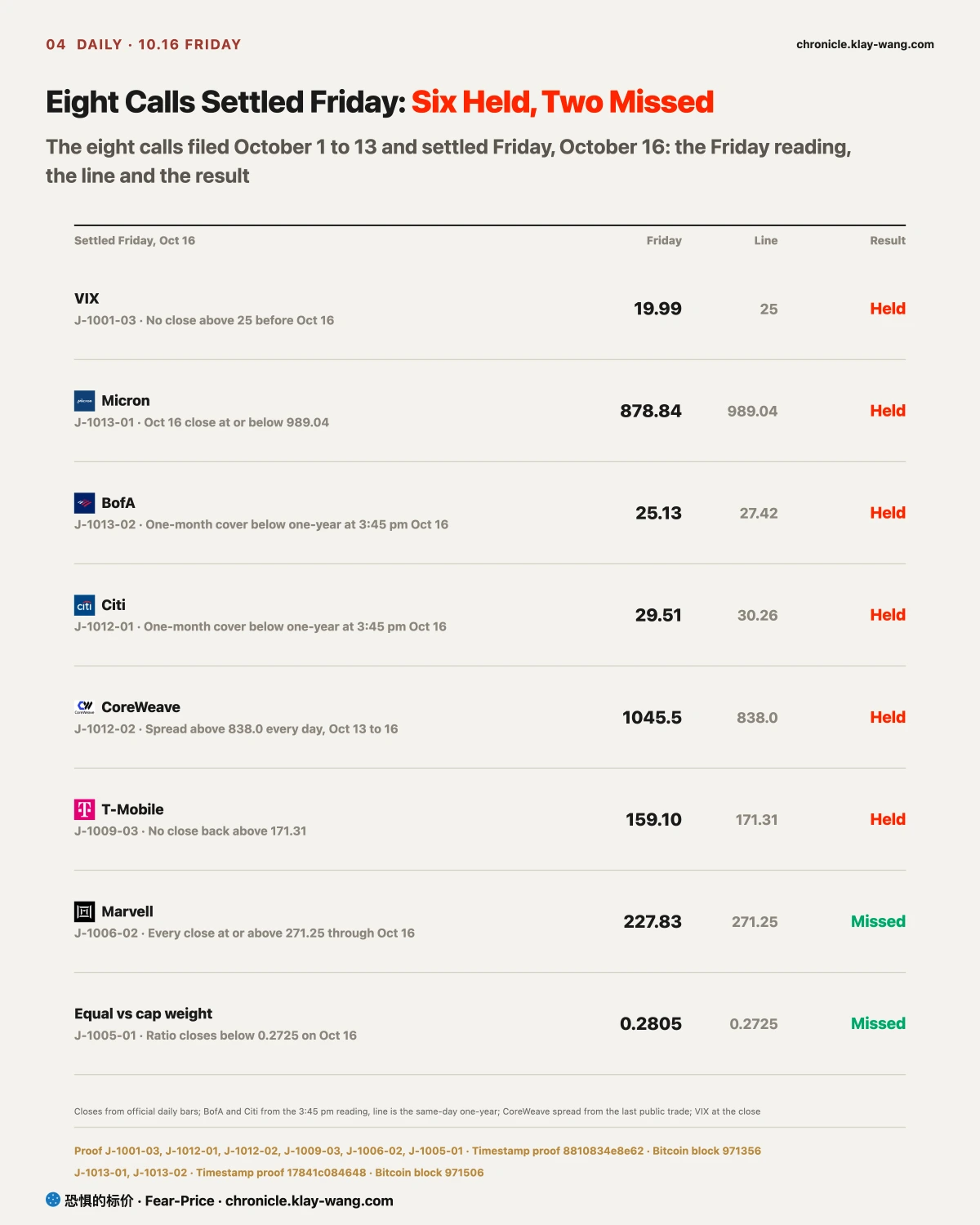
These eight were filed between October 1 and 13 and settled on Friday: six right, two wrong.
- VIX no close above 25 (filed October 1): VIX closed at 19.99 on Friday with an intraday high of 22.31, never above 25, held. The call read the first half of October as calm up close; the near term turned unsettled on the last day but never reached 25.
- Micron no close back above 989.04 (filed October 13): it closed at 878.84 on Friday, held.
- Bank of America and Citi one-month protection back below one-year (filed October 13 and 12): at 3:45 pm on Friday, Bank of America one-month was 25.13 against one-year 27.42, and Citi one-month 29.51 against one-year 30.26; both held. The extra premium paid before earnings came off once results were out.
- CoreWeave spread stays above 838 (filed October 12): the four readings from October 13 to 16 were 969, 1021, 995 and 1046, all above 838, held.
- T-Mobile no close back above 171.31 (filed October 9): it closed at 159.10 on Friday, held.
- Marvell closes above 271.25 every day (filed October 6): it first closed below the line at 265.86 on October 12 and closed at 227.83 on Friday, withdrawn.
- Equal-weight S&P lags cap-weight, ratio below 0.2725 (filed October 5): the ratio was 0.2805 on Friday, withdrawn. The premise was that long-term rates would not fall back; the 10-year fell from 5.31% that day to 5.09%, so the premise failed.
What This Means for What You Hold
If you hold computing renters (CoreWeave, Nebius, Oracle): the bounce from a few words on Thursday was all given back on Friday; until the spread is back under 1000, check the bonds first and the stock second.
If you hold the big platforms (Microsoft, Alphabet, Amazon, Meta): the stocks fell with the rest, while borrowing costs and one-year protection barely moved; Meta reports on October 21, and its one-month protection is already above one-year, so the earnings risk is already in the price.
If you hold energy and defensive names: energy XLE rose with oil, and whether Brent holds 110 is the key; consumer staples XLP and utilities XLU rose a little, but health care XLV fell, so defensives were not bought together.
Three Lines Worth Keeping
- In a full panic money runs into Treasuries and the dollar; on Friday VIX rose a fifth, the 10-year yield fell just 1 basis point and the dollar fell too, so the fear was only in stocks.
- When everything falls, look at who is rushing for protection: Micron fell 5.6% with protection barely moving, while CoreWeave fell 12% with near and far protection both rising.
- The platforms fell with the rest because they ate from the same pot; only when their borrowing costs and one-year protection rise too has the trouble spread to them.
No investment advice. No direction calls. No market timing.