Everyone Says US Stocks Crashed. It Was Treasuries That Swung Violently
Three Lines: The Selling Hit the AI Supply Chain While Companies With Early Cash Rose
- 336 of 503 S&P 500 stocks rose, high-yield bonds held up and the term structure of S&P protection stayed normal. Thursday was far from a crash.
- Tesla spent less and Meta spent more while planning new shares. Within the AI supply chain, the further a segment sits from end-customer cash and the more it relies on borrowing, the harder it fell and the more its downside insurance and borrowing cost rose.
- The 10-year Treasury yield fell to 4.96% in a day, Coca-Cola and Berkshire closed at records, and AI borrowers paid wider spreads.
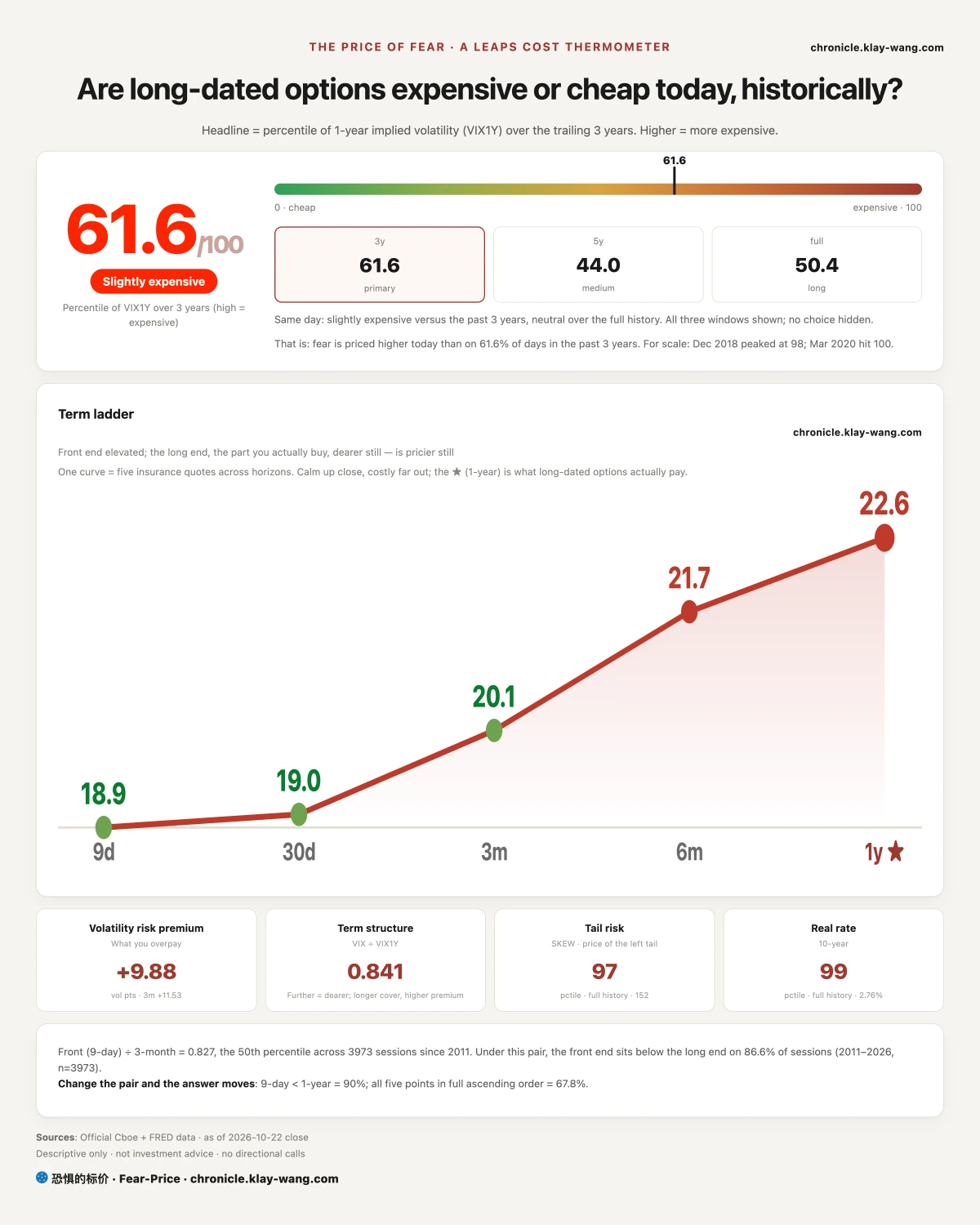
Fear-Price Index 61.6: One-Year Insurance on US Stocks Got Pricier, Not Yet Scrambled For
Fear-Price Index · 2026-10-22 · Reading 61.6/100: one-year volatility VIX1Y was 22.62, in the 61.6th percentile of the past three years, where high means expensive. Daily ledger and definitions at chronicle.klay-wang.com · Please credit: Fear-Price Index · Fear-Price
The Fear-Price Index measures how expensive one-year downside insurance on US stocks is compared with the past three years; a higher reading means pricier. Protection in this note means that kind of downside insurance, put options, priced through implied volatility.
The reading rose from 50.0 on Wednesday to 61.6, and one-year volatility rose from 22.03 to 22.62. VIX jumped 14% to 19.03, yet protection from nine days to one year still cost more the further out it went. Whether near-term insurance starts costing more than long-dated insurance can be tracked daily at chronicle.klay-wang.com/leaps.
SKEW was 152.39, in the 97.4th percentile since 2011; it measures the price of insurance against deep declines. A correction: Wednesday note said SKEW rose to 150.36. The Cboe official reading was 160.40 on Tuesday, so Wednesday was a 10-point decline.
CNN Fear and Greed was 19.8, in extreme fear. The K Index was 1.041 (provisional), below the final 1.632 on Wednesday. The closer K gets to 1, the more people turn pessimism into paid protection. With Fear and Greed at 19.8, VIX would need to rise above 19.8 for K to fall below 1. Whether it breaks 1, and what followed each past break, can be checked at chronicle.klay-wang.com/kindex.
[Not a Crash] A Crash Needs Several Things at Once; Thursday Had None of Them
In a full market crash, people sell for cash and sell whatever they can: defensive stocks and junk bonds fall together and about nine in ten stocks decline. Near-term S&P insurance costs more than one-year insurance because everyone pays for the next few days, and the dollar gets bid as dollar borrowers scramble to repay.
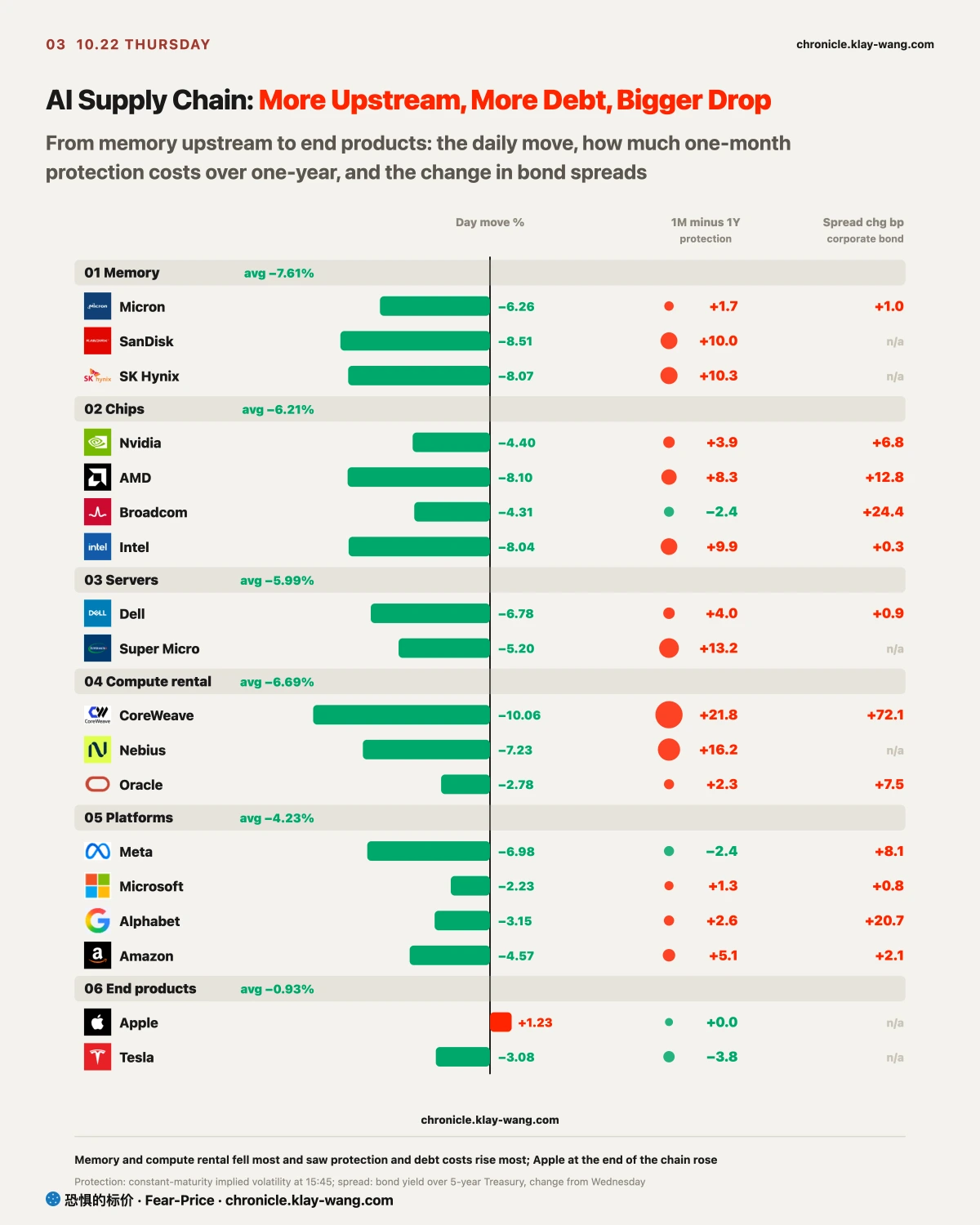
On Thursday the S&P 500 fell 1.21%, yet 336 of its 503 members rose, the equal-weight S&P gained 0.72% and the Dow was flat. The high-yield bond ETF edged up, S&P protection still cost more the further out it went, and the dollar barely moved. The index fell because tech carries a heavy weight in it, and the selling concentrated in the AI supply chain. Thursday was far from a crash, and far from broad panic. If you hold a broad index fund, most of the 1.2% decline came from the tech weight.
It was Treasuries that swung violently. According to Dow Jones Market Data, the 10-year yield fell 19.3 basis points in a day, the largest daily move since March 2023. Over the past decade there were only 15 moves that large, a span that includes the pandemic, the 2023 regional bank crisis and the tariff shock of April last year. Stocks only reshuffled, while Treasuries had a crisis-sized day. A Mackenzie Investments fixed income strategist said investors were taking profits on this year tech gains, some money moved into Treasuries, and earlier bond shorts were covering, which amplified the buying. Long-dated Treasury calls cost more than puts for the first time in seven months, a bet that yields fall further.
The calls we have filed so far still have time on our side. The S&P 500 is bumpy, not trending, through October 28; Thursday close was only 0.3% from the September 18 baseline. Dell would not trade at 502.32 dollars intraday through October 29; Wednesday high reached 502.00, missing by 0.32 dollars.
The call that the 10-year stays above 5% on October 30 has six trading days left and currently sits on the losing side. Friday settles whether asset managers held their Nasdaq futures longs, with the CFTC report out Friday. Every call, with its filing text and settlement date, sits in the ledger at chronicle.klay-wang.com/options, right or wrong.
[AI Supply Chain] The Further From End-Customer Cash and the More Borrowed Money, the Harder the Fall
This is how money moves along the AI supply chain. Users and advertisers pay platforms such as Meta and Microsoft. Platforms spend part of it on capex, buying servers and renting compute. Server makers and compute rental firms then buy chips and memory, and chipmakers buy equipment. Upstream revenue is downstream capex. Each dollar less spent downstream is a dollar less received upstream, and when downstream spending depends on new shares or new debt, that upstream revenue becomes less certain.
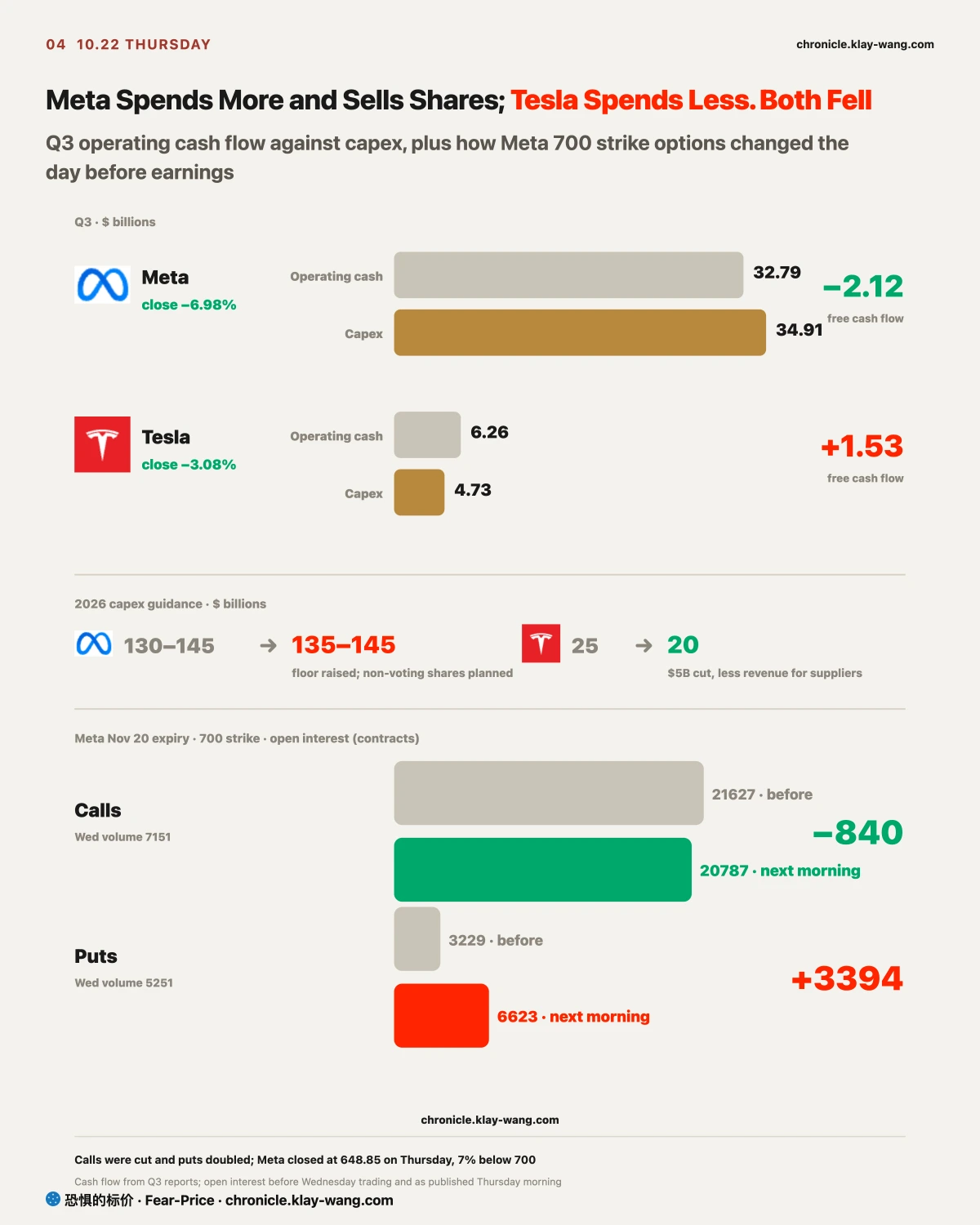
On Thursday, Tesla cut its capex plan for this year from 25 billion dollars to 20 billion dollars. Meta spent more on capex in the third quarter than it generated in operating cash flow, raised the floor of its full-year range and proposed issuing non-voting shares to raise money. On the same day, chip equipment maker Lam Research guided next-quarter revenue below expectations. Two downstream companies gave opposite answers.
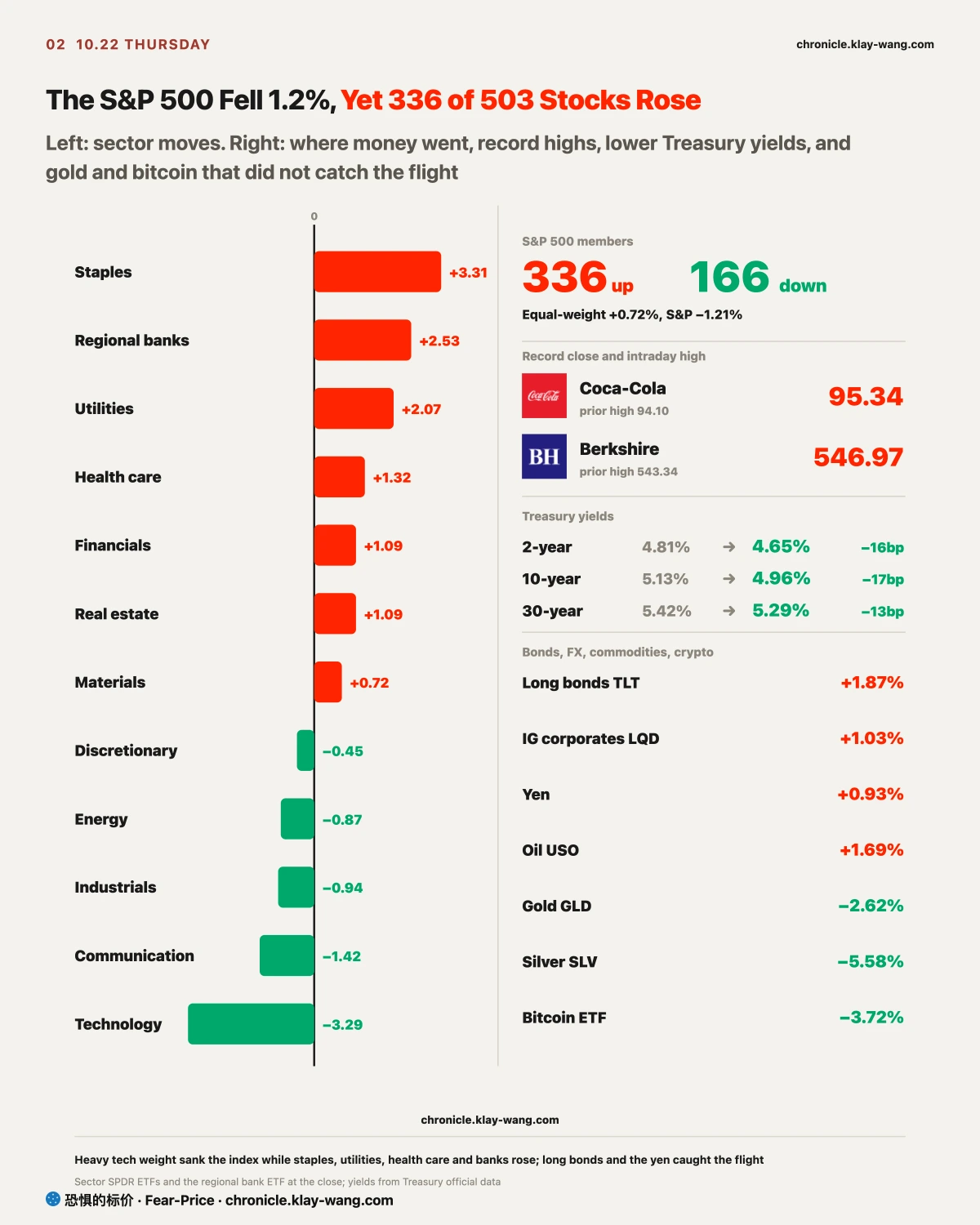
Laid out by segment, the further upstream, the bigger the drop, and compute rental firms building data centers with debt fell hardest. Memory stocks fell 7.6% on average and CoreWeave fell 10%. Chips and servers fell about 6% on average, platforms about 4%, and Apple, at the end of the chain and collecting cash directly from phone buyers, rose 1.2%. Chip stocks gapped lower and kept selling during the session, most closing in the bottom fifth of their daily range on volume 1.2 to 1.4 times normal, with the semiconductor ETF near twice normal. Monday note described chips opening higher and being sold on light volume; Thursday was a different pattern, with sellers present all day.
We track downside insurance premiums and corporate bond spreads every day, and this is how both moved on Thursday. First, on the same stock, one-month insurance normally costs less than one-year insurance on an annualized basis; when the one-month premium costs more, someone is rushing to pay for the next few weeks.
CoreWeave one-month premium was 21.8 points above its one-year premium, SanDisk and SK Hynix about 10 points, and Nvidia and the semiconductor ETF 4 to 5 points. Microsoft and Alphabet were only 1.3 and 2.6 points higher, and the S&P one-month premium still cost less than one-year.
On corporate bond spreads, the extra interest a company pays over Treasuries: Treasury yields fell, yet 14 of the 15 AI issuers with trades that we track saw spreads widen. CoreWeave widened 0.72 percentage point and its bond yield rose to 15.59%; SpaceX and Broadcom widened 0.2 to 0.3 point, while Microsoft, Amazon and Dell barely moved. The price of protection rose only upstream. Borrowing costs rose only for companies that expand with debt. These two readings do not show up on a quote screen.
Memory fell the most partly because of positioning. Western Digital reported quarterly revenue up 55% after the close and guided above expectations, yet the stock fell more than 8% after hours, and Seagate and SanDisk followed. According to FactSet, SanDisk is still up about 430% this year and Micron about 200%. Good results sold anyway, which suggests holders with large gains are cashing in. Jensen Huang saying he sees no memory oversupply before 2029 did not stop it.
Our October 16 note said bottoms usually come after individual stocks trade heavy volume and protection gets scrambled for; Monday note added that protection prices then need to ease. Thursday showed the first two together for the first time in these notes; the third has not appeared. Over the next few trading days, semiconductor one-month protection falling back below one-year while prices stop making new lows would match what we wrote. If one-month protection keeps rising and high-yield bond protection follows, the reading that the scramble is confined to AI hardware does not hold, and the scope is widening. If you hold chip stocks, watch those two before deciding whether to step in.
[Room Opened by the Drop] Separate Stocks Dragged Down From Stocks That Should Fall
Happy families are all alike; the stocks that fell on Thursday each fell for their own reason. Memory, Dell, AMD and Marvell are up 1.4 times to 4.3 times this year, with SanDisk at 16 times earnings and AMD at 129 times. Holders sit on the thickest gains, good results still sold, so this group is cashing in and may not be cheap after the drop. CoreWeave still loses money and its borrowing yield rose to 15.59% on Thursday; the stock is falling on funding cost, and until spreads ease, no size of decline makes it a level.
The other group was dragged down by the supply chain. Nvidia is up only 14% this year, Alphabet and Amazon less than 10%, and Meta is down, all lagging the Nasdaq 100. At Wednesday close, Nvidia traded below its P/E for 98.85% of the past five years and Alphabet below 98.72% of the past three years. Amazon was below 91.71% of the past five years, and each fell another 3% to 4.6% on Thursday.
They have their own problem: Amazon and Alphabet, like Meta, posted negative free cash flow in their latest quarter, with capex running ahead of operating cash flow, and third-quarter numbers arrive next week. The difference is borrowing cost. Spreads for Nvidia, Amazon and Meta widened only 2 to 8 basis points; Alphabet bond widened 0.21 point and needs a few more days. Their one-month premiums were 2.6 to 5 points above one-year, and Meta one-month cost less, nowhere near the 21.8 points at CoreWeave. Institutions would put this group on a watch list: valuations were not stretched, borrowing cost barely moved, and Thursday drop came mainly from supply-chain sentiment.
Our September 18 note filed a call that after rate hikes, the expensive group with the most distant cash flows would be repriced first, while the cheaper group (Nvidia, Alphabet, Goldman Sachs) would hold up relatively. On Thursday SanDisk and Intel fell more than 8%, Nvidia and Alphabet 3% to 4.4%, and Goldman only 1.5%. The direction matches, and the settlement window opens after October 28.
When would this case fail? If Microsoft, Alphabet and Amazon results on October 28 and 29 show capex pulling clearly further ahead of operating cash flow, or if their bond spreads start rising with CoreWeave. Before then, semiconductor one-month protection returning below one-year would show the forced sellers are done. If you are thinking of adding here, those two readings matter more than a single day move.
[Meta and Tesla] Spending More With New Shares, Spending Less and Hurting Suppliers; the Market Bought Neither
Meta third-quarter operating cash flow was 32.79 billion dollars and capex 34.91 billion dollars, leaving 2.12 billion dollars to be covered from cash or outside financing. Reuters described it as the first quarterly cash outflow in more than a decade. In its filing, an independent board committee warned that borrowing at the contemplated scale could hurt its credit rating, and the company also proposed issuing new shares. The new shares carry no votes, so Zuckerberg control does not shrink; the dilution falls on profit per share for existing holders.
Meta still holds 82.45 billion dollars of cash and marketable securities, and operating cash flow of about 97 billion dollars in the first nine months still exceeds capex of about 86 billion dollars, so money is not short for now. If even Meta weighs the cost of borrowing, compute rental firms upstream that expand mainly with debt are in a tougher spot. If you hold Meta, the number to watch is the gap between next-quarter capex and operating cash flow.
Options positioning had already shifted the day before earnings. Meta November 20 calls at the 700 strike traded 7151 contracts on Wednesday, and open interest published Thursday morning fell from 21627 to 20787. Puts at the same strike rose from 3229 to 6623, doubling. Volume does not show direction; next-morning open interest shows what stayed: calls were reduced and puts were opened. Meta closed Thursday 7% below 700 dollars.
Tesla third-quarter free cash flow was a positive 1.53 billion dollars. After the capex cut, the stock gapped 3.15% lower, never recovered during the session and closed near the low of the day. Its valuation rests on future businesses such as autonomy and robotics, so pushing spending out pushes those businesses out. Analysts at JPMorgan and StoneX both see it as a deferral, with spending rising again from 2027.
[Rates] Oil at a Five-Month High, Yet the 10-Year Yield Fell Back Below 5%
Houthi forces struck Saudi Arabia again, and crude rose to a five-month high. Higher oil usually lifts inflation expectations and pushes Treasury yields up. Thursday went the other way: the Treasury Department 10-year yield fell from 5.13% to 4.96%, its first close below 5% since September 22 (the 19.3 basis points from Dow Jones uses a different source and timing, so the figures differ slightly), and the 2-year fell from 4.81% to 4.65%, the largest daily drop this year.
The 2-year sits closest to market expectations for the next few Fed meetings. It fell as much as the 10-year, which means the market is trimming how many more hikes it expects. The tech selloff made investors reassess growth, and inflation pressure from oil moved to the back of the queue for now.
Our October 1 note filed the call that the 10-year yield would still close above 5% on October 30, because the compensation for lending long had not eased. It closed at 4.96% on Thursday with six trading days left. It will settle on the original text, and if it is wrong, it is recorded as wrong.
When rates fall, companies with steady, early cash benefit first. Consumer staples rose 3.31%, and utilities, health care and regional banks also gained; Coca-Cola closed at 95.34 dollars and Berkshire B shares at 546.97 dollars, both records intraday and at the close. Gold, silver and bitcoin did not catch the safety money, and gold fell 2.62%. If you hold high-dividend stocks, the 10-year is the one number to watch.
What This Means for What You Hold
If you hold memory and chip stocks: Thursday opened with selling, kept selling during the session and ran on heavy volume, with protection scrambled for, and memory added profit-taking. Until semiconductor one-month protection returns below one-year and prices stop making new lows, there is no need to act on a single day decline.
If you hold compute rental names such as CoreWeave, Nebius and Oracle: Treasury yields fell but their extra interest did not, and CoreWeave paid 0.72 point more. Check bond spreads first, then the stock.
If you hold Nvidia, Alphabet, Amazon, Meta or Microsoft: platforms and Nvidia fell less than upstream, valuations sit near multi-year lows and cash flow is still there. For Meta, watch how many new shares are issued and at what price; for Microsoft and Alphabet on October 28 and Amazon on October 29, watch whether the gap between capex and operating cash flow widens or narrows.
If you hold Tesla: free cash flow turned positive, spending moved out and the stock closed near the low of the day. Whether the spending increase analysts expect next year appears in guidance is the next number to watch.
If you hold staples, utilities or banks: Thursday gains came from lower rates and rotation. Whether the 10-year holds below 5% decides how far this rotation runs.
Three Lines Worth Keeping
- 336 S&P 500 stocks rose, high-yield bonds and the term structure of S&P protection held up; Thursday was the AI supply chain being repriced, far from a crash.
- Upstream revenue is downstream capex; the further from end-customer cash and the more debt-funded the segment, the harder it fell and the more its downside insurance and borrowing cost rose.
- Treasury yields fell, yet CoreWeave paid 0.72 point more in extra interest; buying went to Treasuries and to companies with early cash that do not depend on borrowing.
No investment advice. No direction calls. No market timing.