The AI Trade Is Splitting: Apple at a Record, Meta 19% Off Its High, and Bond Investors Charge Nvidia More
Three Lines: Tech Insurance Is Easing, Next Week Decides Whether to Buy, and the Defensive Rally Lacked New Money
- The Nasdaq 100 is 7.6% below its early-October high, and one-month premiums on stocks broadly eased; options price the Nasdaq to move 4.2% either way over the next two weeks and the Magnificent Seven 5% to 9%.
- Borrowing costs rose this week for all five Magnificent Seven names with bonds trading, and SpaceX widened more than any of them; among memory stocks, Micron premiums and borrowing cost are back to normal, while SanDisk still faces results on October 29.
- On the day defensive stocks surged, utility and health care funds saw 1.1 billion dollars of net redemptions, and more than half the gain was gone by Friday; financials are not on the defensive side, as credit insurance rose two days in a row.
Fear-Price Index 67.3: Nasdaq Near-Term Insurance Fell Back Below Long-Term, Yet One-Year Insurance Keeps Getting Pricier
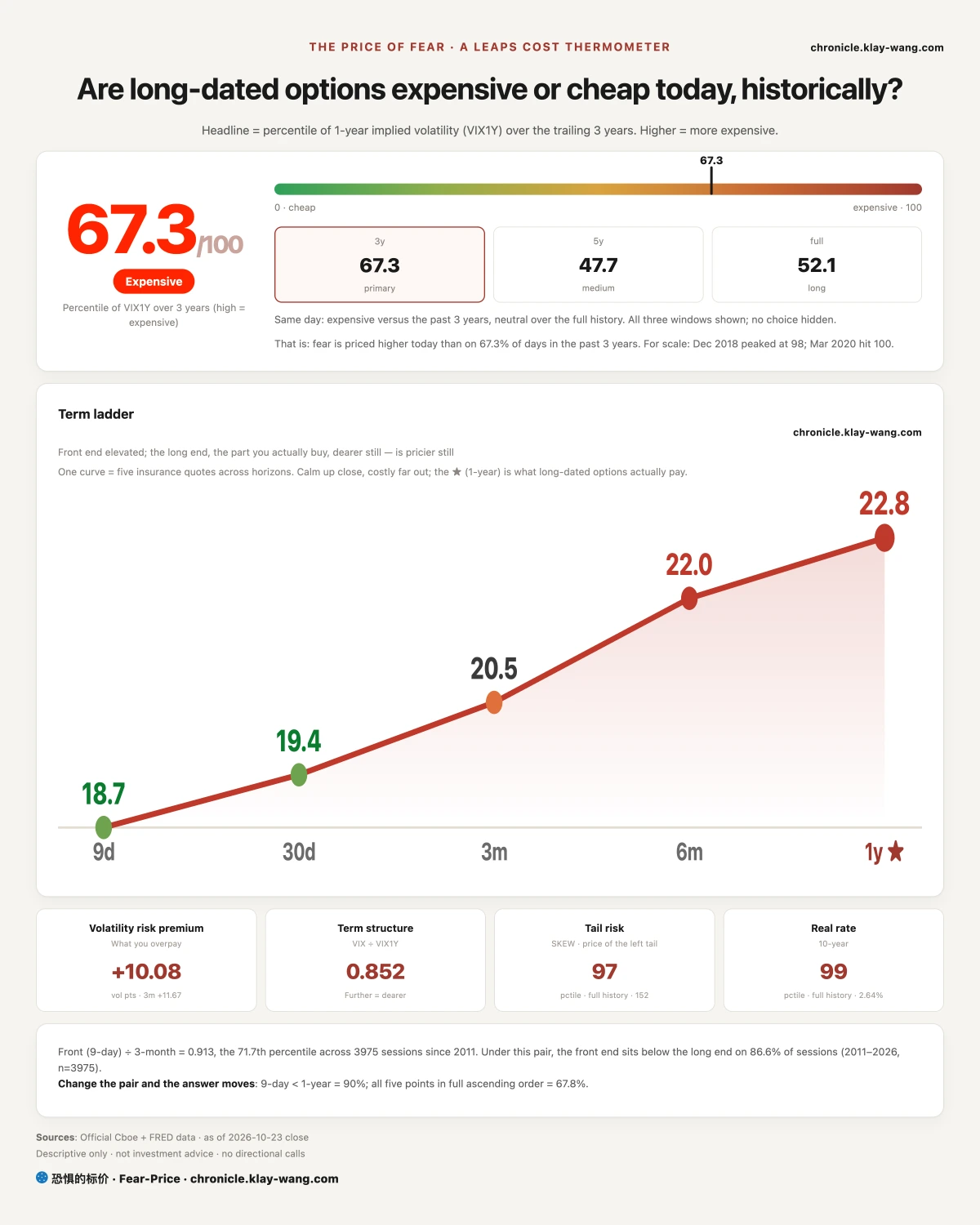
Fear-Price Index · 2026-10-23 · Reading 67.3/100: one-year volatility VIX1Y was 22.82, in the 67.3rd percentile of the past three years, where high means expensive. Daily ledger and definitions at chronicle.klay-wang.com · Please credit: Fear-Price Index · Fear-Price
The Fear-Price Index measures how expensive one-year downside insurance on US stocks is compared with the past three years; a higher reading means pricier. Downside insurance means put options; the more the market expects stocks to swing, the higher the premium.
The reading rose from 61.6 on Thursday to 67.3, and VIX edged up from 19.03 to 19.45. Premiums from nine days to one year still rose the further out they went; Nasdaq one-month insurance cost more than one-year insurance on Thursday for the first time since our record began in late July, then fell back below on Friday. Nobody scrambled for the next few days; the added price went onto a longer stretch of time. If you hold only index funds, one-year protection now costs more than on two-thirds of the days in the past three years.
The K Index was 1.079 (provisional), above the final 1.022 for Thursday, which replaces the provisional 1.041 in the Thursday note. The closer K gets to 1, the more people turn pessimism into paid protection; with Fear and Greed at 21.0 on Friday, VIX would need to rise above 21.0 for K to fall below 1, and what followed each past break can be checked at chronicle.klay-wang.com/kindex.
[The Index] The S&P 500 Closed at Its 760 Put Wall, Yet Near-Term Insurance Was Not Bid
The S&P 500 fell only 0.52% on Friday and the Nasdaq 100 closed flat. A few large stocks were holding the index up: 366 of 503 S&P members fell. The S&P ETF closed at 759.97, right at 760, where put open interest is heaviest; the Nasdaq ETF closed at 704.40, 7.6% below its early-October high, with its heaviest put strike at 700.
Below 775 on the S&P ETF and 747 on the Nasdaq ETF, these levels matter: market makers hedge in the direction of the move, selling into declines and buying into rallies, which amplifies swings. Both are below those lines now.
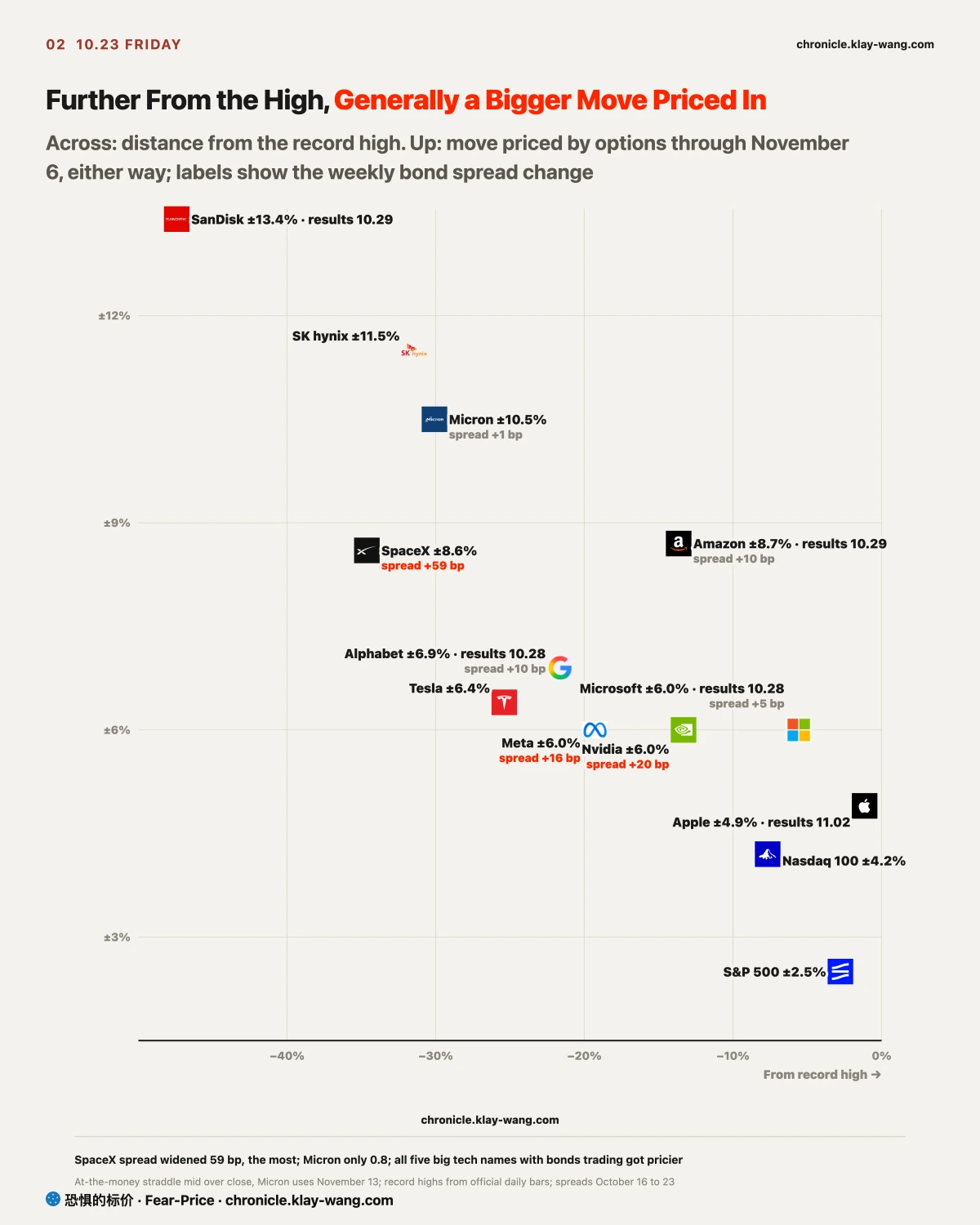
Options have priced the next two weeks. By November 6, the S&P 500 is priced to move 2.5% either way and the Nasdaq 4.2%, a window that includes the Fed meeting on October 27 and 28 and results from Microsoft, Alphabet, Amazon and Apple. Long-term money stayed this week: as of October 20, asset manager longs in Nasdaq futures fell only 2.4% (see the settlement section).
If the S&P ETF holds 760 and the Nasdaq ETF holds 700, and one-month premiums stay below one-year, this pullback looks more like a rotation. If both levels break and near-term premiums again exceed long-term ones, people are still scrambling for protection and it is not yet time to buy. If you hold an S&P or Nasdaq ETF, 760 and 700 are the two levels to watch over the next two weeks.
[Magnificent Seven] Three Report Next Week; Borrowing Costs Answered Before the Stocks Did
The Magnificent Seven split into three tiers this week. Meta and Alphabet fell the most and are now about 20% below their record highs; Nvidia, Microsoft and Amazon fell only about 1%; Apple hit an intraday record on Friday, briefly passing Nvidia in market value, and Tesla also rose.
The tiers follow whether money spent comes back. Meta spent more on capital projects than it earned in operating cash flow and plans new shares, and was sold the most; Tesla cut spending and rose.
Meta is exploring new lines of business: Alexandr Wang said Meta plans paid enterprise services and a commission from sellers on purchases completed through AI agents; it also bought AI data platform Sundial. But these are still plans, and the market will wait for them to show up as real cash and revenue in its results.
All five of the Magnificent Seven with bonds trading paid more extra interest this week, Nvidia and Meta the most and Microsoft the least. Nvidia sells the chips and holds more than $20 billion more in cash than it owes, yet its spread widened the most, which suggests the bond market is repricing the whole AI supply chain, not only the heavy spenders. So as the stocks moved, what each of them pays to borrow moved too.
Options have already priced how much these names could swing in earnings week: through November 6, Amazon 8.7% either way, Alphabet 6.9%, Microsoft 6% and Apple 4.9%. Amazon one-month premium was still rising on Friday, the only one of the seven getting pricier; the market is least sure about its results.
Near-month trading leaned to calls in Alphabet, Amazon and Nvidia, with one Alphabet call strike trading more than 40 times its open interest; it leaned to puts in Microsoft and Meta. Volume does not show who bought or sold; Monday morning open interest will show how much stayed.
Whether to buy waits for the October 28 and 29 results. The names whose capital spending does not outrun operating cash flow and whose borrowing cost stops rising are the ones whose pullback can be bought. On valuation, Nvidia, Alphabet and Amazon sit near multi-year lows (covered in the October 22 note). If you hold the Magnificent Seven, a pricey one-month premium before earnings is the price of the event itself and usually falls back after results.
[Memory and SpaceX] Micron Is Back to Normal First, SanDisk Still Waits for Results, and SpaceX Stock and Bonds Disagree
All three memory names are more than 30% below their highs: Micron 30%, SanDisk 47% and SK hynix 31%. On trailing earnings, Micron trades at 11.7 times and SanDisk at 15.9 times.
They are at different stages. Micron one-month premium was 1.7 points above one-year on Thursday and only 0.4 on Friday, its option prices sit near the low of the past year, and its borrowing cost barely moved this week. The urgent sellers are mostly done; its heaviest put strike is 850 and call strike 900, and it closed Friday in between.
SanDisk opened higher Friday and slid all day to close near the low; its one-month premium is still 8.3 points above one-year. It reports on October 29, and options price an 11% move either way that week. Western Digital reported 55% revenue growth after the close on Thursday and still fell more than 8% after hours: for stocks with thick gains, good news also gets sold.
SpaceX stock is 35% below its June high and rose 1.9% on Friday on above-average volume, one of the few that did, on a report that it is in talks to access about 80000 US cell sites. Option buyers are adding upside bets: several February 2027 call strikes traded 1.3 to 5 times their open interest.
The bond market points the other way: the extra interest its bonds pay over Treasuries rose from 1.66 to 2.25 percentage points in a week, the most among the 14 AI issuers we track. Building a mobile network and AI both take big money, and lenders are charging more. Its latest quarterly filing includes a 561 million dollar unrealized investment gain on its Boring Co. stake, money on paper that cannot pay interest.
Micron conditions are maturing first; SanDisk waits for its results; until the SpaceX spread stops widening, the optimism in its options does not count yet. If you hold memory stocks, a heavy-volume recovery of the Thursday low says more about a bottom than a one-day bounce.
[Value] Where Big Tech and AI Stocks Have Fallen To: Cheapness Has to Be Read With Payback
Benjamin Graham said that in the short run the market is a voting machine, but in the long run it is a weighing machine. This week the vote pushed several big platforms to multi-year low valuations; the weighing depends on whether the money they spend comes back.
On valuation alone, the cheap names are concentrated among the big platforms. On October 19 data, Alphabet traded at 16 times earnings, cheaper than 99.6% of the past three years; Nvidia at 26 times, cheaper than almost any time in the past five years; Amazon at 20 times and Meta at 22 times, also cheaper than more than 90% of their recent history. The four are 13% to 22% below their record highs.
Whether cheapness becomes an opportunity depends on whether the money spent comes back. All four saw borrowing costs rise this week; Alphabet and Amazon report next week and Nvidia on November 18. The ones whose capital spending does not outrun operating cash flow and whose borrowing cost stops rising are the ones that are truly cheap.
Two kinds of cheap need care. Oracle trades at 20 times, cheaper than 97% of the past five years, but its borrowing cost rose 0.36 percentage point this week, second only to SpaceX among the 14 we track; it is cheap because it borrowed a lot. Memory is cyclical: Micron at 11.7 times sits only in the middle of its five-year range, and a cyclical stock looks cheapest when profits are at their best; what matters is how long memory prices keep rising. Apple and Tesla are not on this list: Apple is near its record, and Tesla trades above almost any time in the past three years.
If you hold cash and want to buy the dip, Alphabet, Nvidia, Amazon and Meta are not expensive; what to watch next is the October 28 and 29 results and borrowing costs.
[The Defensive Side] On the Day Defensive Stocks Surged, Money Was Leaving; Financials Are Not on the Defensive Side
Sun Tzu wrote that the skilled first make themselves invincible, then wait for the enemy to become vulnerable. Many people are buying tech, and the technology sector ETF took in 1.69 billion dollars over the past month; when sectors rotate, it pays to be clear about where the defensive part of a portfolio sits.
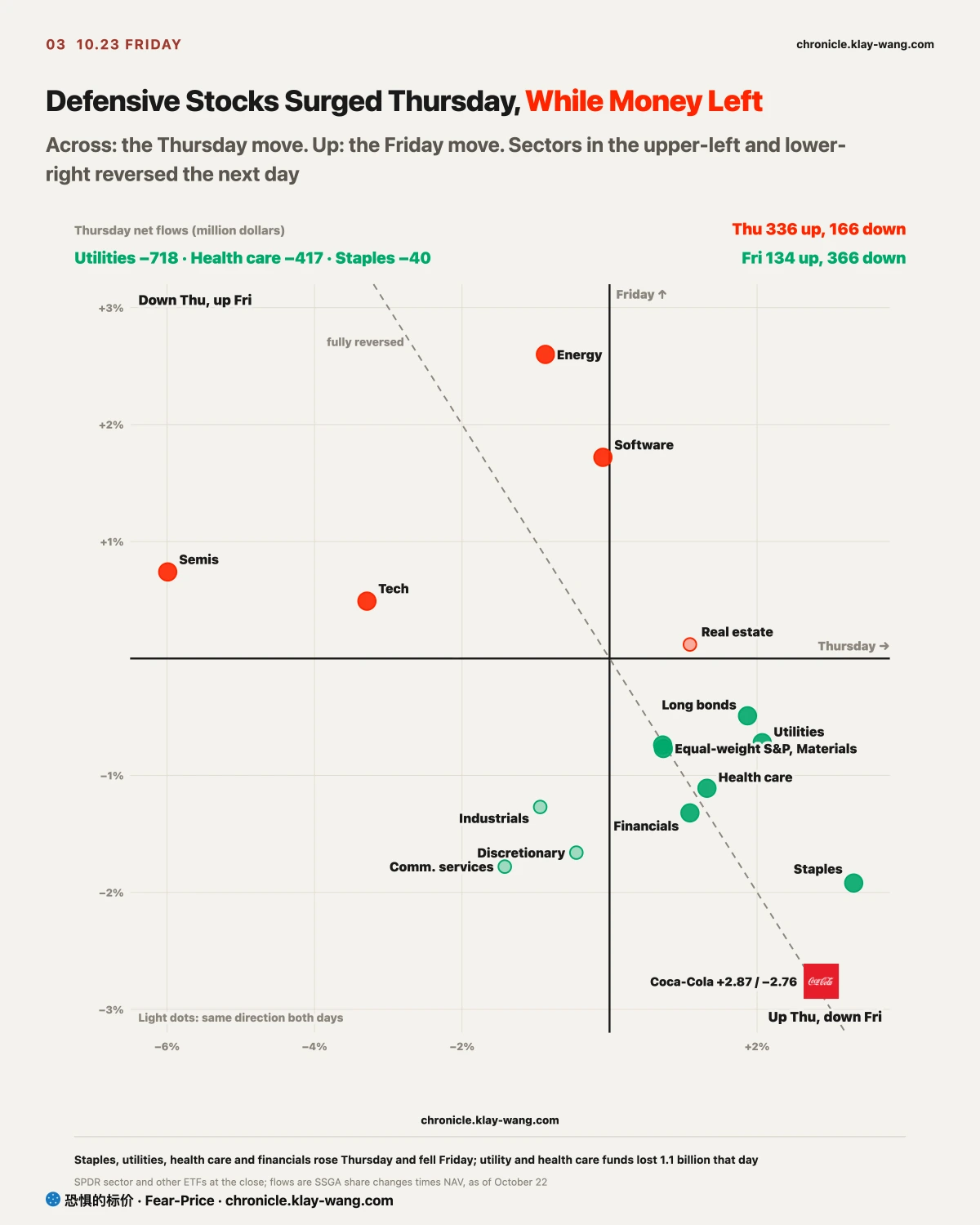
On Thursday staples rose 3.31%, utilities 2.07% and health care 1.32%, and Coca-Cola closed at a record. But the money flowed the other way: the same day the utilities ETF saw 718 million dollars of net redemptions, the health care ETF 417 million, and the staples ETF a small outflow. Prices rose while shares outstanding fell; the gain did not come from new money.
It looks more like hedge funds cutting positions: Goldman Sachs prime brokerage data showed three types of hedge funds all lost more than 1% on Thursday, the first time since the pandemic, and cutting positions usually means selling crowded tech longs and buying back shorts in defensive stocks. By Friday, five of the six sectors that rose on Thursday fell, all but real estate; staples gave back about 60% and Coca-Cola slipped below its record.
Rates played a part on Friday too. With the 10-year Treasury yield back at 5%, dividend-paying defensive stocks such as Coca-Cola and Procter and Gamble are usually the first to lose appeal when yields rise; in the S&P Global October purchasing managers survey, company selling prices rose the most in more than four years, driven mainly by oil.
Financials are not on the defensive side. On Friday the financials ETF one-month premium rose 1 point and JPMorgan one-year premium rose 0.9 point, the largest increase among the 45 names we track; the price of insurance on high-yield credit rose for a second day to the 84th percentile of the past three years, and investment grade to the 87th. American Express beat on profit but card member spending missed, and it gapped down 3.7% at the open, taking Visa, Mastercard and JPMorgan down with it. The financials ETF saw 631 million dollars of net redemptions this week.
Over the week, health care held up: the health care ETF rose 1.45%, Johnson and Johnson 3.2% and UnitedHealth 4.2%; it was redeemed on Thursday, but the week and the month were both net inflows. Energy followed oil: US crude topped 100 dollars and the three big US oil companies closed at records on Friday.
To tell whether it is a real sector rotation, look at three things: whether it rises more than the market, whether money is flowing in, and whether it holds at the highs. The Thursday defensive move had only the first. If you hold tech and want some defense, the Thursday jump does not tell you much; watch whether health care and staples draw inflows over the next few days.
[Settlement] In a Week of Chip Selling, Long-Term Asset Managers Kept Their Nasdaq Longs
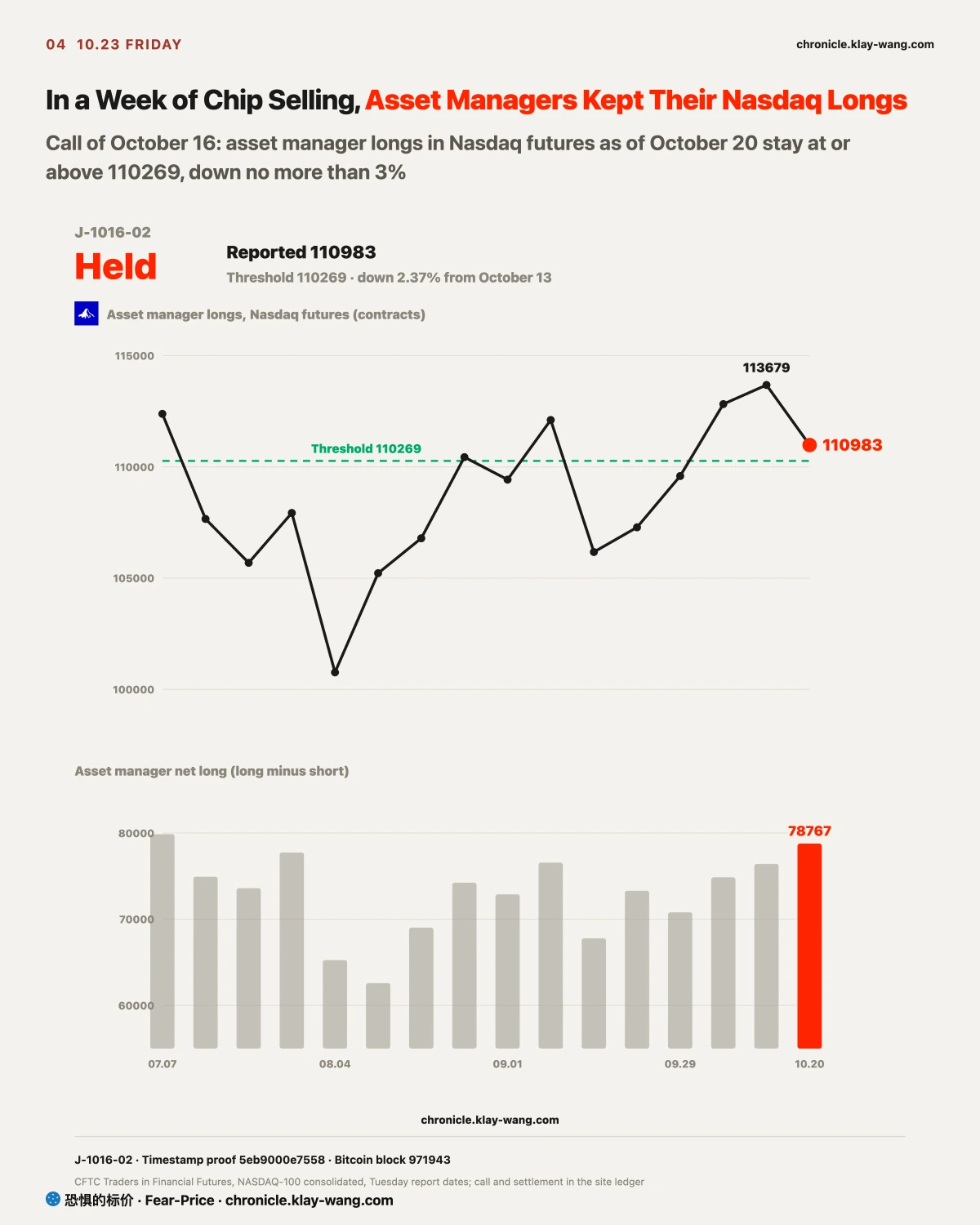
A call made two weeks ago settled on Friday. Our October 16 note said that in the CFTC report released Friday, asset manager longs in Nasdaq futures would fall no more than 3% from October 13, that is, stay at or above 110269 contracts.
The reasoning then was that single chip stocks traded only 1.0 to 1.15 times normal volume that Friday, the selling went through the semiconductor ETF basket, and long-term money had not run.
The report released Friday showed 110983, down 2.37% from October 13, short of a 3% drop, so the call held. Asset manager shorts fell from 37277 to 32216 over the same week, and the net long rose from 76402 to 78767.
While chips were sold early in the week, long-term asset managers such as pension and mutual funds did not pull their Nasdaq longs. If you hold a fund that tracks the Nasdaq 100, the money that ran this week was short-term; the long-term money stayed.
The original call and this settlement are in the judgment ledger at chronicle.klay-wang.com/options, right or wrong.
What This Means for What You Hold
If you hold S&P 500 or Nasdaq 100 ETFs: watch 760 and 700, and whether Nasdaq one-month premium again exceeds one-year. If neither breaks, this pullback looks more like a rotation.
If you hold the Magnificent Seven: the October 28 and 29 results decide it on the gap between capital spending and operating cash flow; borrowing costs rose for all of them this week, and the names where they stop rising after results are the ones whose pullback can be bought.
If you hold memory stocks: Micron premiums and borrowing cost are back to normal, so wait for volume; before SanDisk reports on October 29, options already price an 11% move.
If you have cash and want to pick fallen big tech: Alphabet, Nvidia, Amazon and Meta trade cheaper than more than 90% of their recent history; wait for results to confirm capital spending and borrowing costs, and note that Oracle is cheap because it borrowed a lot.
If you hold SpaceX: options are betting on a rise while the bond market charges more; until the spread stops widening, do not treat the optimism in options as a bottom.
If you want to add defense: the Thursday jump lacked new money, and financials are themselves under pressure from credit and consumers; health care and energy are the two groups with net inflows this week.
Three Lines Worth Keeping
- Options have priced the next two weeks: the Nasdaq 4.2%, the Magnificent Seven 5% to 9%, SanDisk 11%. Whether to buy waits until after earnings and the Fed, and depends on whether borrowing costs and near-term premiums return to normal.
- Borrowing costs rose for all five Magnificent Seven names with bonds trading, SpaceX rose the most of the 14 we track and Micron barely moved; the same decline leads down different roads.
- On the day defensive stocks surged, utility and health care funds were being redeemed, and financials remain under credit pressure; defense depends on whether money comes in, not on one day of gains.
No investment advice. No direction calls. No market timing.