Credit Prices Nvidia Like Micron. Options Disagree. Has the Chip Cycle Peaked?
At a glance
- Monday hit one chain only: chips and servers fell while about seven in ten S&P 500 constituents rose.
- Since October 30, the spread on one Nvidia 2031 bond has been wider than the comparable Micron bond and those of its largest customers.
- Options are mostly pricing the next few weeks; one-year volatility rose far less. AMD earnings on Tuesday are the first test.
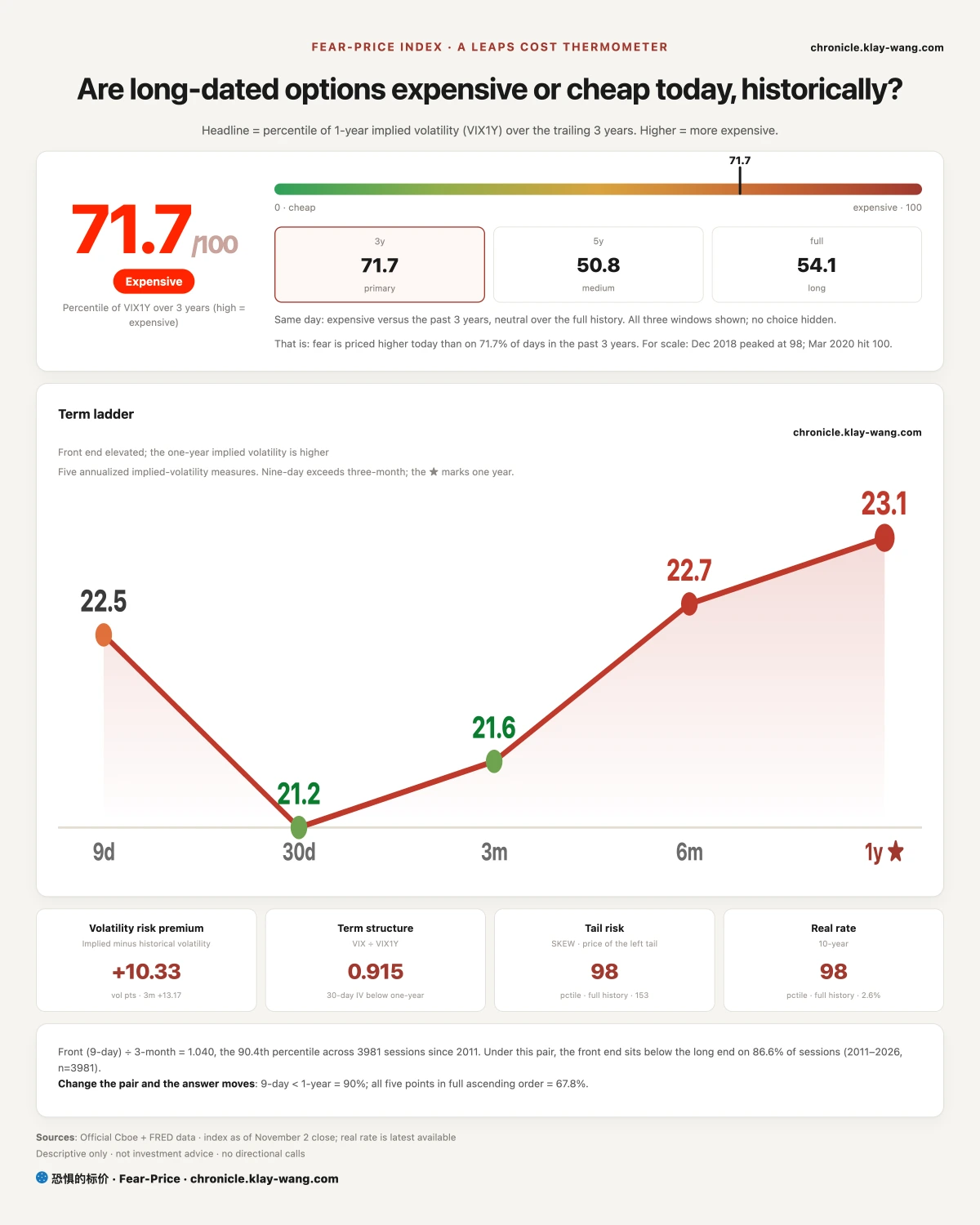
Fear-Price Index: one-year protection costs more than on seven in ten days
The Fear-Price Index registered 71.7 on November 2, up from 67.3 on Friday. One-year downside protection on the S&P 500 now costs more than on about seven in ten trading days over the past three years. The reading places the price of protection in history; it does not forecast returns.
The K Index was 1.075, down from 1.351 in the Friday edition (1.355 after a data revision). The closer it gets to 1, the more investors are actually paying for protection. At the provisional Monday fear-and-greed reading, VIX would need to rise above 22.7 for K to fall below 1; VIX closed at 21.15. Index-fund holders are not yet looking at a scramble for protection. Methodology: chronicle.klay-wang.com/kindex and chronicle.klay-wang.com/fear-price.
Fear-Price Index · November 2, 2026 · 71.7/100. One-year implied volatility was 23.12%, at the 71.7th percentile of the trailing three years, up 4.4 points from 67.3 on Friday; higher means historically more expensive. Daily ledger: chronicle.klay-wang.com. Credit: Fear-Price.
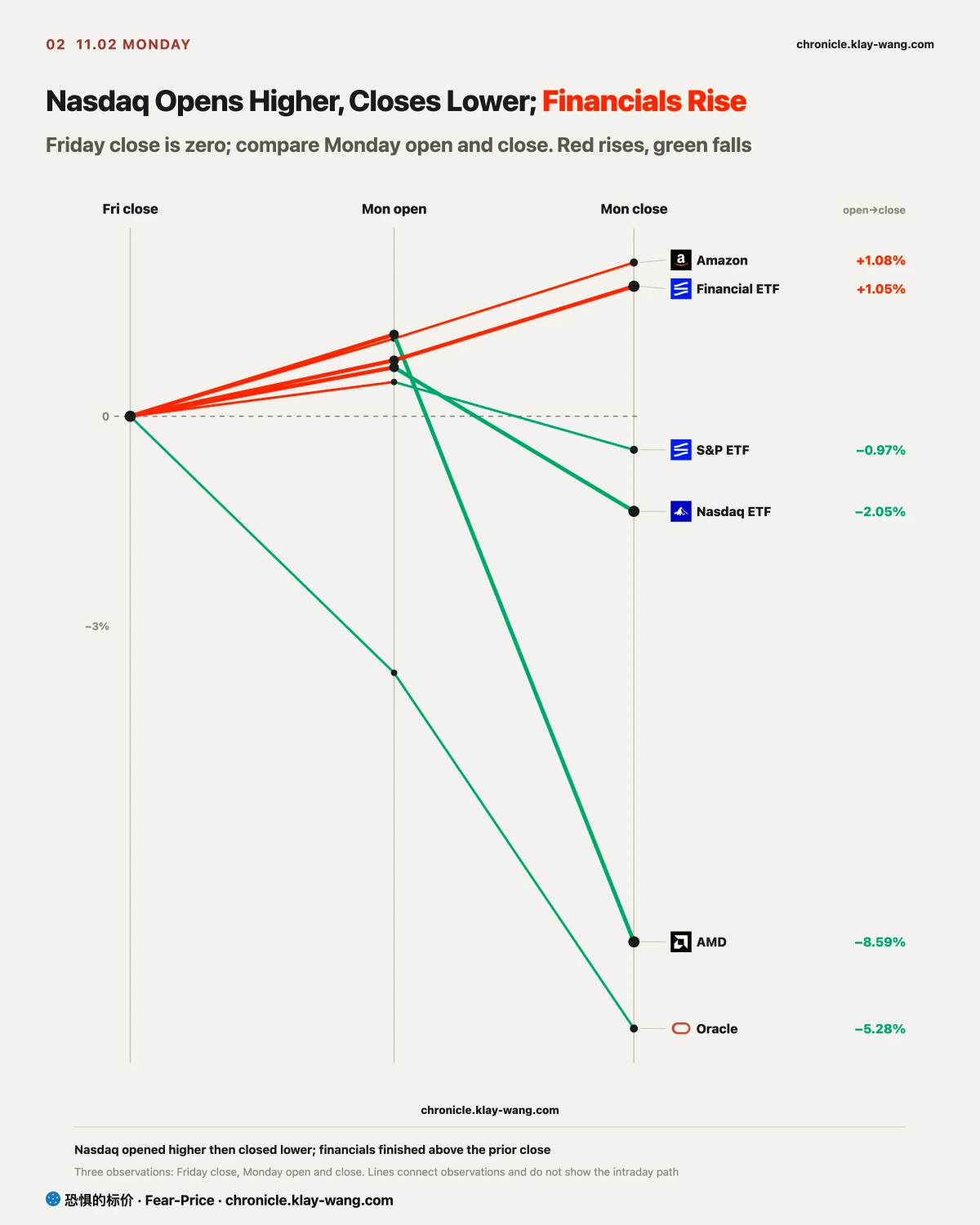
Only one chain fell, and it fell like a cyclical
The S&P 500 ETF lost 0.48%, yet about seven in ten constituents closed higher, according to the AP. The losses sat in chips and servers: the semiconductor ETF fell 2.71%, and Marvell fell the most among the 34 names we track. AMD, Micron and SanDisk all opened higher, then slid to finish near their lows. No overnight news drove it; holders reduced exposure during the session.
Chips have always been cyclical. When customers expand, orders and prices rise; when expansion stops, both fall together. For two years Nvidia was treated as the exception. Nvidia earns its revenue from the capital spending of cloud companies, and if that spending slows, the exception no longer holds. Intel fell 49.7% in a month, and Apple said after the Monday close that higher memory prices are compressing its gross margin. Rising prices upstream and complaints downstream are a familiar cyclical pairing.
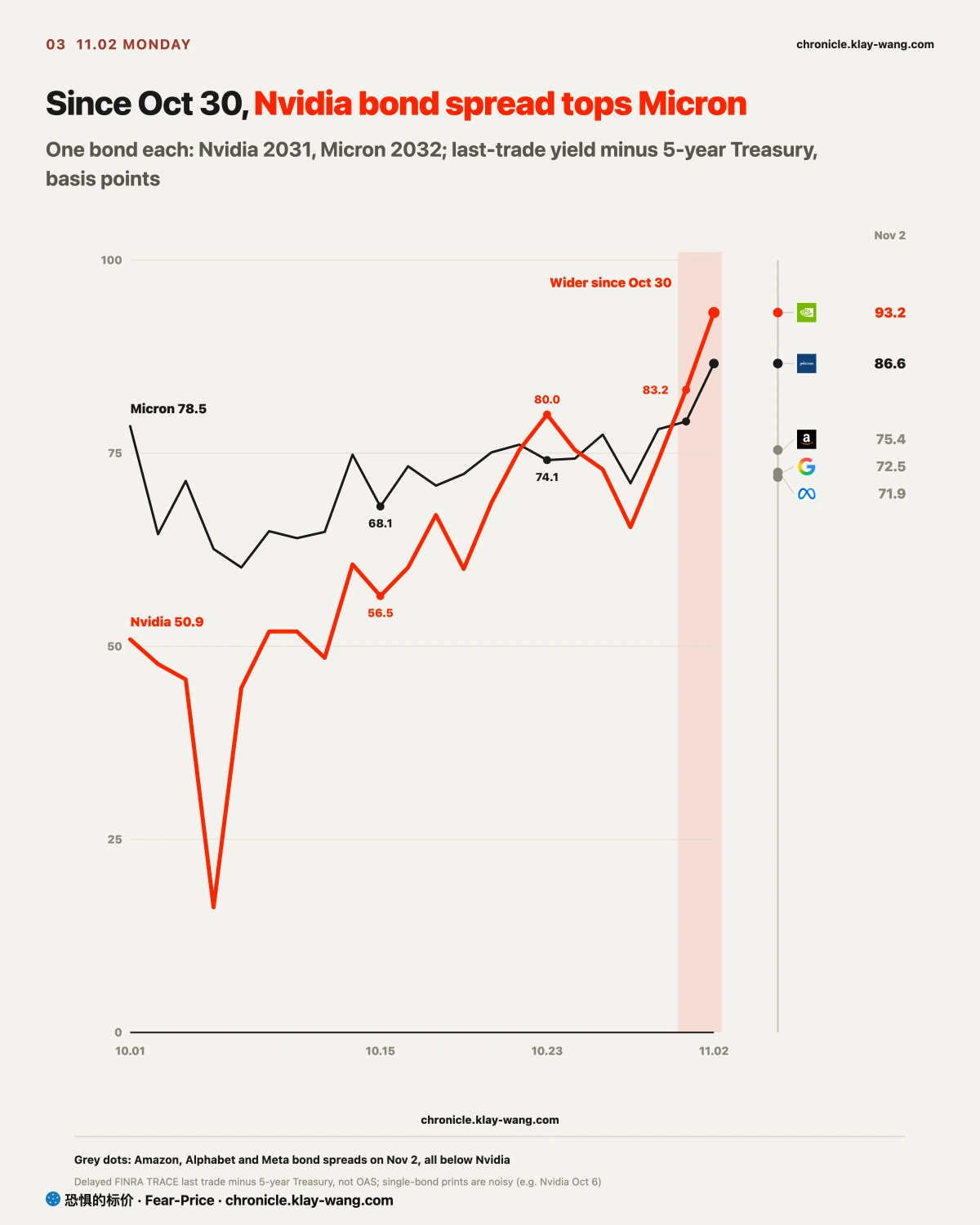
Credit charges Nvidia more than Micron
A corporate bond spread is the extra yield investors demand over Treasuries; the less stable and more cyclical the cash flow of a company, the more they ask. One Nvidia bond due 2031 traded around 50 basis points over in early October and reached 93.2 on Monday. A Micron bond due 2032 moved from around 70 to 86.6 over the same period. Since October 30, the Nvidia spread has been wider than the Micron bond and wider than comparable Amazon, Alphabet and Meta bonds. A Broadcom bond widened 47.4 basis points over the month, almost exactly as much as Nvidia.
By repayment capacity, that ranking makes no sense: Nvidia holds far more cash than debt. A chart circulating on Monday showed credit default swaps on Nvidia, Amazon and Broadcom still rising as the Nasdaq fell. Institutions holding large AI equity positions often buy CDS on the most liquid names to protect against a stock decline, which can widen spreads without any change in default risk.
The wider Nvidia spread mainly prices the AI capital-spending cycle. Single-bond last trades are noisy day to day, but the trend since mid-October has been mostly upward. For Nvidia holders, credit has already asked the cycle question; earnings will answer it.
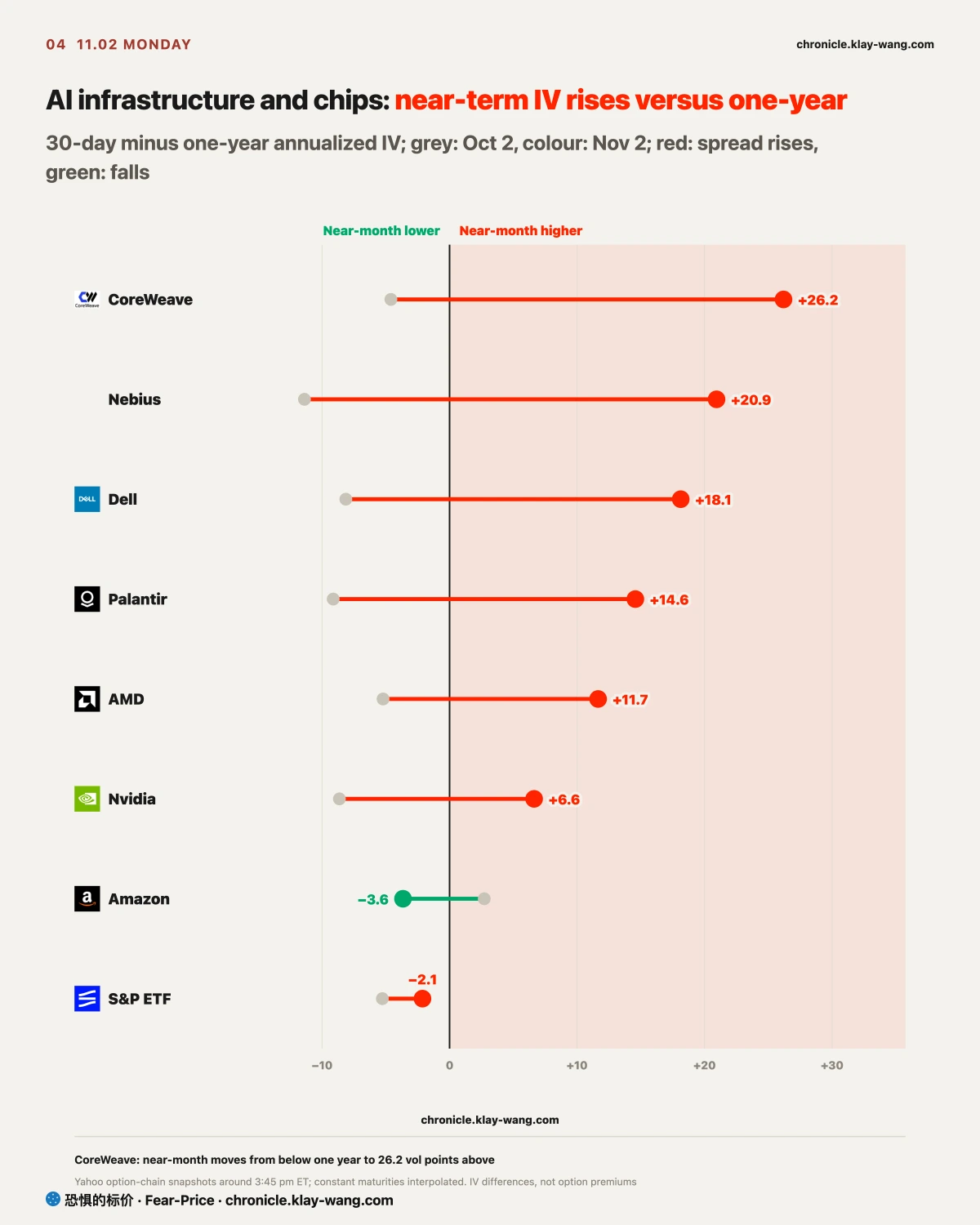
Options are pricing only the next few weeks
Nvidia 30-day implied volatility was 28.9% on October 2 and 47.9% on Monday; one-year volatility rose only from 37.5% to 41.2%. Options traders see high risk over the next few weeks without changing much of their one-year view. SanDisk one-year volatility actually fell, from 72.8% to 69.9%. Protection on rates did not move either: the MOVE bond-volatility index was 100.4 on Monday, against 100.2 on Friday.
Each market covers a different horizon. Options are pricing specific dates, AMD earnings and the midterm election on Tuesday; credit is pricing the whole cycle. If the market concluded that the cycle had peaked, one-year volatility would rise along with the near month, and that has not happened. My view is that this is not yet the top of the chip cycle; it would be wrong if Nvidia one-year implied volatility rises above 45% before the end of November while memory buyers start cutting orders.
The other side: Bank of America on slower spending
Bank of America argued on Monday that cuts to cloud capital spending, though unpopular, could help chip stocks. If paid AI demand holds, slower capacity growth keeps existing equipment busier, supports pricing and reduces overbuilding: a lower peak, but a longer earnings run. The bank estimates that free-cash-flow burn at eight US cloud providers widens from $128 billion in 2026 to $335 billion in 2027, then narrows to $77 billion in 2028.
Both views turn on the same variable: how fast the cloud companies spend. Too fast, and oversupply cuts chip prices; slower, and demand can keep up. The previous weekly review asked whether a second company would echo the Intel warning about memory costs. Apple answered on Monday, guiding next-quarter gross margin to 45%–46%, citing higher memory costs and Siri AI expenses, and saying Mac and iPad supply is constrained by memory. In memory, at least, the market is still short of supply.
Marvell pays in stock, yet the arbitrage spread is 11%
Marvell agreed to buy optical component maker Lumentum in an all-stock deal: 4.5 Marvell shares for each Lumentum share, with closing expected in the first half of 2028. Both fell, Lumentum by 19% to $684.40. At the Marvell close, 4.5 shares are worth about $771, and Lumentum closed about 11% below that.
That gap is the merger-arbitrage spread: the return for holding Lumentum to closing, in exchange for waiting about eighteen months and bearing regulatory risk. A spread this wide shows limited confidence in timely completion. Marvell holders face another calculation: a third of the combined company in exchange for a business whose revenue grew 136.5% and that was valued at about $76 billion before the announcement. Optical demand is real; the question is where in the cycle the business was bought.
The defensive side: rates flat, gains furthest from AI
The five-year Treasury yield was 4.70%, against 4.71% on Friday, and Brent crude fell 7.6%. Rates did not drive the selloff. Visa, Mastercard and financials rose; they are furthest from AI capital spending and have the steadiest cash flows. Amazon rose 2.2%, the best of the Magnificent Seven. This was not a retreat from stocks; the losses sat in the AI spending chain.
Scorecard: the September chain got the end right and one link wrong
On September 10 we argued that big tech would fund capital spending with debt, heavier issuance would push long-term rates up, higher rates would reprice slow-payback assets first, and the cost would come back to the issuers and their suppliers; the review date was October 31. The middle link failed: the 10-year Treasury yield fell from 5.24% to 4.94% in October while issuance continued. The end link showed up on Monday: Oracle is raising equity and debt, and credit repriced suppliers Nvidia and Broadcom. We mark it partly right. The mistake was treating long-term rates as a required step; credit spreads carried the transmission on their own. Holders of supply-chain stocks will learn more from credit spreads than from Treasury yields.
What This Means for What You Hold
Nvidia, Broadcom, TSMC: credit is pricing the cycle; options are not yet. AMD data-centre guidance on Tuesday will be the earliest read on whether cloud orders are slowing. On Monday morning the Nvidia gamma flip was near $208, above the $202.06 close; below that line, dealer hedging tends to amplify moves.
Micron, SanDisk, SK Hynix: Apple guidance shows memory prices still rising, the most profitable stretch of a memory cycle and the one most exposed to order cuts. Watch downstream guidance: any company saying it sold fewer products because memory was too expensive would turn a memory-cycle peak from a guess into evidence.
Amazon, Alphabet, Microsoft, Meta: they pay for the buildout. Near-month protection is cheaper than one-year, and earnings are behind them. Slower capital spending would improve their free cash flow first. Their bond spreads are also widening, partly because Alphabet and Meta are preparing new debt.
Three Lines Worth Keeping
- Credit has begun to price Nvidia as a cyclical: one of its bonds has traded wider than comparable bonds from Micron and its biggest customers since October 30.
- Options are mostly pricing the next few weeks; one-year volatility rose far less, so the market has not concluded that the cycle has peaked.
- Peak or longer cycle depends on how fast the cloud companies spend; AMD guidance and any memory order cuts are the first places to look.
Fear-Price Index · Nov 2, 2026 · 71.7/100. Daily ledger and definitions: chronicle.klay-wang.com
No investment advice. No direction calls. No market timing.