CPU 托底,GPU 接棒:AMD 收入多了 16%,现金流少了近一半 · 11.2-11.6
CPUs hold the floor, GPUs take the baton: AMD revenue up 16%, cash flow down by almost half
Chip stocks bounced for a day; the most leveraged layer of the AI build-out has not eased.
- Chips rebounded while October gainers, staples and materials, were sold. The one-month picture is unchanged.
- AMD and Supermicro beat on revenue, but cash is tied up in inventory and receivables. Next quarter is about collections.
- CoreWeave stock rose 7%, yet its bond still pays about 240 basis points more than in early October.
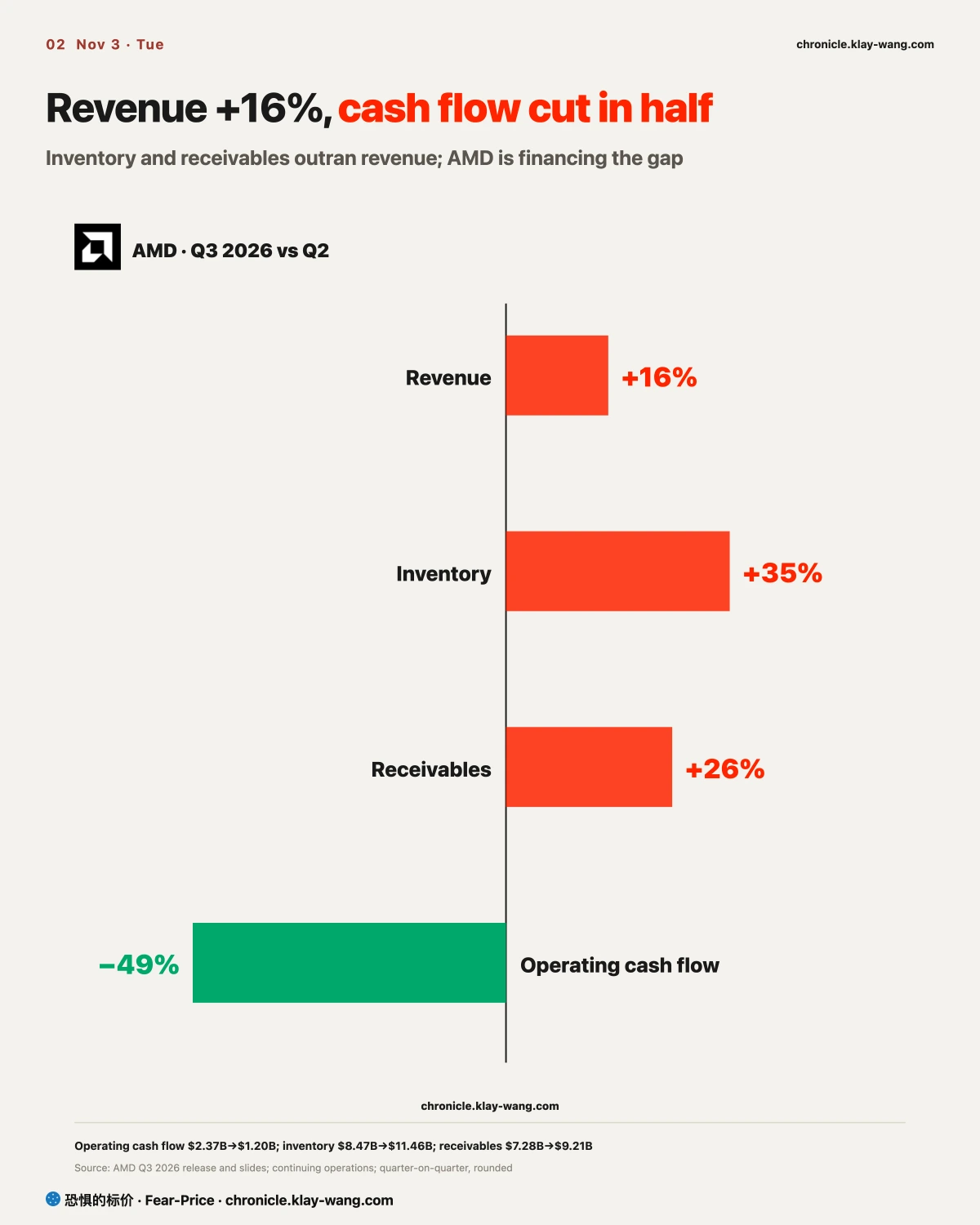
After the close on Tuesday, AMD reported third-quarter revenue of $13.38 billion, up 16% from the prior quarter, with data-center revenue nearly double a year earlier and fourth-quarter guidance of about $17 billion. In the same report, operating cash flow fell from $2.37 billion to $1.20 billion. AMD attributed data-center growth to EPYC server-CPU demand and first shipments of its Instinct MI450 accelerators. The money did not vanish: it became chips in the warehouse and bills customers have not yet paid.
Fear-Price Index
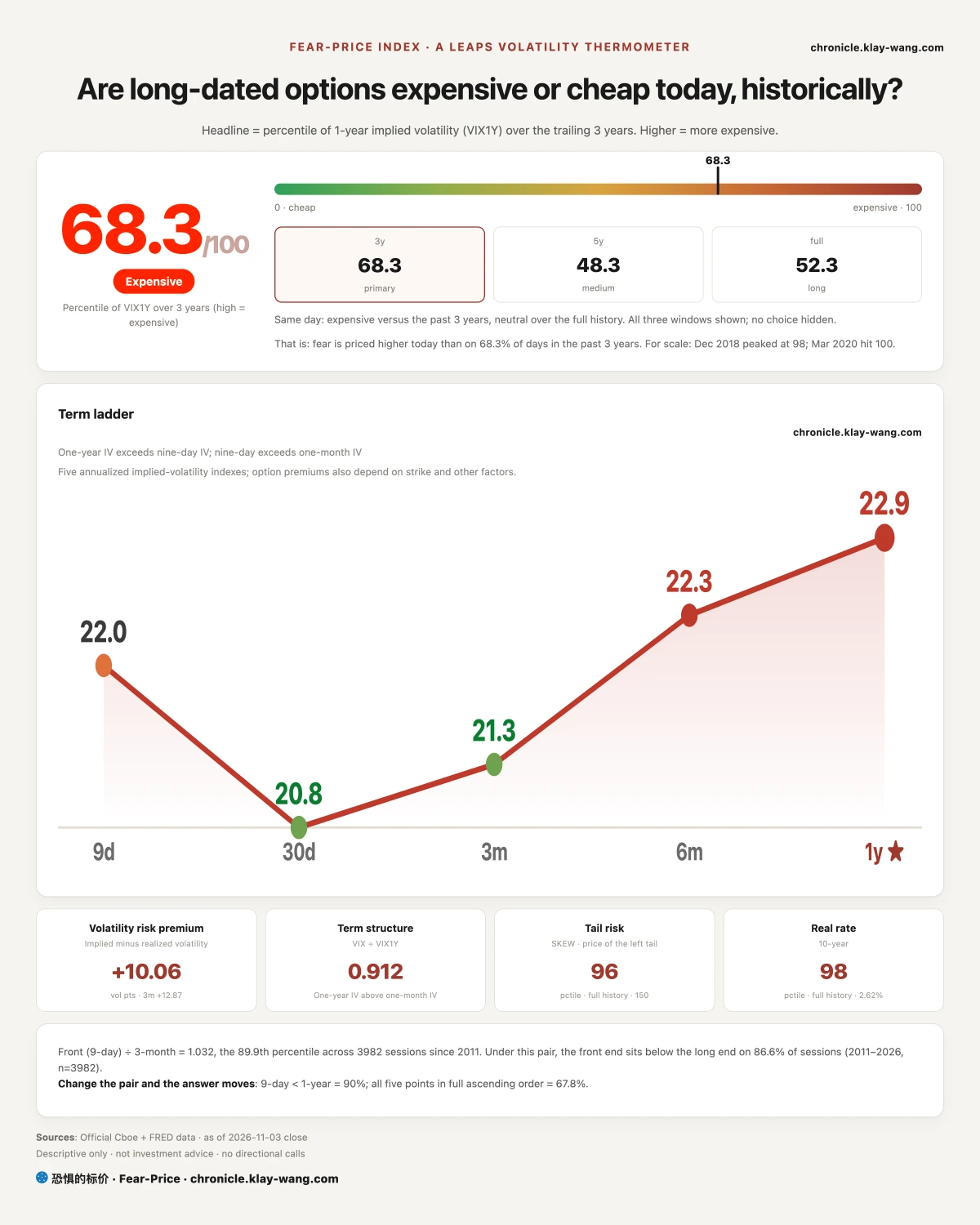
The index read 68.3, down from 71.7. One-year protection got slightly cheaper but still sits in the expensive part of its three-year range. The near end is tighter: nine-day implied volatility (21.96) is above three-month (21.27), an inversion more extreme on only about one day in ten over three years. Election day plus a week of AI-hardware earnings explains it. If nine-day still trades above three-month at Friday's close, the market is worried about more than this week's events. The K index fell below 1 on Monday and read a provisional 0.917 today, unchanged; the CNN Fear & Greed reading was 19.1, extreme fear. Since 2011 K has crossed below 1 seventy times; history and method at chronicle.klay-wang.com/kindex.
Chips up, October's winners sold
The S&P 500 rose while most constituents fell. Staples and materials each lost about 2%; since October 2, staples are up 10.46% and tech is down 11.66%. The ten-year Treasury yield rose to 4.95% from 4.91%, which hurts dividend stocks that trade like bonds. Among the 34 names we track, the biggest gainers were Nebius, CoreWeave, Oracle and Coinbase; Nebius and CoreWeave had fallen about 40% in a month, while freshly reported Apple and Palantir fell. That looks like short covering, not a regime change. The semiconductor ETF closed at $518.52, about 18% below October 2; a return to roughly $575 would be needed to call it a real return of capital.
Earnings: the faster you sell, the more you finance
Quarter on quarter, AMD's revenue rose 16%, inventory 35%, receivables 26%, while operating cash flow fell by about half. AMD is financing the gap between building product and getting paid. According to a third-party call transcript, management said the roughly $3 billion inventory build was for data-center demand. Supermicro's cash-conversion cycle shortened from 149 to 97 days on customer prepayments, but one large data-center customer was 44% of quarterly revenue. Supermicro posted $19.9 billion in revenue and about $1.59 billion in net income, but operating cash flow of about negative $434 million. Around 6:30 p.m. ET, AMD traded near $518 after hours (about +7%) and Supermicro near $34.70 (about +10%). If AMD's receivables again outgrow revenue next quarter, it is buying volume with longer payment terms. On Monday we said to watch for memory-cost-driven order cuts in hardware guidance; neither company signaled one, and AMD guided Q4 revenue about 27% above Q3. Apple's 47.9% gross margin included about one point from tariff refunds, and it guided December-quarter gross margin to 45%-46%, mainly on memory costs. The cost squeeze has reached devices; slower demand has not reached servers.
Credit and long-dated options: CoreWeave
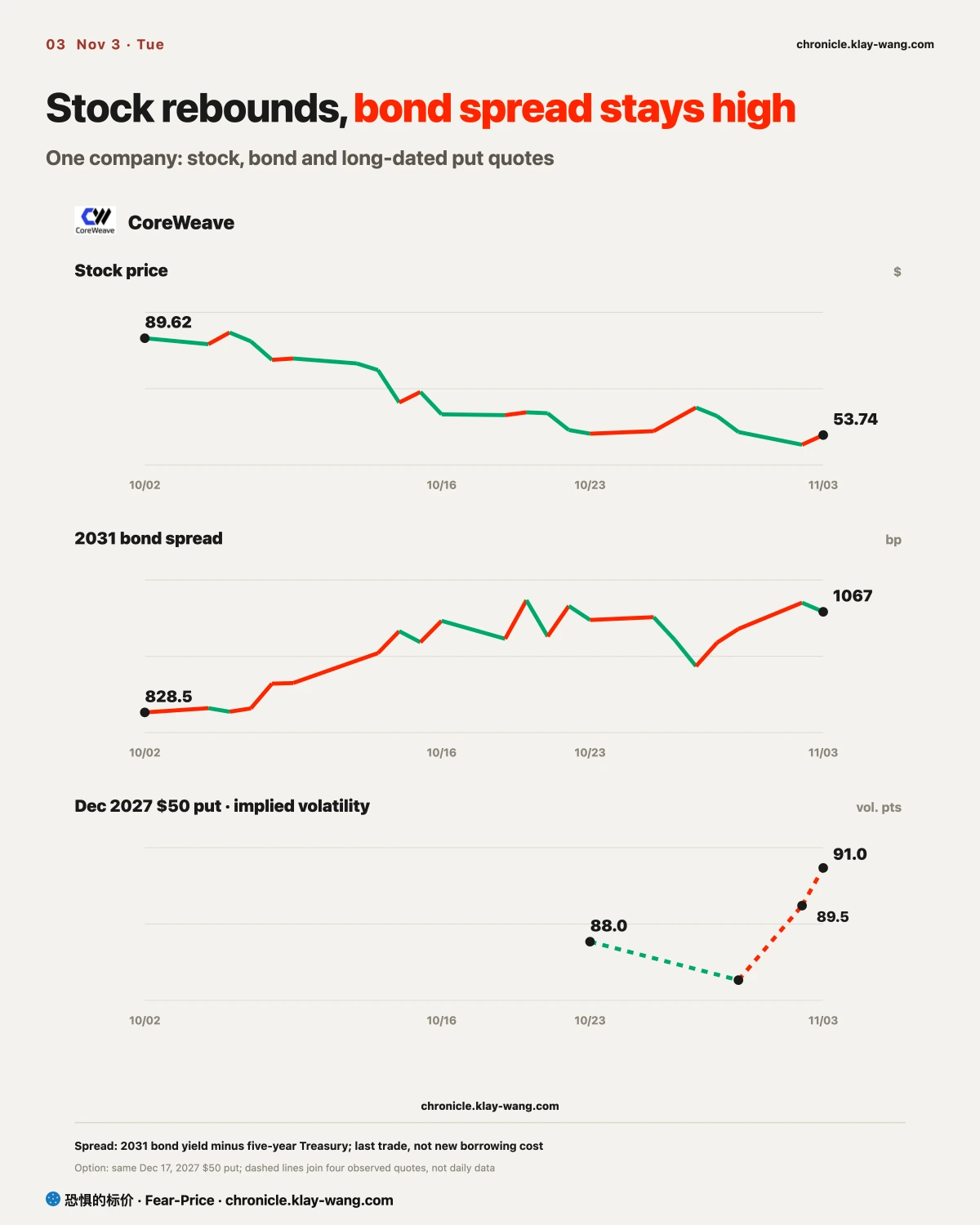
CoreWeave rose 7.16% but is still down 40% since October 2. Its 9.75% 2031 bond yields about 1,067 basis points over the five-year Treasury, versus 1,088 on Monday and 829 on October 2. Its December 2027 $50 put rose in implied volatility from 89.5 to 91.0. Lenders and long-dated option sellers are pricing whether CoreWeave can refinance a year from now; a one-day rally does not answer that.
Correction: Monday's headline said the bond market was starting to price Nvidia like Micron, based on one pair of bonds. Today the ranking reversed (Nvidia 78 bp, Micron 85 bp). We downgrade that reading and will only use five consecutive readings of the same bond.
New call: CoreWeave's 2031 bond spread stays above 900 bp at every reading through November 20. Any reading below 900 means lenders followed the stock, and we withdraw it. There is not enough history for a base rate.
Long-dated contracts
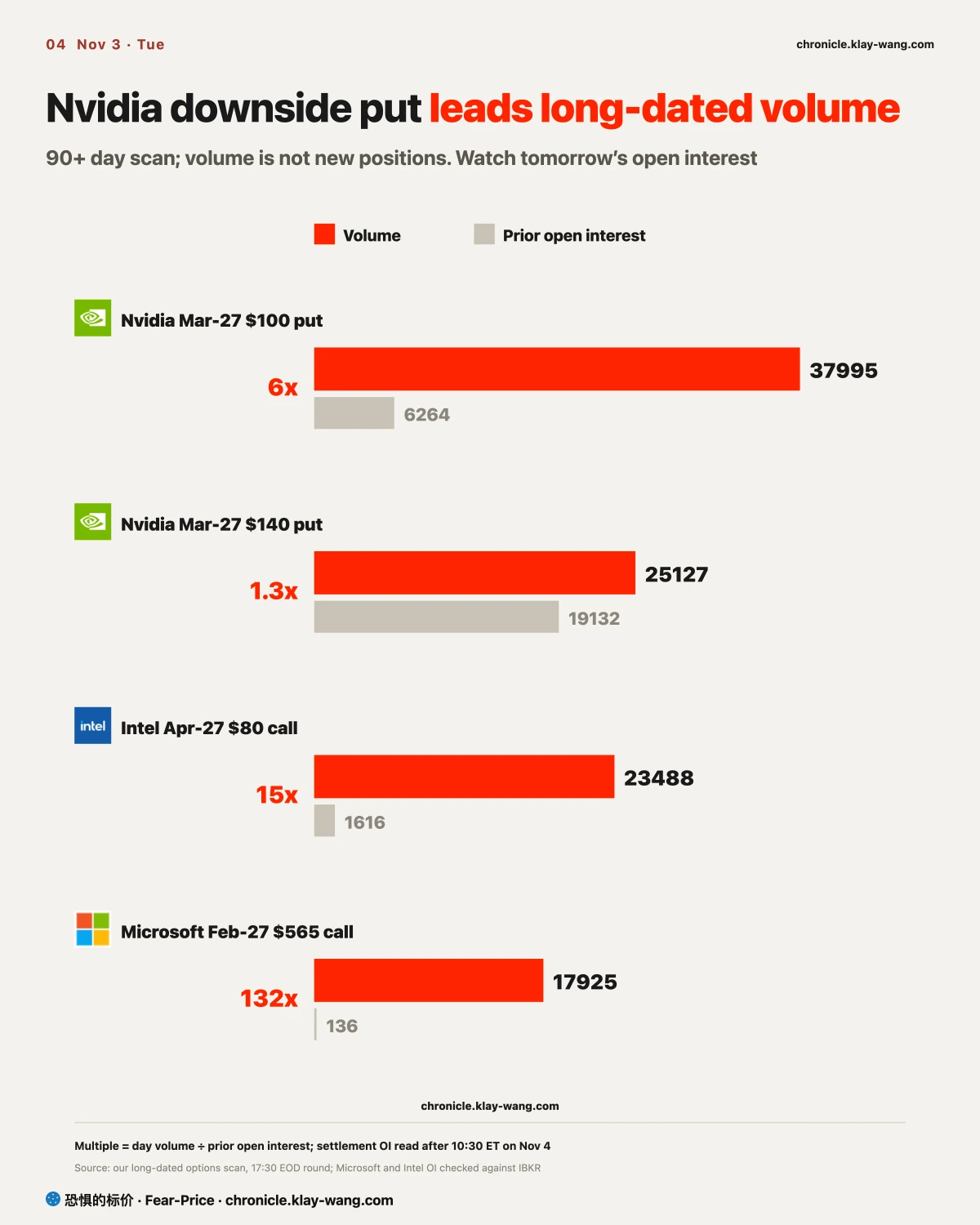
A put works like downside insurance that pays only below the strike. The largest far-dated trade was Nvidia's March 2027 $100 put, a strike about half today's $206.69 close: 37,995 contracts against prior open interest of 6,264. Microsoft's February 2027 $565 call traded 17,925 against 136; Intel's April 2027 $80 call traded 23,488 against 1,616. Volume does not show who bought. Tomorrow's open interest will show whether the positions stayed. We take no directional view.
What it means for your holdings
AMD, Nvidia, Broadcom: tomorrow's regular session is the first real vote on AMD's report; its one-month volatility (64.75) should fall toward one-year (54.82) after earnings. Supermicro, Dell: watch whether operating cash flow turns positive. Memory names: device cost pressure is confirmed while server orders are still rising. CoreWeave, Oracle, Nebius: until CoreWeave's 2031 bond is back under 900 bp, treat rallies as rallies. Index and LEAPS holders: the nine-day premium should fade after this week; if it does not, the market is pricing something further out.
Three lines worth keeping
- AMD revenue up 16%, operating cash flow down by almost half: watch collections next quarter.
- CoreWeave rose 7%, but neither its bonds nor its long-dated options got cheaper.
- Nine-day protection costs more than three-month; it should fade after this week.
Fear-Price Index · 2026-11-03 · 68.3/100. Data and methodology: chronicle.klay-wang.com.
No investment advice. No direction calls. No market timing.