市场可能在一夜之间转向,且毫无预兆 11.02–11.06 周回顾
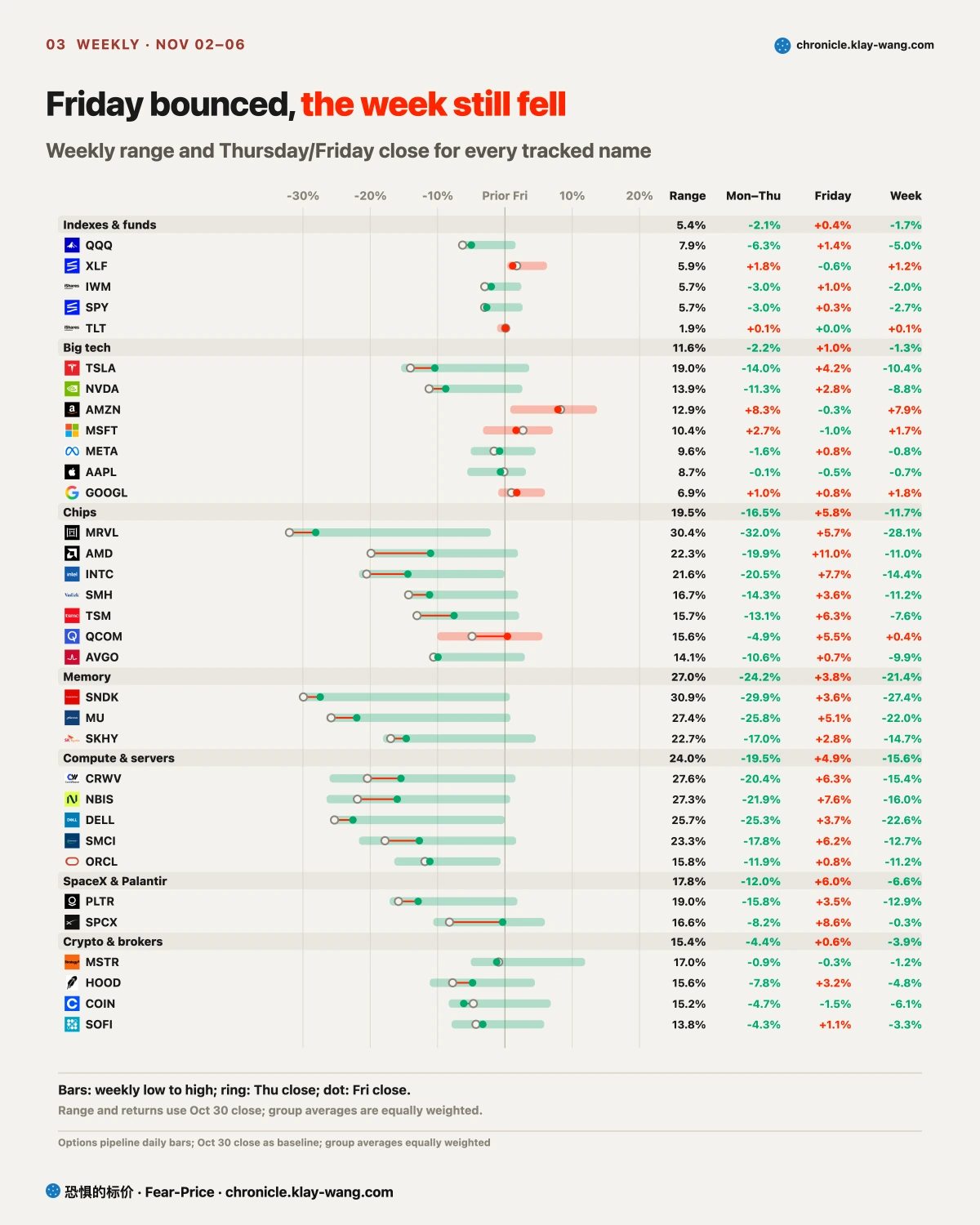
Three lines: Oil fell 13%, rates barely moved, and the companies that borrow to build data centres were sold first
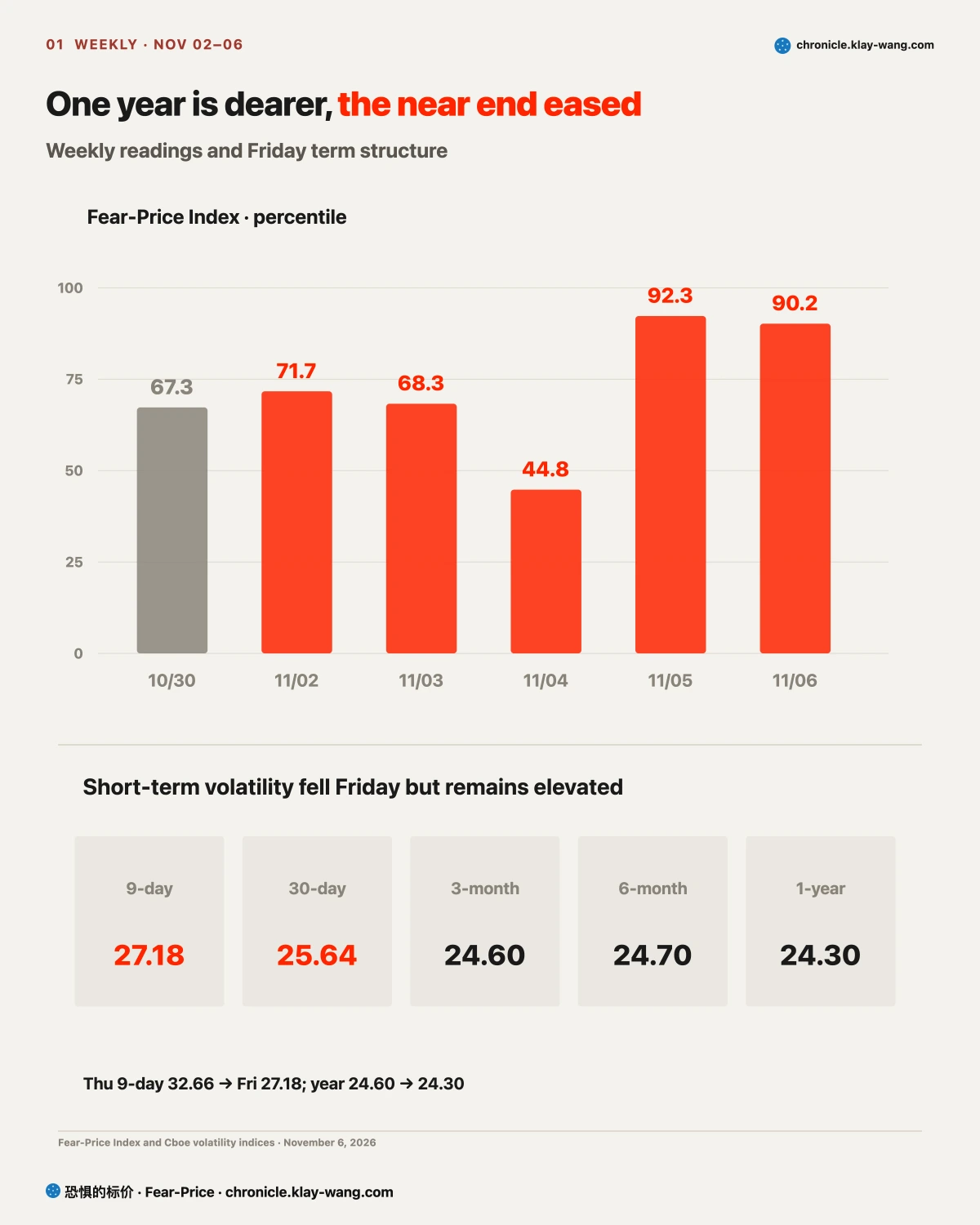
The semiconductor ETF lost 11.20% and the energy ETF 12.00%, while the equal-weight S&P 500 fell only 1.04%. Ten-year Treasury yields fell about 7 basis points, bond volatility eased and the high-yield bond ETF slipped 0.26%, yet CoreWeave and Oracle bonds widened. VIX futures inverted on Thursday and one-year implied volatility rose across most AI names.
Fear-Price Index: One-year protection did not ease with Friday's bounce
Fear-Price Index · November 6, 2026 · 90.2/100. One-year volatility was 24.30, around the 90th percentile of the trailing 756 trading sessions. The reading was 67.3 a week earlier, 44.8 on Wednesday and 92.3 on Thursday. Nine-day volatility fell from 32.66 to 27.18 on Friday; one-year volatility barely moved. Method and daily ledger: chronicle.klay-wang.com/fear-price.
The K Index was a provisional 0.861, below the prior Friday's final 1.355. Since 2011, the site's data show 71 drops from above 1 to below 1; the latest came Thursday, after another on Monday that reversed on Tuesday. A K reading below 1 has often been a reasonable time to start looking for entries, with no guarantee of an immediate gain: of 37 episodes with a full year of history, the Nasdaq was higher a year later in 28 and lower in 9, the worst being November 2021 at -28%. History and method: chronicle.klay-wang.com/kindex and chronicle.klay-wang.com/fear-price.
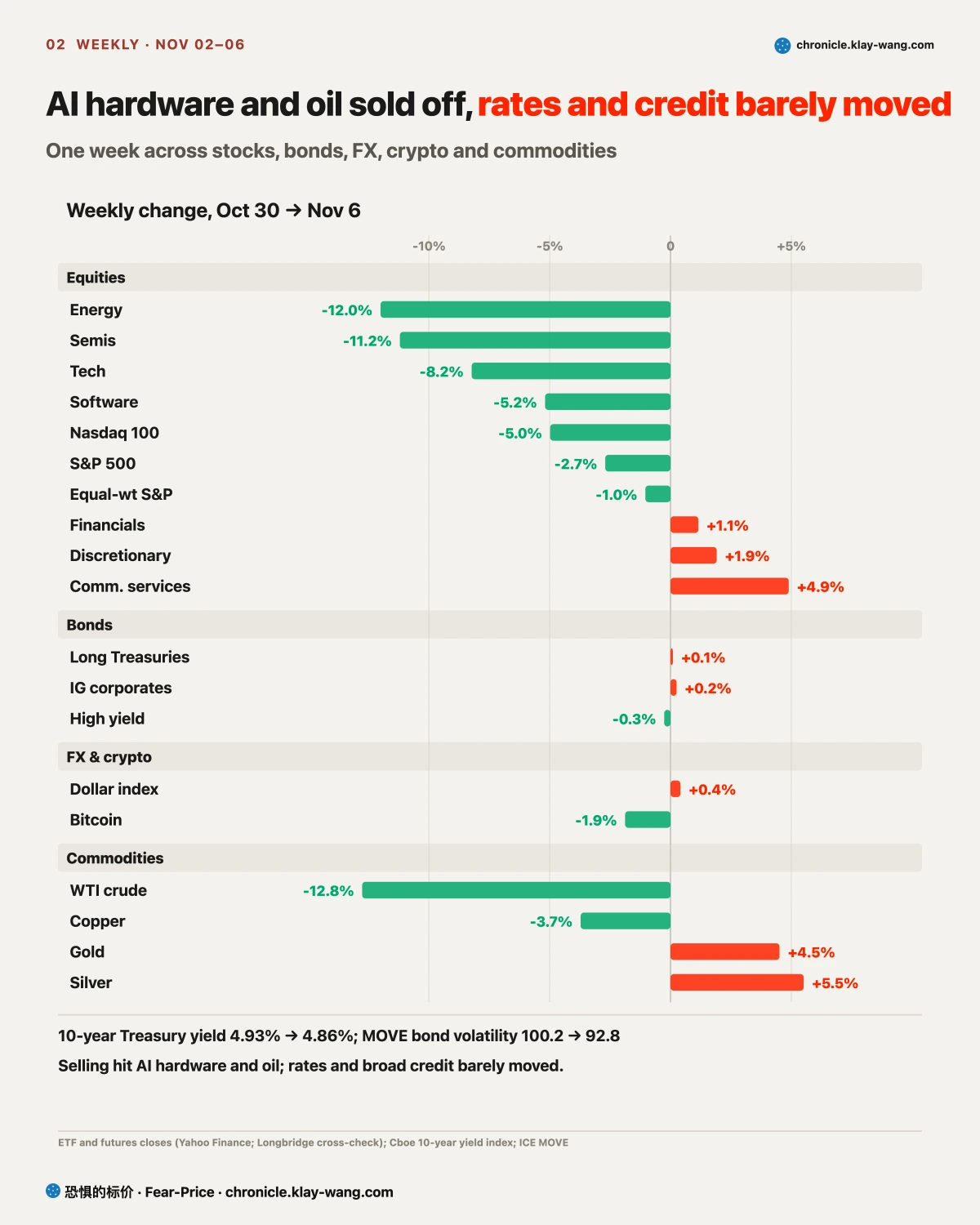
Cross-asset: selling hit AI hardware and oil only
The S&P 500 ETF fell 2.70% and the Nasdaq 100 ETF 4.98%, but communication services rose 4.89% and financials and discretionary edged up. The 10-year yield fell from 4.93% to 4.86%, the MOVE index dropped from 100.2 to 92.8, investment-grade bonds gained 0.25% and gold rose 4.51%. If growth were cracking, rate volatility and junk bonds would move first. Both stayed calm, so this looks like an industry repricing, not a recession trade.
Energy and the election: a war premium came out of oil
WTI fell from $104.12 to $90.83, mostly on Monday (about -7.4%) and on Wednesday after the midterms (about -8.3%). AP reported that voters gave Democrats control of Congress; Chinese media reported that Vice President Vance blamed the loss on the Iran war and that House Democrats pledged legislation to limit tariffs and war. Reports of US-Iran concessions remain unconfirmed. Treasuries barely reacted, and payrolls rose by 165000. CNBC, citing Ballotpedia, counted 41 local data-centre ballot measures in 10 states, all but one favouring restrictions or opposing development incentives.
Thursday: a 4.41% drop from 1.6% below the record, a first since 1993
The S&P 500 ETF fell 4.41% and the Nasdaq 100 ETF 6.49%. The size was not new: SPY had 36 such days since 1993 and QQQ 23 since 1999. The starting point was. Before each of those 36, SPY was at least 4.3% below its record and VIX at least 21.5; on Wednesday SPY was 1.6% below and VIX 16.61. All 23 QQQ days fell inside the 2000-01, 2008 and 2020 bear markets. Options priced Thursday-to-Friday moves of only ±0.76% for SPY and ±1.41% for QQQ; Thursday alone was about 5.8 and 4.6 times that. SPY opened just 0.17% lower and sold off all day; QQQ closed at its low. No single headline explains it: Qualcomm and Arm results, an FT report that Microsoft declined an Nscale Texas option, and Texas's governor-elect calling for a data-centre pause stacked up, and estimated negative dealer gamma amplified the fall. Credit did not follow: high-yield slipped 0.31%, Treasuries and gold rose. The closest calm-start precedent is February 5, 2018. If high-yield and the 10-year stay calm and VIX futures normalise, Thursday looks more like 2018; if high-yield starts to fall, treat it as an industry bubble unwinding.
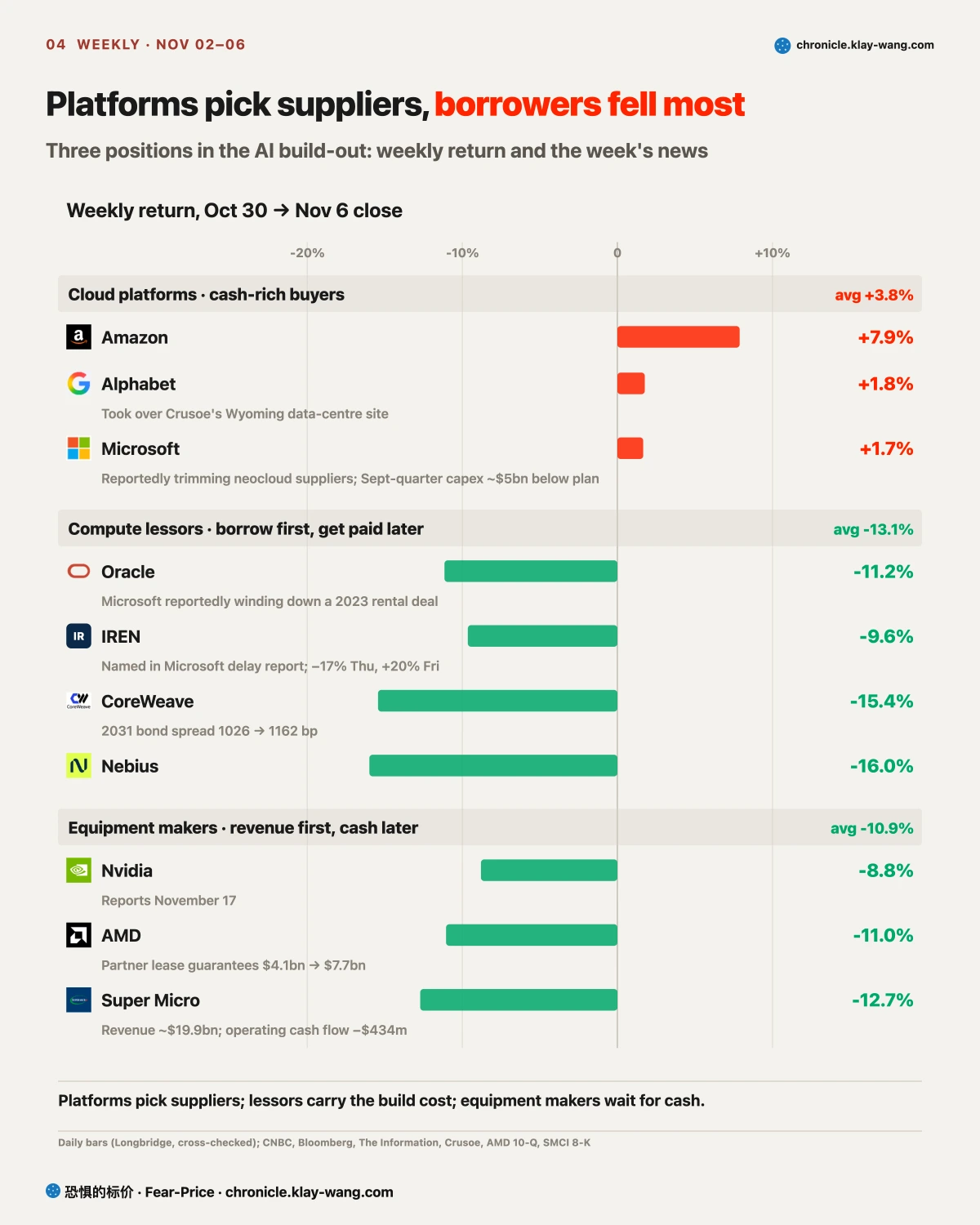
The chain: platforms pick suppliers, lessors carry the cost
The Information reported Microsoft's September-quarter capex was about $5 billion below plan, partly on third-party delays including IREN. CNBC reported Microsoft is reviewing its neocloud suppliers, and Bloomberg reported it is winding down a 2023 Oracle rental deal. Three cloud platforms averaged +3.8%, four compute lessors -13.1% and three equipment makers -10.9%. A gap against plan is not a cancelled order; these reports show risk being reallocated, not proof that total AI demand is falling.
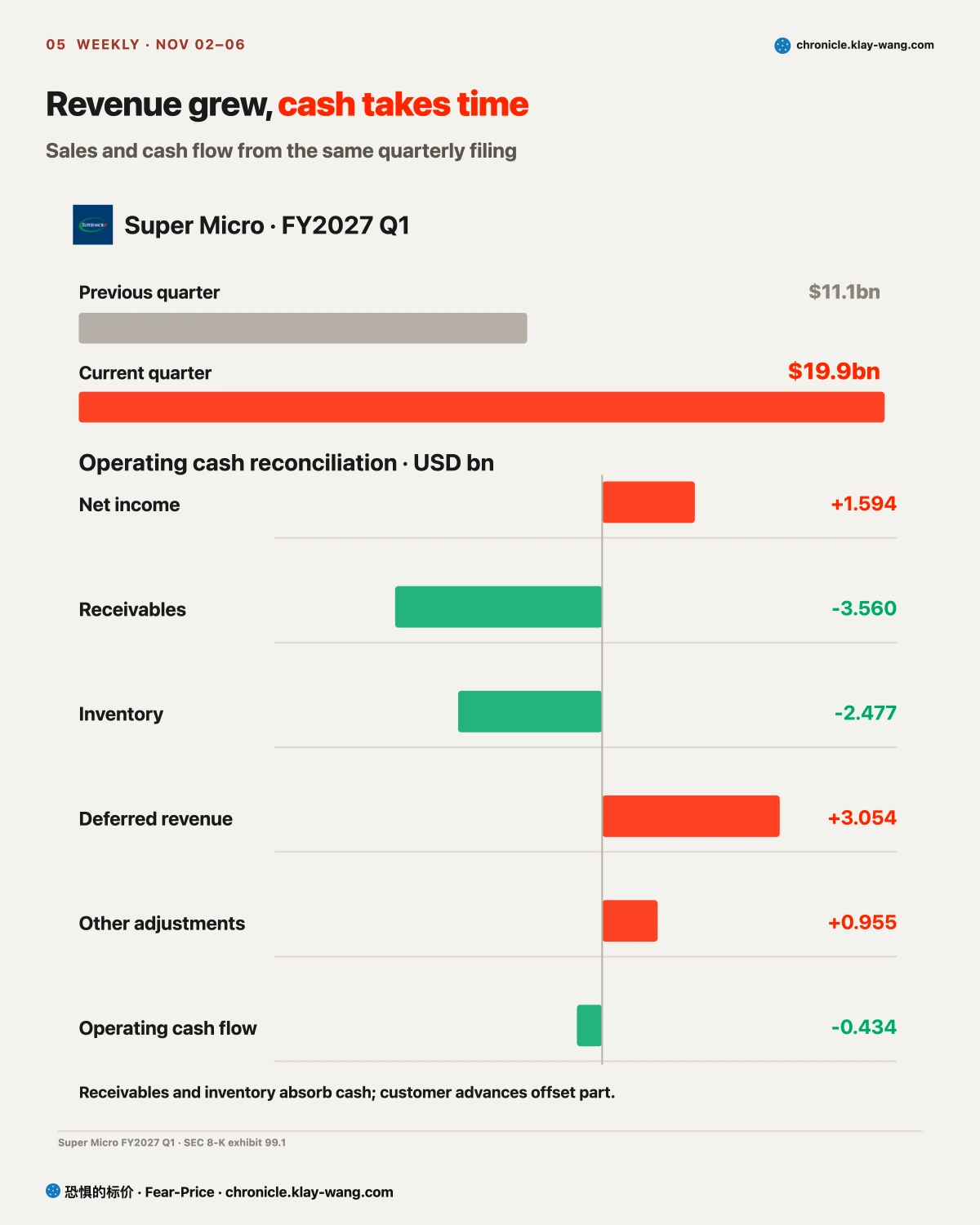
Revenue is booked; cash is still coming
Super Micro reported revenue of about $19.946 billion and net income of $1.594 billion, yet operating activities used $434 million as receivables and inventory absorbed cash. AMD's data-centre revenue rose 97% to $8.546 billion, while its maximum exposure under data-centre lease guarantees for partners rose from $4.1 billion to $7.7 billion, with no default or payment so far.
Credit: cheaper Treasuries, dearer money for lessors
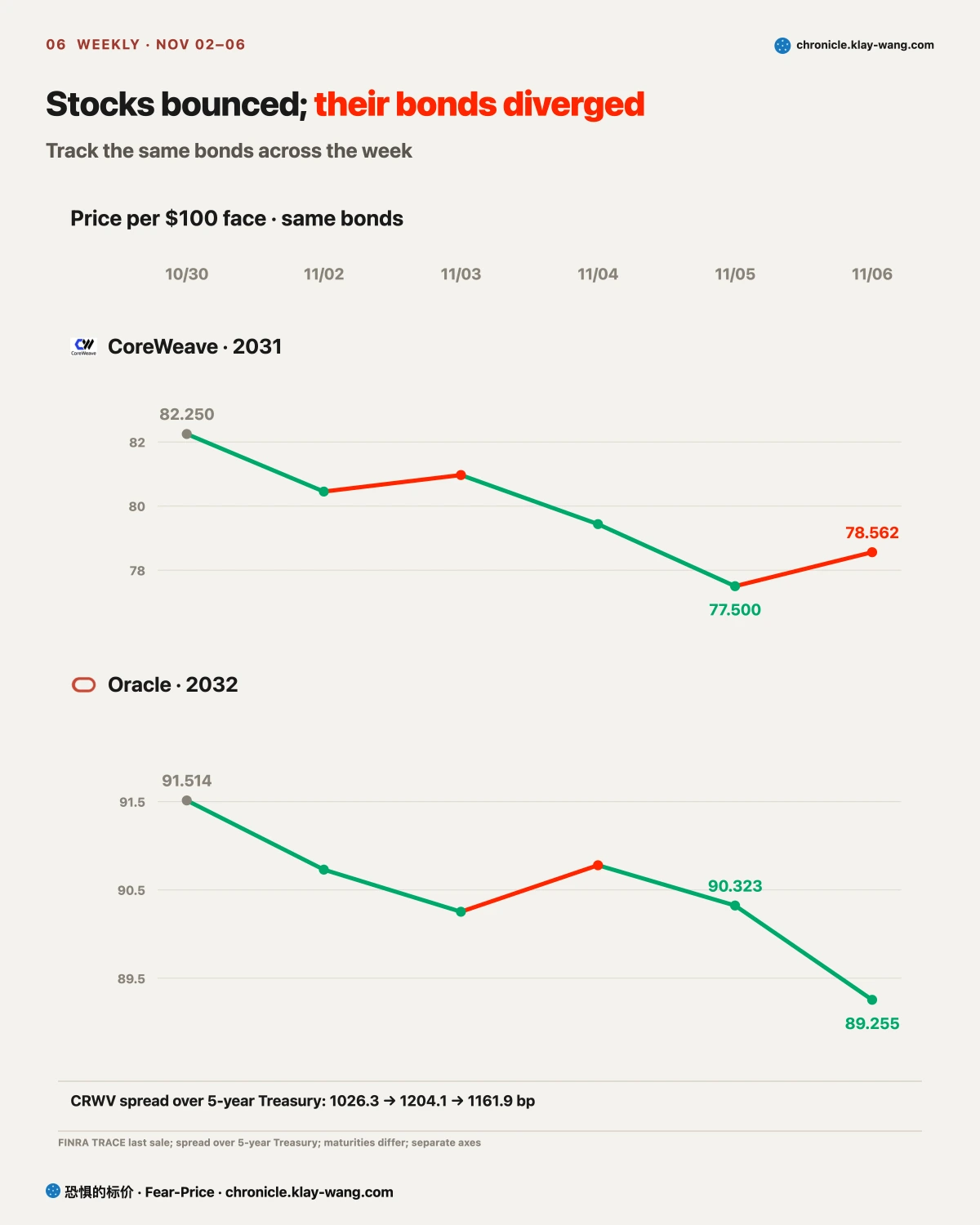
Microsoft's representative spread narrowed from 14.4 to 11.5 basis points and Nvidia's from 83.2 to 79.1. CoreWeave's 2031 bond spread went 1026 → 1204 → 1162 basis points, Oracle's 2032 bond widened from about 251 to 315, and a SoftBank dollar bond widened from 414 to 490. Credit confirmed the equity stress mainly for lessors and their funders; big-platform spreads moved only a few basis points. These are single-bond last-trade measures.
Options: near-term shock and a higher one-year baseline
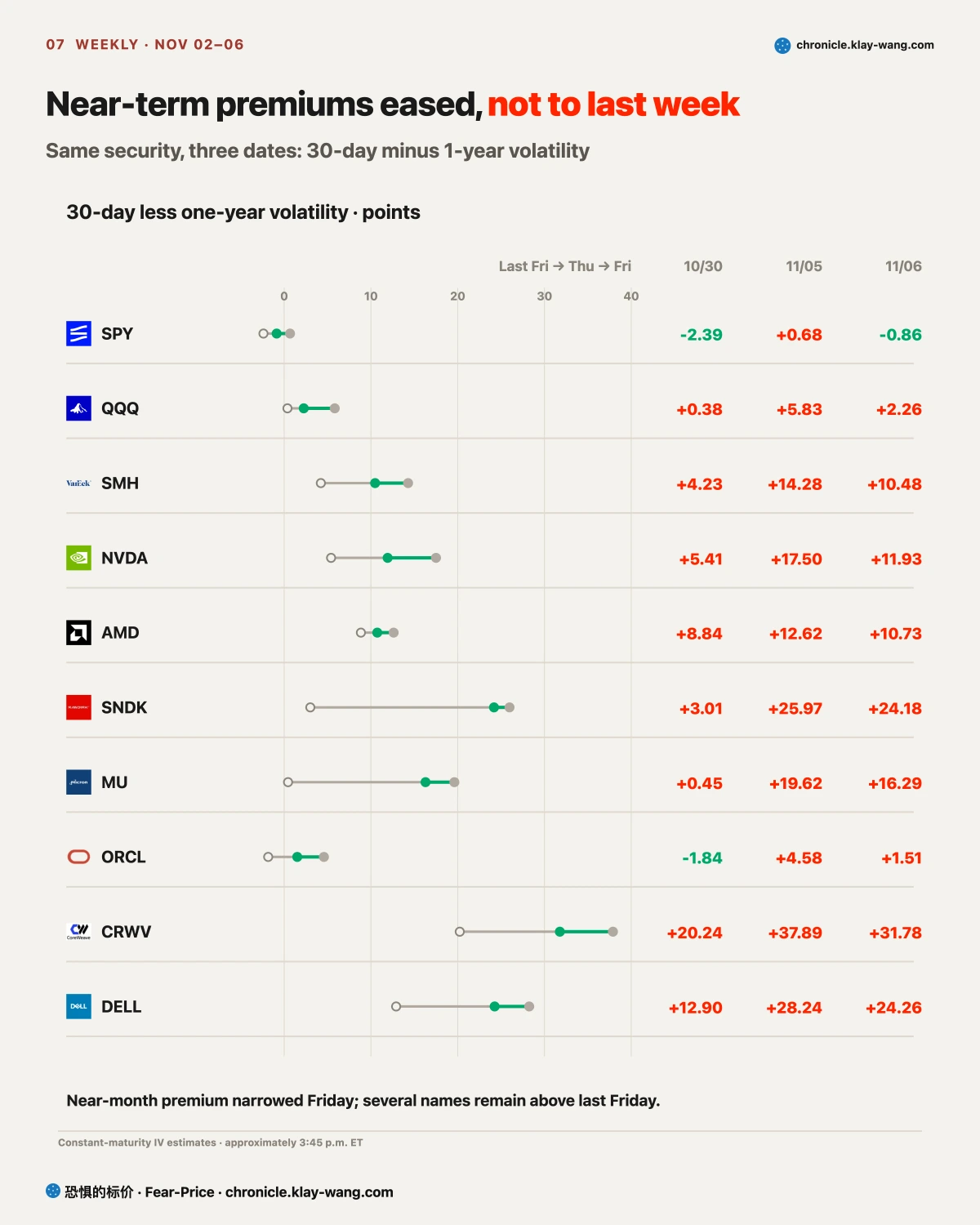
VIX futures inverted on Thursday, the first time since our records began in July, and stayed inverted Friday. Nasdaq ETF 30-day volatility was 2.26 points above one-year; Nvidia 11.93, SanDisk 24.18, CoreWeave 31.78. One-year volatility rose for the S&P 500 ETF from 18.85 to 19.83, Nvidia from 40.54 to 43.35 and CoreWeave from 84.97 to 94.20, while long Treasuries fell. On Friday 53090 Nvidia February 2027 $210 calls traded against roughly 10000 open contracts; volume alone does not show direction.
Looking back: none of last week's five conditions has been met
Last week's conditions remain unmet: Nasdaq and semiconductor near-month volatility is still above one-year, CoreWeave's spread is 1162, the 10-year closed at 4.86% and Nvidia one-year volatility is 43.35%, short of 45%. Microsoft, Amazon and Alphabet spreads are 11.5, 74.3 and 62.9 basis points, all above October 23 levels, so that view still holds until November 20.
What This Means for What You Hold
Cloud platforms: they are the buyers choosing suppliers, and their shares and bonds held up best. Watch the next capex guidance.
Compute lessors: CoreWeave, Nebius and IREN had weekly ranges above 27%. Until the same-bond spread returns below 1000 basis points, a share rebound lacks confirmation from credit.
Energy: oil lost a war premium; the new Congress is seated in January and US-Iran talks are unconfirmed. Energy did not hedge tech this week.
Index funds: only 184 members rose on Friday, and the equal-weight S&P fell just 1.04% for the week.
Three lines worth keeping
- Selling hit AI hardware and oil while rates fell, broad credit held and gold rose: an industry repricing, not yet a recession trade.
- Big buyers are re-choosing compute suppliers; lessors fell most and their spreads widened most.
- VIX futures inverted and one-year protection rose; a repair needs share prices, lessor spreads and chip near-month premiums to improve together.
No investment advice. No direction calls. No market timing.