芯片反弹带起指数,反弹还是诱多? · 11.2-11.6
Three-line brief
- Chips helped lift the S&P 500 after Thursday's selloff, while its equal-weight fund fell and more constituents declined than rose.
- AMD added to its opening gain; Nvidia and SanDisk finished below their opening prices.
- Near-term index volatility eased, but chip volatility remained higher than one-year pricing and stronger payrolls pushed up the two-year Treasury yield.
Fear-Price Index · 2026-11-06 · 90.2/100. Data and methodology: chronicle.klay-wang.com.
Fear-Price Index: Less immediate pressure, high one-year pricing
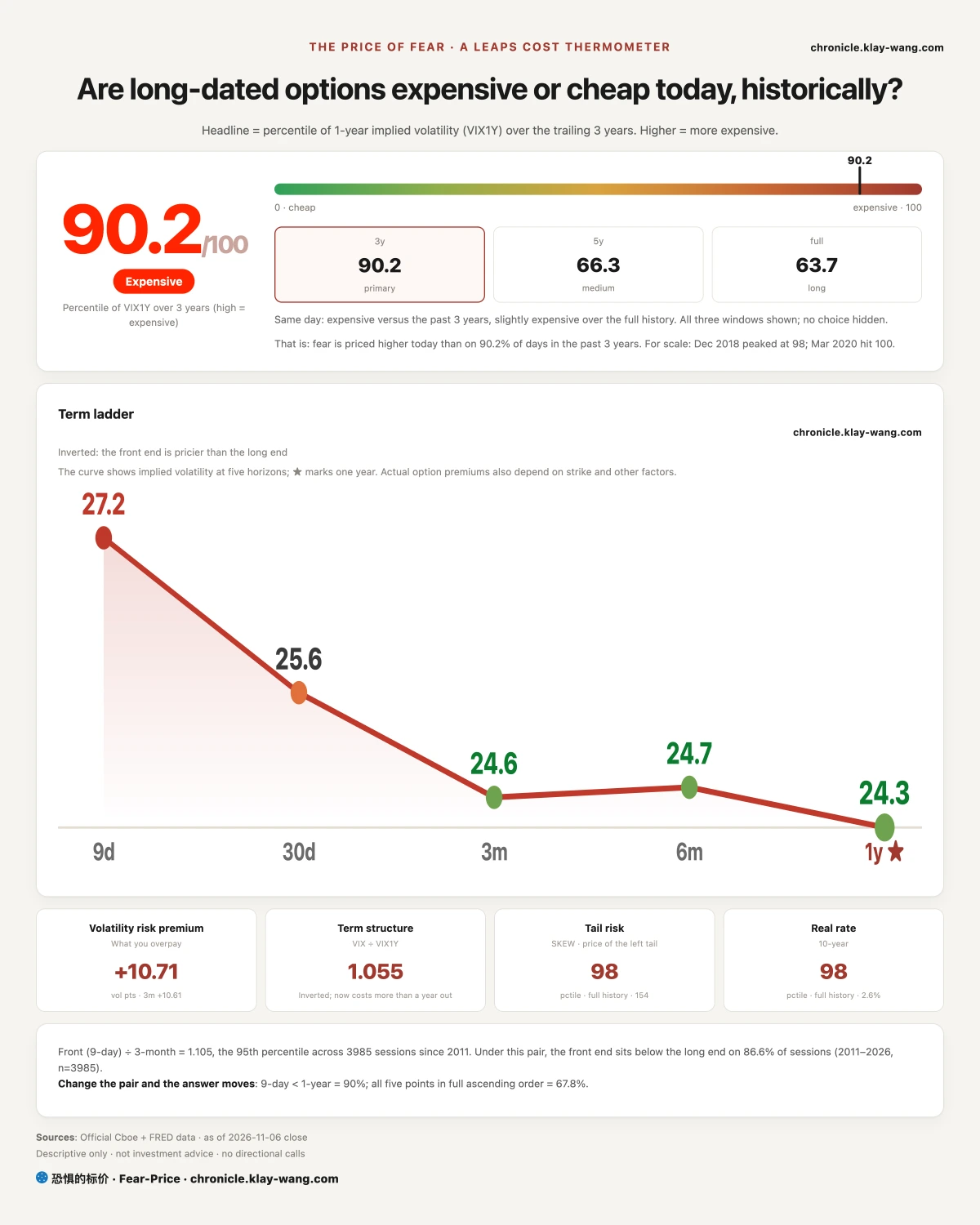
The Fear-Price Index stood at 90.2/100 on November 6. One-year implied volatility of 24.30% ranked at the 90.2nd percentile of its own three-year history, down from a 92.3 reading Thursday.
Pricing for volatility over the next nine days fell below the three-month measure on Wednesday, then moved above it during Thursday’s selloff. The gap narrowed from 7.11 points Thursday to 2.58 Friday. The rebound was accompanied by less concern about an immediate swing, although the difference had not returned to Wednesday’s position. On Tuesday we said we would watch whether that pressure receded after election and earnings week; Friday brought a partial easing.
The K Index recovered to a provisional 0.861 Friday. The Fear & Greed reading rose from 20.0 to 22.1, while the VIX fell from 28.18 to 25.64. Options priced less near-term movement alongside the stock rebound, although sentiment remained in extreme fear. Thursday's 0.705 was provisional; the site's historical series now lists 0.709.
Since 2011, the current site history records 70 moves from above 1 to below 1, most recently on Thursday. Friday was the second consecutive session below 1. The reading is a reason to revisit the price and protection cost of a position under consideration; the historical episodes and methodology are at chronicle.klay-wang.com/kindex and chronicle.klay-wang.com/fear-price.
[Jobs and rates] Hiring remained strong and borrowing costs rose
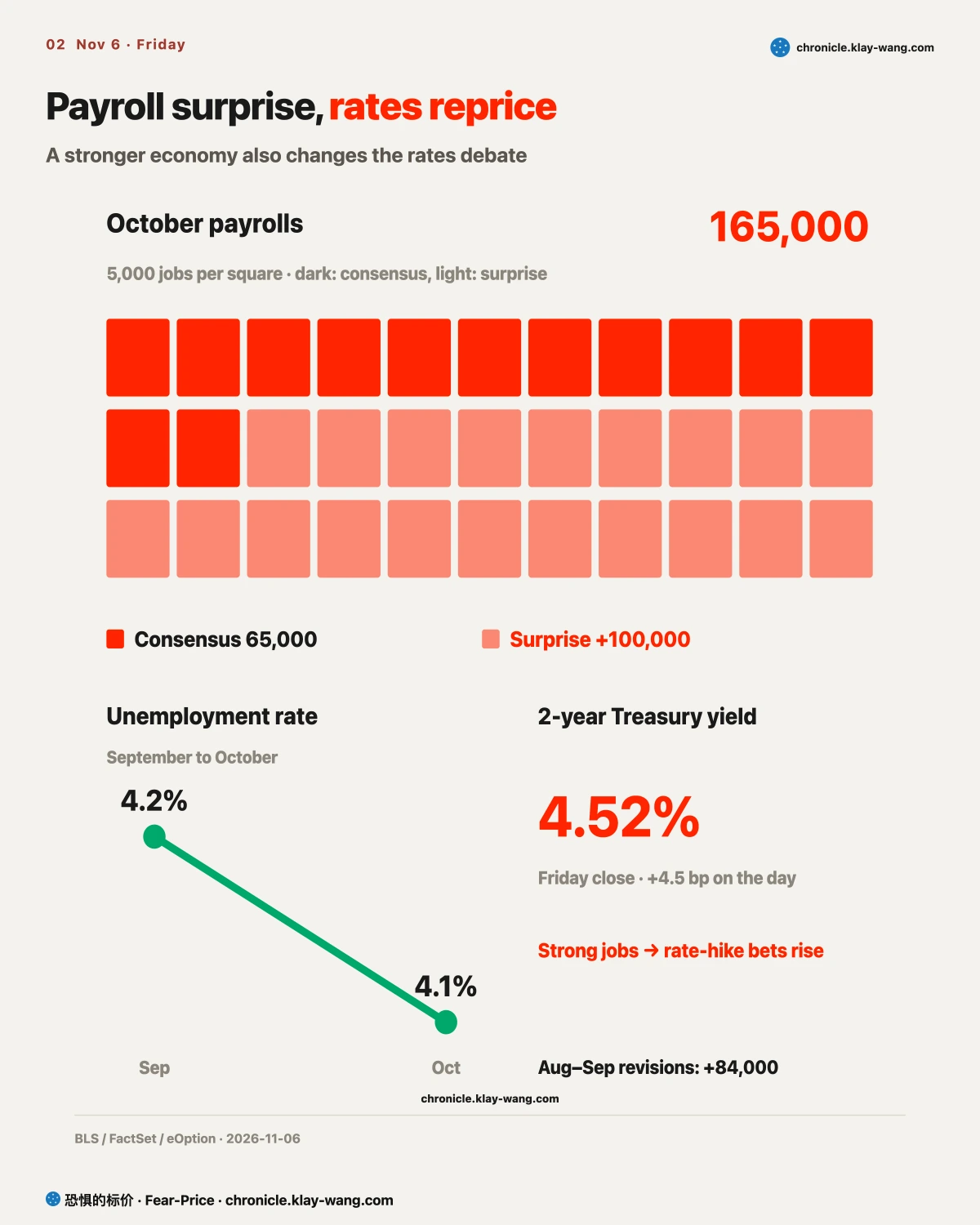
October payrolls increased 165000 against a FactSet consensus of 65000; August and September were revised up by 84000 combined. Unemployment fell from 4.2% to 4.1%. Hiring supports demand and gives the Federal Reserve more room to keep policy tight. An 08:32 Eastern news flash put the two-year Treasury yield at 4.537% after the release; a market-close report put it around 4.52%, up about 4.5 basis points. The figures come from different quotes and show the direction rather than a precisely comparable intraday move.
The jobs report has two implications for shares. Hiring supports household income and demand, while a strong labour market gives the Federal Reserve more room to keep rates high. A data-centre operator must pay for facilities and equipment before collecting rent over several years. If rates remain high when debt needs refinancing, interest can consume more cash; slower customer demand can delay cash coming in. The employment figures support demand, but the cost of financing AI construction remains an open question. The CoreWeave and Oracle bonds below show how investors are pricing two borrowers.
Preliminary Michigan sentiment rose from 48 to 51 and one-year inflation expectations fell from 4.7% to 4.3%. Most responses were collected October 20–November 2, showing households had become less pessimistic about prices before Thursday's selloff.
[Markets] Chips lifted the index while most stocks fell
All eleven S&P sectors fell Thursday. On Friday SPY gained about 0.31% and QQQ rose 1.40%, while the equal-weight S&P fund RSP fell 0.38%. More S&P constituents fell than rose; the semiconductor ETF gained 3.62%. The recovery in the index drew support from chips and other heavily weighted stocks, while many other shares declined.
Friday’s rebound came on lighter trading: dollar turnover in both SPY and QQQ was roughly half Thursday’s. SPY reached $742.21 during the session and closed at $735.29; QQQ also finished below its opening price. The S&P 500 returned close to its late-June level.
The S&P 500 trades at 38.91 times its average inflation-adjusted earnings over the past ten years. Compared with the last available reading from each of the previous 120 months, it is approximately at the 91st percentile; the median for that period was 31.54. Although the index has returned close to its late-June level, the price relative to longer-term earnings remains above most readings of the past decade. The next question is whether companies, especially the largest technology firms, can sustain earnings growth and turn orders into revenue.
Rates, options and credit help track the pressure on those forecasts. The two-year Treasury yield rose to 4.52%; higher rates can increase refinancing costs and make bonds more attractive. Options price larger near-term swings for the Nasdaq than for the S&P, while the CoreWeave and Oracle bonds below provide a view of funding conditions. Sustained earnings growth and easier financing would give the current valuation more support; weaker earnings expectations or persistently expensive financing could make the same index level look more demanding.
Before the open, put option positions were concentrated around $730 for SPY and $640 for QQQ. Friday’s closes were approximately 0.7% and 2.5% above those levels. They provide reference points for following stock and option prices next week: if the funds approach them while short-dated options become more expensive, concern about immediate swings would be rising again.
The options market puts a higher price on the next two weeks of Nasdaq volatility than on the S&P. Buying both a call and a put with strikes near the market, expiring November 20, cost an estimated 3.5% of the SPY share price and 5.2% of QQQ, using Friday’s after-hours quote midpoints. The QQQ combination costs about half as much again relative to the investment. Nasdaq holders therefore have more near-term fluctuation to plan for; anyone buying options through earnings must also account for the premium paid.
On November 3, AMD forecast next-quarter revenue above the current quarter. We were watching whether higher memory costs would lead server customers to cut orders. On Friday AMD opened higher and finished above its opening price; Nvidia and Micron also closed above Thursday but gave up roughly 2.3% and 2.6%, respectively, from their opens. AMD held more of its opening gain, while the rest of the chip rebound had a less consistent intraday response. Watch whether AMD keeps its opening area and whether Nvidia and Micron recover theirs.
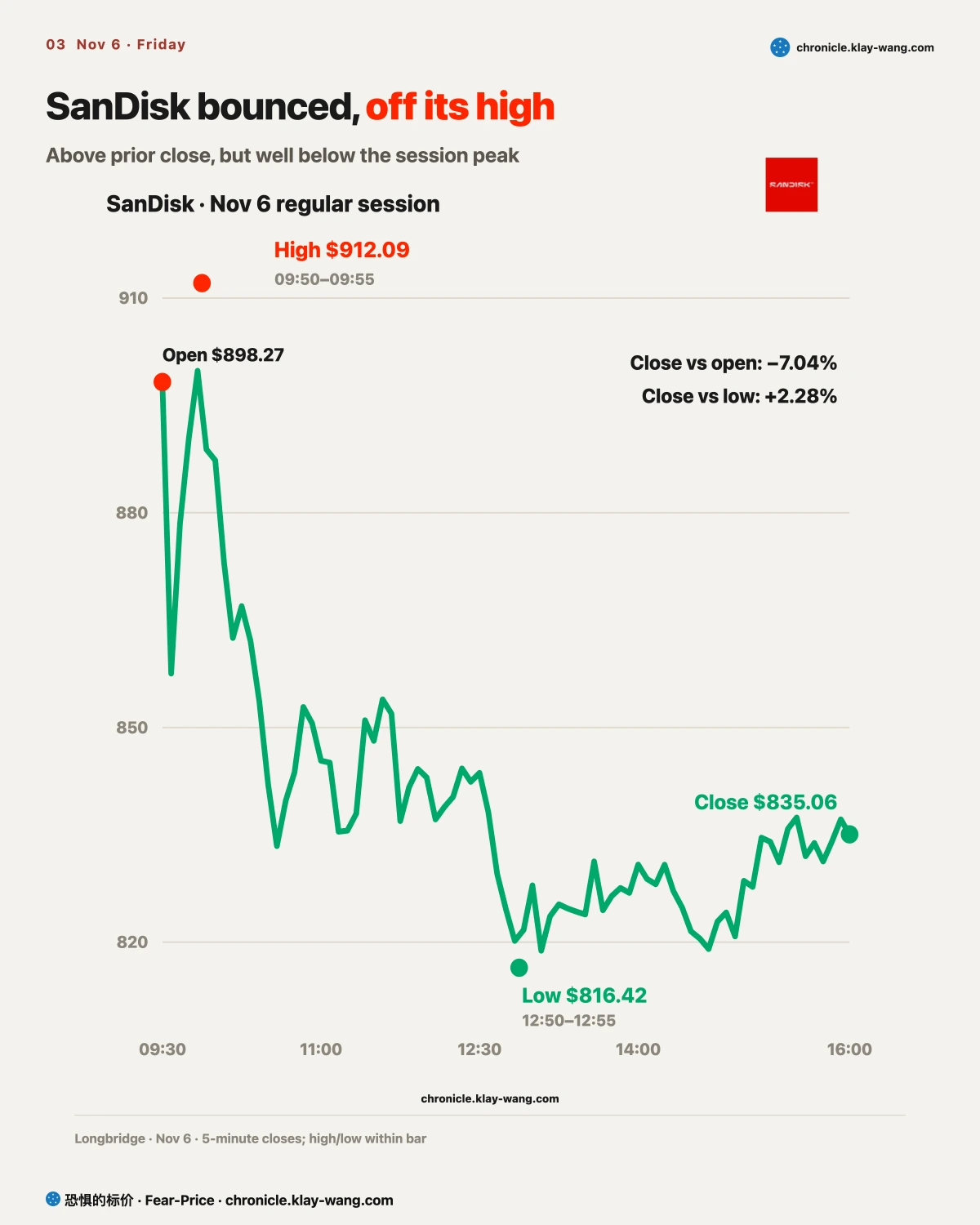
SanDisk opened at $898.27, reached $912.09 in the morning, fell to $816.42 around midday and closed at $835.06. The stock finished roughly 3.55% above Thursday but lost 7.04% from the open. The overnight rebound raised the opening price; regular trading then gave back much of that gain, and the afternoon recovery repaired only part of the decline. Next, watch whether the midday low holds and whether a further rebound reaches Friday’s open.
SpaceX stock and Tesla offered a different comparison: both added to their opening gains. SPCX closed at $134.27, near its session high, while Tesla gained roughly 2.7% from open to close. A morning report described Alphabet increasing its SpaceX holding, though SPCX had already opened higher. Their intraday performance was stronger than Nvidia and the memory stocks; the next test is whether that relative strength persists if chips weaken.
Over the full week, the semiconductor ETF still fell about 11% and SanDisk about 27%, while Microsoft and Amazon gained roughly 2% and 8%. The pullback within the AI supply chain was concentrated more heavily in chips and memory. The next question is whether chip demand and margins can last, and whether customers buying computing capacity can earn enough to finance continued construction.
Microsoft earns revenue from cloud services and software subscriptions; Amazon combines AWS with retail and advertising. SanDisk is more directly exposed to storage shipments and prices. Strong orders can lift chip and memory profits quickly, while added supply or lower customer orders can put pressure on prices and margins. Microsoft and Amazon also face large data-centre spending, but have more diverse sources of revenue. Track memory prices alongside cloud growth and construction spending to see whether this week’s divergence persists.
[Options and credit] What happened to near-term risk and funding costs?
Nvidia reports earnings on November 17, and the options market is charging for a sizeable move around the event. A November 20 $185 call and put together cost an estimated $20.88 per share at Friday’s after-hours quote midpoints. If both are held to expiration, the shares would need to finish above approximately $205.88 or below $164.13 to cover that premium, excluding fees. Buyers holding options through earnings must consider the size of the move as well as its direction; a decline in volatility pricing after results can also affect the sale price.
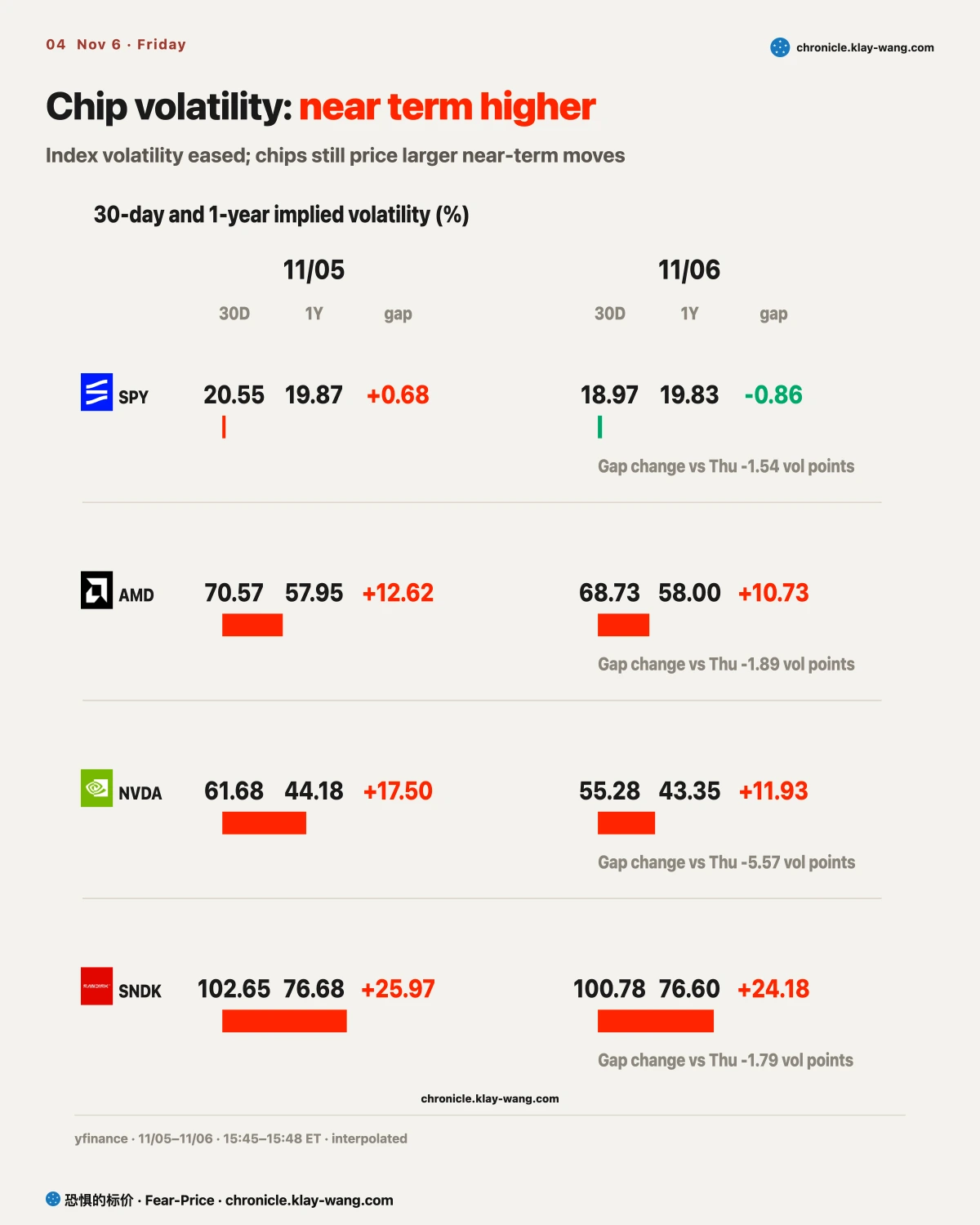
As the shares rebounded Friday, the gap between one-month and one-year volatility pricing narrowed for both AMD and Nvidia. For AMD the gap fell from 12.62 points Thursday to 10.73 Friday, still above Wednesday’s 4.49. Immediate pressure eased, while options continued to price more near-term volatility than before Thursday’s selloff. If AMD holds its gains and the gap continues to narrow, the rebound would have stronger support from the options market.
One long-dated AMD put also saw substantial trading. AMD’s January 2029 $350 put traded 10032 contracts Friday, with the strike roughly 22% below the closing share price. The day’s 141 trades had a combined premium of approximately $76217487, calculated using the volume-weighted average price. The next settlement’s open interest and the price of the same contract will show whether more contracts remain outstanding and how that contract’s price changes.
The equity rebound also raises a funding question. CoreWeave shares rose approximately 6.3% Friday, and its 2031 bond price recovered from 77.50 to 78.56. The bond’s yield difference over the five-year Treasury narrowed from Thursday but remained approximately 1.36 percentage points wider than the prior Friday. A separate Oracle bond’s comparable difference widened Friday. Bondholders priced the two borrowers differently: CoreWeave improved on the day, while its yield premium remained higher over the week. These are latest-trade comparisons for existing bonds; the terms of any new financing will depend on that financing.
This is why chip orders and financing belong in the same discussion. AMD’s maximum potential guarantees on partner data-centre leases rose from $4.1 billion at June end to $7.7 billion at September end, with no default or guarantee payment by then. Chip sales can generate revenue today. If a customer’s payments later fail to cover rent, the operator faces pressure first and the guarantor may then bear a cost. AMD holders should follow customer usage and payments alongside chip revenue and the size of its guarantees.
[Holdings] The next prices to watch
For index holders, watch the premarket put concentrations at SPY $730 and QQQ $640 together with short-term volatility. Both funds closed above those levels, but Friday's turnover was lower than Thursday's.
For Nvidia, Micron and SanDisk holders, watch whether prices recover Friday's opens. Nvidia's earnings fall before November 20 option expiration; SanDisk recovered from its midday low but remained far below its morning peak. AMD held its higher opening price; follow whether it keeps that level and whether its near-term volatility premium narrows.
SPCX and Tesla both closed above their opens, stronger intraday than most memory stocks. Financials and consumer staples did not follow technology higher, so watch rates and spending data for their next move.
[What to watch] One month, three months and beyond
Over the next month, inflation data will matter for how long rates stay high, while Nvidia’s November 17 results will test orders and deliveries. Over roughly three months, follow the price and subsequent open interest of Nvidia’s February 2027 $210 call after its heavy trading. Further out, track AMD’s long-dated put and lease guarantees alongside CoreWeave customer payments and the price of the same bond. Together, those observations address whether demand can continue and whether the buildout can be financed.
Our November 2 test requires both Nvidia one-year volatility above 45% and verified downstream memory order cuts to overturn the earlier cycle thesis. Friday's comparable volatility was 43.35%, up from 41.25% on November 2 and closer to the 45% threshold. Apple had described memory costs and supply constraints, while AMD subsequently guided next-quarter revenue above the current quarter; customer orders remain the next demand test. The separate CoreWeave test, whether the same-bond spread stays above 900 basis points through November 20, remains open.
Three Lines Worth Keeping
- Strong employment supports demand while keeping short-term funding expensive.
- AMD and SPCX added to opening gains; Nvidia and SanDisk faded after higher opens.
- Volatility eased, but chip options and compute financing remain expensive: follow earnings, settlement, collections and comparable credit quotes.
No investment advice. No direction calls. No market timing.