All Eyes on Jensen Huang, Yet Lenders Did Not Charge Nvidia More
Three-Line Summary
- On Monday all 11 sector ETFs closed higher and AMD rose 13.26%, back above its level before the plunge last Thursday; Nvidia opened 7.27% lower and closed at its lowest since April 7.
- The premium of one-month over one-year options on the semiconductor ETF fell from 10.48 points to 4.83; Nvidia only moved from 11.93 to 11.37.
- The Nvidia 2031 bond spread closed at 77.5 basis points, 1.6 narrower than Friday. Lenders did not charge the company more.
On Sunday, November 8, the Nvidia board announced an independent investigation into reports that chief executive Jensen Huang had been a target of foreign intelligence activity, and said it had no reason to believe national security or company secrets had been compromised. On Monday the market priced this separately from AI demand. AMD, Broadcom, Micron, TSMC and Intel all rose while Nvidia fell. Most of the option premium added to peers last week came off, almost none came off Nvidia, and the bond market did not charge even Nvidia more. The market is pricing who will make the calls at Nvidia over the next year, while AI hardware shares rebounded together the same day.
The selloff from last Thursday paused on Monday, but rates kept rising, so the rebound came from sellers stepping back, with no new cheap money coming in.
Fear-Price Back to 70: Near-Term Panic Left, the One-Year Did Not
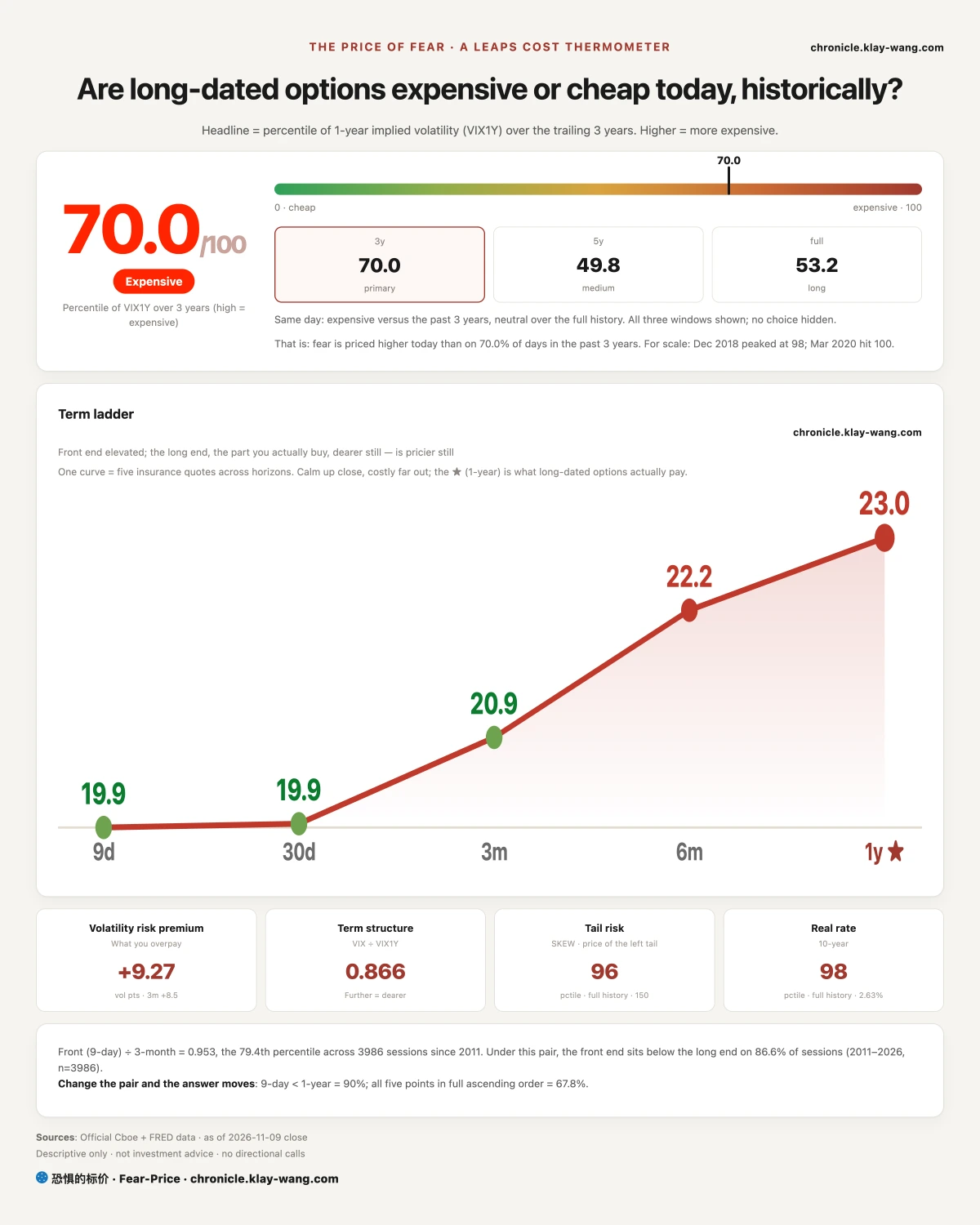
Fear-Price Index · November 9, 2026 · 70.0/100. One-year implied volatility was 23.00%, at the 70.0th percentile of the trailing three years, down 20.2 points from 90.2 on Friday; higher means historically more expensive. Daily ledger: chronicle.klay-wang.com. Credit: Fear-Price.
The near end fell fastest. Nine-day volatility is now below three-month; on Friday it was 2.58 points above. VIX futures returned to the normal shape, with far months dearer than near, the reverse of last Thursday and Friday. Options shed the panic premium for the next few days, while the one-year still ranks around the 70th percentile of three years. For stockholders, a month of insurance is clearly cheaper than on Friday; a year of it is still expensive.
The K index read 1.592 (the sentiment reading for the day is provisional), above the final Friday reading of 0.861. The closer it gets to 1, the more people are actually paying for protection. Sentiment at 31.7 is still in fear, yet fewer people are paying for protection. At the Monday sentiment reading, K would fall below 1 only if the VIX rose above 31.7. History at chronicle.klay-wang.com/kindex, the index at chronicle.klay-wang.com/fear-price.
Markets: AI Hardware Rebounded Together, Only Nvidia Was Left Behind
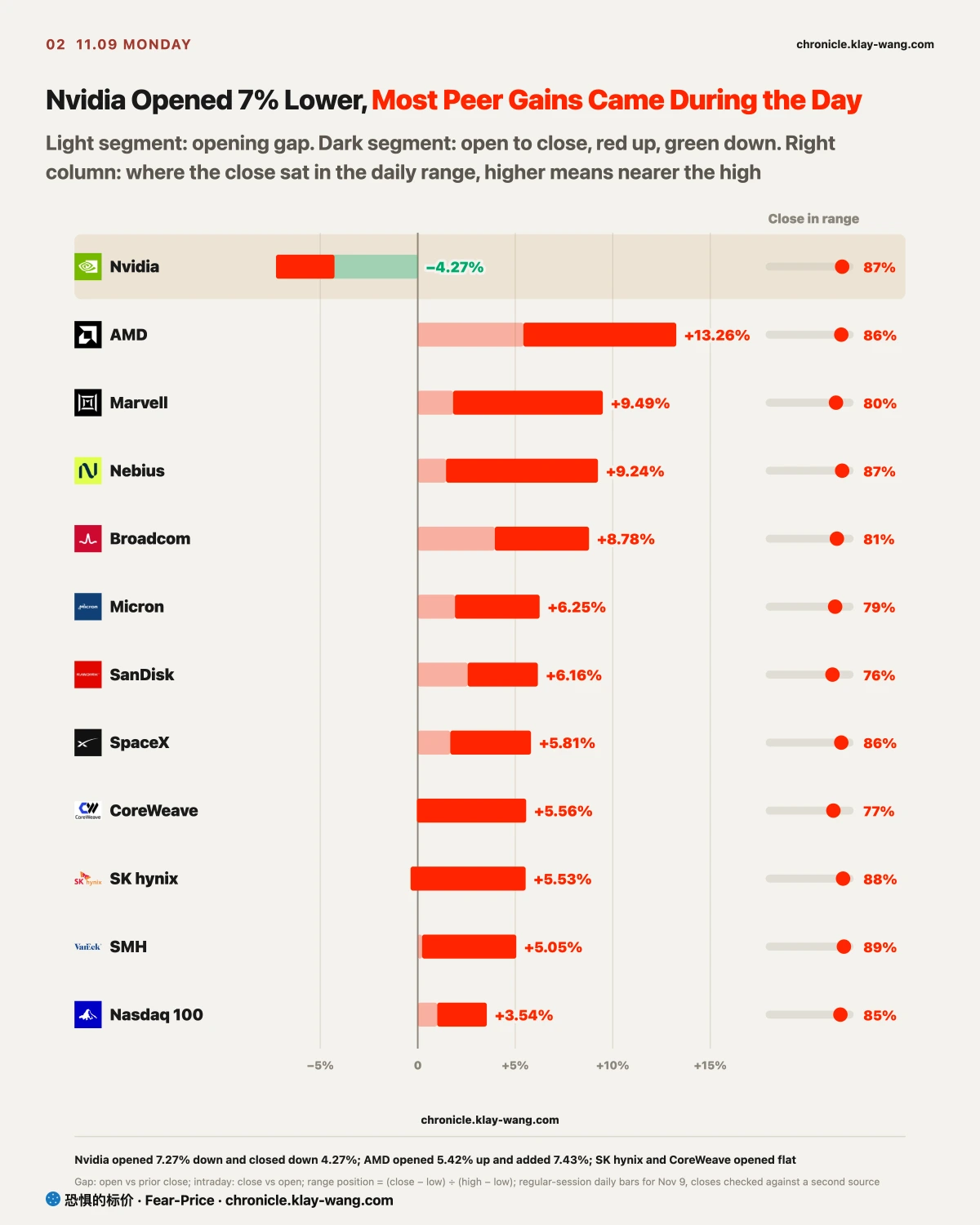
AI hardware led the rebound, and the gain reached most stocks. All 11 sector ETFs closed higher on Monday, and the equal-weight and cap-weighted S&P 500 ETFs rose by almost the same amount, so it did not rest on a few heavyweights. The semiconductor ETF rose 5.05%, and AMD recovered all of its loss from last Thursday.
The opening gap and the move from open to close need to be read separately. The gap reflects overnight news; the move after the open shows whether buyers kept coming during the day. AMD rose in both: the Google TPU 8tx system, announced Monday, uses fifth-generation AMD EPYC as its host processor, Oppenheimer upgraded AMD the same day, and after the higher open it rose another 7.43% during the session. SK hynix, CoreWeave and Nebius opened within 1.5% of the Friday close and barely moved at the open, so there was no major overnight news; all three fell about 15% last week, and Monday gains came from buyers stepping in during the day.
Nvidia opened 7.27% lower on 2.5 times the Friday volume, recovered 3.24 points during the day and still closed down 4.27%. Anyone holding Nvidia over the weekend lost more than 7% at the open and won back less than half during the day. Volume in the S&P 500 and Nasdaq 100 ETFs was 15% to 22% lighter than Friday. The index rose on lighter volume while Nvidia fell on heavier volume: on the rising side, the sellers of last week stopped; on the falling side, someone was actively selling.
Options: The Near-Month Premium on Peers Halved, Not on Nvidia
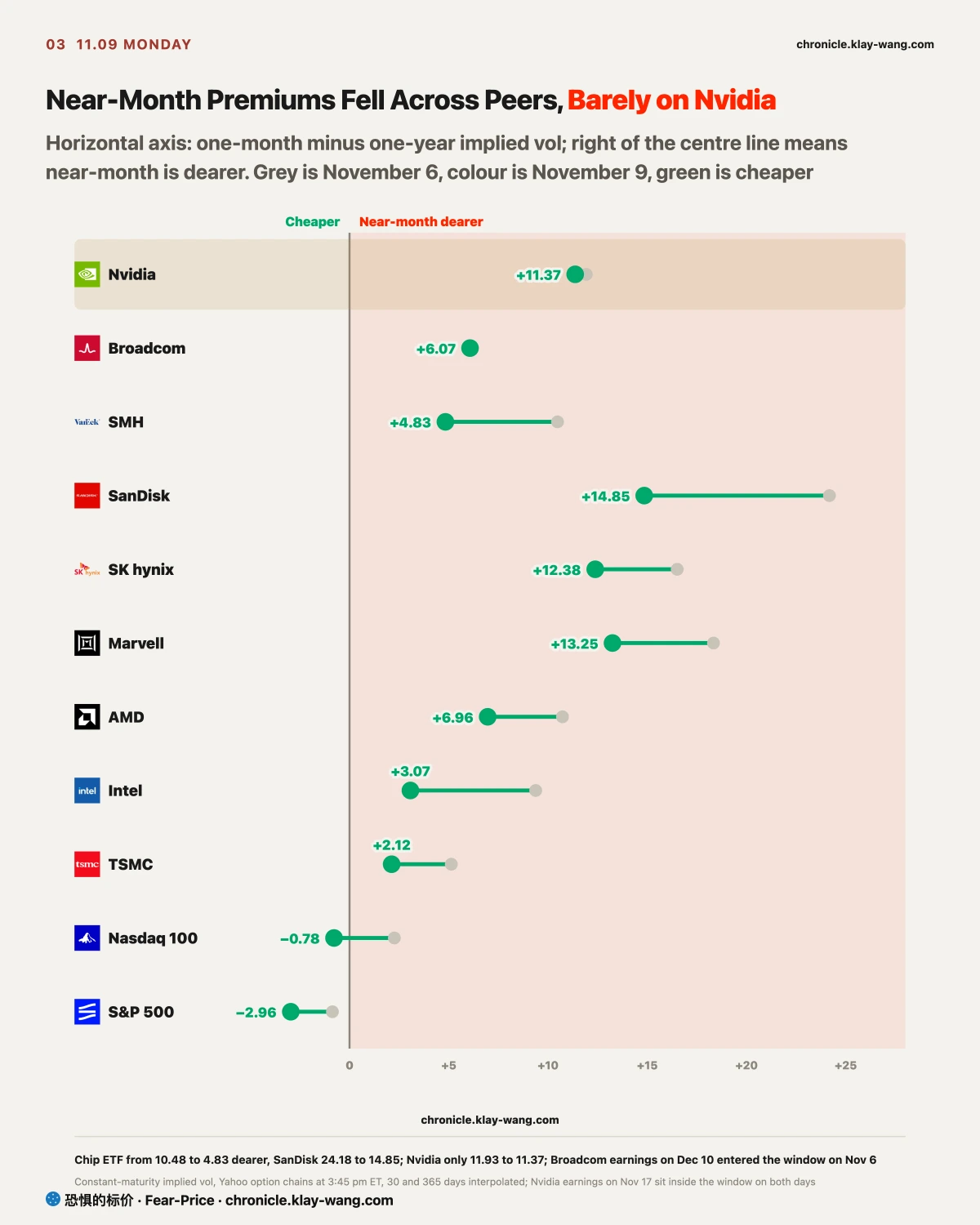
A put option works like downside insurance, and its price is measured by implied volatility: the more the market expects a stock to swing, the dearer the premium. One-month and one-year premiums are both annualized, and normally one-year is dearer; when one-month is dearer, someone is paying up for the next few weeks.
After the plunge last Thursday, one-month premiums across AI hardware rose above one-year. On Monday they broadly fell: the semiconductor ETF went from 10.48 points dearer to 4.83, SanDisk from 24.2 to 14.8, and the Nasdaq 100 is now cheaper than one-year. Nvidia barely moved, from 11.93 to 11.37. What peers pay for a month of insurance above the one-year rate fell by half; on Nvidia it did not.
Broadcom stayed high too, because its December 10 earnings entered the one-month window from Friday. Nvidia reports on November 17, inside the window on both Friday and Monday, so earnings cannot explain the difference; on November 4, with earnings also in the window, it was only 5.0 points dearer.
The one-year shows the same shape. Using the December 2027 contracts closest to the money, the Nvidia one-year implied volatility was 43.6 versus 40.3 on November 4; the S&P 500 ETF was 18.2 versus 17.6, essentially back to pre-plunge levels. A Nvidia holder buying one-year downside protection now pays about 8% more than before the plunge.
Systems engineering has a term for this: a single point of failure, one component whose failure stops the whole system. Investors pricing founder-led companies call the same thing key-person risk. Premiums on peers are fading because the shock last week was a one-off selloff; on Nvidia they are not, because the investigation has no conclusion yet, and until it does, the market pays a little extra every day for uncertainty about who decides over the next year.
Long-Dated: Bullish Money Did Not Leave, It Moved the Nvidia February Target Lower
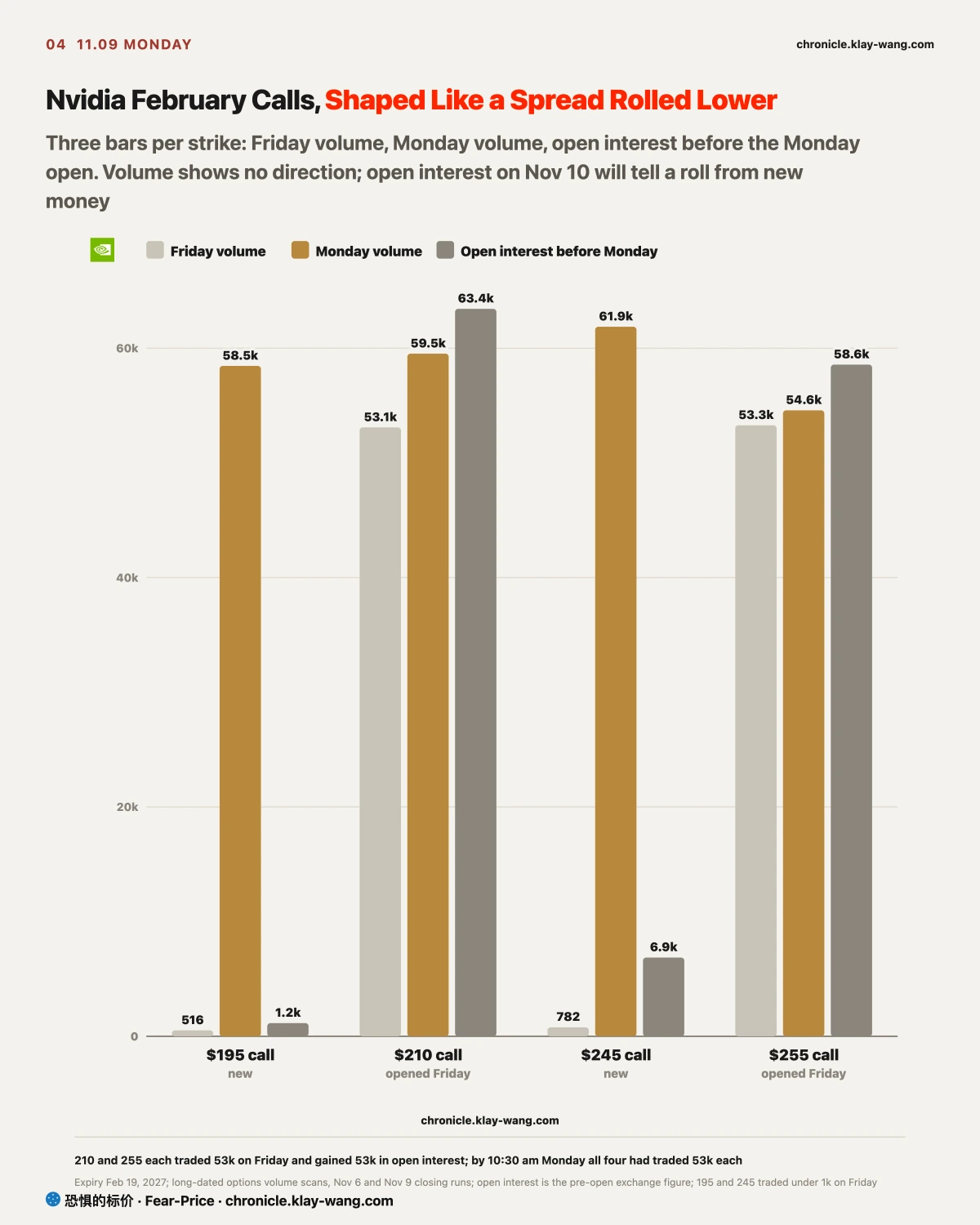
Near-month premiums describe the near term for Nvidia; far-dated contracts show whether bullish money left. Among contracts expiring more than three months out, Nvidia again traded the most on Monday. Four calls expiring next February, at strikes of $195, $210, $245 and $255, each traded fifty to sixty thousand contracts; at closing implied volatility, the lowest strike alone carried an estimated $68 million in premium for the day. The $210 and $255 strikes each traded about 53000 contracts on Friday, and Monday morning open interest in each was up by about the same number. Equal-sized pairs commonly mean a spread: buy one call and sell a higher one, earning the gain between the two strikes.
Heavy volume across all four on Monday suggests someone may have moved the Friday spread lower: the stock fell another 4% and the bullish threshold moved down with it. Volume does not show direction; open interest on Tuesday morning will. If the $210 and $255 strikes each lose about 50000 contracts and the $195 and $245 strikes each gain about 50000, it was a roll; if all four rise, it was new money and the roll reading does not hold. If Tuesday confirms a roll, for anyone holding Nvidia shares it means the big bullish money moved its target range for next February down to 195 to 245.
There was also deeper downside insurance. The $95 put expiring next June traded 75000 contracts against prior open interest under 5000, at a strike just over half the closing price. The $100 puts expiring next March that we wrote about last Tuesday traded nearly 40000 contracts at the time. A price near half drew heavy volume twice in a week, so someone is paying for an extreme case, but the estimated premium was only about $12 million, less than a fifth of one bullish strike.
Credit: For the AI Bubble, Watch Lenders: Nvidia Is Not Repriced, the Strain Is on Borrowers
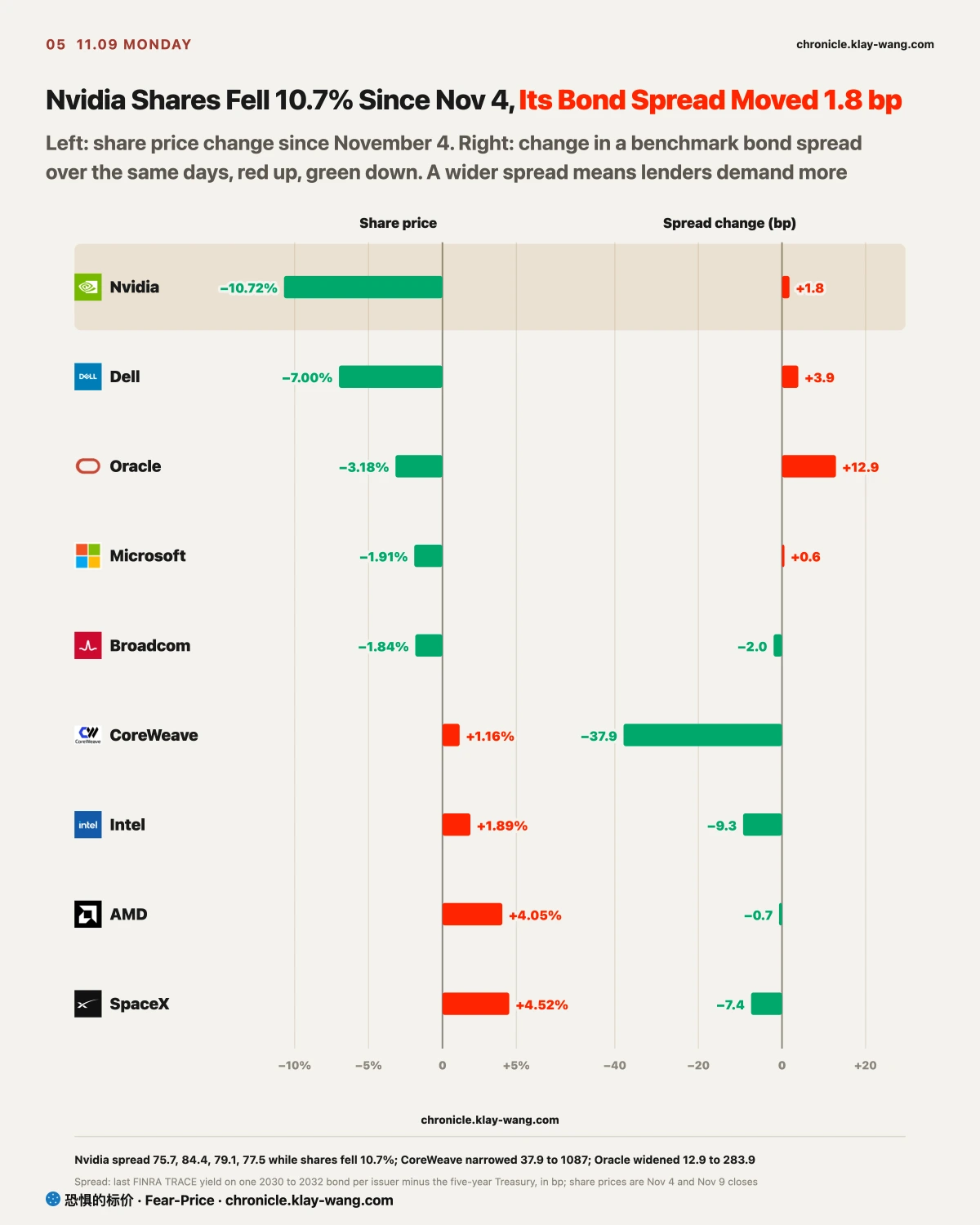
Nvidia shares fell about 11%, and its bond spread is almost back to where it was before the plunge. The 2031 bond spread was 75.7 basis points on November 4, 84.4 on the day of the Thursday plunge, 79.1 on Friday and 77.5 on Monday. A spread is the extra interest a company pays over a Treasury of the same maturity, and lenders care only about getting principal and interest back at maturity. Shareholders are discounting decision risk; lenders are not following. For anyone holding Nvidia bonds, through Monday the investigation has not shown up in the price.
The real state of the AI bubble depends on who borrowed the money. In the 2000 tech bubble, Global Crossing and WorldCom, which borrowed to lay fiber, went bankrupt, while Cisco, which sold the equipment, lost more than 80% of its share price and survived. Monday spreads split the AI supply chain in two: the Nvidia bond pays only 77.5 basis points over Treasuries, while CoreWeave, which borrows to build data centers, pays 1087, fourteen times as much. The Oracle bond spread is still more than 200 basis points above benchmark bonds of Microsoft, Alphabet and Meta; since November 4 it has widened 12.9 basis points, against 1.8 for Nvidia. This week the bond market has not charged the whole AI supply chain more; the extra charge sits with the companies borrowing to expand.
The CoreWeave bond spread narrowed from 1161.9 on Friday to 1087.1, still about 190 basis points wider than a month ago. Last Tuesday our call was that this spread would stay above 900 at every reading through November 20; through Monday it has held. CoreWeave reports after the close on Tuesday, and three things matter: how many new contracts come online on schedule, whether customer payments keep pace, and the cost of the next round of funding. Its one-month options are 27.5 points dearer than one-year, and that window includes earnings.
Three things are worth watching. First, if the CoreWeave spread goes back above 1204, its November 5 level, after earnings, lenders are growing less sure about the borrowing end. Second, if the gap between Oracle and the three cloud giants keeps widening, the strain is spreading to larger companies. Third, as long as the Nvidia bond spread stays below 84.4, the level on the day of the Thursday plunge, the investigation remains a shareholder issue and has not become a repayment issue.
Rates are adding cost for borrowers. The two-year yield rose 5 basis points, and the delayed after-close quote on the fed funds future for January next year implied about 4.10%, roughly 0.2 percentage point above the current overnight rate of about 3.88%, close to one more hike. Yet the MOVE index, the price of insurance against rate swings, fell from 92.8 to 86.0: rates are drifting up while disagreement in the bond market over where they end up is narrowing. October CPI comes out at 8:30 a.m. ET on Tuesday; because of the government shutdown last year, the monthly change is the main reading. A hot monthly print makes the base-rate part of borrowing costlier first for borrowers like CoreWeave, which yield above 15%.
What This Means for What You Hold
Nvidia: For holders, the next level I am watching is the March 30 close of 165.17, the lowest in a year. Our current call is that before its November 17 earnings, the Nvidia one-month-over-one-year premium will stay at least 3 points above the same measure for the semiconductor ETF; on Monday the gap was 6.5, against roughly 1 to 3 points in the days before. If the gap falls to 3 or less on any reading before earnings, we are wrong, and the market has started to absorb the investigation as ordinary industry volatility.
AMD: Up two days in a row, it has recovered its Thursday loss and closed above 488.78, its close last Wednesday. AMD one-month options are still 7 points dearer than one-year; the repair is complete only if the stock holds above 488.78 and that premium keeps fading.
Micron, SanDisk, SK hynix: One-month options remain 10 to 15 points dearer than one-year. The next reports from Micron and SanDisk are more than a month away, so the premium is not waiting on an event; it reflects disagreement over the memory cycle itself. Until the premium falls within 5 points, treat the rebound as a rebound.
Index and SpaceX: S&P 500 one-month options are 3 points cheaper than one-year; for anyone protecting a large position before CPI, one-month contracts cost less than one-year. SpaceX rose 5.81%, and its one-year option premium and bond spread fell the same day. After its $40 billion GPU financing began syndication, shareholders and lenders moved in the same direction.
Three Lines Worth Keeping
- On the same day, premiums faded across the industry and stayed on one company: a one-off selloff passes, an investigation with no conclusion gets priced day by day.
- Shareholders and lenders keep two different books. Shareholders discount decision risk over the next year; lenders only ask whether they get paid back at maturity.
- To judge the AI bubble, look at the borrowers first: the CoreWeave spread is fourteen times that of Nvidia, and the strain sits with companies borrowing to expand.
Note: share prices are November 9 regular-session closes, checked against a second data source, with an independent review still running that evening; the fed funds future is a delayed after-close quote, and the near-month contract had no valid quote that day.
Fear-Price Index · 2026-11-09 · 70.0/100. Data and methodology: chronicle.klay-wang.com.
No investment advice. No direction calls. No market timing.