Nvidia Fell to Its Lowest P/E in Five Years: Good News or Bad?
Three-Line Summary
- October core CPI rose 0.3% month over month against 0.2% expected, and the two-year Treasury yield jumped 18.44 basis points, its biggest one-day rise since April 2025 according to Reuters.
- Against the close on November 4, the day before the plunge last Thursday, AMD was 5.4% higher, Broadcom 2.0% higher and TSMC flat; Micron was 8.8% lower, SanDisk 17.1% lower and Nvidia 15.6% lower.
- Nvidia trades at about 21 times trailing earnings, its lowest in five years and below TSMC at 26; the spread on its 2031 bond widened to 82.8 basis points, 1.6 from the level on the day of the plunge.
At 8:30 a.m. ET on Tuesday, November 10, the Bureau of Labor Statistics reported October CPI: headline up 0.4% and core up 0.3% on the month, against expectations of 0.3% and 0.2%. Core has printed 0.3% for three months in a row. Before the data, Fed Governor Christopher Waller said a core reading of 0.3% or more would lead him to consider a 50 basis point hike in December. The two-year yield rose 18.44 basis points to 4.731%, and the ten-year rose 12.55 to 4.988%.
Tuesday was the third trading day after the AI hardware selloff last Thursday, when the semiconductor ETF fell 11.21% and Nvidia, Broadcom and TSMC each lost more than 9%. Three days later came the biggest one-day rise in the two-year yield in a year and a half. The question for anyone holding AI stocks: is this AI rally still intact, and is Nvidia the same story as the other chipmakers?
Fear-Price at 66: Rate Insurance Got Dearer, Stock Insurance Got Cheaper
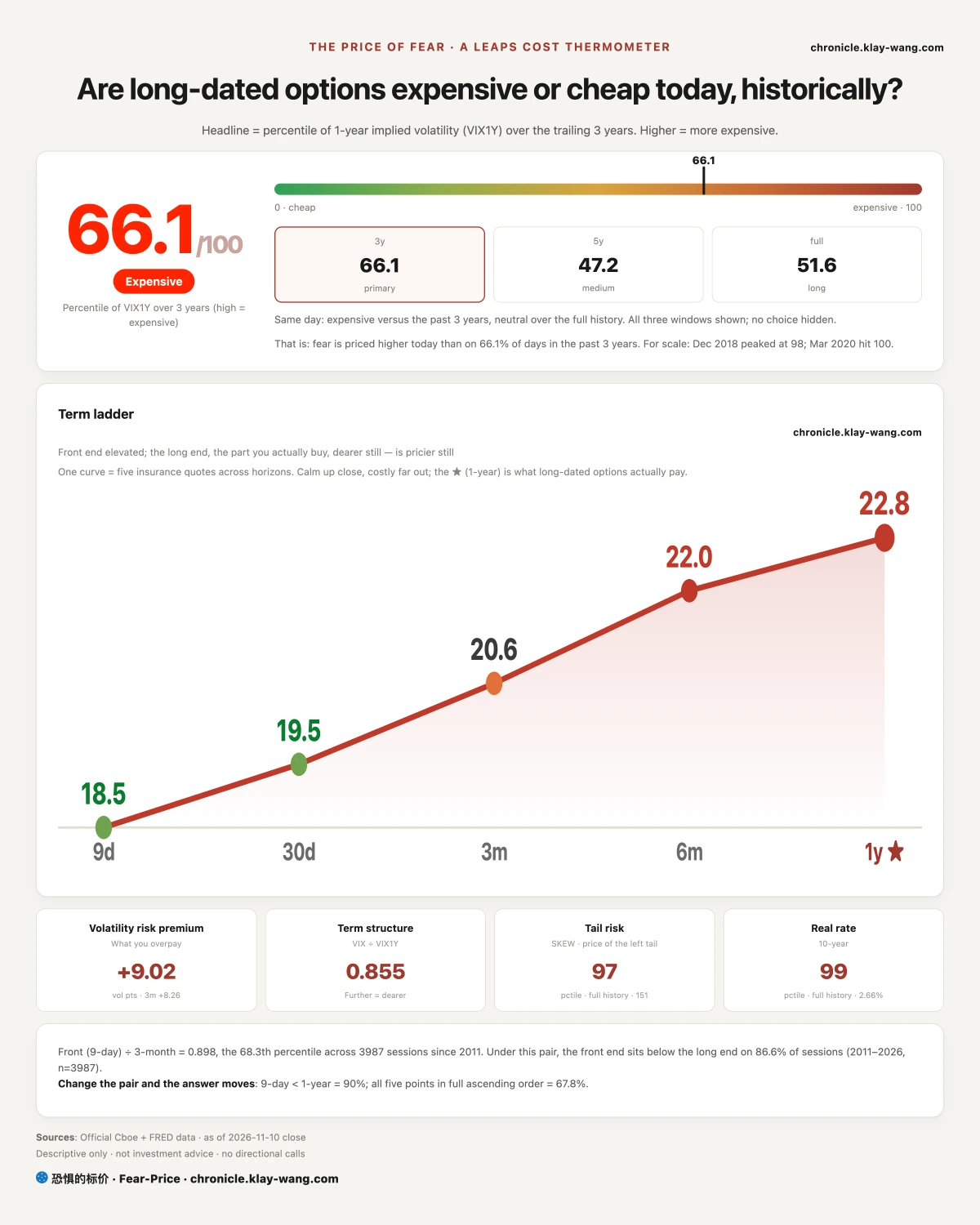
Fear-Price Index · November 10, 2026 · 66.1/100. One-year implied volatility was 22.76%, at the 66.1st percentile of the trailing three years, down 3.9 points from 70.0 on November 9; higher means historically more expensive. Daily ledger: chronicle.klay-wang.com. Credit: Fear-Price.
The two kinds of insurance moved in opposite directions. The VIX fell from 19.92 to 19.46, the term structure rose steadily from nine days to one year, and far VIX futures stayed 1.42 points above the front month, so stock options did not add a rush premium for the coming weeks. The MOVE index, the price of insurance against rate swings, rose from 85.98 to 92.43, moving from the 39.0th to the 48.7th percentile of three years. The uncertainty sat in the price of money; the stock market treated it as a repricing, not as a sign of a crash.
The K index read 1.719 (the sentiment reading for the day is provisional), above the final November 9 reading of 1.581. The closer it gets to 1, the more people are actually paying for protection. At the Tuesday fear and greed reading of 33.5, K would fall below 1 only if the VIX rose above 33.5. History at chronicle.klay-wang.com/kindex, the index at chronicle.klay-wang.com/fear-price.
For index holders, S&P 500 one-month options are 3.1 points cheaper than one-year, so short-term protection is the cheap end.
Markets: The Open Priced Rates, Only a Few Companies Kept Falling After
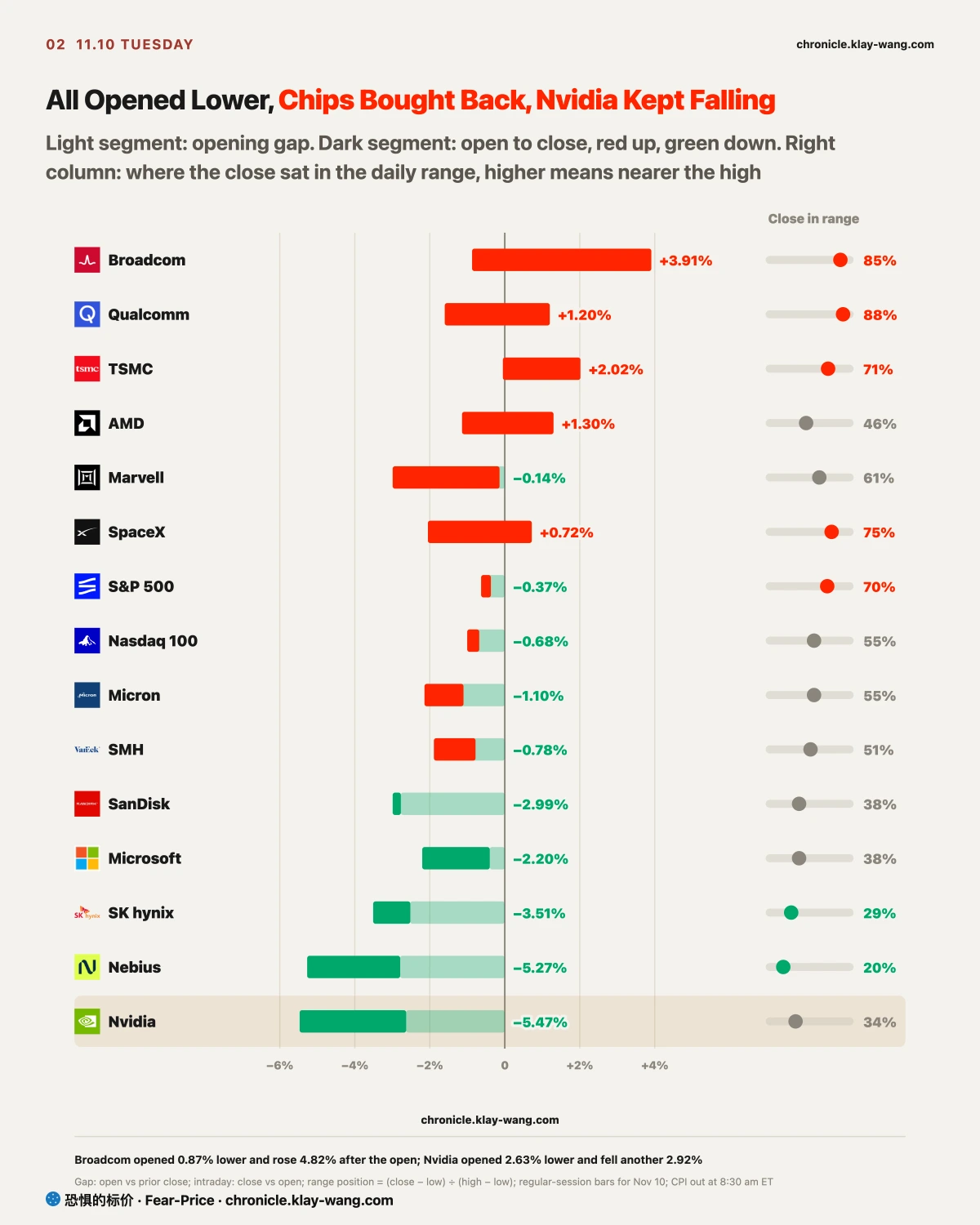
The opening gap and the move after the open need to be read separately. CPI came out an hour before the open, so the gap carried the rate shock; whatever kept moving after the open reflected daytime judgments on each company.
Of the 47 stocks we track, 39 opened lower. After the open, chips split in two. Broadcom opened 0.87% lower, rose 4.82% during the day and closed at 85% of its daily range; TSMC, AMD, Qualcomm and Marvell were also bought back after a lower open. Nvidia opened 2.63% lower, fell another 2.92% and closed at 34% of its range. Nebius, SK hynix, SanDisk and Dell also fell in both segments. If rates were the main driver, the longest-duration growth stocks should have kept falling during the day; instead chips were bought back, and the laggards each had their own news.
The Nvidia news escalated. Reuters and others reported that Jensen Huang admitted an affair and that the company review covers whether the other party was linked to intelligence activity; two days of selling took about $470 billion off its market value, and Microsoft briefly moved back to second place by market value. Microsoft itself fell 2.20%, almost all of it after the open, on the day Anthropic launched office software.
At the index level, the equal-weight S&P 500 ETF closed flat while the cap-weighted one fell 0.37%, and rising and falling members split about evenly. The losses were concentrated in two or three giants; most companies absorbed the rate shock.
The rate shock hit assets that pay no income directly. Gold fell 2.68%, silver 3.45% and the bitcoin ETF 1.51%, while the dollar rose. The cost of holding them is the risk-free interest given up; when the two-year pays 0.18 percentage point more, they have to get cheaper. Banks show the other side: the financials ETF rose 0.52% and JPMorgan closed flat, but a JPMorgan preferred fell 2.02% and a Bank of America preferred 2.46%. At the same bank, the common stock can earn more from higher loan rates, while the preferred pays a fixed dividend, so its price has to fall when rates rise.
Mainline: Three Days After the Plunge, AI Chips Split Three Ways
Against the November 4 close, the day before the plunge, AMD was 5.4% higher, Broadcom 2.0% higher, and TSMC and Qualcomm about flat: the plunge was fully recovered. Memory was not: Micron 8.8% lower, SK hynix 9.4% lower, SanDisk 17.1% lower. Nvidia was 15.6% lower and fell on two of the three days after the plunge.
Valuation adds the second layer. The trailing P/E, what the market pays for each dollar a company earned over the past four quarters, is about 21 for Nvidia, against a five-year median of 56, lower than 99.9% of the past five years and below both its foundry TSMC at 26 and its large customer Microsoft at 28. Broadcom is at 41 and AMD at 111. Memory is low by design: Micron at 9.7, below its own five-year median of 13.1, SK hynix at 7.1, SanDisk at 6.3.
All three groups sit in the AI supply chain, but their prices answer three different questions. AMD, Broadcom and TSMC answer whether data centers are still buying chips: they were bought back on the day the two-year yield jumped, and the same evening CoreWeave said its 2027 capacity is sold out. Memory stocks answer how long memory prices can keep rising: memory profits follow contract prices, and the market rarely pays a high multiple in boom years because it assumes prices will fall back. Bank of America expects the upcycle to last into 2028; the multiples say the market has not accepted that. Nvidia answers a question about the company itself: its trailing profits are already earned, yet its multiple fell from 56 to 21, a cut in what the market will pay for its future earnings, The cut began in the days the board opened its investigation, and other AI chip multiples did not follow, so the market discounted trust in the company itself, not data center demand.
The two biggest gainers are exactly the two options a large customer has if it wants to buy a little less from Nvidia: AMD sells the same kind of general-purpose GPU, and Broadcom designs custom chips for Google and Meta. The AMD multiple of 111 has to be carried by profits two years out, a price that only makes sense if it takes orders from Nvidia. After the Nvidia news, the market raised the price of its competitors and did not lower the price of AI chips as a group.
The Magnificent Seven show the same shape. Since November 4, only two fell meaningfully: Nvidia, and Microsoft, down 4.1%, with Anthropic launching office software that competes with the core productivity business of Microsoft. Microsoft fell as much as 3.45% intraday and closed about a third of the way back; buyers stepped in at the low, a sign the market has not concluded that Microsoft will lose its office software revenue. Meta and Amazon were each about 1.8% higher; Apple, Alphabet and Tesla moved less than 1.5%.
For anyone holding AI stocks, three days of trading say demand for AI chips is intact and the split is between companies. The test before Nvidia reports on November 17: if AMD and Broadcom keep closing above their November 4 levels of $488.78 and $325.48, the demand side holds; if they fall back below those levels along with Nvidia, the market is starting to doubt the whole supply chain, not one company.
Rates: Hikes Pulled Closer, the Short End Rose More
The two-year rose 18.44 basis points and the ten-year 12.55; the short end rose more and the curve flattened by about 6 basis points. The short end is most sensitive to policy, so this shape says the market pulled hikes closer. As relayed by Zhitong Finance, after CPI the probability of a 50 basis point hike in December was about 11.8%, with 25 basis points still the main bet; expected cumulative hikes through mid-2027 rose from two to three. Dallas Fed President Lorie Logan said the same day that at least two more 25 basis point hikes are needed.
The bond market itself was selling. The long Treasury ETF fell 1.32% on 1.40 times normal volume, the investment-grade corporate bond ETF fell 0.75% on 1.37 times, and the high-yield ETF fell only 0.43%. The longest duration fell most, with no sign of a credit selloff. There were also far-dated bets: the December 2028 $70 put on the long Treasury ETF traded 18600 contracts against prior open interest under 4000, a bet that long bonds fall another 13% or more within two years, with estimated premium of about $3 million, small in size.
Options: Index Near-Month Premium Did Not Rise, Nvidia Rose Again
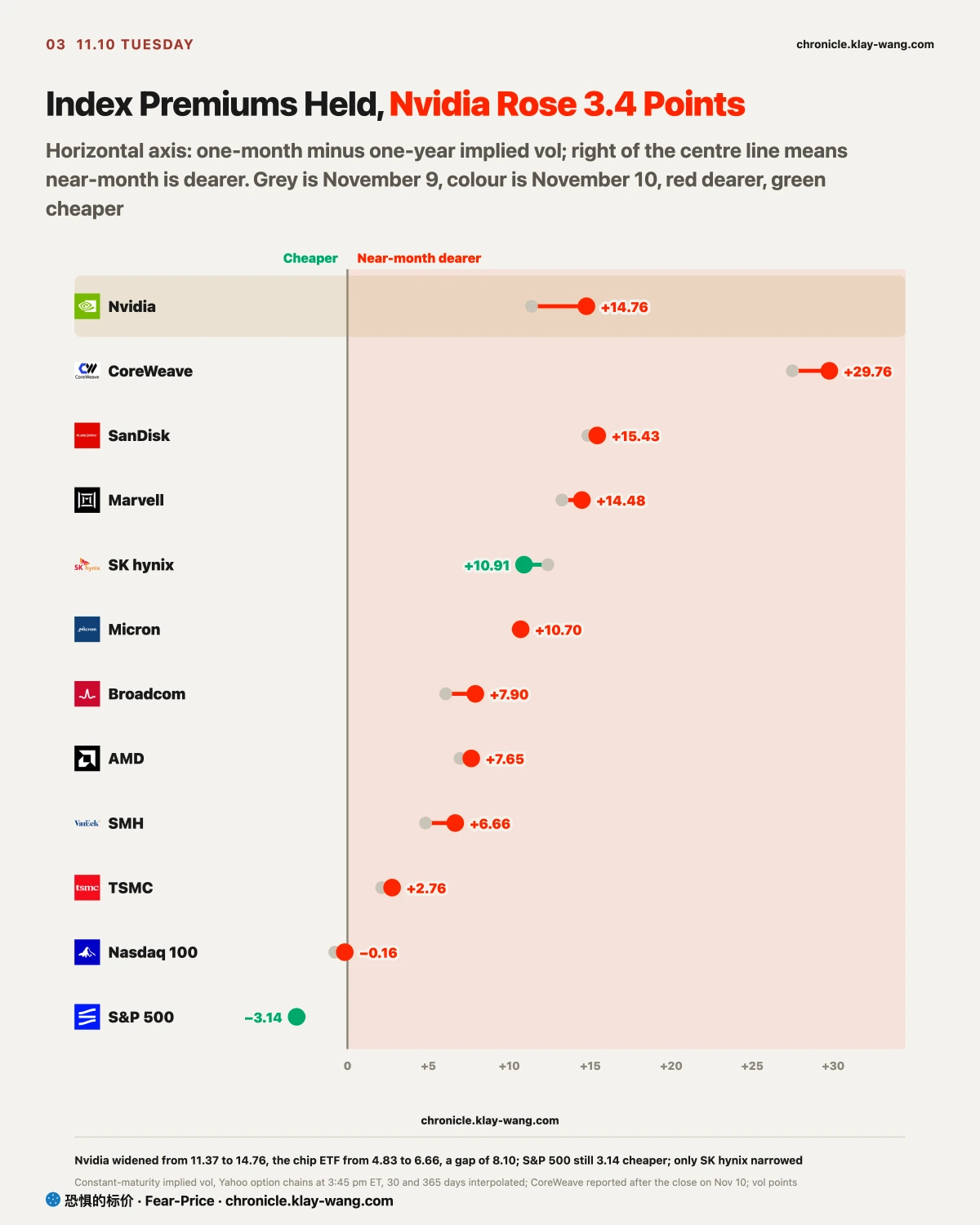
One-month and one-year options are both annualized, and normally one-year is dearer; when one-month is dearer, someone is paying up for the next few weeks. On November 10, Nvidia one-month implied volatility rose from 54.62 to 59.34, and its premium over one-year widened from 11.37 to 14.76. The semiconductor ETF widened from 4.83 to 6.66, and the gap between the two grew from 6.54 to 8.10.
If the rate shock were a market-wide matter, index insurance would rise first. S&P 500 one-month options are still 3.1 points cheaper than one-year, and the Nasdaq 100 is only 0.16 cheaper, roughly flat. The rise in near-month premiums sat in single stocks, Nvidia most of all. Among chips only SK hynix saw its near-month premium narrow, from 12.38 to 10.91. CoreWeave was 29.8 points dearer than one-year, with its earnings after the close on November 10 inside the window.
Long-Dated: The Bullish Block Stayed, and Moved Down Another Strike
On November 9 we wrote that the Nvidia February call spread may have been moved lower as a whole, and that open interest on the morning of November 10 would tell. It was a roll: the $210 and $255 strikes lost about 47000 and 52000 contracts, and the $195 and $245 strikes gained about 55000 and 54000.
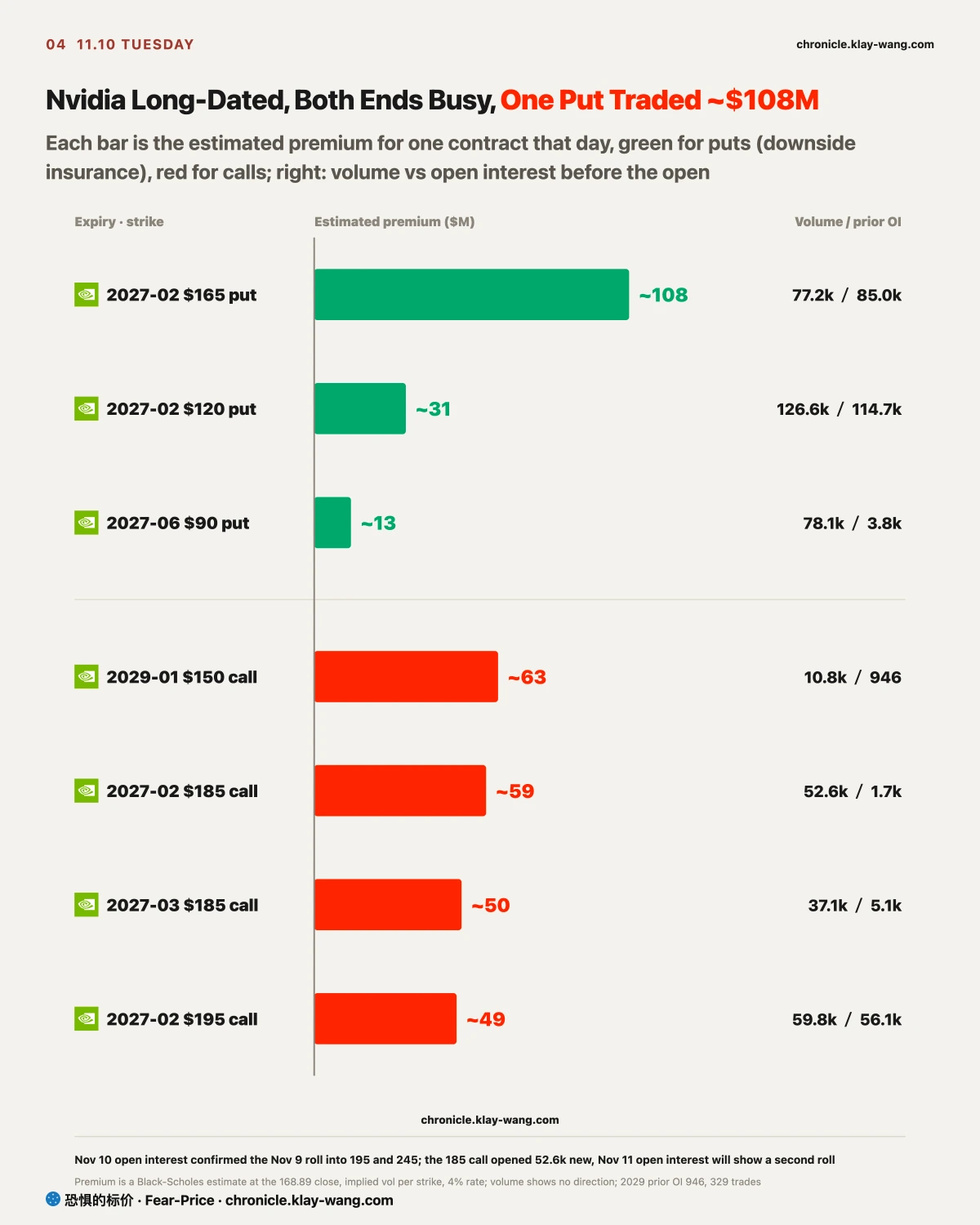
The same group moved again on November 10. The $195 and $245 strikes traded about 60000 and 56000 more, and the $185 February call traded 52600 new contracts against prior open interest of only 1727. If open interest on the morning of November 11 shows the $195 down about 50000 and the $185 up about 50000, the same money lowered its threshold a second time: each time the stock drops, the bullish money steps down one strike and stays in the trade.
The downside moves were larger. The February $165 put traded 77200 contracts and the $120 put 126600, against existing open interest of about 85000 and 115000, so volume roughly matched open interest and large positions changed hands as a whole. The June $90 put traded 78100 new contracts; a day earlier, June $95 open interest had just jumped from 4408 to 79423, a shape that looks like moving that insurance down from 95 to 90. At closing implied volatility, the $165 put carried an estimated $108 million in premium for the day, about 80% more than roughly $59 million on the $185 call.
The farthest trade was in January 2029. The $150 call, $19 below the current price, traded 10800 contracts, an estimated $63 million in premium, spread over 329 trades, an average of 33 contracts each. A deep in-the-money two-year call moves close to the stock but ties up far less money, so this looks more like many accounts using options in place of shares. Volume shows no direction, so each of these readings needs next-day open interest to confirm.
Credit: Nvidia Lenders Started Charging More, CoreWeave Lenders Charged Less Before Earnings
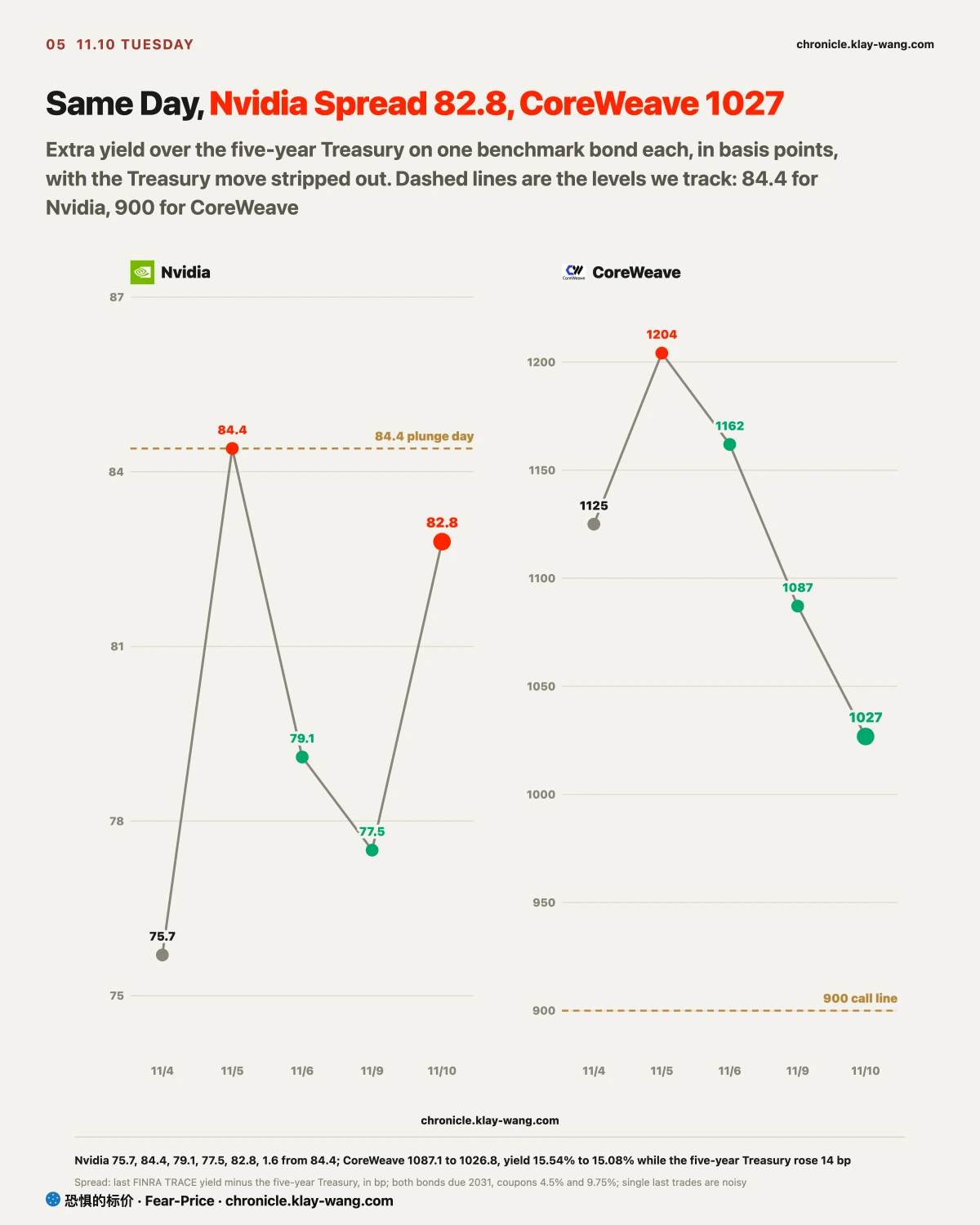
A spread is the extra interest a company bond pays over a Treasury of the same maturity, so moves in Treasury yields are already stripped out. The spread on the Nvidia 2031 bond was 75.7 basis points on November 4, 84.4 on the day of the Thursday plunge, 79.1 on Friday, 77.5 on November 9 and 82.8 on November 10, with a yield of 5.638%. The same day, benchmark bonds of Meta, Alphabet and Microsoft moved less than 2 basis points. A day earlier we wrote that as long as it stays below 84.4, the investigation remains a shareholder issue; it is now 1.6 basis points away. The last trade on a single bond is noisy, so read it over several days.
On the same day rates jumped, the CoreWeave bond spread narrowed from 1087.1 to 1026.8 and its yield fell from 15.54% to 15.08%. Earnings after the close gave the reason. Third-quarter revenue was $3.661 billion, above the $3.6 billion top of company guidance; operating income was $207 million and net interest expense $846 million, four times operating income. Operating cash flow was $1.975 billion against $9.441 billion of cash capital spending; the gap of about $7.5 billion was filled by financing, with net financing inflow of $7.361 billion in the quarter.
The company gave numbers for each of the three things we listed on November 9. Online capacity: more than 1.7 gigawatts of power in service at quarter end, a backlog of about $132.5 billion, and capacity for 2027 described by the company as sold out. Customer payments: about $9 billion of prepayments and deposits expected over the next three months. Funding cost: the next contract-linked delayed-draw term loan is expected to yield 7% to 7.5%.
That last number splits CoreWeave debt into two layers. Loans tied to customer contracts are repaid from those contract cash flows and stand in front, at a cost just above 7%; unsecured bonds stand behind, yielding 15%, twice the contract loans. The same company borrows at two prices, and the place of each lender in line sets the price. More prepayments and cheaper contract loans make the lenders at the back more comfortable, which is what the spread said before earnings. The company also said it will issue no new parent-level unsecured bonds before 2027, so cheap money stays tied to customer contracts and the lenders at the back will not be pushed further back by new debt of the same kind. The stock rose 7.90% after hours to $52.58.
Reconciliation: Three Calls Held, One Was Half Right
- November 9: the Nvidia February call spread was moved lower. Open interest on November 10 confirmed a roll.
- November 9: before earnings, the Nvidia near-month premium stays at least 3 points above the semiconductor ETF. The November 10 reading was 8.10, so it holds.
- November 3: the CoreWeave spread stays above 900 at every reading through November 20. November 10 was 1026.8, so it holds.
- November 9 we wrote that a hot CPI would first make the base-rate part costlier for borrowers like CoreWeave. The five-year Treasury did rise 14 basis points, but its spread narrowed 60 basis points, so its total borrowing cost fell 46 basis points. The first half was right; the conclusion was incomplete, because lenders repriced the company itself by more on the same day.
What This Means for What You Hold
Nvidia: Closed at 168.89 and traded back to 171.58 overnight. The lowest close in a year was 165.17 on March 30, 2.2% below. Before earnings on November 17, watch two numbers: whether the bond spread closes above 84.4, and whether open interest in the February $185 call picks up the $195 position. If the first happens, the investigation turns from a shareholder issue into a lender issue; if the second holds, the big bullish money is still in.
Other chips: Broadcom, TSMC and AMD were bought back on a rate-shock day, so the market is still paying for AI demand. Broadcom one-month options are 7.9 points dearer than one-year, with December 10 earnings in the window.
Memory: Micron and SanDisk fell 22% and 27% in the week from October 30 to November 6, and Bank of America expects the memory upcycle to last into 2028. SK hynix long-term contracts with major customers lock in volume while prices float with the market, so they do not shield it from the price cycle. Of the three, only SK hynix saw its near-month premium narrow; the other two widened.
CoreWeave: Revenue beat guidance, and prepayments and cheaper contract loans are in place, yet interest is still four times operating income, with fourth-quarter interest guidance of $1.05 billion to $1.15 billion.
Index and long bonds: S&P 500 one-month protection is 3.1 points cheaper than one-year. Long bonds take the first hit when hikes are pulled closer; the two-year rose more than the ten-year, and long bond holders face a curve that keeps flattening.
Microsoft and Anthropic: The Anthropic IPO price range is $70 to $78, while offshore pre-IPO perpetual contracts imply $98, a market value of about $1.7 trillion; that market is closed to US investors. Amazon and Google are also investors; at the $78 top of the range, Reuters estimates their related investments at about $271.8 billion and $139.0 billion, with the Amazon figure including convertible notes not yet converted and the Google figure including a planned private placement alongside the IPO. The Microsoft February $595 and $700 calls each traded about 24000 contracts against prior open interest under 200, a shape like a spread betting on Microsoft back above 595 by next February.
SpaceX: Opened 2.05% lower and rose 2.82% during the day; its near-month options got 2.53 points dearer, and its bond spread widened from 233.1 to 239.3. Musk said SpaceX ordered equipment for 100 gigawatts a year of solar cell output from Singulus of Germany; so far there is only his statement, with no announced amount or delivery date.
Three Lines Worth Keeping
- After the plunge, AI chip prices answer three different questions: AMD, Broadcom and TSMC answer whether data centers still buy chips, memory stocks answer how long memory prices can rise, and Nvidia answers a question about the company itself.
- Single-digit memory multiples assume boom profits will fall back; Nvidia at 21 means the market cut what it will pay for its future profits. Two low multiples, two different reasons.
- The Nvidia problem has moved from the stock to the options and now to the bonds, and a spread of 84.4 is the next line.
Note: share prices are November 10 regular-session closes; after-hours and overnight prices are extended-session trades; yields match the Reuters closing report; CoreWeave data come from the company third-quarter press release; option premiums are Black-Scholes estimates.
Fear-Price Index · 2026-11-10 · 66.1/100. Data and methodology: chronicle.klay-wang.com.
No investment advice. No direction calls. No market timing.