Nvidia Board Moves on Huang: Cheapest on Forecasts, Yet Cash Lags Profit
Three-Line Summary
- After the report that the board may remove its CEO, Nvidia fell to $158.78 after hours, 8.61% below the close and below its one-year closing low of 165.17; AMD rose 4.32% after hours.
- On analyst profit forecasts for the next two quarters, 158.78 is about 15 times earnings, against about 20 for TSMC and 44 for AMD; adjusted for growth, Nvidia is the cheapest of the four.
- The short case holds up too: last quarter Nvidia operating cash flow was only 40% of net income, and receivables rose 55% in one quarter; using AMD to protect Nvidia, short or long, covers only half.
This issue answers one question: Nvidia is at a one-year low, so is it a mis-sale or a fair one? The control group is AMD, Broadcom and TSMC. The method has five steps and works for any company that hits similar news: name the type of risk, read how money, options, rates and credit respond, use valuation, earnings and cash to judge whether the drop is overdone, then see who gains up and down the chain and what to defend with.
Fear-Price at 53: Near-Month Insurance Got Cheaper, Crash Insurance Did Not
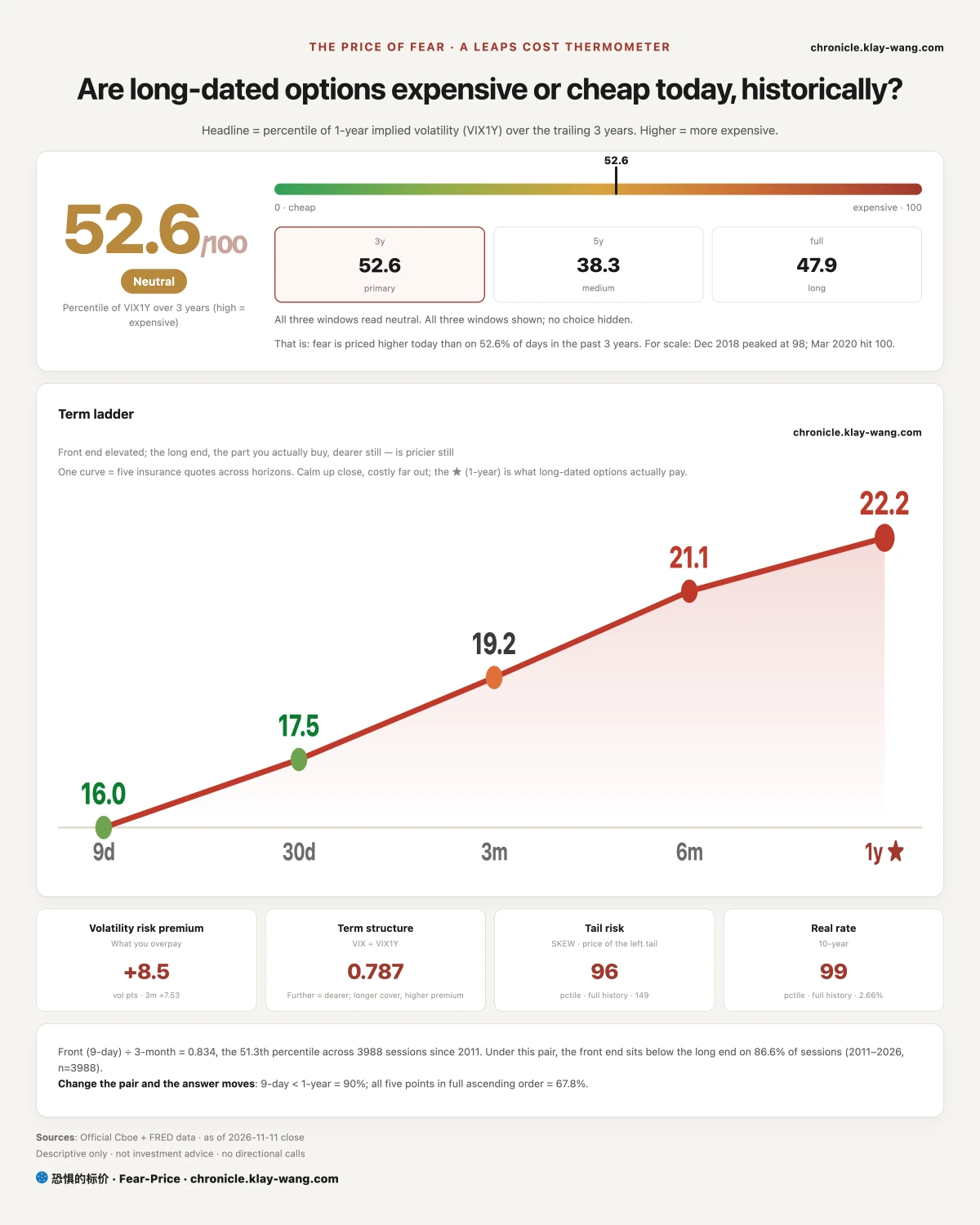
Fear-Price Index · November 11, 2026 · 52.6/100. One-year implied volatility was 22.22%, at the 52.6th percentile of the trailing three years, down from 66.1 on November 10; higher means historically more expensive. Daily ledger: chronicle.klay-wang.com. Credit: Fear-Price.
The VIX fell from 19.46 to 17.49, while the SKEW index sat at the 95.8th percentile of its full history. SKEW measures how much more a hedge against a sharp S&P 500 drop costs than a hedge against an ordinary decline: option buyers bet on calm weeks ahead and still paid up for a crash. A few hours later, the crash landed on one stock, Nvidia.
For holders of a large index position, one-month insurance is not expensive now: S&P 500 one-month options are 4.45 points cheaper than one-year.
The K index was 2.114 (same-day sentiment reading provisional), up from 1.92 on November 10. The closer it gets to 1, the more people are actually paying for protection. With the Wednesday fear-and-greed reading at 37.0, K drops below 1 only if the VIX climbs above 37.0. History at chronicle.klay-wang.com/kindex; the index at chronicle.klay-wang.com/fear-price.
Risk: Removing a CEO Is a Company Risk, and the Market Did Not Price It as an Industry Risk
The Nvidia story is still unfolding. We do not chase the gossip; we analyze the company and the market. The first step is to name the type of risk.
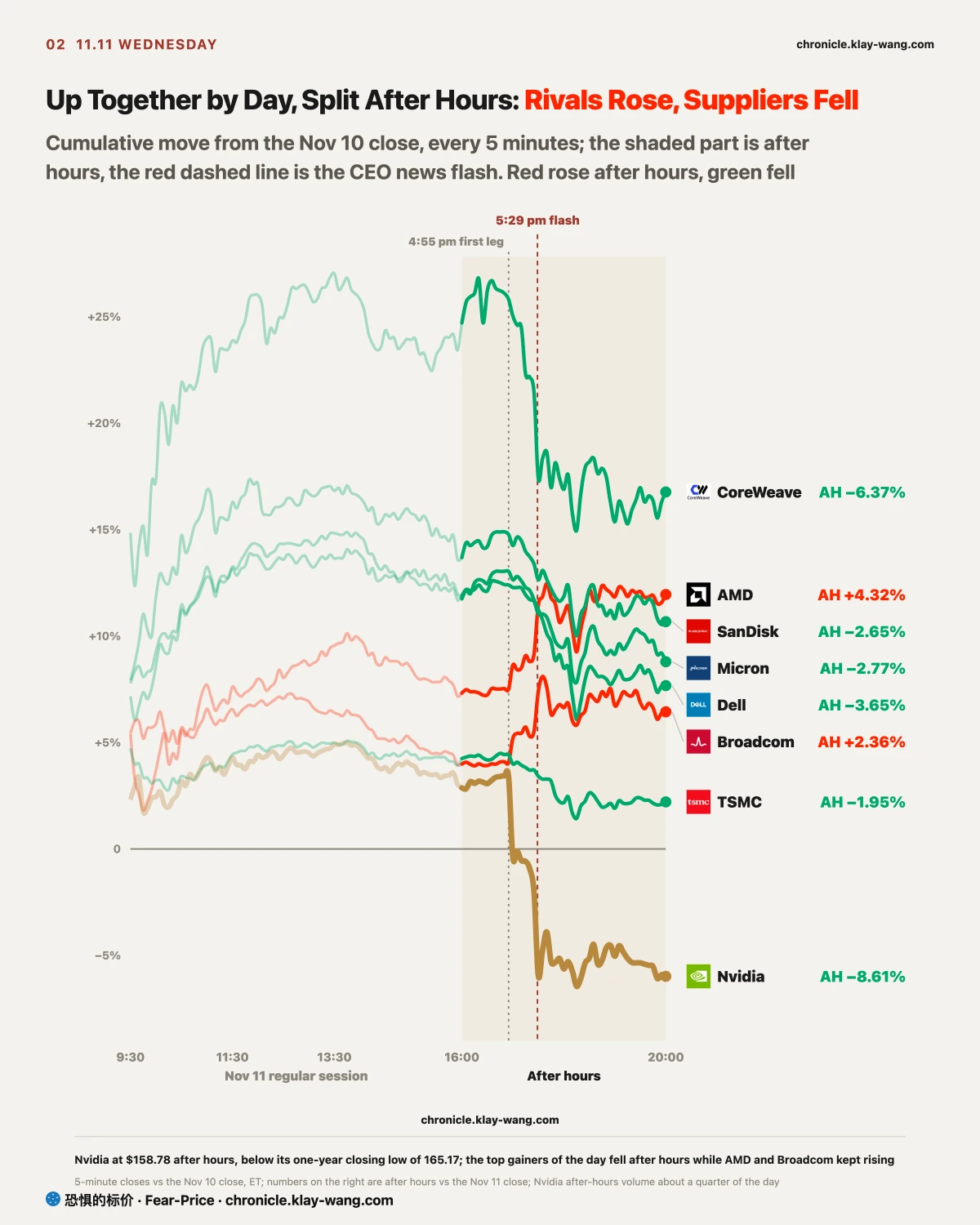
Risks, or black swans, come in many kinds: natural disasters such as tsunamis and earthquakes, human failures such as management trouble or accounting fraud, technology shifts and more. An industry risk drags the whole chain down, rivals included; a company risk usually hits only the company in trouble and the businesses that depend on it, and rivals benefit directly. On Wednesday after hours Nvidia fell 8.61%, the Nasdaq 100 ETF only 0.92%, and AMD and Broadcom both rose: the market took the second view.
Ming-Chi Kuo gave this risk a concrete landing point on social media. In his view, Huang turns what engineers think is feasible into products that must ship on schedule, and suppliers dare to stock up for aggressive spec upgrades because they can see the orders. What to watch next is whether Nvidia keeps launching products as efficiently, and how rivals respond.
The same holds for other companies. The more a company depends on one person to decide, and the more its suppliers plan output around those decisions, the more a problem with that person hits the company and its suppliers, and the more it lifts the rivals that can take the orders. For holders of such a company, the first task is to know whether you hold the main company, a supplier or a rival.
Market Response: Shareholders Ran First, Options and Lenders Had Not Yet Spoken
Shareholders moved fastest: Nvidia traded 79.33 million shares after hours, about a quarter of regular-session volume, a very large amount. The Thursday open is the first price set with everyone taking part. The board conclusion and any interim CEO have not been announced.
The options market had no warning before the news. At 3:45 p.m. on Wednesday, the premium of Nvidia one-month implied volatility over one-year fell from 14.76 the day before to 10.25; the big long-dated bullish block had cut its strike to 185 the day before and had not left.
Lenders have not spoken yet. The Treasury market was closed on Wednesday, so the spread on the Nvidia 2031 bond stayed at 82.8 basis points from November 10, close to the 84.4 of the crash day. Credit is still flowing: CoreWeave plans to borrow at least $4 billion in an investment-grade loan. For holders of Nvidia bonds, if the spread closes above the crash-day level for several trading days in a row, that would mean the problem has moved from shareholders to lenders. Shareholders lose on valuation; lenders care only whether the money comes back on time. A spread above the crash-day level means lenders want more compensation than on that day, and their worry has moved to cash flow. Nvidia borrowed $24.9 billion last quarter, so the view of its lenders feeds straight into the cost of its next loan.
Valuation: On Profit Forecasts, Nvidia Is the Cheapest in the Control Group
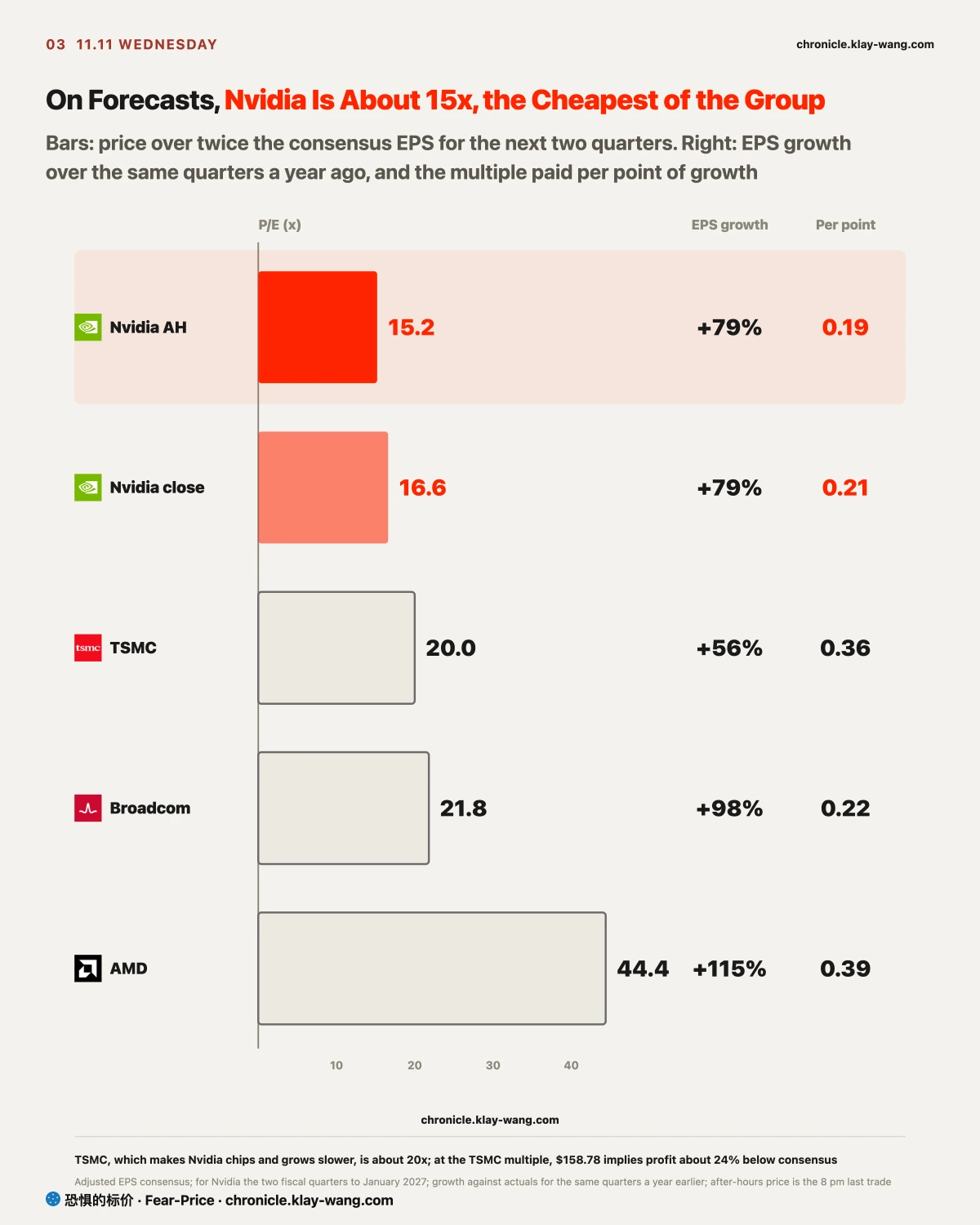
On profit forecasts for the next two quarters, Nvidia is only about 15 times earnings after hours. At the Wednesday close it was about 16.6 times. In the control group, TSMC is about 20 times, Broadcom about 22 and AMD about 44.
Cheap has to be read against growth; sometimes cheap is a trap. For the same two quarters, analysts expect Nvidia earnings per share to be 79% higher than a year earlier, AMD 115%, Broadcom 98% and TSMC 56%. For each point of growth, Nvidia pays only about 0.2 times earnings, close to Broadcom and about half of AMD.
So a price of 158.78 means either the market does not believe the analyst numbers, or it is charging Nvidia an extra risk discount. At the TSMC multiple, that price implies profit about 24% below consensus. On the Kuo reading, what to watch is the pace of the next few product generations, and the quarterly forecasts have not caught up.
That makes the long case specific. If results and next-quarter guidance on November 17 hold consensus, and the board outcome does not disrupt the product pace, 15 times for a company still growing earnings by nearly 80% is the lowest price in the control group. For holders of Nvidia, the test is on November 17: until forecasts are cut, cheap is really cheap.
The Short Case: Profit Grew Fast, Cash Did Not Keep Up
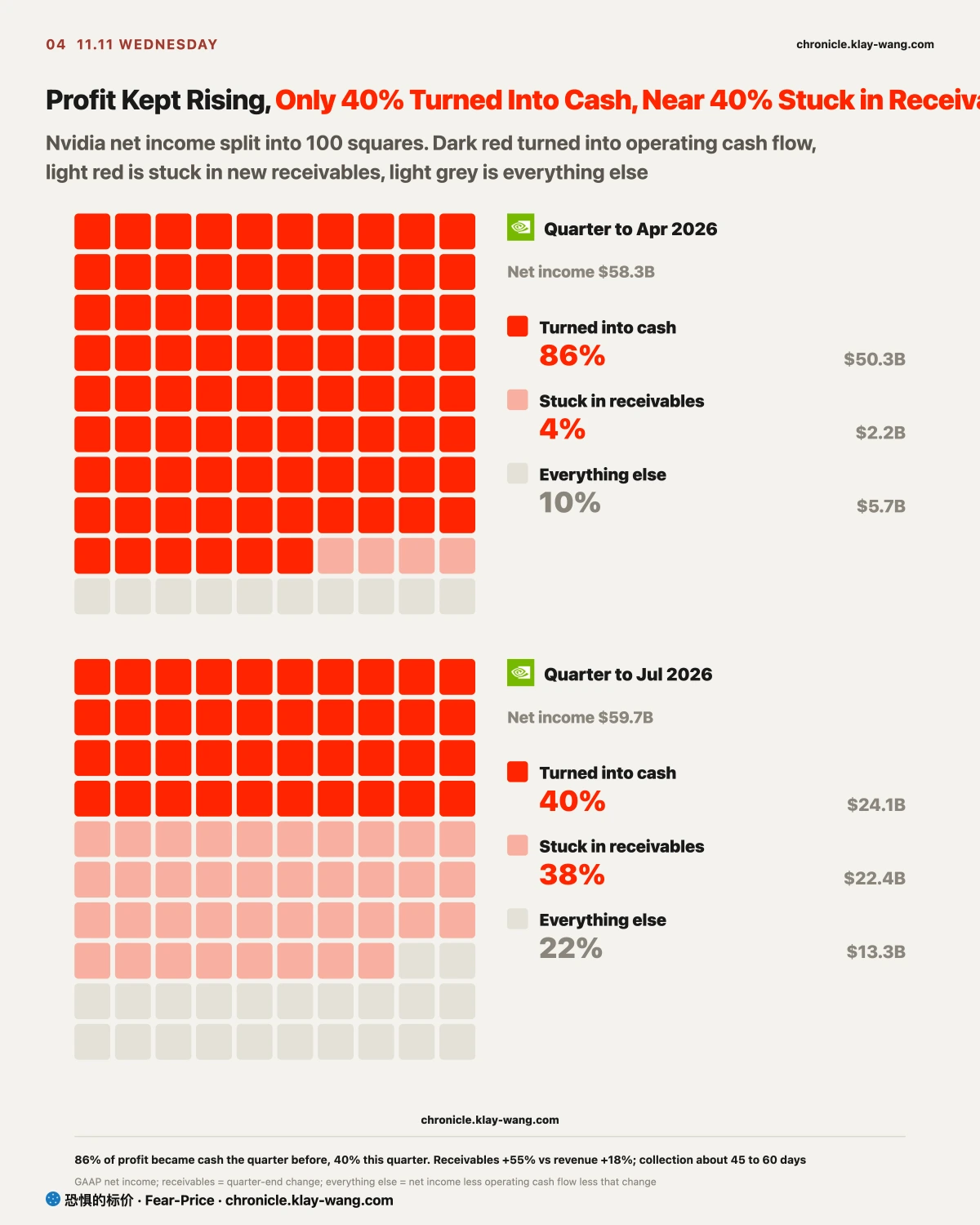
The short case rests on profit quality. In the quarter to July 2026, Nvidia earned $59.7 billion in net income but only $24.1 billion in operating cash flow, about 40%; the quarter before, the ratio was close to 90%.
The cash is stuck in receivables. Receivables rose 55% in one quarter while revenue rose only 18%, and the time customers take to pay stretched from about 45 days to about 60. The filings do not say whether customers are paying later or Nvidia is offering longer terms to win orders.
Part of net income does not come from selling chips. Over the last two quarters, net income under accounting rules exceeded the company adjusted figure by about $18.5 billion, while long-term investments rose from $8.2 billion three quarters earlier to $51.2 billion. If that gap comes from rising investment values, it will drag on profit when AI valuations fall. Net cash also fell from $40.4 billion the quarter before to $23.6 billion, and the company borrowed $24.9 billion in the same quarter.
The short case is therefore: it is cheap because forecasts have not changed yet, the quality of profit is falling, and once management is in disarray and analysts cut forecasts, 15 times will not hold the price. For holders of Nvidia, watch two numbers on November 17: whether receivables come down, and whether operating cash flow gets back above 80% of net income.
Up and Down the Chain: The Nvidia Supply Chain Fell, Yet Its Rivals Rose
After hours, the stocks that fell with Nvidia were the businesses tied to its shipments. CoreWeave fell 6.37% from the close, Dell 3.65%, Micron and SanDisk about 2.7% each, and TSMC 1.95%. AMD and Broadcom went the other way, up 4.32% and 2.36%.
If the market doubted AI demand, AMD and Broadcom should have fallen too. They rose, so that evening the tape looked like a bet that some orders move away from Nvidia, with demand itself not cut. Holders of CoreWeave should know that its data centers run almost entirely on Nvidia chips; it is the slowest to switch suppliers and in the short run the most tied to Nvidia news.
How fast orders can move depends on software. The Nvidia moat is CUDA: code written for it has to be retuned to run on AMD ROCm. In 2026 that wall got lower for inference. AMD released ROCm 10 in August; in SemiAnalysis tests in October, existing AMD chips, helped by software tuning, matched or briefly passed some Nvidia setups on inference. When a reply had to start within two seconds, the estimated inference cost of the MI355X was about 9% below the B200, while in other setups the Nvidia GB200 and GB300 were still cheaper and the ecosystem lead remains.
On the customer side, the first gigawatt of OpenAI MI450 capacity is planned to deploy from the second half of 2026, and the first Helios racks at Meta are installed and in testing.
Set side by side, what can move first is new inference orders, while Nvidia keeps its lead in training and large clusters, and that is exactly what AMD at 44 times has to deliver. The two also share a habit: AMD gave OpenAI warrants for up to 160 million shares and put $1 billion into a Meta equity offering, while Nvidia holds stakes in customers such as CoreWeave and its long-term investments rose to $51.2 billion in three quarters. Both are using their own balance sheets to tie in big customers, so buying AMD to catch Nvidia share buys the same playbook.
So the test does not rest on any single day of prices. Treat AMD and Broadcom as the rival group and CoreWeave, Dell, Micron, SanDisk and TSMC as the supply-chain group, measured from the November 11 close; after hours the two group averages were already about 6.8 points apart. Our current view is that through the November 17 results and up to the December 31 close, the rival group still beats the supply-chain group; if the gap closes to zero or flips, the market has decided the Nvidia product pace is intact, and the share-shift view is wrong.
Defense: Using AMD to Protect Nvidia, Short or Long, Covers Only Half
To keep Nvidia and still guard against the board story spreading, a common move is to pair it with a stock in the same industry, the other way round. With AMD there are two directions, and each covers half.
The first is to short AMD, which guards against the whole industry falling. On daily moves over the past 60 trading days, the correlation between the two stocks is only 0.54; AMD annualized volatility is about 79%, Nvidia about 43%. At the ratio that minimizes portfolio volatility, each $1 of Nvidia needs about $0.29 of AMD, and portfolio volatility falls from 43% to 36%, a cut of only about a sixth. This time the trouble is at the company itself: on Wednesday after hours Nvidia fell 8.61% and AMD rose 4.32%, so long Nvidia and short AMD lost on both legs.
The second is to buy AMD, a bet that orders move from Nvidia to AMD, which guards against exactly this kind of company risk. The cost is double the industry risk: if AI demand is cut, both fall together, and AMD moves almost twice as much as Nvidia.
So AMD covers only one risk, and which one depends on what you worry about. To guard against industry risk, shorting the semiconductor ETF is steadier and brings portfolio volatility down to about 28%. For holders of Nvidia, the most direct tools against company risk are Nvidia options, or simply a smaller position.
From the seat of an institutional portfolio manager, before the board outcome and the results are in, the odds on this risk cannot be priced, so adding to it now is not the right play. The more common move is to cut the position to a size you can carry and decide once the November 17 numbers are out.
Long-Dated: The Bullish Holder Did Not Leave, Moved Down Again, Pierced That Night
On the near end, the November 9 call still stands. We wrote that until the November 17 results, the Nvidia one-month premium over one-year would stay at least 3 points above the semiconductor ETF; on Wednesday it was 10.25 against 3.86, still true.
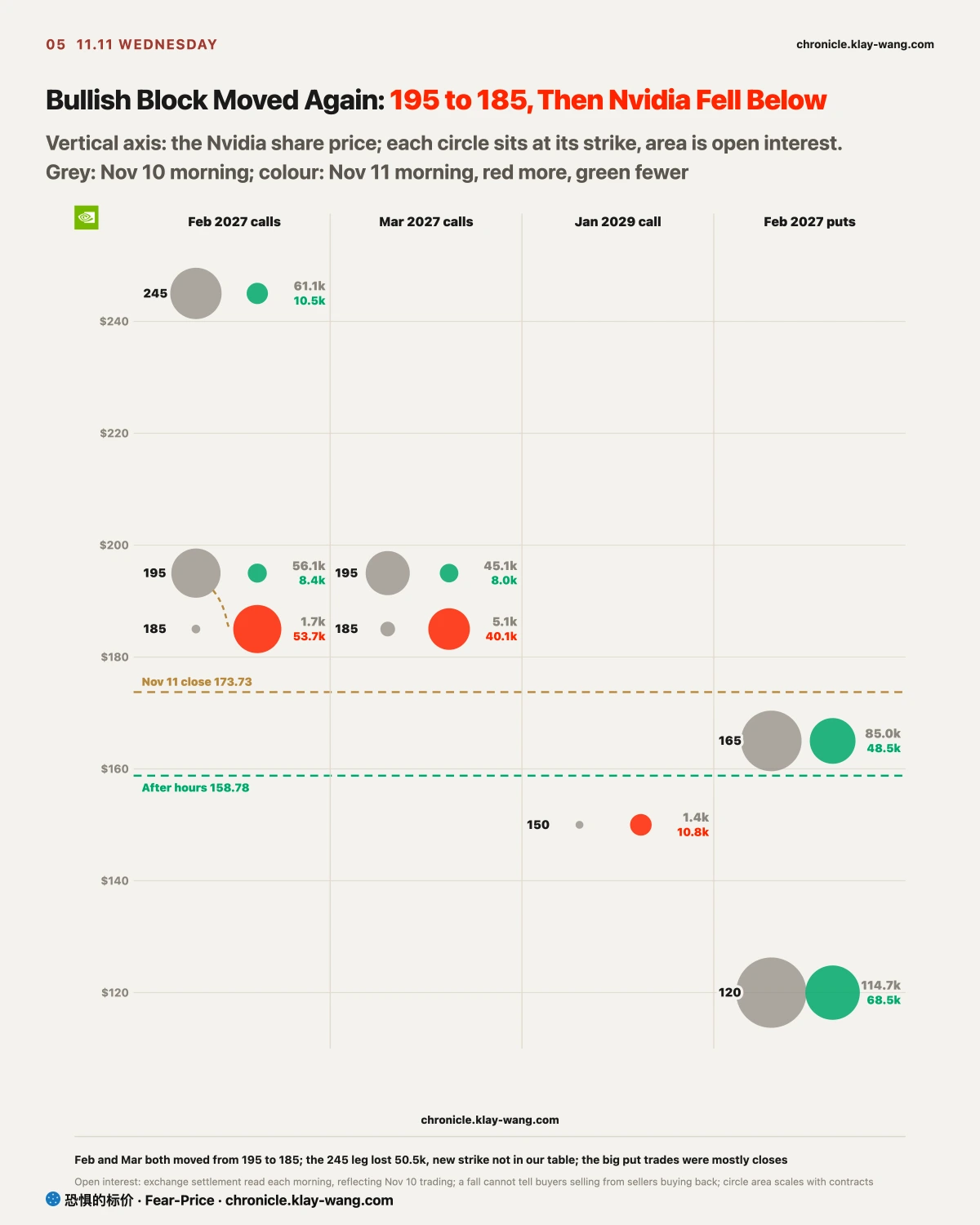
The big long-dated bullish money on Nvidia did not leave either; it only lowered its strike one more step. In the last issue we wrote that if the February calls moved from the 195 strike to 185, it would be the second step down. The Wednesday morning open interest gave the answer: about 48k fewer contracts at 195, about 52k more at 185, and the March expiry made the same move.
We called this one right. For holders of Nvidia or anyone thinking of buying near the lows, read it this way: the big bullish money has not taken its loss and left; it is still betting the stock is back above 185 before February. It only shows the big holder is still in; whether to buy depends on how big a drop you can take. The big holder owns options and can lose at most the premium; a buyer of shares near the lows loses as much as the stock falls, so the risks are not the same.
The higher 245 strike also lost about 50k contracts. In the previous roll, the upper leg moved from 255 to 245. The upper leg sets the most this position can earn; if it moves down too, the big holder has lowered not only the entry point but also the highest price it expects to see. Where it moved this time is not in our table yet; whichever strike suddenly gains about 50k contracts in the next few days is the answer.
That evening the after-hours price was $26 below the 185 strike. If open interest at 185, the contracts still open at the exchange count after each close, stays below 40k for 3 trading days in a row before December 31, the reading that the bullish holder is still in no longer holds.
Reconciliation: The Roll Call Held, Only the Bond Call Carries Over
- On November 10 we wrote: a move in the February Nvidia calls from 195 to 185 would be the second step down. Wednesday morning confirmed it. Right.
- On November 10 we wrote: if AMD and Broadcom stay above their November 4 closes, the demand side holds, tested until the November 17 results. On Wednesday both stayed above, and both were still rising after hours. Day one held.
- On November 10 we wrote: watch over several days whether the Nvidia bond spread holds above 84.4. The bond market was closed on Wednesday, so the call stays open and carries over to November 12.
What This Means for What You Hold
Nvidia is a real worry. For holders of Nvidia, both the long and the short case get settled in the November 17 results. The long side needs next-quarter guidance to hold consensus and receivables to come down; the short side needs analysts to start cutting forecasts and operating cash flow to keep lagging profit. As long as open interest in the February 185 call block does not stay below 40k for several days, the big bullish holder is still in.
AMD is the beneficiary this time, but a price of 44 times already prices in taking orders from Nvidia. Bloomberg Intelligence also warned that a clean handover or strong results could quickly reverse these relative moves.
CoreWeave, memory and Dell rose the most during the day and fell with Nvidia after hours, and TSMC fell too. If orders only shift from Nvidia to AMD or Broadcom, TSMC still makes the chips and memory is still needed; the most direct exposure is CoreWeave.
Three Lines Worth Keeping
- On profit forecasts for the next two quarters, Nvidia is only about 15 times earnings after hours, the cheapest in the control group on growth, as long as analyst numbers are not cut.
- The short case is about profit quality: last quarter operating cash flow was only 40% of net income.
- Using AMD to protect Nvidia covers only one risk: a short guards against the whole industry falling, a long against trouble at Nvidia itself.
Note: share prices are November 11 regular-session closes, after-hours prices are the last trades of the 8 p.m. post-market session; price-to-earnings uses the consensus of adjusted earnings per share for the next two quarters, times two; financials are from the latest reported quarter of each company; open interest is exchange settlement; the Treasury market was closed on November 11.
Fear-Price Index · 2026-11-11 · 52.6/100. Data and methodology: chronicle.klay-wang.com.
No investment advice. No direction calls. No market timing.