Without Jensen Huang, What Happens to Nvidia and AI?
Three-Line Summary
- Nvidia opened down 13% and closed down only 4.34%, near the high of the day.
- AMD and Broadcom held the index up; only about a quarter of S&P 500 stocks rose.
- Rates held the market down: the 10-year Treasury yield is back at 5.10%, and long bonds, gold and bitcoin fell together.
Two things landed on Thursday. Before the open, Nvidia announced that Jensen Huang has resigned, a company event. Cleveland Fed President Beth Hammack said policy needs to turn restrictive, an event for every asset. The first was mostly bought back the same day; the second left three quarters of stocks lower. This issue takes Nvidia and the customers it finances first, then rates and options.
Fear-Price at 61: Index Insurance Rose Only a Little, Crash Insurance Stayed High
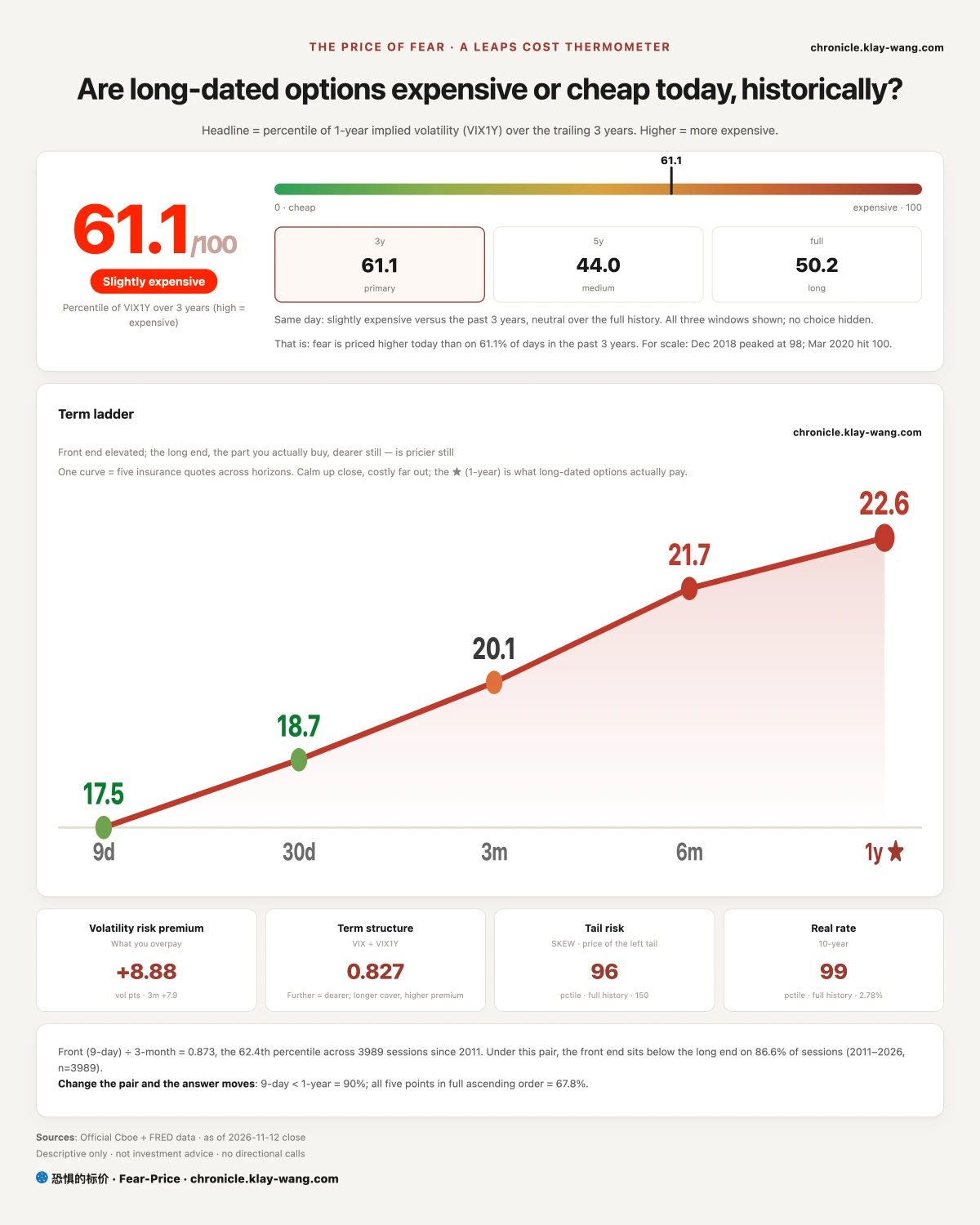
Fear-Price Index · November 12, 2026 · 61.1/100. One-year implied volatility was 22.6%, at the 61.1st percentile of the trailing three years, up from 52.6 on November 11; higher means historically more expensive. Daily ledger: chronicle.klay-wang.com. Credit: Fear-Price.
The Fear-Price reading rose only to 61; index insurance got only a little dearer. Nvidia fell as much as 14% intraday, yet the VIX rose only from 17.49 to 18.70, and S&P 500 one-month options are still 4.20 points cheaper than one-year. Option buyers did not price the Nvidia news as a market-wide crash. Insurance against a sharp fall stays expensive: the SKEW index sat at the 96.3rd percentile of its history, higher than on Wednesday.
The K index was 2.136, slightly above Wednesday. The closer it gets to 1, the more people are actually paying for protection; at the Thursday fear-and-greed reading, K drops below 1 only if the VIX climbs above 39.9. For index fund holders, one-month protection is still cheaper than one-year, so short-dated cover is the relatively better buy. History at chronicle.klay-wang.com/kindex; the index at chronicle.klay-wang.com/fear-price.
Company: Nvidia Gapped Down 13%, Was Bought Back 10%, Closed Near the High
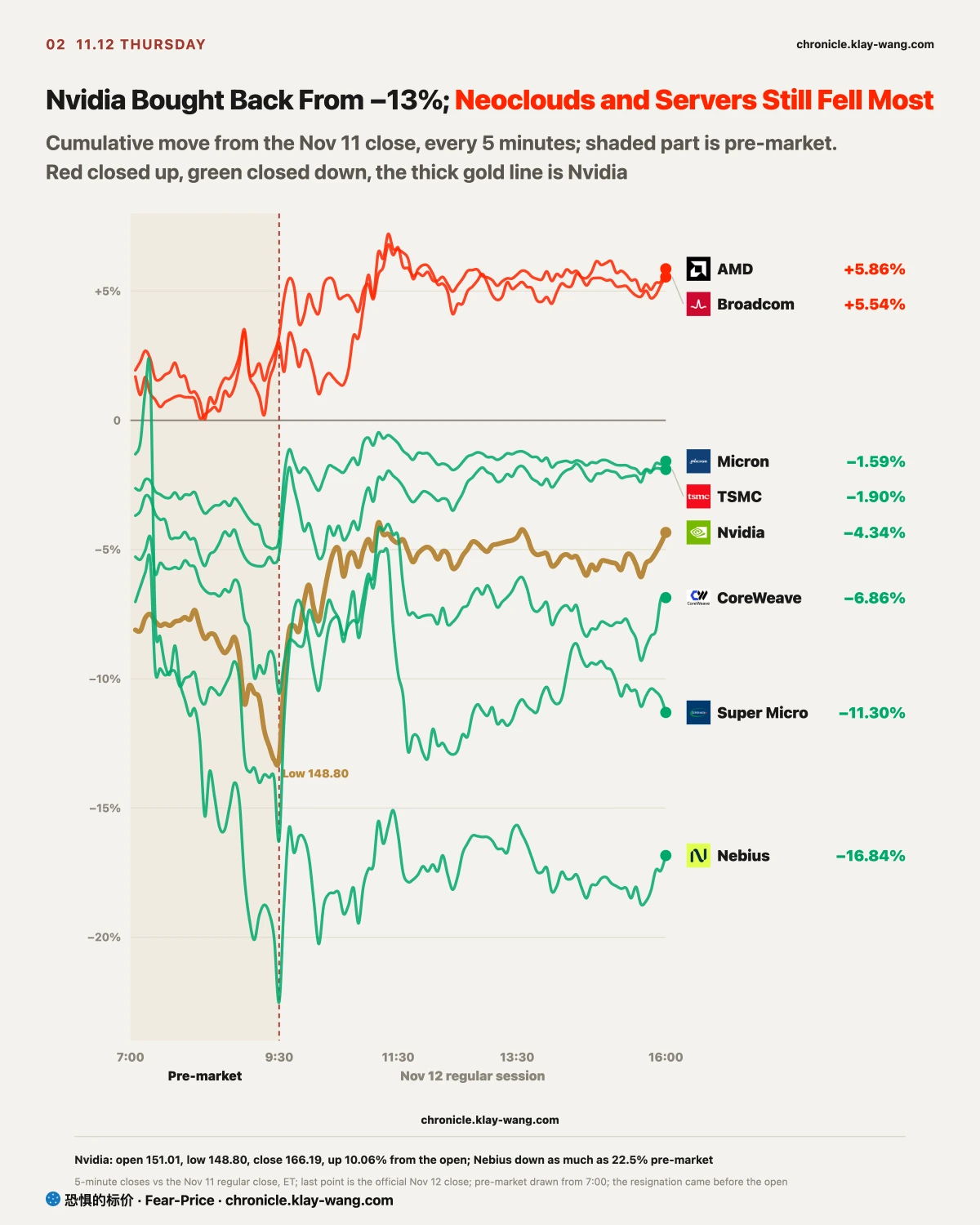
Thursday was a high-volume gap down that got bought. The resignation was announced before the open. Nvidia opened at $151.01, 13.08% below the Wednesday close, and touched 148.80. It was then bought all day to close at 166.19, 10.06% above the open, at the 95% point of the range for the day. Volume was 741 million shares, 2.18 times Wednesday.
Dollar volume was about $120.3 billion, the highest single day on record for Nvidia; the previous high was about $104 billion on March 8, 2024. In the first half hour alone, pre-market included, Nvidia traded about $40 billion; second in that window was AMD at about $8.5 billion, and the S&P 500 ETF only about $4 billion. For that half hour, one stock traded nearly 5 times the next.
A high-volume fall means someone is selling; a high-volume close near the high means someone is taking the stock. Thursday was the second kind. Sellers mostly got out around the open, buyers near $150 outnumbered them, and the close held above the one-year closing low of 165.17. On Wednesday we wrote that the Thursday open would be the first price everyone took part in; the result was a discount on a company risk, not an industry risk. For Nvidia holders, the market absorbed the resignation itself in one day; the next test is the November 17 report.
Rivals and suppliers split again. AMD and Broadcom gapped up and kept rising, each closing more than 5% above Wednesday. TSMC, Micron and SanDisk gapped down and were only partly bought back. The biggest losers were neoclouds, which rent out AI computing power, and a server maker: Nebius fell 16.84% after saying 2026 revenue will be at the low end of guidance; Super Micro fell at the open and through the day; CoreWeave gapped down and was partly bought back.
The opening gap was the first verdict on who loses a backer: the closer to Nvidia financing, the deeper the gap, with CoreWeave opening 16% lower and Nebius 22% lower. Buyers pulled them back during the day too, CoreWeave rising 11% from its open, but the hole was too deep and it still closed down nearly 7%. In this group only Super Micro kept falling during the day. It carries an extra risk: according to the indictment as summarized by SemiAnalysis, its co-founder was charged in March over servers diverted to China. With Huang gone, China controls may tighten, and server sellers are first in line.
Using the Wednesday groups, the rival group (AMD, Broadcom) is up 5.70% on average from the Wednesday close, and the supplier group (CoreWeave, Dell, Micron, SanDisk, TSMC) is down 3.03%. The gap widened from about 6.8 points on after-hours prices to 8.7 points.
A wider gap says the market is betting on Nvidia share being split up, not on total AI spending shrinking. If the fear were less industry spending, AMD and Broadcom would have fallen too; they rose more than 5%, a bet that the same cake is being cut differently. SemiAnalysis made the same call that day: without Huang, customers will give Nvidia less priority and rivals will find capacity easier to get. Suppliers fell because their orders are tied to Nvidia shipments. The day rivals and suppliers fall together, the worry has moved from share to total spending.
Financing Chain: The AI Central Bank Has a New Governor, and the Neoclouds It Backs Fell More
For two years Nvidia has not only sold chips but also found money for its customers. According to Bloomberg, in August it announced a $500 billion AI computing finance platform with Apollo, BlackRock, Blackstone, Brookfield, Goldman Sachs and KKR; months later, not one deal has closed. The sticking point is the guarantee: Nvidia residual value support covers at most 25% of a deal, while Broadcom guaranteed 72.5% of a $63 billion financing for Anthropic, and the guaranteed part won an investment-grade rating and a lower rate.
The mechanism is simple. A special company borrows to buy chips, leases them to an AI company and repays debt from the rent; if the rent stops, the chips are re-leased or sold, and the guarantor covers any shortfall. The bigger the guarantee, the easier the debt sells, the lower the interest for the customer, and the easier the chips sell. Stijn Van Nieuwerburgh of Columbia Business School estimates such Nvidia commitments at about $400 billion in total, including up to $36 billion of cloud services purchase commitments disclosed in July; neoclouds such as CoreWeave have disclosed partnerships with Nvidia. In its last quarterly report Nvidia itself disclosed $530 billion of off-balance-sheet guarantees, nearly 3 times the $184 billion of the quarter before; the November 17 report will update that number.
Huang carried more weight in this machine than a single CEO. Through the Nvidia technology ecosystem, customer ties, strategic investments and financing deals, he linked cloud providers, AI labs, chipmakers and financial institutions, and acted as the credit backstop for an industry expanding on borrowed money. AI expansion leans more and more on financing, and less on end demand and the cash flow of the companies themselves. With the backer gone, the first to feel it are neoclouds that do not yet make money and depend on outside funding; next in line is the chip supply chain that sells to them.
The interim CEO is the CFO herself, Colette Kress. The board letter to employees calls her one of the key architects of the Nvidia growth and capital strategy; according to The Information, she opposed a plan to give OpenAI up to $250 billion of credit support; after the deal was split, Nvidia committed about $100 billion, and she has been spreading the Nvidia financial exposure away from a few customers. For Nvidia itself, fewer guarantees mean less bad-debt risk and cleaner cash flow, an answer to the short case we laid out on Wednesday (operating cash flow only 40% of net income last quarter). For the customers it backs, money gets harder to raise; for Nvidia itself, without the coordinator in the middle, the growth that came from customers borrowing to buy chips will also slow.
Nscale, which updated its listing filing the same day, is a ready example. Third-quarter revenue at this Nvidia-backed neocloud was $307.5 million, more than 13 times higher than a year earlier, yet its net loss was $1.69 billion, more than 5 times revenue. However fast revenue grows, the money for chips and data halls has to be borrowed or raised; what such a company fears most is losing its backer.
The Thursday tape split along this line; Broadcom, the more generous guarantor, rose 5.54%. The test runs to year end: by the December 31 close, CoreWeave and Nebius, averaged from the November 12 close, lag Nvidia. If they outperform instead, the market does not believe Nvidia will tighten customer financing, and the call is withdrawn.
The Anthropic listing next week is another test. According to Bloomberg, the offering is about six times oversubscribed, with up to about $64.35 billion in the public part and a $26 billion private placement that includes Nvidia, AMD, Broadcom, Alphabet, Microsoft, Marvell and TSMC. The more AI companies raise directly in the stock market, the less they lean on chipmaker guarantees. If financing confidence does ebb, it will show first in harder neocloud offerings and loans, and only later in the spending plans of the giants.
Rates: The Index Fell Only 0.35%, Three Quarters of Stocks Fell, and Rates Did It
Rates held the market down, starting with one Fed speech. Cleveland Fed President Hammack said on Thursday morning that the Fed has been absent on inflation for years and policy needs to turn restrictive; last month she argued for a 25 basis point hike. Initial jobless claims released the same day were 200000, so the job market is still firm. President Trump said there is no need for a deal with Iran now, and oil jumped nearly $2 before the open. All three point to inflation that has not come down.
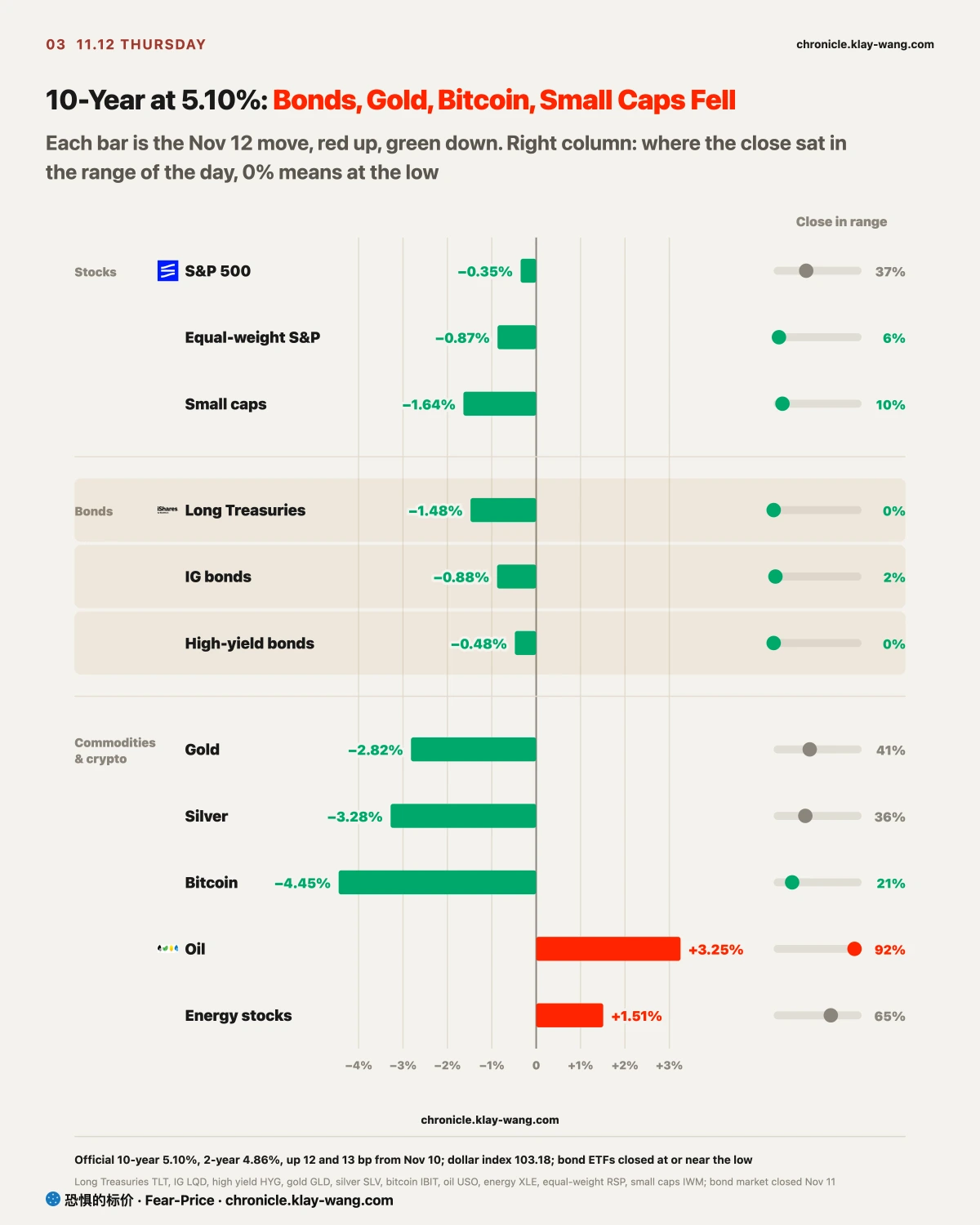
The official 10-year yield closed at 5.10%, 12 basis points above Tuesday (the bond market was closed on Wednesday); the 2-year closed at 4.86%, 13 basis points above Tuesday. The dollar index closed at 103.18, about a 19-month high.
Over November as a whole, the oil ETF fell 13.5% while the 10-year yield rose from 4.94% to 5.10%; what pushed rates up was mainly the tone of Fed officials.
Prices moved in step. The long Treasury, investment-grade and high-yield bond ETFs all closed at or near the low of the day; gold, silver and bitcoin fell together; only oil and energy stocks rose. The equal-weight S&P 500 fell 0.87%, more than twice the cap-weighted index; small caps fell 1.64%, more than the large caps, and closed at the 10% point of their range.
It is one account. Higher yields raise the cost of holding gold and bitcoin, which pay nothing; small companies borrow more and earn thinner margins, so each extra point hurts them directly; the longer a bond matures, the more its price moves with rates. The Nvidia news hit Nvidia and the customers it backs; the rate news hit every asset priced on cheap money.
Insurance got dearer in all three markets: S&P 500 one-month options from 13.95 to 14.63, long Treasury one-month options from 11.68 to 12.47, high-yield one-year from 8.08 to 8.71. Three layers moving together means the repricing is macro; one company cannot move three markets.
The Friday producer price index is the next test. The working read: through the November 19 close, the official 10-year yield stays at or above 5.00% and the equal-weight S&P keeps lagging the cap-weighted index. If the 10-year falls back below 5% before then, this read is withdrawn. For holders of small caps and long bonds, watch rates first this week, then your own names.
Options and Lenders: Nvidia Options Got Dearer, the Chip ETF and Bondholders Did Not Follow
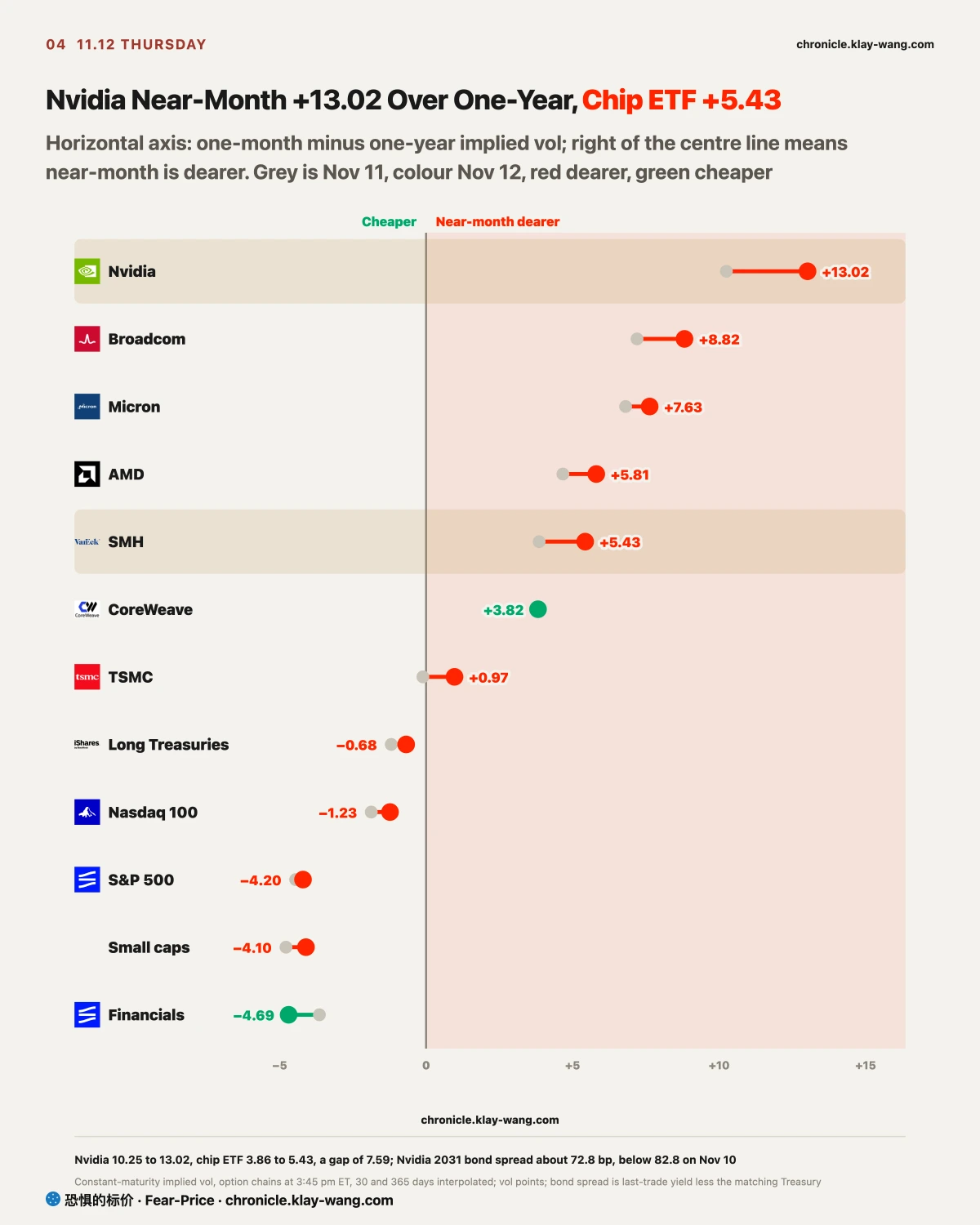
The premium of Nvidia one-month options over one-year rose from 10.25 on Wednesday to 13.02; for the semiconductor ETF it rose only from 3.86 to 5.43. On November 9 we wrote that before the results, the Nvidia gap would stay at least 3 points above the semiconductor ETF; on Thursday it was 7.59 points above. The options market booked this event to Nvidia alone. For anyone hedging Nvidia with options, protection is expensive now, and the cost sits in Nvidia itself.
Lenders were calmer still. The Nvidia 2031 bond traded at a spread of about 72.8 basis points on Thursday, below the 82.8 of Tuesday. On Tuesday we wrote that the problem would reach lenders only if the spread held above 84.4 for several days; Thursday moved further from that line. The CoreWeave 2031 bond spread also fell, from 1026.8 to 979.6 basis points. For now, the people lending to these companies have not priced a CEO change as a repayment risk.
Long-Dated: Heavy March Call Trading Looks Like the Bullish Holder Stepping Down, Not Leaving
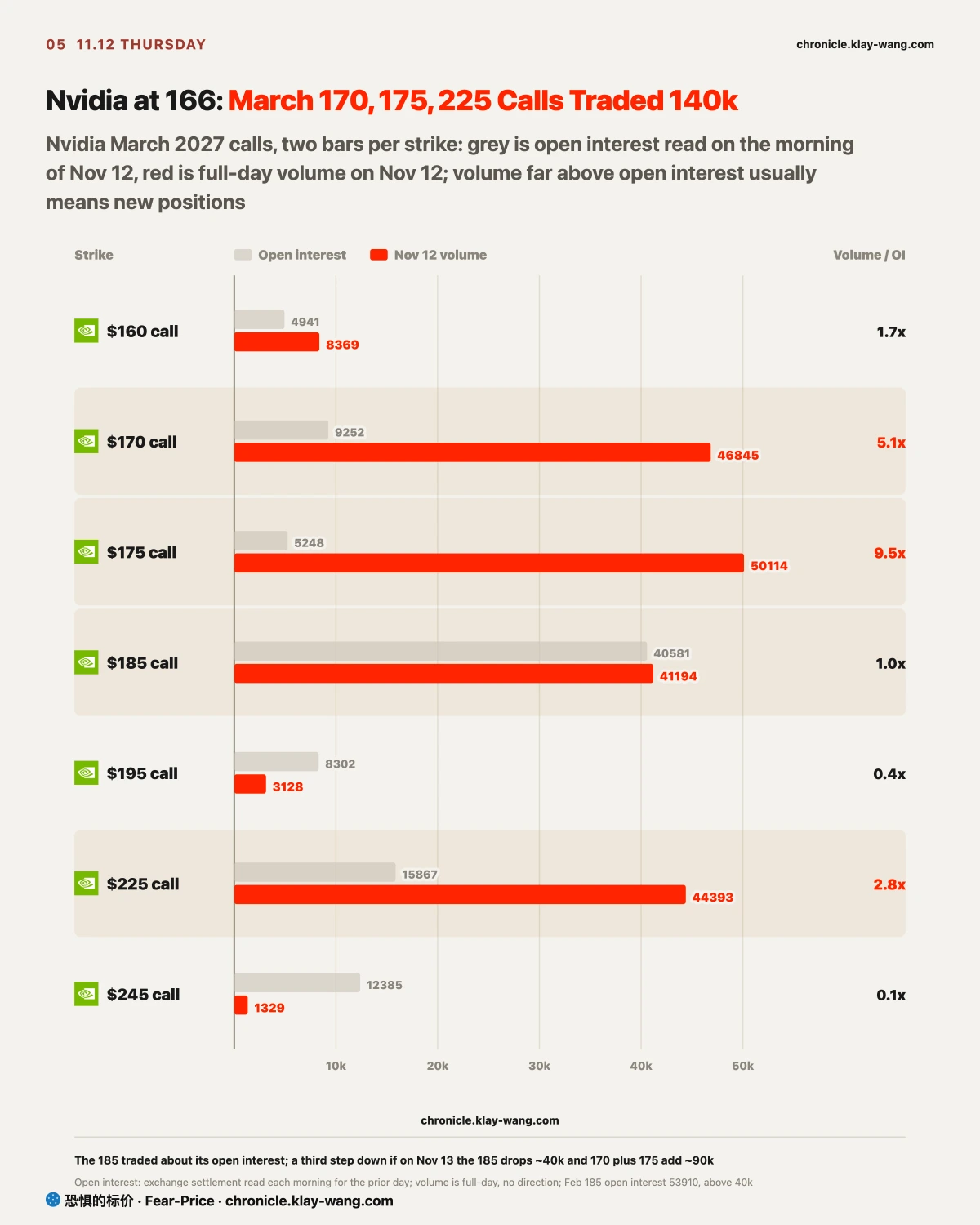
Thursday trading clustered in calls expiring next March. The 170 and 175 strikes traded about 97 thousand contracts combined, more than six times their open interest; the 185 traded about 41 thousand, almost exactly its open interest; the 225 traded about 44 thousand, also far above its open interest.
These numbers look most like a third step down by the bullish holder: close the 185, open the 170 and 175, and put the upper leg at 225. Volume cannot tell buyers from sellers; the answer is in the Friday morning settlement count of contracts still held after the close. The 185 down about 40 thousand and the two lower strikes up about 90 thousand combined would confirm it; if the 185 does not fall, these trades are new positions from someone else. For holders of Nvidia shares, this only shows that big money is still betting on a return above 170 to 175 before March; it says nothing about where the bottom is.
Reconciliation: Five Earlier Calls, None Overturned on Thursday
- On November 9 we wrote: before the results, the Nvidia near-month premium over one-year stays at least 3 points above the semiconductor ETF. Thursday 13.02 against 5.43, not wrong so far; settles on the report date.
- On Tuesday we wrote: if AMD and Broadcom stay above their November 4 closes, the demand side holds. Thursday they were about 20% and 12% above those closes, not wrong so far; settles November 16.
- On Tuesday we wrote: the problem reaches lenders only if the Nvidia bond spread holds above 84.4 for several days. Thursday 72.8, not wrong so far; settles November 17.
- On Wednesday we wrote: by December 31, the rival group beats the supplier group. Thursday the gap was 8.7 points, not wrong so far; settles December 31.
- On Wednesday we wrote: if February 185 call open interest stays below 40 thousand for 3 trading days, the read that the bullish holder is still in fails. Thursday morning it was 53910, not wrong so far; settles at year end.
What This Means for What You Hold
For holders of Nvidia, the Thursday intraday low of 148.80 is the test line. The high-volume buying on Thursday is the strongest evidence for the long case; a close below 148.80 before the November 17 results means that buying failed. Friday morning long-dated open interest will show whether the bullish holder stepped down a third time.
For holders of AMD and Broadcom, this is the beneficiary side, but part of the AMD gain is a bet on replacing Nvidia. The Nvidia moat goes beyond chip performance to the CUDA software ecosystem, networking, system integration and years of customer relationships, which are hard to copy soon; AMD can win share, not replace it. Broadcom gives bigger guarantees, which wins orders from big customers like Anthropic and also carries more bad-debt risk; if the rent stops, Broadcom covers the gap.
For holders of neoclouds like CoreWeave and Nebius, the exposure is the most direct. Their backer is gone, the new leader is more cautious, money may be harder to get, and whether the Anthropic listing goes well next week is the first test.
For holders of long bonds, gold, bitcoin and small caps, the thing to watch this week is rates. With the 10-year yield above 5%, the pressure on these assets will not last only one day.
Three Lines Worth Keeping
- Nvidia opened down 13% and closed down 4.34%, near the high of the day: the company risk was discounted the same day.
- Three quarters of stocks fell, and long bonds, gold and bitcoin fell together: the 10-year Treasury yield back at 5.10% held the market down.
- Nvidia itself was bought back; the neoclouds it backs fell more, and Broadcom, the more generous guarantor, rose 5.54%.
Note: share prices are November 12 regular-session closes; Treasury yields are official closes, compared with November 10 because the bond market was closed on November 11; implied volatility is from 3:45 p.m. ET option chains; open interest is exchange settlement read each morning for the prior session; volume is full-day and cannot tell buyers from sellers; bond spread is the last trade yield of the bond less the Treasury of the same maturity.
Fear-Price Index · 2026-11-12 · 61.1/100. Data and methodology: chronicle.klay-wang.com.
No investment advice. No direction calls. No market timing.