Nvidia Fell 12.75% in a Week, the S&P Still Rose 2.59%: What Really Fell Was Bonds, Gold and Bitcoin
Three-Line Summary
- Nvidia fell 12.75% in a week, the S&P 500 rose 2.59%, and all 10 sector ETFs with data rose.
- What fell was long bonds, gold and bitcoin; the bitcoin ETF lost 9.19% in the week.
- The 2-year Treasury yield rose 37 basis points, its biggest week this year: the market is pricing hikes for next year.
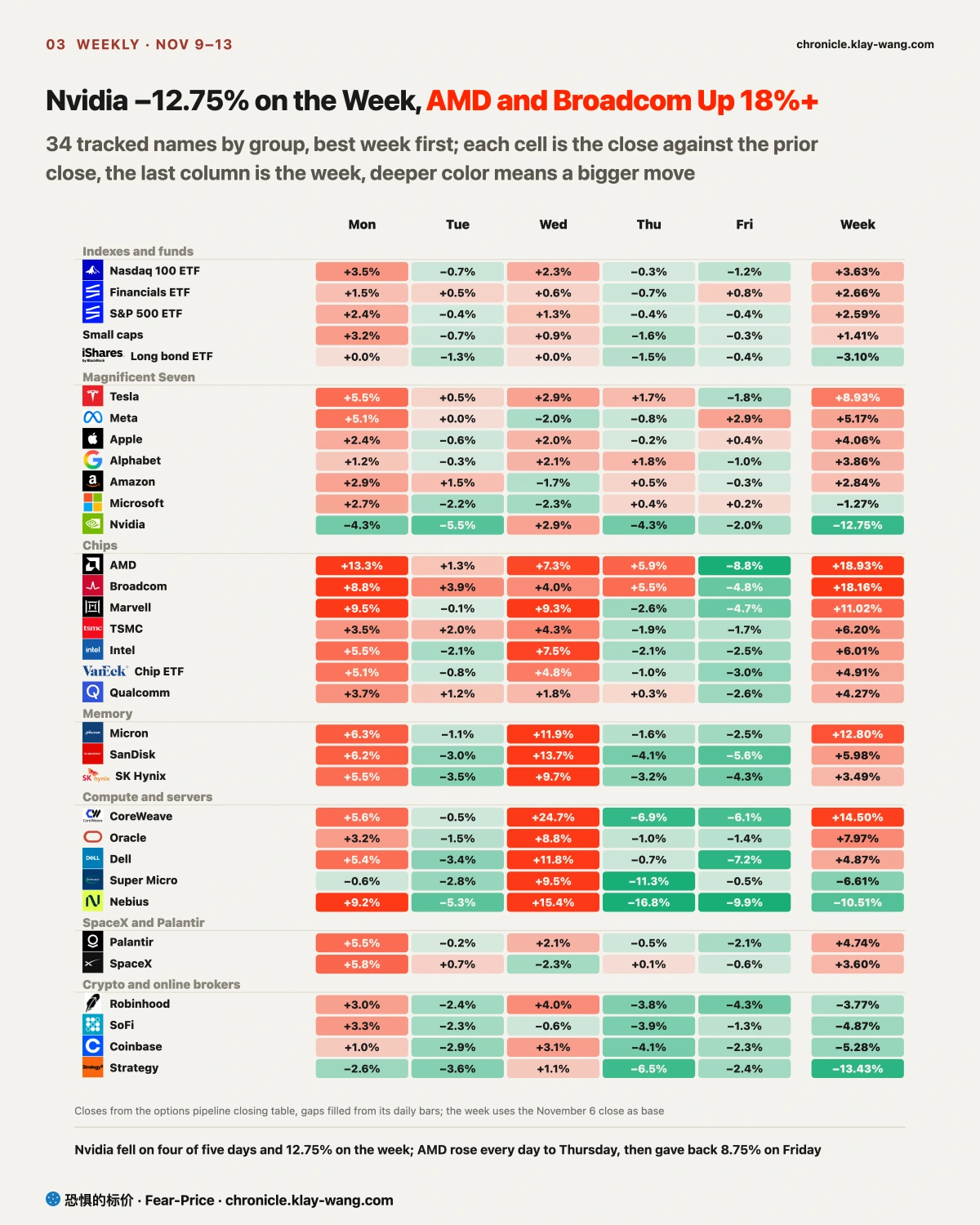
Last week the semiconductor ETF fell 11.20%; this week looked different. Nvidia first saw its board open an independent investigation, then Jensen Huang resigned, and the stock fell 12.75% in the week. Yet the semiconductor ETF rose 4.91% and the index rose too. In the same week the 10-year Treasury yield rose from 4.86% to 5.15%, and long bonds, gold and bitcoin fell all the way. Two events: stocks priced one; the other landed on bonds, gold and bitcoin.
Fear-Price at 68: Short-Term Panic Is Gone; Only One-Year Stays Dear
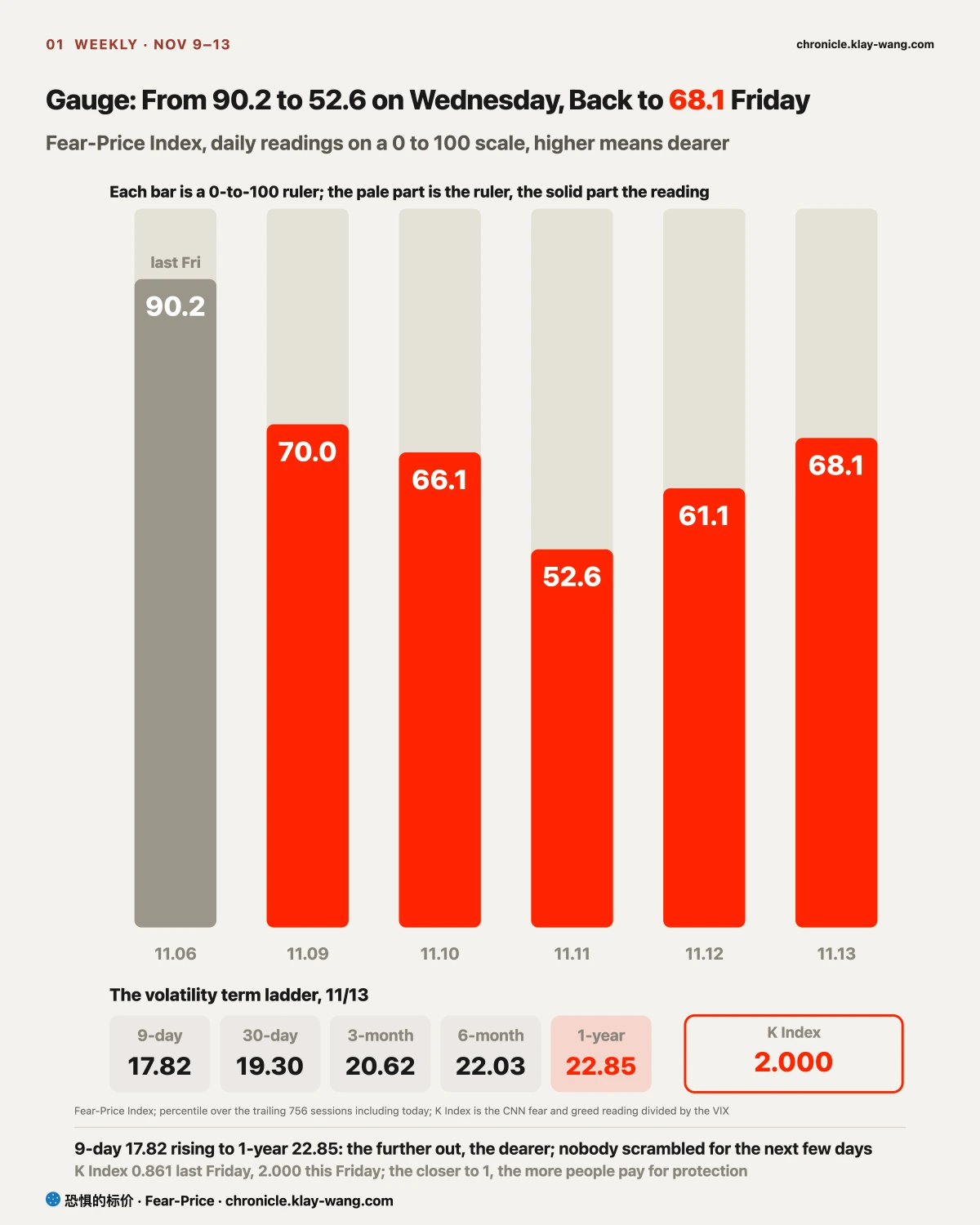
Fear-Price Index · November 13, 2026 · 68.1/100. One-year implied volatility was 22.85%, at the 68.1st percentile of the trailing three years, down from 90.2 on November 6; higher means historically more expensive. Daily ledger: chronicle.klay-wang.com. Credit: Fear-Price.
The reading fell, then rose: 90.2 last Friday, 70.0 on Monday, 52.6 on Wednesday, 61.1 on Thursday, 68.1 on Friday. The first half of the week went down because the options market booked the Huang news to Nvidia alone; the second half went up because, after a hot CPI on Tuesday and a hawkish Hammack on Thursday, rates started to weigh on prices.
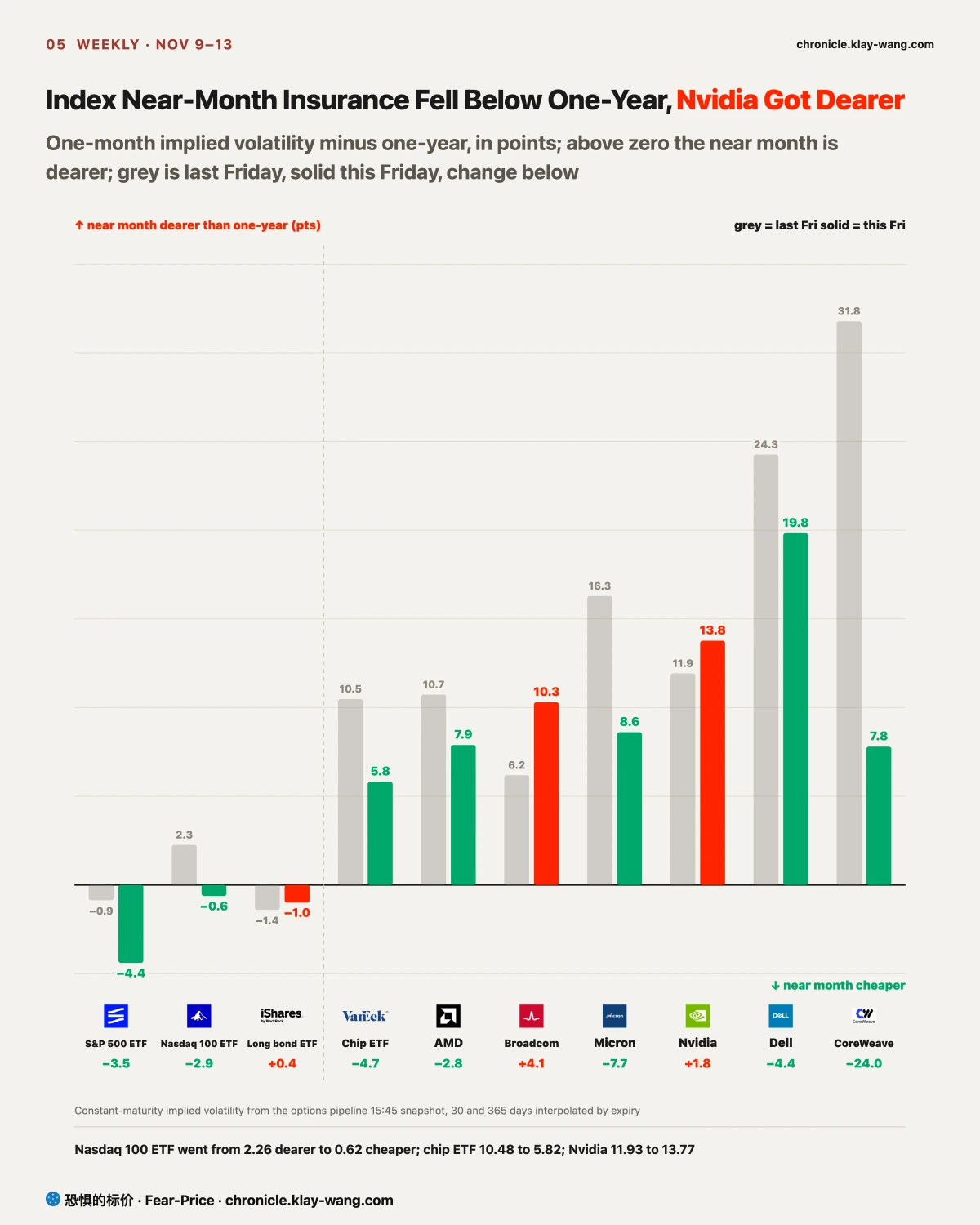
Short-term panic faded most cleanly. The VIX fell from 25.64 last Friday to 19.3; S&P 500 one-month options fell from 18.97 to 15.17, while one-year only moved from 19.83 to 19.56. Nasdaq 100 ETF one-month options were 2.26 points dearer than one-year last Friday and 0.62 points cheaper this Friday. What stays expensive is one-year protection, and that is the price of rates. For index holders, one-month protection is cheaper than a week ago.
The K index was 2.0 on Friday, below the final Thursday reading of 2.157; last Friday it was only 0.861. The closer it gets to 1, the more people really pay for protection; last Friday it was below 1, and people really were paying for insurance. At the Friday fear-and-greed reading, the VIX would have to rise from 19.3 to above 38.6 for K to drop below 1. History at chronicle.klay-wang.com/kindex; the index at chronicle.klay-wang.com/fear-price.
Panorama: Stocks All Up; Bonds, Gold and Bitcoin All Down; Cash Flow Was the Dividing Line
This week the dividing line was cash flow: as rates rise, profits can carry the load and assets that pay nothing cannot.
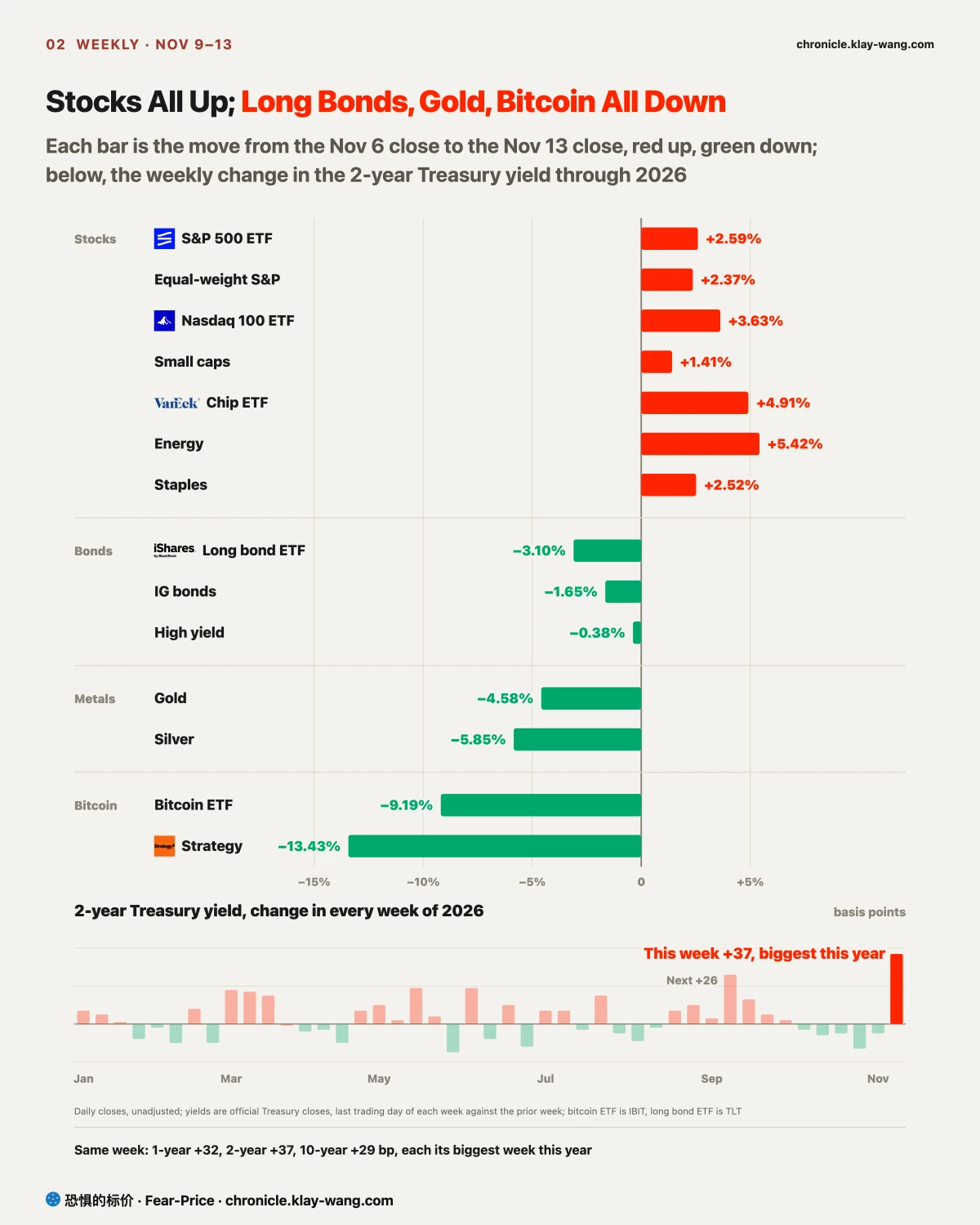
All 10 sector ETFs with data rose, energy led with a 5.42% gain from last Friday, and the equal-weight S&P rose 2.37%, only 0.22 points from the cap-weighted index. On the other side, the long Treasury ETF fell 3.10% in the week, gold 4.58% and the bitcoin ETF 9.19%.
How a company collects cash decides whether it can carry higher rates. Companies selling oil, chips or insurance collect cash every quarter, and when the economy runs hot and inflation is high, revenue and profit rise too. A bond pays fixed interest, so it has to reprice when rates rise; gold and bitcoin pay nothing. Energy is the example: the oil ETF fell 1.91% in the week, yet energy stocks rose 5.42%, bought for cash flow that is already here.
Hike bets drove rates. Official Treasury yields, last Friday to this Friday:
| Term | Nov 6 | Nov 13 | Change |
|---|---|---|---|
| 1-year | 4.33% | 4.65% | +32 bp |
| 2-year | 4.51% | 4.88% | +37 bp |
| 10-year | 4.86% | 5.15% | +29 bp |
| 30-year | 5.26% | 5.47% | +21 bp |
The one- to two-year stretch rose most, with the 2-year up 37 basis points, its biggest Friday-to-Friday rise this year; the 1-year and 10-year also had their biggest weeks of the year. This is the part of the curve closest to the next Fed move.
On Tuesday, October core CPI rose 0.3% on the month, above forecast; on Thursday Hammack said policy must turn restrictive; on Friday Goolsbee also said demand must not overheat. Within one week, the market priced in more hikes for next year. Options read the same way: the price of S&P 500 protection fell at one month and barely moved at one year, so what stays dear is a bet on rates.
Among the 34 stocks and ETFs the pipeline tracks, the biggest gainers this week were AMD and Broadcom, both taking share from Nvidia; the biggest loser was MicroStrategy, which holds bitcoin that pays nothing. If the 2-year yield turns down next week while long bonds, gold and bitcoin keep falling, this cash-flow dividing line does not hold. For holders of long bonds and gold, while the 2-year yield is still rising, these two stay at the front of the line to pay.
Nvidia: Shareholders Ran, Options Stayed Dear, Bondholders Did Not Follow
Nvidia shareholders, option buyers and bondholders gave three different answers this week.
Shareholders moved first. On Monday, after the independent investigation news, Nvidia opened 7.27% lower; on Thursday Huang resigned, the stock opened down 13% and was bought back to close down only 4.34%; for the week it fell 12.75%, erasing about 570 billion dollars of market value.
In the same week AMD rose 18.93% and Broadcom 18.16%. The money did not leave AI chips; it changed companies. The sell side read it the same way. According to a Wallstreetcn roundup of 14 banks, the main read was earnings forecasts unchanged and valuation multiples cut; Goldman Sachs cut the multiple it applies to Nvidia from 30 times to 22.
On price, options and profits, Nvidia is where the three disagree most this week. The stock is about 30% below its one-year high; one-month options are dearer than on 99% of days in the past year, the highest of the 34 names the pipeline tracks; on trailing four-quarter profit it trades at about 21 times earnings, against about 124 for AMD. Money moved from Nvidia at 21 times to AMD at 124 times, buying a share story. The stock went on sale while its insurance went up in price.
Options never eased. Nvidia one-month options rose from 55.28 last Friday to 59.62, while S&P 500 one-month options fell 3.80 points. The Nvidia premium of near-month over one-year stayed more than 6 points above the semiconductor ETF all week. Option buyers booked the event to Nvidia alone the whole time. For Nvidia holders, options stayed dear, which means the market has not put this behind it.
Bondholders barely moved. The spread on the Nvidia 2031 bond was 77.5 basis points on Monday, 82.8 on Tuesday, 72.8 on Thursday and 68.3 on Friday, never settling above the 84.4 of November 5. Lenders to Nvidia booked the CEO change as a shareholder matter, not a repayment matter.
Long-Dated: The Bullish Holder Stepped Down Three Times, Betting on a Lower Price Each Time
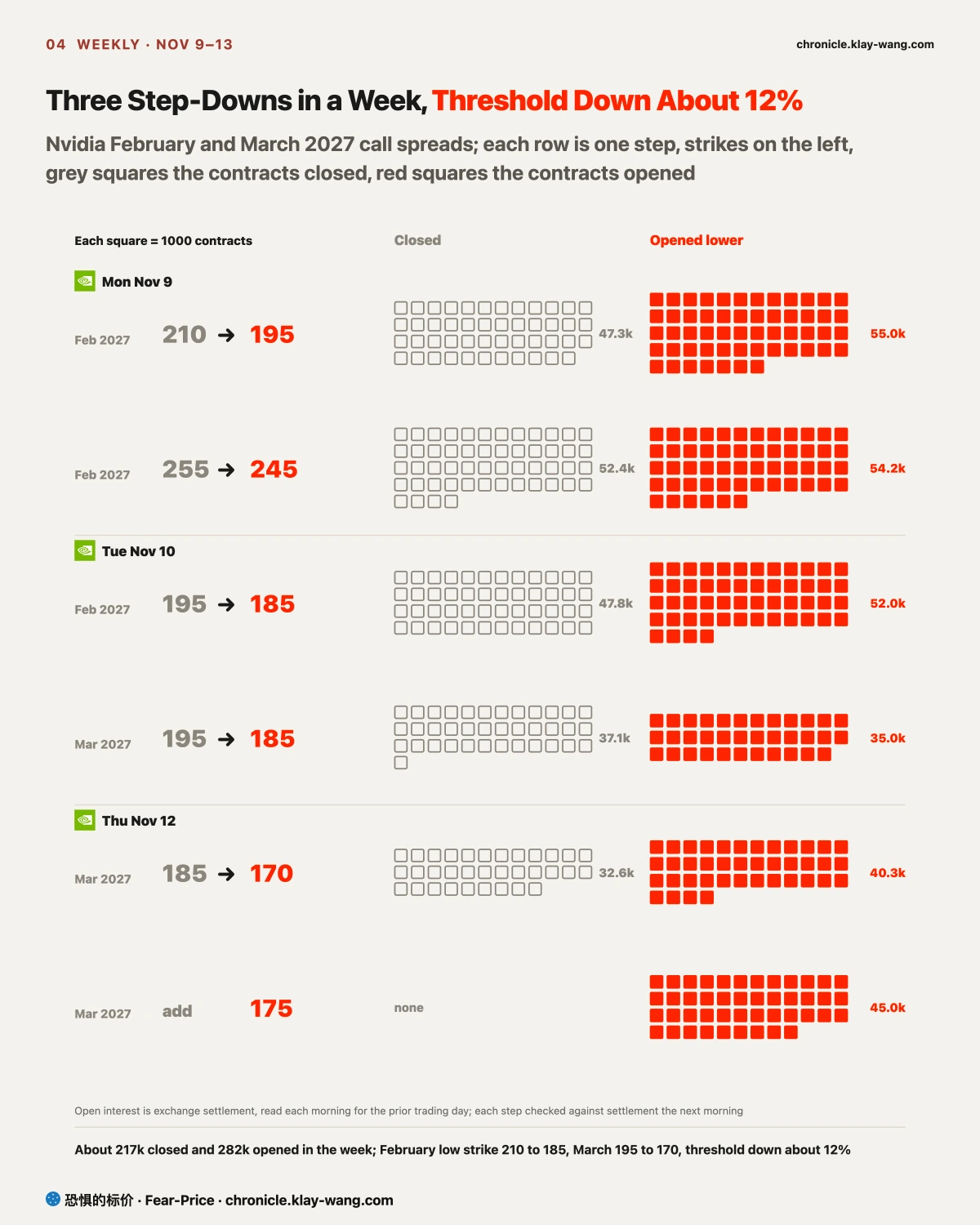
This week the big bullish money moved strikes three times in far-dated calls, and settled open interest (the contracts still held after the close) confirmed each one. On Monday and Tuesday the low strike of the February set moved down twice; on Tuesday and Thursday the March set followed with two moves of its own, and on Thursday the upper leg moved one strike too.
Taken together, the February low strike fell from 210 to 185 and the March one from 195 to 170. The big money stayed, and each time the contracts it cut came back at a lower strike, but its threshold fell about 12% in a week. This means the bulls are still bullish; they moved their starting line down, trading a lower bar for better odds.
If open interest in February 185 calls stays below 40 thousand for 3 days in a row, the call that the bullish holder is still here is withdrawn. For Nvidia holders, open interest on Monday says more than the pre-report share price about whether the big money is still here.
Lenders: SoftBank and SpaceX Were Both Called Out; Only SoftBank Had to Pay More
On November 6 Musk said on X that SoftBank was defaulting on its turbine orders; SoftBank denied it. SoftBank reported on November 10: SB7, the unit buying power generation equipment for US AI data centers, changed its purchase plan and booked a 3.73 billion dollar loss, including 2.85 billion of advance payments it cannot get back.
The two sides were talking about different things. Musk meant orders: equipment ordered and not taken, deposits written off. SoftBank denied a debt default: interest and principal paid in full. The pipeline tracks the second. The spread on the SoftBank dollar bond due 2031 was 408 basis points on October 21, already 459 the day before Musk posted, and 522 on November 9. Lenders started asking for more before the post appeared. Losing a deposit is business; missing principal is default.
In the same week, SpaceX was said to be losing a big client. The amended prospectus Anthropic filed on November 10 says it rents Nvidia GPU compute from SpaceX for up to 120.5 billion dollars through 2029, about 3.1 billion a month once all capacity is delivered in December.
The initial non-cancelable periods of the two agreements end in January and March 2027, after which either party can cancel on 90 days written notice. The next day, notes from an analyst meeting circulated saying these contracts would not run past mid-2027; the company did not confirm them.
In the same prospectus, the 110 billion dollar Amazon contract and the AMD chip contract are both non-cancelable; the SpaceX one can end in 2027. The 90-day notice cuts both ways: if compute is tight, SpaceX can take it back and raise the price; if compute is loose, Anthropic can leave. The spread on the SpaceX 2031 bond fell from 246.8 to 212.0 basis points in the week; lenders did not book the news as a revenue risk. One was called a defaulter and lenders charged more; one was said to lose a client and lenders charged less.
The prospectus has one more line: a 34.9 billion dollar Lambda contract can now be ended by either side because Lambda did not secure the facility lease in time. The customers are waiting; the bottleneck is borrowing to build. The CoreWeave bond spread fell back below 1000 basis points this week, 981.4 on Friday against 1162 last Friday.
For holders of compute and power stocks, watch the lenders first: until the SoftBank dollar bond spread is back below 450, treat its commitments with a question mark; while the CoreWeave spread holds below 1000, borrowing costs for compute renters are still falling.
Next Week: Six Calls Settle, Four on the Day of the Nvidia Report
Of the five conditions left last week, three were answered. Nasdaq ETF near-month options fell back below one-year, the semiconductor ETF has not, and the CoreWeave and 10-year conditions both happened. The ledger for next week, by settlement date:
November 17, the day of the Nvidia report, settles four:
- The Nvidia near-month premium over one-year stays at least 3 points above the semiconductor ETF, 7.95 on Friday.
- The Nvidia 2031 bond spread does not close above 84.4 for 3 days in a row, 68.3 on Friday.
- AMD and Broadcom hold above their November 4 closes, 9% and 7% above on Friday.
- Nvidia does not close below 148.80, 162.85 on Friday.
The other two:
- November 19: the 10-year holds at or above 5% and the equal-weight S&P lags the cap-weighted index. The first half is on track; the second half went wrong on Friday, day one.
- November 20: the CoreWeave bond spread stays above 900 basis points on every reading day, 981.4 on Friday; the Microsoft spread is not yet back below its October 23 level.
For chip stock holders, watch the 10-year first next week, then the Nvidia report on November 17.
What This Means for What You Hold
For index holders, the week ended calmly: the index rose, short-term panic faded, and one-month protection got cheap again. What is expensive is one-year protection, and that cost sits on the rates account, with Nvidia billed separately.
For Nvidia holders, watch February 185 call open interest on Monday and the report on November 17. The Thursday low of 148.80 is the test line; the bullish holder has already lowered its threshold to 170, a reference set by big money.
For AMD and Broadcom holders, this week paid you for share moving over from Nvidia, and on Friday AMD gave back 8.75% in one day. The share story stands; the pressure from rates is new, and their valuations also rest on distant orders.
For holders of long bonds, gold and bitcoin, this was the hardest week. As long as one- and two-year yields keep rising, the market is still adding hikes for next year, and assets that pay nothing or run long are likely to stay first in line to pay.
Three Lines Worth Keeping
- Nvidia fell 12.75% in a week while the semiconductor ETF rose 4.91%: the money did not leave AI chips, it changed companies.
- Rates rose: profits carried the load and assets that pay nothing could not, so stocks rose while bonds, gold and bitcoin fell.
- The 2-year rose 37 basis points, its biggest week this year; while the short end keeps rising, assets that pay nothing or run long stay first in line to pay.
Definitions: weekly changes are November 6 to November 13 regular-session closes; Treasury yields are official Treasury closes; implied volatility is the 15:45 ET option chain snapshot; open interest is exchange settlement, and the morning read is the prior trading day; volume cannot tell buys from sells; bond spread is the yield of the last trade minus the matching Treasury.
Fear-Price Index · November 13, 2026 · 68.1/100. Data and method: chronicle.klay-wang.com.
No investment advice. No direction calls. No market timing.