Before Nvidia Reports, the 10-Year Still Decides the Market
Three-Line Summary
- Before the Nvidia report, the 10-year pressed AI hardware first: Meta rose 2.90%, five sellers of chips fell 7.35% on average.
- The further out the profits, the more long-term rates take off; banks rose instead.
- Option insurance sits mostly on the report, lenders did not charge more, and Friday recomputed the discount rate.
The market is waiting for the Nvidia report on November 17, and on Friday AI hardware fell first, but Nvidia did not lead the fall. Nvidia closed down 2.01%, about 1 point better than the semiconductor ETF; AMD, Nebius, Dell, CoreWeave and Broadcom fell 7.35% on average, more than 5 points worse than Nvidia; Meta rose 2.90% from Thursday. The same day 315 S&P 500 members rose, more than twice the Thursday count.
Why one end of the same AI supply chain rose while the other fell: the clue sits in the 10-year Treasury. It is the ruler that discounts future profits, and the further out the profits, the more a move in it takes off; yet most of the insurance in options was bought for the day of the report.
Fear-Price at 68: One-Year Insurance Rose More Than One-Month
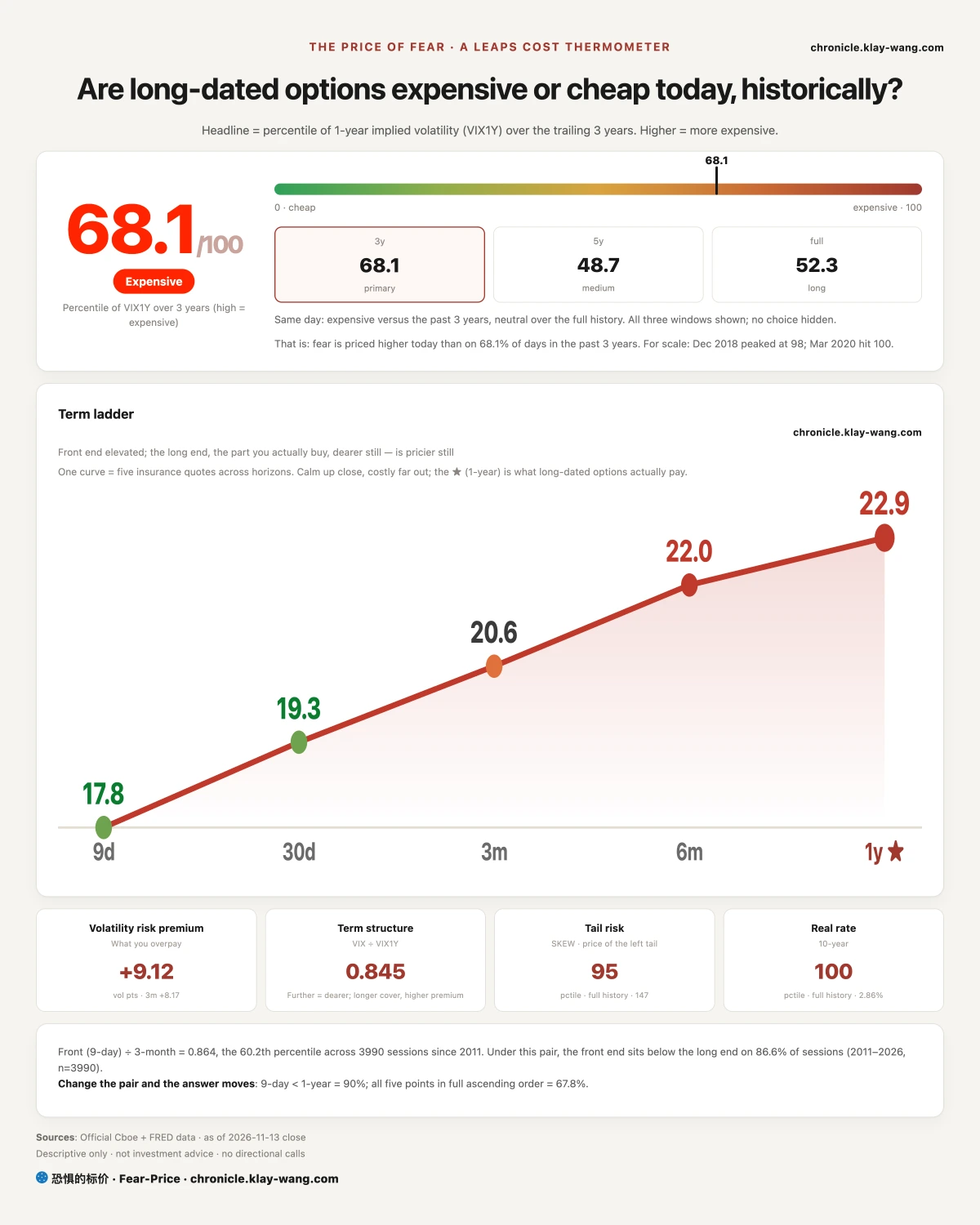
Fear-Price Index · November 13, 2026 · 68.1/100. One-year implied volatility was 22.85%, at the 68.1st percentile of the trailing three years, up from 61.1 on November 12; higher means historically more expensive. Daily ledger: chronicle.klay-wang.com. Credit: Fear-Price.
The index fell only 0.36%, yet the Fear-Price reading rose 7 percentile points from Thursday, and what got dearer was the far end. S&P 500 one-year options rose 0.73 points from Thursday, one-month options only 0.54; from nine days to one year, the longer the term, the dearer. Option buyers were not betting on a crash next week; they were pricing a year of rates. For index holders, short-dated protection is still cheaper than one-year.
Crash insurance eased a little. The SKEW index, a gauge of how much the options market pays extra for a crash, fell from 150.16 on Thursday to 147.14, still at the 94.7th percentile of its history. The K index was 2.0, below the final Thursday reading of 2.157; the closer it gets to 1, the more people turn worry into paid protection. At the Friday fear-and-greed reading, the VIX would have to rise from 19.3 to above 38.6 for K to drop below 1. History at chronicle.klay-wang.com/kindex; the index at chronicle.klay-wang.com/fear-price.
AI: The Big Buyers of Compute Barely Fell; the Sellers of Chips and Rented Compute Fell Hard
The same AI supply chain moved two ways on Friday, depending on which end spends and which end collects. Meta rose 2.90%, Apple and Microsoft edged up, Amazon and Alphabet edged down; AMD, Nebius, Dell, CoreWeave and Broadcom fell 7.35% on average, 7 points worse than the S&P 500.
The capital spending of one company is the revenue of another. The money the big platforms spend on chips and servers comes from profits they earn today in ads, cloud and software, so a slightly higher discount rate takes little off it. The companies selling equipment and renting out compute depend on whether those platforms keep spending next year and the year after; their profits sit further out and are less certain, so a higher discount rate takes off the most. What rose on Friday was the long-term rate that sets that discount.
AMD fell hard partly because it had risen hard. After the Huang news, money moved from Nvidia to AMD, and AMD rose 30.3% from November 6 to the Thursday close. When Nvidia opened higher on Friday, part of that rotation was unwound; AMD had no news of its own that day. For holders of AMD, Dell and the neoclouds, their profits sit years out, so their shares are the most sensitive to long-term rates; beyond the report, watch the 10-year.
Rates: Which Part of the Curve Rises Decides What Falls
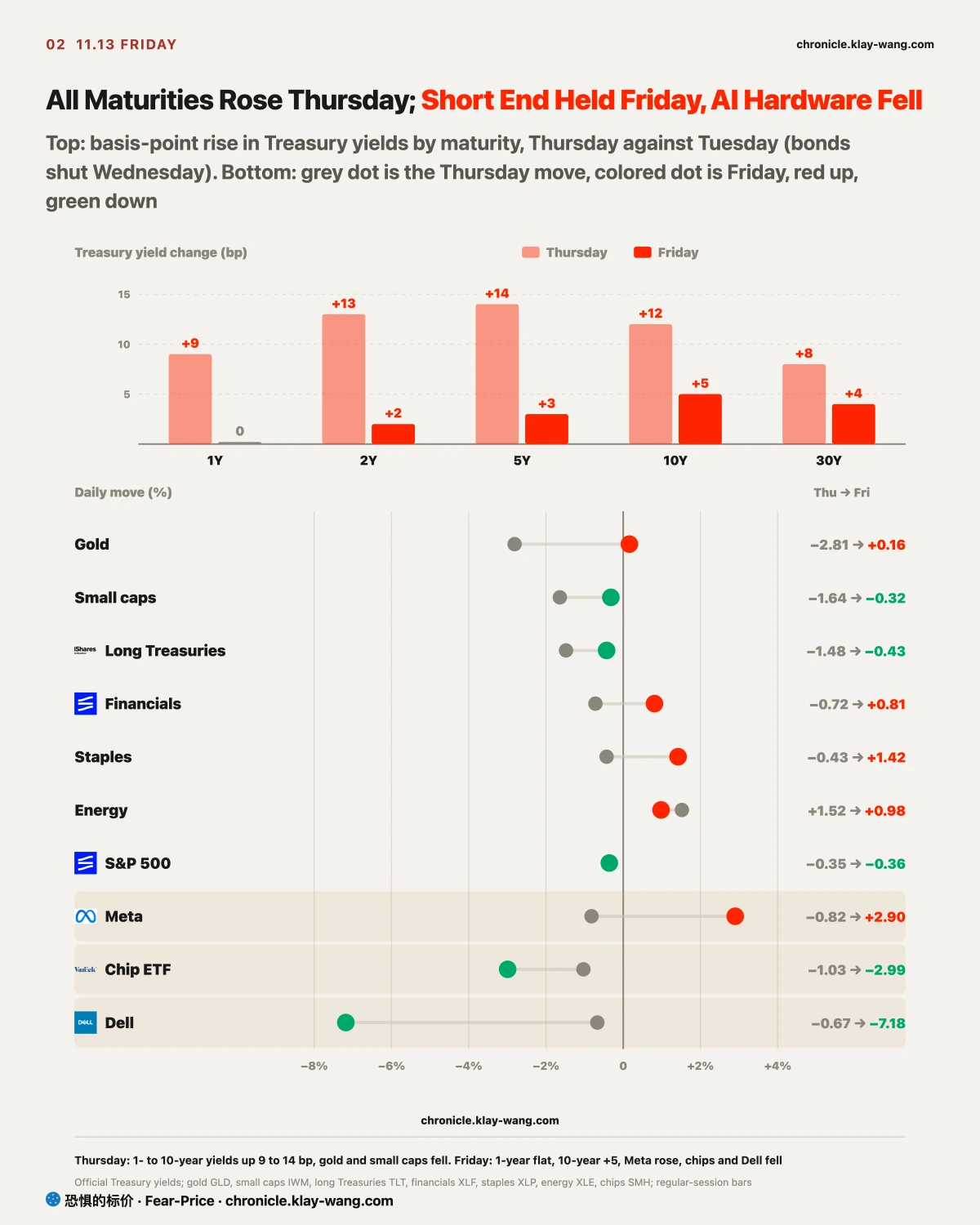
The 10-year Treasury yield did not fall back on a softer PPI. The October producer price index (PPI, prices at the factory gate and wholesale level) rose 0.3% on the month, far slower than 1.4% in September and slightly below the market forecast. The annual rate still climbed from 6.3% to 6.5%, and service prices rose for a fifth month in a row.
The official 10-year yield closed at 5.15%, 5 basis points above Thursday; the 1-year did not move by a single basis point, and the 2-year was only 2 basis points above Thursday. A still short end means the market did not add to hike bets for next year; a rising long end means the longer you lend to the government, the more pay you ask for.
Thursday and Friday make a natural comparison. The bond market was closed on Wednesday, so Thursday caught up two days at once: yields from 1 to 10 years ended 9 to 14 basis points above Tuesday, as the market added to hike bets for next year. The first to fall that day were assets that compete with the interest on cash: small caps fell 1.64% and gold 2.81%. Small companies borrow mostly at floating rates, so their interest bill follows the short end; gold pays nothing, so the higher the deposit rate, the more interest you give up to hold it.
On Friday short-term rates did not rise, gold stopped falling too and closed up 0.16%, and the biggest losers were AI hardware again. A company is worth the sum of all its future profits discounted back to today, and the long-term rate is the ruler used for that discount. The further out the profits, the more is taken off.
Banks went the other way across the two days; banks live on the interest gap. On Thursday both ends rose and the financials ETF fell 0.72%; on Friday the long end rose more than the short end, the gap widened, and the financials ETF rose 0.81%, closing at 95% of the range of the day. What does that mean? The close sat almost at the high of the day; buyers did not step back into the final hour. Banks up and AI hardware down on the same day shows money picking stocks by which part of the curve is rising.
Chicago Fed President Austan Goolsbee said on Friday that inflation still needs work and demand must not overheat; according to InvestingLive, he also said AI investment is heating up the economy. Goolsbee usually leans dovish; this time he pointed the same way as Hammack, who said on Thursday that policy must turn restrictive. The real rate attached to the gauge, the rate after expected inflation, was 2.86%, at the 99.5th percentile of its full history; any asset that makes money only many years from now carries a high opportunity cost.
Our call is that the 10-year decides who falls more this week: by the November 20 close, as long as the official 10-year yield stays at or above 5%, the semiconductor ETF lags the consumer staples ETF from the November 13 close. If the 10-year falls back below 5% before then, or the semiconductor ETF outperforms, the call is wrong.
The Gap: Insurance Sits on the Report, Yet Rates Pressed AI Hardware on Friday
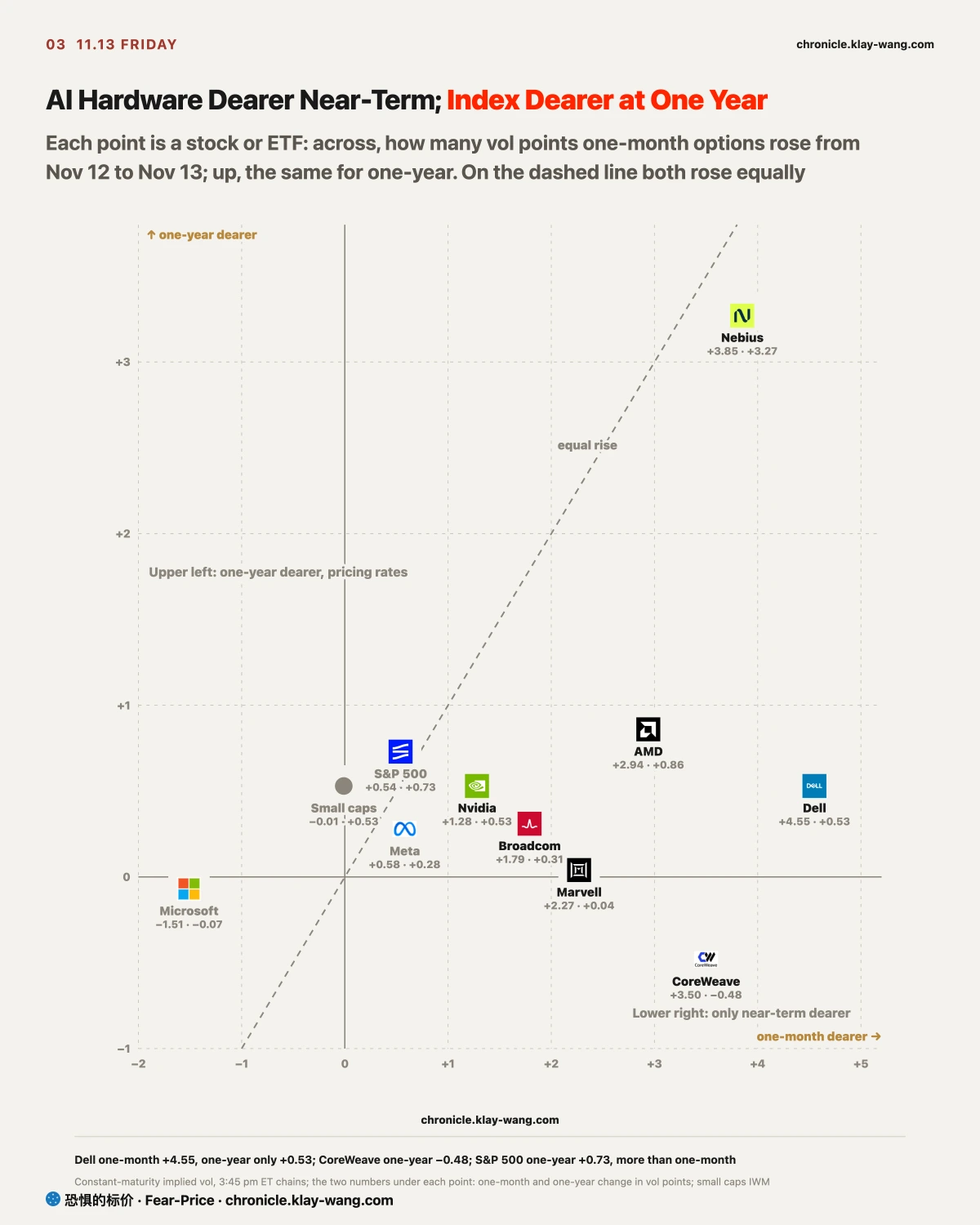
On the options side, the market put the AI hardware risk in the coming month and the index risk across a year. Dell one-month options rose 4.55 points from Thursday, one-year only 0.53; CoreWeave one-month rose 3.50 while one-year got 0.48 cheaper. The S&P 500 went the other way, one-year up 0.73 and one-month up 0.54; small caps one-month did not move while one-year rose 0.53.
Near-month dearer with the far end still says the market sees the AI hardware risk as near-term, and the Nvidia report on November 17 falls inside that month. The dearer one-year index options price a full year of high rates. The exception in this group is Nebius, where one-month and one-year both rose more than 3 points: someone is asking for more compensation at the far end there too.
The big buyers of equipment show no such worry. Microsoft and Meta one-month options are still 3 to 5 points cheaper than one-year, the usual shape; Dell, Nvidia and Marvell one-month options sit 13 to 20 points above one-year.
The premium of Nvidia near-month options over one-year was 7.95 points larger than for the semiconductor ETF. Before the report, the options market books the risk to Nvidia itself. For Nvidia holders, protection is expensive now, and the cost sits in Nvidia itself.
On November 11 we wrote that using AMD to protect an Nvidia position covers only one of two risks, and these two days showed each in turn. On Thursday Nvidia fell 4.34% and AMD rose 5.86%: a problem of Nvidia itself, where a short AMD leg also lost. On Friday rates pressed the whole industry; with the mix from that issue, 0.29 dollars of AMD short for each dollar of Nvidia, the pair rose about 0.5% on the day, against a 2.01% loss for Nvidia alone. Everyone is watching the report, and option pricing is concentrated on the report too; what actually pressed AI hardware on Friday was rates, the risk priced lower right now.
Bond Market: The Biggest Stock Losers Saw Bonds Calmer Than a Week Ago
For the companies whose stocks fell most, bond spreads did not widen against last Friday, and some are much tighter. Against last Friday, the CoreWeave spread narrowed from 1162 basis points to 981, and Oracle from 315 to 275.
AMD was at 60.6 basis points on Friday, at the low end of its 57 to 87 range over the past two weeks; Nvidia fell from 72.8 on Thursday to 68.3, further from the 84.4 line.
Stocks down and spreads flat means Friday sold valuation, while the ability to repay that lenders watch did not worsen. A higher discount rate cuts what distant profits are worth today; whether these companies can pay interest next year did not change in the eyes of their lenders. Each of these bonds is read from its last trade of the day, so single days swing; the direction over several days is what counts. Only when spreads worsen along with stocks does a valuation problem become a credit problem. For holders of these corporate bonds, the Friday drop is still a shareholder matter.
That is the main line. The next three sections cover three other moves today: the bullish Nvidia holder, option trading, and the ledger of earlier calls.
Nvidia: The Bullish Holder Stepped Down a Third Time; the Money Stayed, the Strike Fell
The near-month options of Nvidia were covered above; this section looks at the bullish holder on the far-dated side. Nvidia fell on light volume on Friday, and those who took the stock near $150 on Thursday did not leave. It opened 2.24% higher, slid through the day and closed at $162.85, down 2.01% from Thursday and about 1 point better than the semiconductor ETF; volume was 363 million shares, less than half of Thursday. The close sat 9.4% above the 148.80 test line.
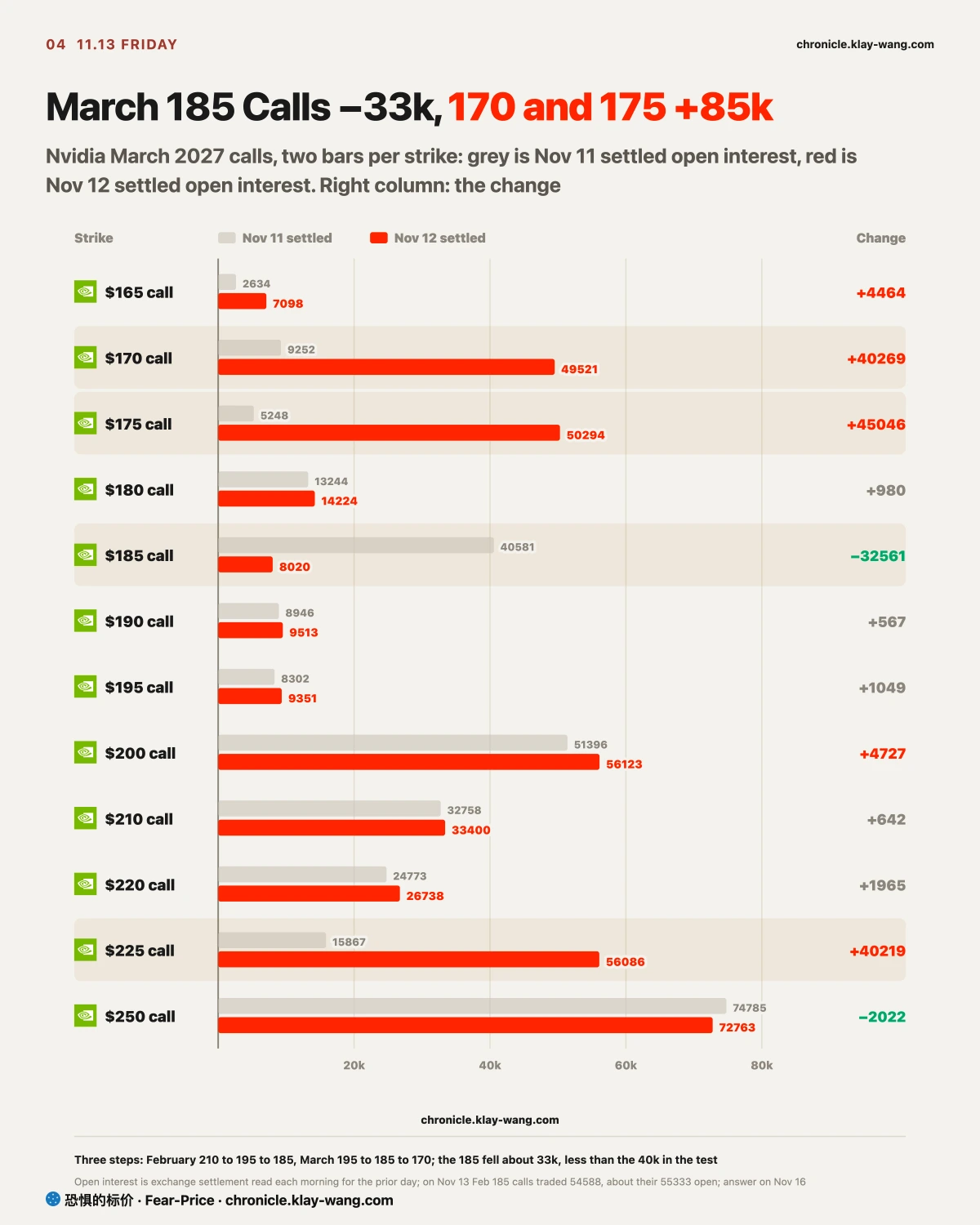
The bullish holder stepping down a third time is confirmed in direction. On the far-dated side, settled open interest read on Friday morning showed March 185 calls down about 33 thousand, the 170 and 175 strikes up about 85 thousand together, and the 225 upper leg up about 40 thousand.
Against the Thursday test the direction was right; only 185 fell about 7 thousand less than the test said. After three steps the strike of the lower leg is about 12% lower than a week ago: the big money has not left, but each time the price it bets on is lower.
Put the three steps together as one trader, and it reads like this. The position started as March 185 calls; as the stock moved further from that strike, the holder did not take the loss and leave, and chose to close part of it and move into the 170 and 175, closer to the current price. The 225 leg looks like a sale that collects premium to pay for the switch, at the cost of handing someone else any gain above 225. The aim is a lower bar: if Nvidia gets back above 170 to 175 before expiry, the position starts to make money, with no need to wait for 185.
Friday brought a new pair. February 185 calls traded about 55 thousand contracts, close to all of their open interest; 240 calls in the same month traded about 54 thousand, 7 times open interest. The 185 strike is the contract we flagged on Wednesday; if its open interest falls below 40 thousand on Monday and stays there for 3 trading days, the call that the bullish holder is still here is withdrawn.
After the report, the thing to watch is whether the two groups keep falling together. On Friday the rival group and the supplier group fell together for the first time since the November 11 call; on Thursday we wrote that the day both fall together, the market has moved from betting on share to betting on total AI spending. One day is not enough: from the November 11 close the rival group is down 1.44% on average and the supplier group 7.49%, and the gap narrowed only from 8.7 to 6.0 points. If the two keep falling together next week and the gap keeps closing, the market has started to doubt the whole chain.
For chip stock holders, watch the 10-year first this week, then the Nvidia report on November 17.
Trading: The Index Is Buying Protection; AI Names Are Betting on a Rise Three Months Out
Laid out by expiry, the trading in the index and in AI names points different ways:
- Within two months: small-cap and financial ETF puts traded more than 13 times the calls; Nvidia, Micron and CoreWeave went the other way, with more calls than puts.
- Three weeks out: semiconductor ETF 520 calls expiring December 4 traded nearly 40 times their open interest; that strike is 6.8% above the Friday close.
- Four months out: S&P 500 ETF 605 puts expiring next March traded 11.8 times open interest; the 715 puts in the same month traded 4 times open interest.
- Three months out: AMD February 700 and 870 calls, and Micron February 1000 and 1350 calls, each traded in one-to-one pairs.
- More than a year out: financial ETF 55 puts expiring January 2028 traded 20 times their open interest.
The two S&P strikes sit about 5% and about 20% below spot; it looks like a put spread: one payment buys protection for an index fall of 5% to 20% four months out. The AMD and Micron pairs look like call spreads betting on a rise to a higher strike three months out.
Put together, trading in the index is buying protection against a fall, and trading in AI names is betting on a rise three months out. Volume cannot tell buys from sells; settled open interest on Monday morning (the contracts still held after the close) will show whether these are new positions or closes. If they are new, the money guards against rates pressing the whole market, while some still bet on the far future of AI names. For holders of financials and small caps, someone is paying premium on this rise at the same time.
Ledger: Six Earlier Calls, and the Equal-Weight Half Went Wrong on Day One
- November 9: before the report, the Nvidia near-month premium stays at least 3 points above the semiconductor ETF. Friday: 7.95 points above. Still right; settles November 17.
- November 10: AMD and Broadcom hold above their test lines. Friday AMD closed at 534.06, 9% above its line; Broadcom at 347.01, 7% above. Still right.
- November 11: by year end the rival group beats the supplier group. Both fell on Friday and the gap narrowed to 6.0 points; still right.
- November 12: the 10-year stays at or above 5% and the equal-weight S&P lags the cap-weighted index. On Friday the first half held and the second half went wrong on day one: equal weight beat by 0.56 points.
- November 12: Nvidia does not close below 148.80 before the report. Friday: 162.85. Still right.
- November 12: by year end CoreWeave and Nebius lag Nvidia. Friday they fell 8.03% on average against 2.01% for Nvidia. Still right.
What This Means for What You Hold
For shareholders of AMD, Dell and the neoclouds, this group is the longest-duration corner of the stock market. With the 10-year still 15 basis points above 5%, rallies are easy for rates to cut short. Their one-month options all got dearer on Friday, so protection is most expensive right now; one-year barely moved, so the options market sees the risk as close at hand.
For Nvidia shareholders, watch two lines: whether the close holds 148.80, and the November 17 report. Options still book the risk to Nvidia itself; open interest in February 185 calls on Monday will show whether the bullish holder is shifting or leaving.
For holders of financials, Friday gained because the long end rose more than the short end and the gap between deposit and loan rates widened. The same logic has a flip side: if the short end leads again, as on Thursday, banks lose that edge. Financial and small-cap puts traded more than 13 times the calls; part of this rise is being insured at the same time.
Three Lines Worth Keeping
- Before the Nvidia report, the 10-year pressed AI hardware: it is the ruler that discounts future profits; the big buyers of compute barely fell, the sellers of equipment and rented compute fell hard, and the further out the profits, the more was taken off.
- Which part of the curve rises decides what falls: on Thursday all maturities rose and gold and small caps fell first; on Friday the short end held, the long end rose, banks rose and AI hardware fell.
- Option insurance sits mostly on the report, yet Friday brought rates; lenders did not charge more, so the market is recomputing the discount rate and credit has not cracked.
Definitions: stock prices are November 13 regular-session closes, changes against the prior trading day close; Treasury yields are official Treasury closes, the bond market was closed on Wednesday November 11, so the Thursday change is against Tuesday; implied volatility is the 15:45 ET option chain snapshot; open interest is exchange settlement, and the morning read is the prior trading day; volume is full-day and cannot tell buys from sells; bond spread is the yield of the last trade minus the matching Treasury.
Fear-Price Index · November 13, 2026 · 68.1/100. Data and method: chronicle.klay-wang.com.
No investment advice. No direction calls. No market timing.