Rates Eased, AI Stocks Still Fell, and Bondholders Charged CoreWeave More
Three-Line Brief
- The 10-year eased 3 basis points, yet chips, bitcoin and silver fell together; money hid only in the dollar and intermediate Treasuries.
- Bondholders split: the CoreWeave bond spread widened 77 basis points in a day while the Meta and Alphabet spreads narrowed.
- Nine-day S&P protection caught up with three-month, and the Nvidia report falls inside those nine days.
US stocks did not crash on Monday. The S&P 500 ETF fell 1.91%, the equal-weight S&P only 1.01%, and 145 of 503 components rose; the selling sat in the AI chain. On Friday we wrote that the 10-year yield was pressing AI hardware, since the further away the profits, the more a higher rate discounts them. On Monday the 10-year eased from 5.15% to 5.12%, and that explanation no longer covers the tape: Nvidia fell 4.12%, the semiconductor ETF 5.11%, and even Amazon and Alphabet, which buy compute, lost more than 3%.
Rates loosened a little and AI stocks fell further, so the market was recomputing something else. Friday was about the discount rate; Monday was about AI spending itself, and about who pays whom, in what order.
Fear-Price Index at 83: Insurance for Next Week Costs More Than Three Months
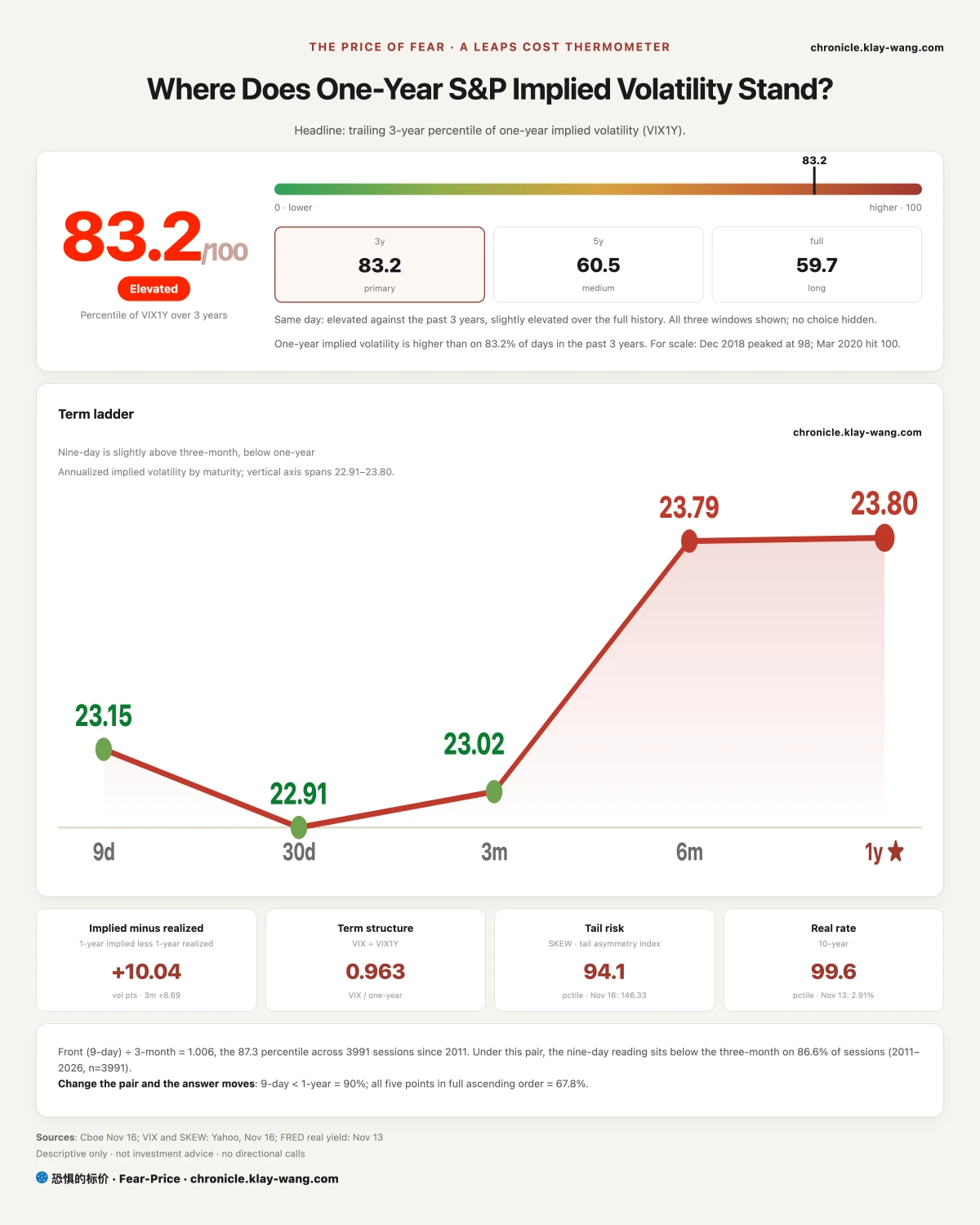
Fear-Price Index · November 16, 2026 · 83.2/100. S&P 500 one-year implied volatility was 23.80%, at the 83.2nd percentile of the past three years, up from 68.1 on Friday. Data and method: chronicle.klay-wang.com. The index describes a historical position and does not forecast returns.
The jump came from the near end. The nine-day index rose from 17.82 to 23.15, up 5.33 points; three-month rose 2.40 and one-year only 0.95. On Friday longer maturities were more expensive; by the Monday close nine-day sat slightly above three-month.
Buyers are pricing this week: Nvidia reports after the Tuesday close and the Fed releases its meeting minutes on Wednesday. VIX futures agree: the front month now costs more than the second month, an inversion that says the trouble is close. The last inversion was on November 5 and 6, and on November 5 the S&P 500 ETF fell 4.41%; this time the S&P fell only 1.91% and futures inverted anyway, so buyers are paying in advance.
The extra premium for a crash did not follow; SKEW eased slightly. Buyers expect large moves this week without paying up for a collapse. For the index, short-dated protection was cheaper than one-year on Friday; a week of protection now costs as much per unit as three months.
The K index was 1.35, down from 1.94 on Friday. The closer it gets to 1, the more people are turning worry into paid protection. History: chronicle.klay-wang.com/kindex and chronicle.klay-wang.com/fear-price.
Cross-Asset: Rates Fell, and Bitcoin, Silver and Chips Fell Together
On Monday the five-year and 10-year Treasury yields both fell, so borrowing got cheaper. Assets valued on distant earnings should have breathed easier; instead they fell hardest. Since the November 11 close the bitcoin ETF is down 12.9%, the silver ETF 9.1% and the semiconductor ETF 8.9%: a digital currency, a metal and a chip index, falling by the same depth.
What links them is who holds them. Robinhood one-month implied volatility rose 8.79 points, close to Nebius and CoreWeave; Goldman Sachs and Citigroup rose less than 5, and the long Treasury, high-yield and investment-grade bond ETFs each rose less than 1. Protection got more expensive mainly in the AI chain and in the high-volatility stocks retail investors favor; bonds and the large banks barely moved.
The havens were plain too: the dollar, the yen, intermediate Treasuries, consumer staples and utilities all closed slightly higher. Gold fell and was not bought as a haven that day. The oil ETF is down 17% since October 30; oil and the five-year yield falling together usually means the market is lowering its growth expectations.
Put together, the Monday selling came from two things at once: growth expectations being revised down, and money leaving high-volatility assets together. Lower rates could not help, because rates were not the cause. So far the transmission has stopped at stocks and crypto; the bond market has stayed orderly. If you hold bitcoin or high-volatility brokers, you are watching the same thing as chip holders: whether protection gets cheaper after the Nvidia report.
AI: Rates Eased, Memory and Neoclouds Still Fell Most
The further a company sat from the end user, the more it fell: SanDisk, Micron and SK hynix each lost more than 7% on Monday, Microsoft and Apple about 1%. The memory selloff lines up with a weekend industry forecast. SemiAnalysis cut its 2028 global AI accelerator spending forecast from $1.054 trillion to $758 billion, down 28%; as reported, a lower price assumption for high-bandwidth memory was one important reason. Spending is still forecast to grow, just less; for memory makers a lower price assumption comes straight out of profit.
Our November 11 call said AMD and Broadcom would beat the supply chain. Since that close, AMD and Broadcom averaged −6.11% versus −14.08% for CoreWeave, Dell, Micron, SanDisk and TSMC; the gap widened from 6.0 to 8.0 points. Money has not left AI; it is leaving the part that must wait for others to pay. If you own memory stocks, watch memory prices this week more than the Nvidia revenue beat.
Bondholders: The Strong Collect First, the Weak Pay First
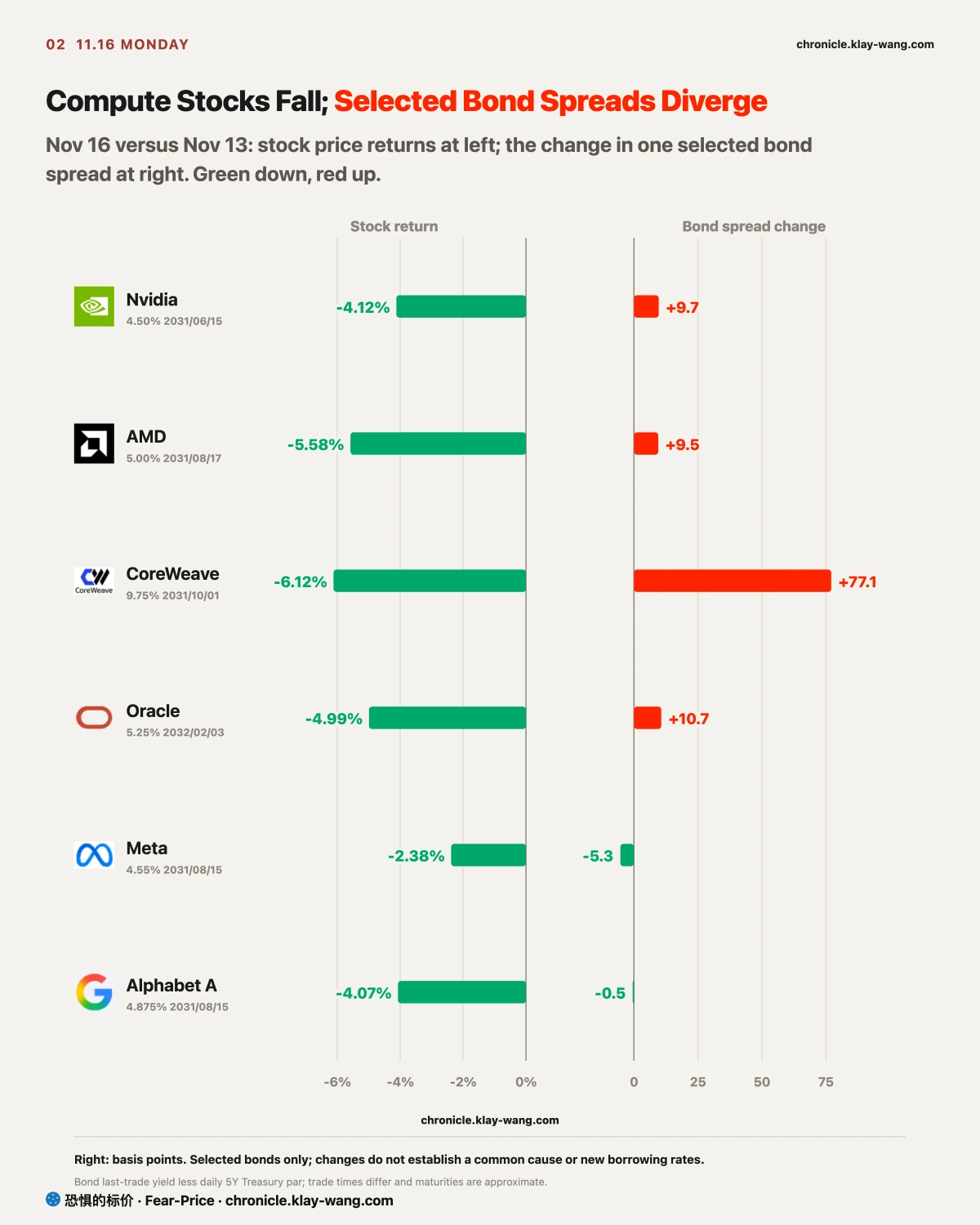
The spread on the same CoreWeave 2031 bond over the five-year Treasury rose from 981.4 to 1058.5 basis points, 77 in a day; a basis point is 0.01 percentage point. The Nvidia, AMD and Oracle bonds widened about 10 points each, the Meta bond narrowed 5.3 and the Alphabet bond barely moved.
A 77-point day is not rare for this bond. Over the past month its spread has ranged from 938 to 1204, and daily swings of 50 or 60 points are common. The direction matters: around the November 10 earnings report it fell from 1087 on the 9th to 981 on the 13th, and Monday took back most of that relief in one day. On Friday we wrote that a valuation problem becomes a borrowing problem on the day spreads and share prices worsen together. On Monday CoreWeave did both; the other five did not. The bond price fell 2.6% in a day.
Follow the order of cash. TSMC has customers prepay to reserve capacity; those prepayments rose 53.5% in a quarter. The amended Anthropic prospectus says future compute will be split among suppliers, and a supplier may be paid once its own part is done even if the whole system cannot yet run. Those with pricing power collect first; the rest pay first and wait. In between sit neoclouds such as CoreWeave, which spent $9.44 billion of cash on equipment in the third quarter against $1.98 billion of operating cash flow, funding most of the gap with debt.
Our call: this repricing will not unwind by month-end. The average CoreWeave bond spread over the last 5 reading days of November stays above 1026.7 basis points, the average of the 5 readings from November 9 to 16; an average below 1026.7 means the call was wrong. We use a 5-day average because each reading is a single last trade and swings widely, and month-end covers the Nvidia report and the days of digestion after it. The longer test: on November 10 management said it expects about $9 billion of customer prepayments and deposits over the next three months, and the next quarterly report will show whether it arrived. If you hold neocloud stocks or their bonds, watch this spread after the Nvidia report before you watch the share price.
Options: The Day Before the Report, Risk Spread From Nvidia to the Sector
Nvidia reports after the Tuesday close. The revenue guidance given last quarter midpoint was $108 billion; consensus read Monday evening was about $108.7 billion, and next-quarter consensus is about $124.8 billion. It is the first report since Jensen Huang resigned on November 12; Treasury Secretary Bessent asked the board to answer on export compliance within 10 days.
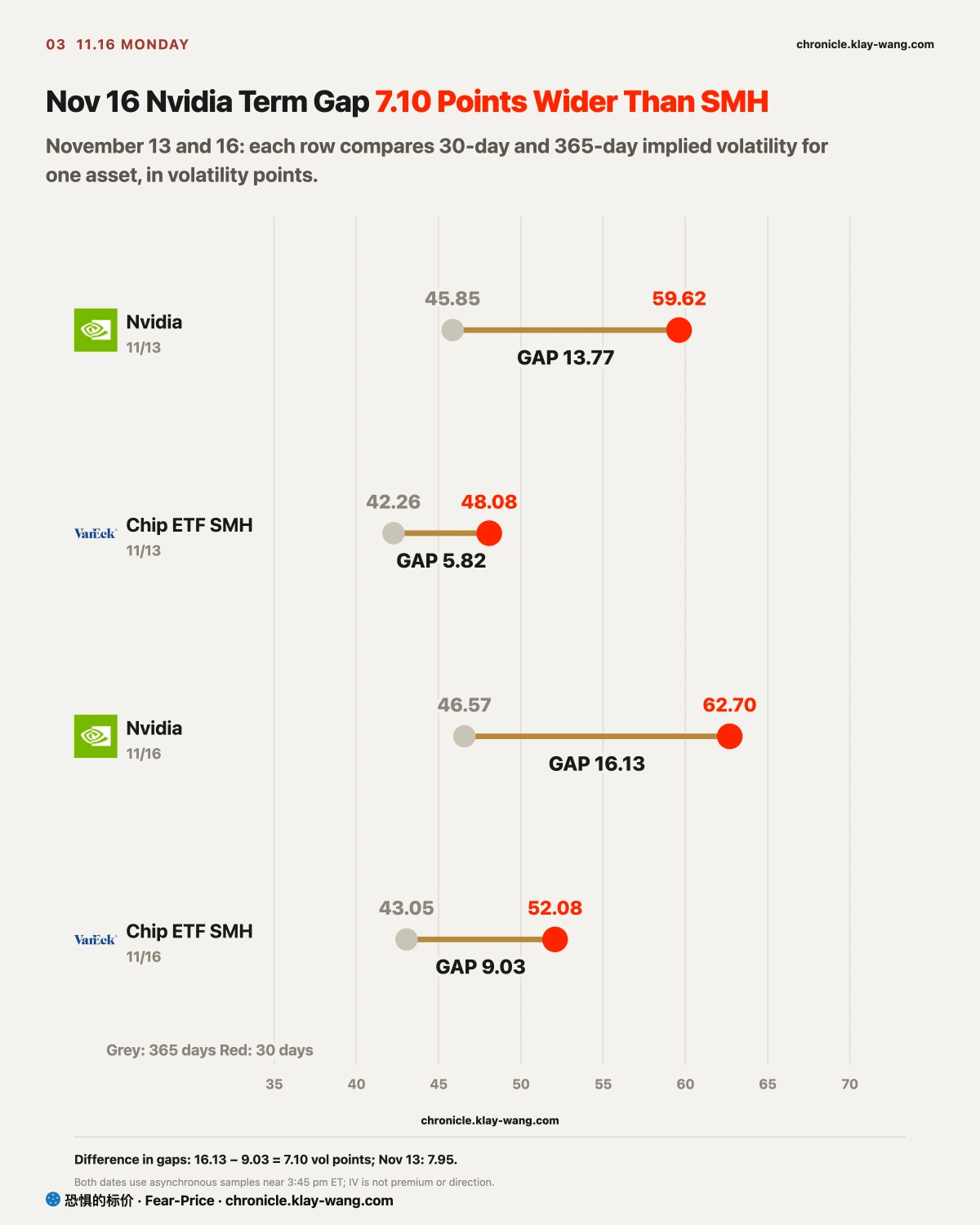
Nvidia, AMD and Broadcom all opened lower, rallied once during the session and were sold back toward the open. Only Nvidia briefly traded above the Friday close, yet closed 1.8% below its open at 156.14, little more than a dollar above the low of the day. Buyers tried during the day and did not hold it. Nvidia one-month implied volatility was 16.13 points above one-year, versus 9.03 for the semiconductor ETF, an extra 7.10 points, down from 7.95 on Friday because ETF one-month volatility rose more.
Our November 9 call said the market would keep pinning the risk on Nvidia alone, by at least 3 points every day before the report; all five readings met it, and it settles Tuesday. The shift on Monday is that the market started buying near-dated protection on the whole sector. If you own Nvidia, protection now costs for both the company and the industry. The 156.14 close is 4.9% above the 148.80 test line.
Maturities: Oracle Protection for a Month, Rebound Bets for February, a Floor Under Financials Two Years Out
Line up the options from the same day by expiry and each horizon carries a different bet. Volume does not show direction; what follows is only where trading concentrated.
At one month, Oracle protection got the most expensive: one-month implied volatility rose 10.15 points, first among the 45 stocks and ETFs we sample daily. Its bondholders did not single it out; the spread widened only 10.7 basis points, in line with Nvidia and AMD. CoreWeave flashed on both options and bonds; Oracle only on options. Which market changes its mind first should show after the Nvidia report.
At three months, February expiries showed paired calls: TSMC 430 and 520, Micron 920 and 1000, Amazon 295 and 350, each pair with nearly equal volume. The common structure buys the lower strike and sells the higher one: a capped bet on a rebound at a lower cost. The strikes sit 14% to 28% above the Monday close. On November 13 AMD and Micron showed the same February pairs. In the same month, the long Treasury ETF closed flat while its $83 call traded 84 thousand contracts, five times prior open interest. The strike is 4.6% above the close, roughly another 30 basis points off long-term yields.
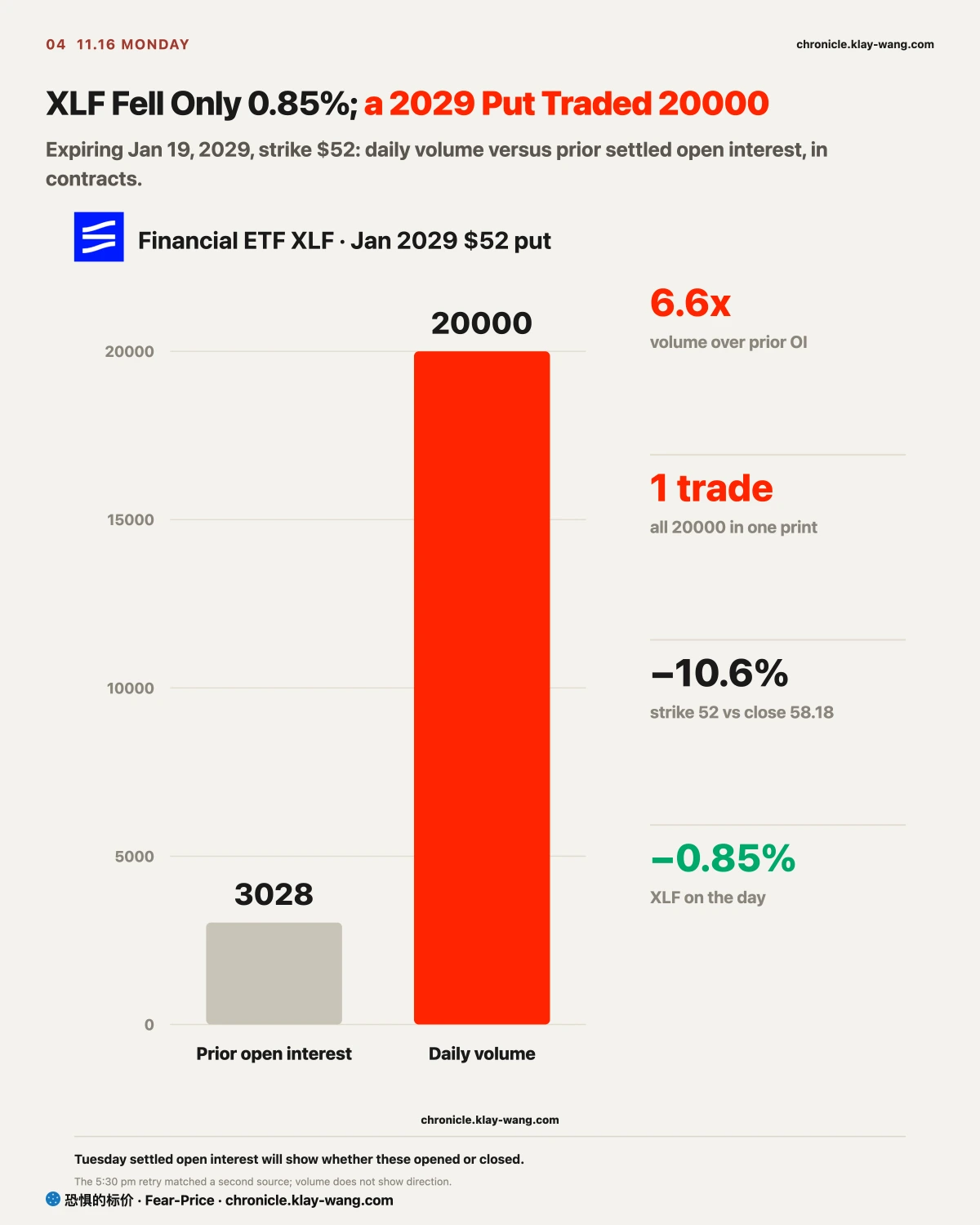
Two years out, the financial ETF fell only 0.85%, yet its puts lined up from March and June 2027 to January 2029, with strikes 10% to 18% below the close. The farthest, the January 2029 $52 put, traded 20000 contracts in a single trade against prior settled open interest of 3028. The Fed stability report puts compute-related debt issuance this year above $680 billion through October, and much of the money for data centers comes from banks and private credit. If Tuesday open interest shows these positions are new, the put ladder may be protecting that chain: lower AI spending forecasts, slower collections for neoclouds, and the risk ending with the lenders.
Protection up close, rebound bets in the middle, a floor under financials far out. If you own TSMC or Micron, someone has bet on a rebound before February, with a cap. If you own financials, check Tuesday open interest first.
Ledger: The Nvidia Step-Down Held; the Early-Month Credit Call Is Wrong So Far
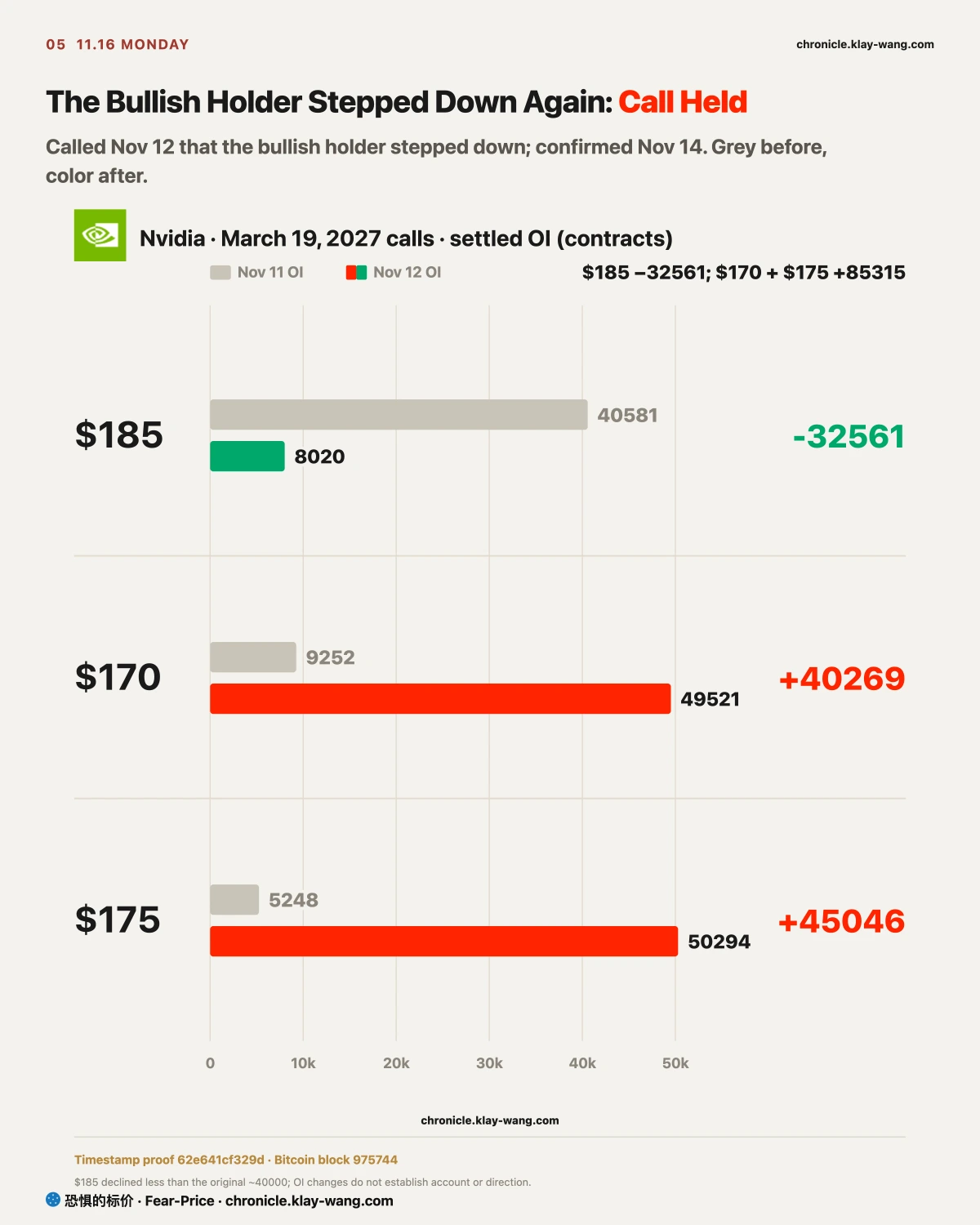
The November 12 call that the bullish Nvidia holder stepped down a third time was confirmed on November 14: March 2027 $185 call open interest fell 32561 while the $170 and $175 lines rose 85315 combined. The $185 decline was smaller than the roughly 40000 in the call, recorded as observed; the public timestamp is on the result card.
- November 3: CoreWeave spread above 900 through November 20. Monday 1058.5, holding.
- November 9: the Nvidia bond spread will not stay above 84.4 for three days before the report. Monday 78.0, holding; settles Tuesday.
- November 10: AMD and Broadcom hold above their test lines before the report. Both are about 3% above, holding.
- November 12: 10-year above 5% and equal-weight lagging cap-weight. First half holds; the second has run the other way for two days.
- November 12: CoreWeave and Nebius lag Nvidia by year-end. Since November 12, −14.3% versus −6.0%, holding.
- November 13: with the 10-year above 5%, the semiconductor ETF lags consumer staples. Monday −5.11% versus +0.27%, holding.
From the October 30 monthly issue, settling November 30:
- The main monthly call was that credit pressure would move toward highly rated giants. By Monday the Microsoft, Amazon and Alphabet spreads were all narrower than on October 30. That call is wrong so far: the pressure landed on CoreWeave, the heaviest borrower.
- Broadcom spreads would widen more than Nvidia. Broadcom fell from 120.0 to 78.6 and Nvidia from 83.2 to 78.0, running the other way.
- Microsoft beats Oracle in November. Since October 30, Microsoft −0.75% versus Oracle −8.86%, holding.
- Semiconductor ETF one-month volatility back below one-year by November 20. Still 9.03 points above on Monday; the three days after the report decide it.
What This Means for What You Hold
Nvidia: after the Tuesday close, look first at next-quarter revenue guidance against the $124.8 billion consensus, then at whether the stock holds 148.80.
Memory and neoclouds: memory prices for Micron and SanDisk; the bond spread for CoreWeave and Nebius. Until that spread falls back below 981.4, treat rebounds as rebounds.
Compute buyers: bondholders did not charge Meta, Alphabet or Amazon more. Watch whether next-quarter capital spending guidance is revised down.
The index: short-dated protection is at its most expensive this week.
Three Lines Worth Keeping
- Rates eased and bitcoin, silver and chips still fell together: the market moved from repricing the discount rate to repricing growth and AI spending.
- In the chain, the strong collect first and the weak pay first; bondholders charged the borrower building data centers first.
- Protection up close, rebound bets for February, a floor under financials two years out: the most expensive thing this week is near-dated protection.
Definitions: equity prices are November 16 regular-session closes versus November 13. Index volatility is the official Cboe close; stock and ETF implied volatility is sampled around 3:45 p.m. ET. Spreads are the last-trade yield of a single bond minus the same-day five-year Treasury yield, not new-issue borrowing costs. Option volume and open interest do not show trade direction.
No investment advice. No direction calls. No market timing.