Nvidia Beat on Revenue, Collected Cash 4 Days Slower, and Software Fell Harder Than Chips
Three-Line Brief
- Nvidia revenue beat estimates by 6.6%; the stock rose 4% after hours and neoclouds rose more.
- Collection days stretched from 60 to 64. Nvidia is carrying more of the bills of its customers.
- Chips steadied Tuesday while software, financials and crypto kept falling. Near-term protection cost more than long-term.
Fear-Price Index at 92.9: Protection Is Expensive for the Next Few Days
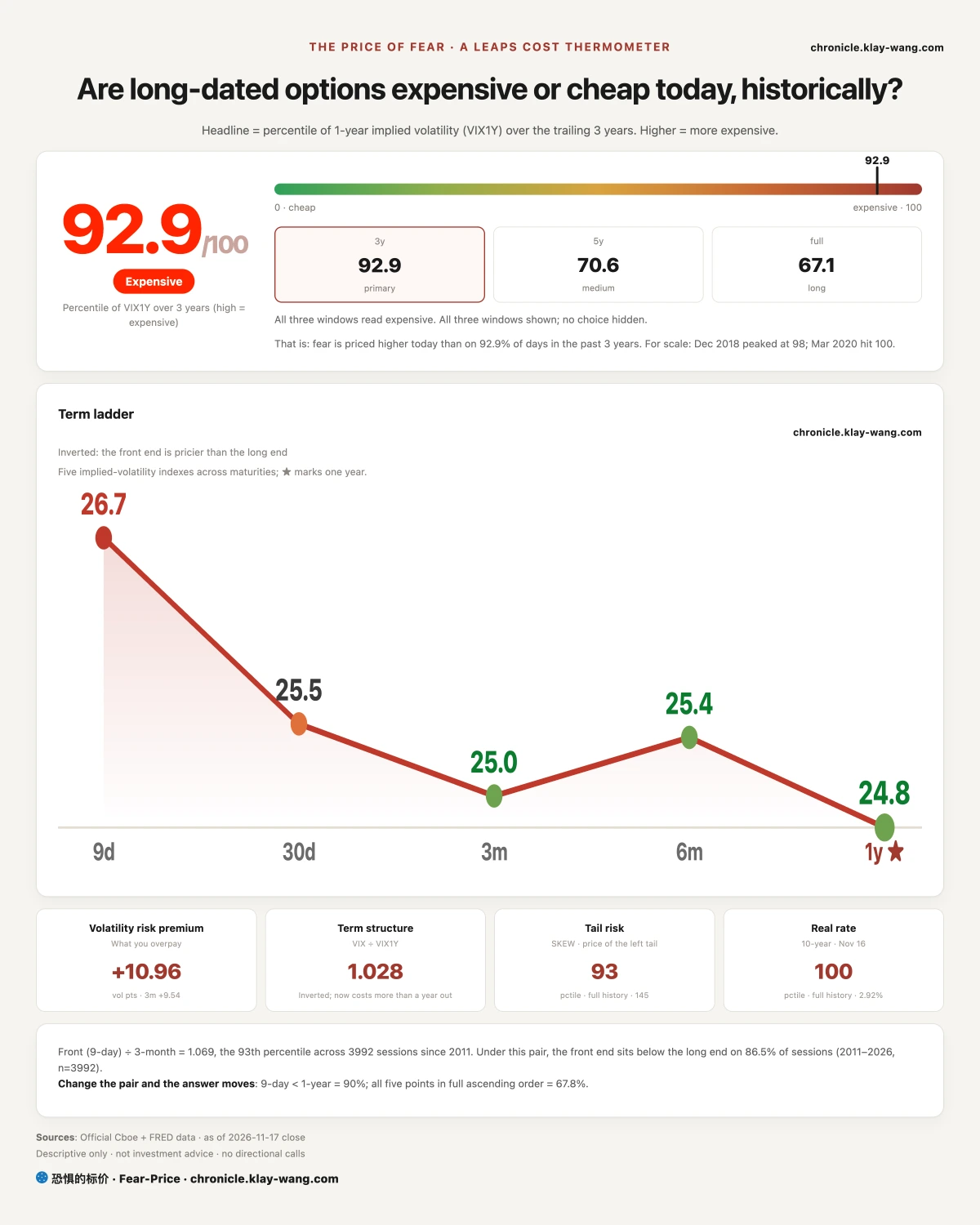
Fear-Price Index · November 17, 2026 · 92.9/100. One-year implied volatility was 24.77%, at the 92.9th percentile of the past three years, up from 83.2 on Monday. Daily ledger and methodology: chronicle.klay-wang.com. The index describes historical position and does not forecast returns.
Most of the premium sits in the next few days. The 9-day S&P 500 volatility index closed at 26.70, above the 3-month reading of 24.98, and VIX rose from 22.91 to 25.46. The bond market stayed calm: the 30-day volatility index for long Treasuries was 14.23, about where it was Monday. Tuesday repriced equity risk, not rates.
The K Index was provisionally 0.99, down from the Monday reading of 1.356 and below 1. The closer to 1, the more investors are turning worry into protection they actually buy; on Monday we wrote that spoken fear and purchased protection had not yet met, and on Tuesday they did. The sentiment reading is provisional, so K may be revised. Daily readings: chronicle.klay-wang.com/kindex.
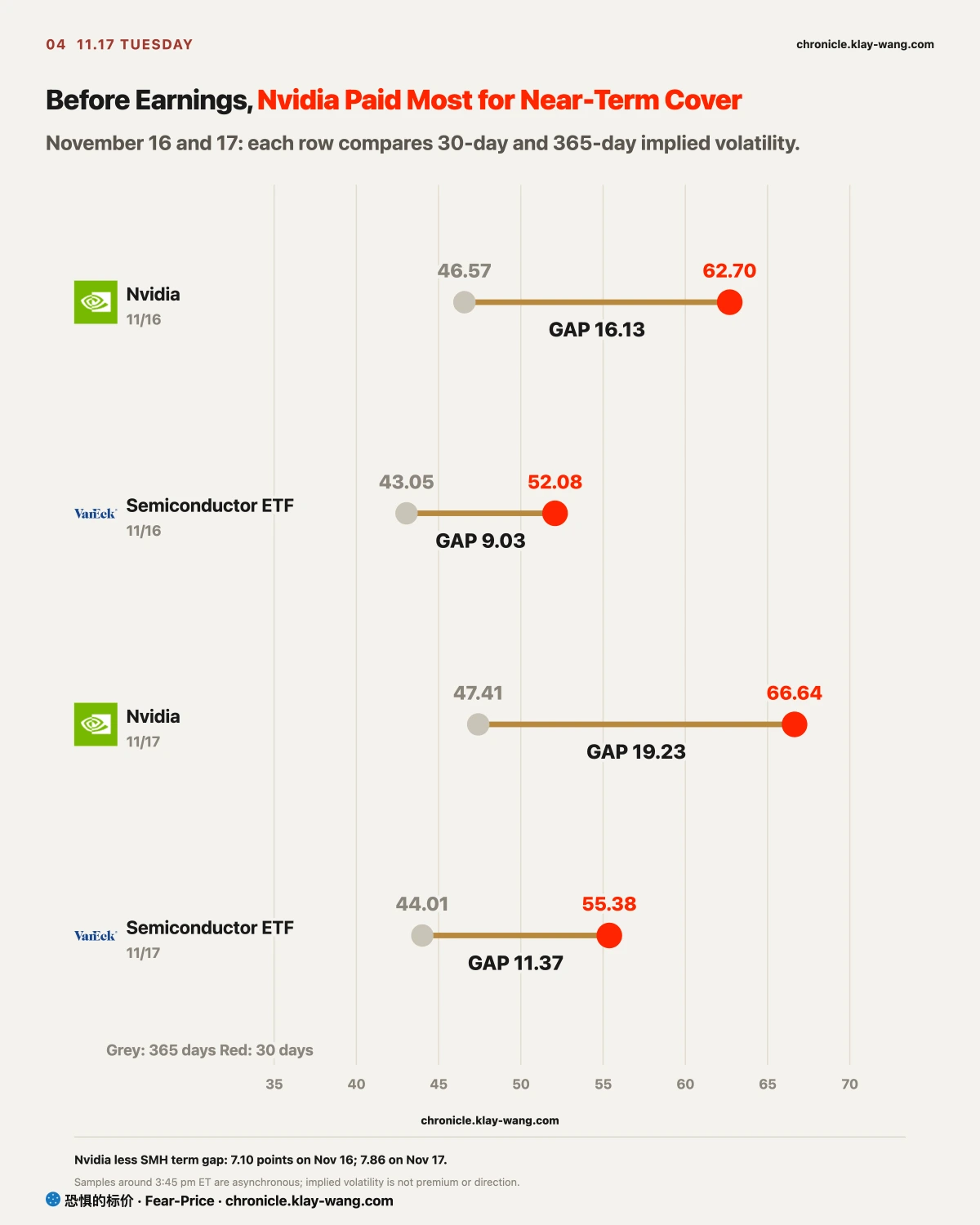
One-year single-stock volatility barely moved. Nvidia one-year implied volatility went from 46.6% to 47.4%. LEAPS buyers did not reprice the long-term risk of AI leaders; the market is treating this as an event that resolves within weeks.
Market: Chips Steadied, and the Pressure Moved
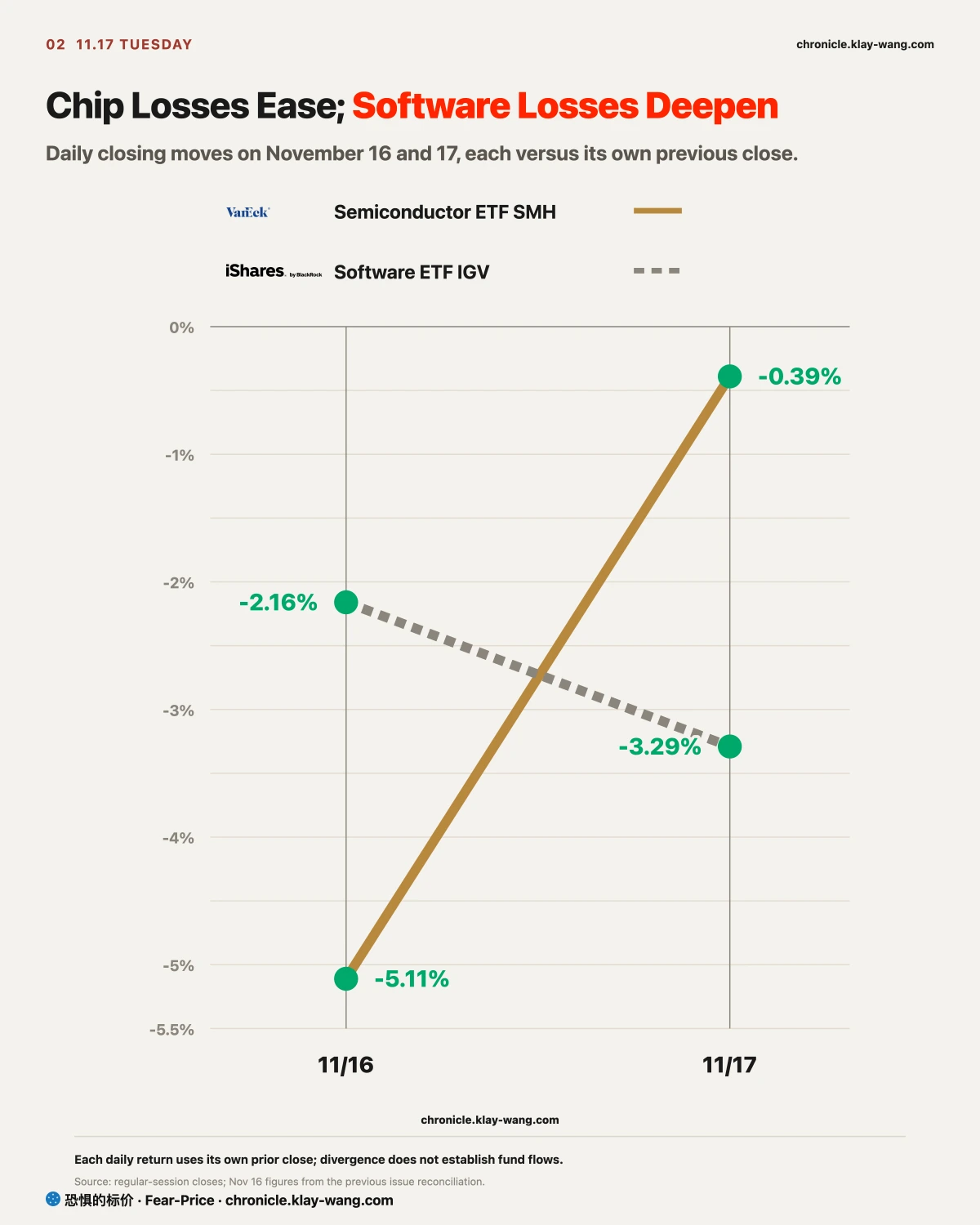
Monday hit AI hardware hardest: the semiconductor ETF fell 5.11% and memory names fell 7% to 9%. On Tuesday the semiconductor ETF slipped just 0.39%, Broadcom rose 2.46% and Marvell 2.33%. The losses moved elsewhere. The software ETF fell about 3.3%, Salesforce 9.4%, Microsoft 2.27% and Oracle 3.43%. The financial ETF fell 1.91%, and Strategy, Coinbase, Robinhood and SoFi fell roughly 4% to 6%.
Read together, the two days follow AI money downstream. Monday asked whether the shovel sellers keep getting orders; Tuesday reached the buyers. Software companies pay for compute before AI features prove they bring revenue, and reports cite fears that AI agents will erode per-seat pricing. Every extra Nvidia sale is first a cost for software.
Financials and crypto are a separate thread. The 10-year Treasury yield remains at 5.10%, and banks, brokers and crypto assets depend on cheap money and risk appetite. Regional bank ETF 30-day implied volatility jumped from 24.7% to 30.5% while its one-year reading did not move. Equal-weight S&P fell 1.43%, 0.42 point more than the cap-weighted S&P 500 ETF, so the decline was broader than the index suggests.
Nvidia: Demand Is Fine; the Cash Takes Longer
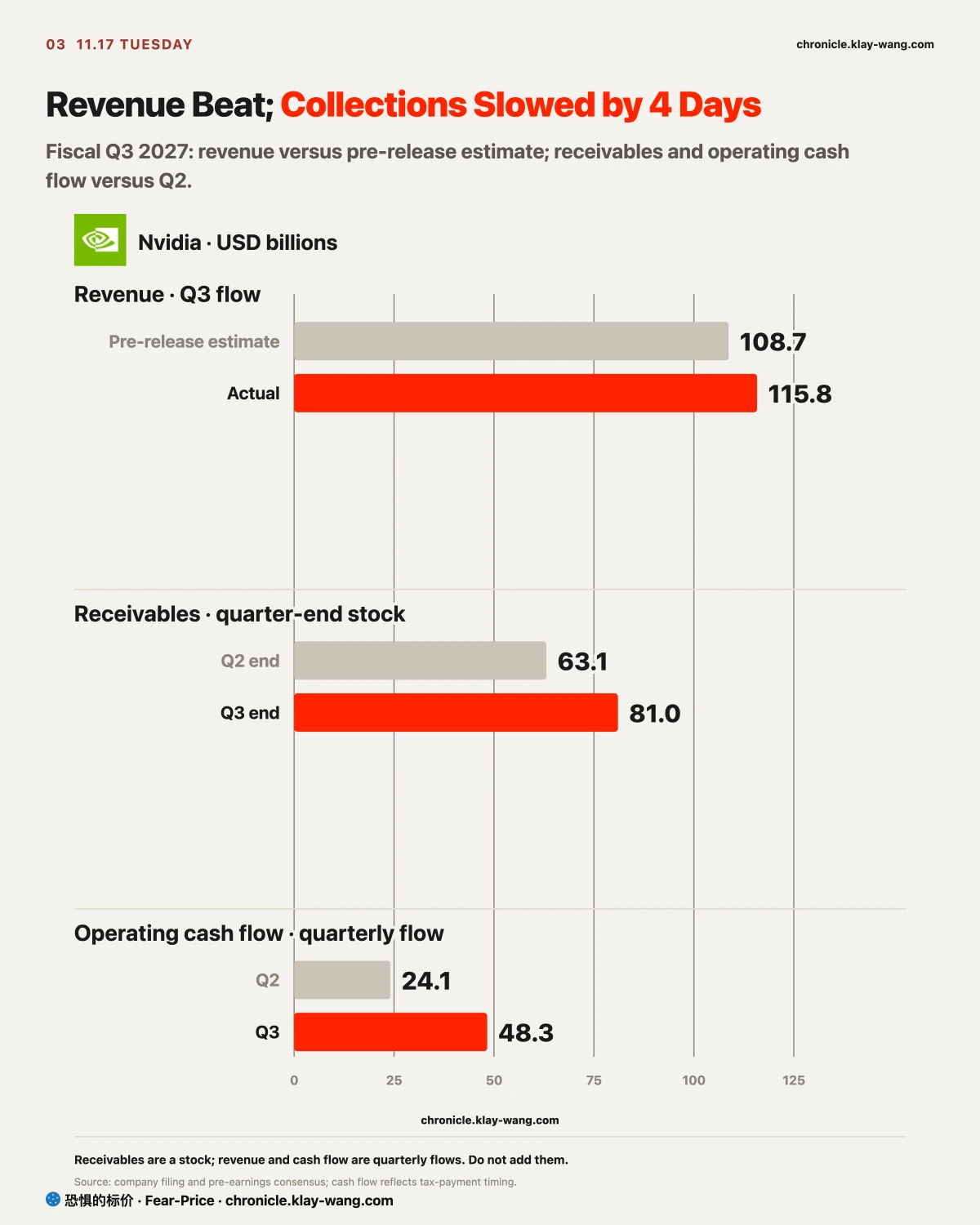
Nvidia reported $115.8 billion of fiscal third-quarter revenue against roughly $108.7 billion expected, and guided fourth-quarter revenue to a $130 billion midpoint against about $124.9 billion. Management raised fiscal 2028 growth to about 75% from about 70%, and said the cloud industry backlog rose from $2 trillion to $2.5 trillion in three months. On demand, the answer is yes.
The guide needs one adjustment. The fourth quarter has 14 weeks and the third had 13. Per week, next-quarter revenue is only about 4% above this quarter, against a headline 12%. Gross margin falls from 74.9% to 71% to 72%, a range flagged in August because of memory costs.
The new change is on the balance sheet. Receivables rose from $63.1 billion to $81.0 billion and collection days from 60 to 64, which Nvidia tied to Rubin shipment timing and longer terms for some highly rated customers. Supply and capacity commitments rose from $279 billion to $390 billion, mostly multiyear memory purchases. Separately there are $32 billion of conditional neocloud commitments and up to $118 billion of guarantee exposure.
Put together, Nvidia is doing two things: carrying the bills of customers and locking in its own memory. The longer terms go to highly rated customers, so default risk is low and the cost is cash arriving later. The guarantees and neocloud commitments are the real credit exposure; their triggers differ and they are not cash already spent. Operating cash flow doubled from $24.1 billion to $48.3 billion, partly from tax-payment timing, so cash itself did not weaken.
Interim CEO Colette Kress said on the call that the company will rigorously evaluate future investments, commitments and guarantees. For neoclouds that is a constraint: Nvidia will keep selling but will be choosier about backing customers. After hours the market chose optimism: CoreWeave rose 8.2%, Nebius 9.9% and Nvidia 4.0%.
Three issues remain open. The Wall Street Journal reported an SEC civil investigation; Muddy Waters disclosed a short position and questioned sales channels, while saying the lawsuit allegations it cites are unproven; Jensen Huang said he would return if asked, and the chairman said on the call the board is not considering it. From the November 9 close of $178.67, Nvidia fell 13% through Tuesday. The report did not answer the governance questions.
Options and Credit: The Front Month Waits; Further Out, Someone Built a Pair
Before the release, Nvidia 30-day implied volatility was 19.23 points above its one-year reading, versus 11.37 for the semiconductor ETF. The front month carried three events: earnings, the SEC probe and the leadership change. Earnings are out; near-term volatility usually drops sharply the next day, and what remains is the price of Nvidia-specific governance risk.
Further out, the semiconductor ETF September 2027 $380 put traded about 20600 contracts against prior open interest of 129, with a strike 17% below the price. Open interest in the long Treasury ETF February 2027 $83 call rose by about 65000 contracts, from a single source so far. If both were opening purchases, the pair bets on one scenario: AI hardware falls further while long-term rates drop. Volume does not show direction; the next open-interest update will.
Credit split. The same CoreWeave 2031 bond yield minus the five-year Treasury narrowed from 1058.5 to 1019.1 basis points, while the comparable Broadcom spread widened from 78.6 to 102.3 and Oracle widened slightly. These are pre-earnings last trades, not a reaction to the report, but they show bondholders are not pricing only the neoclouds.
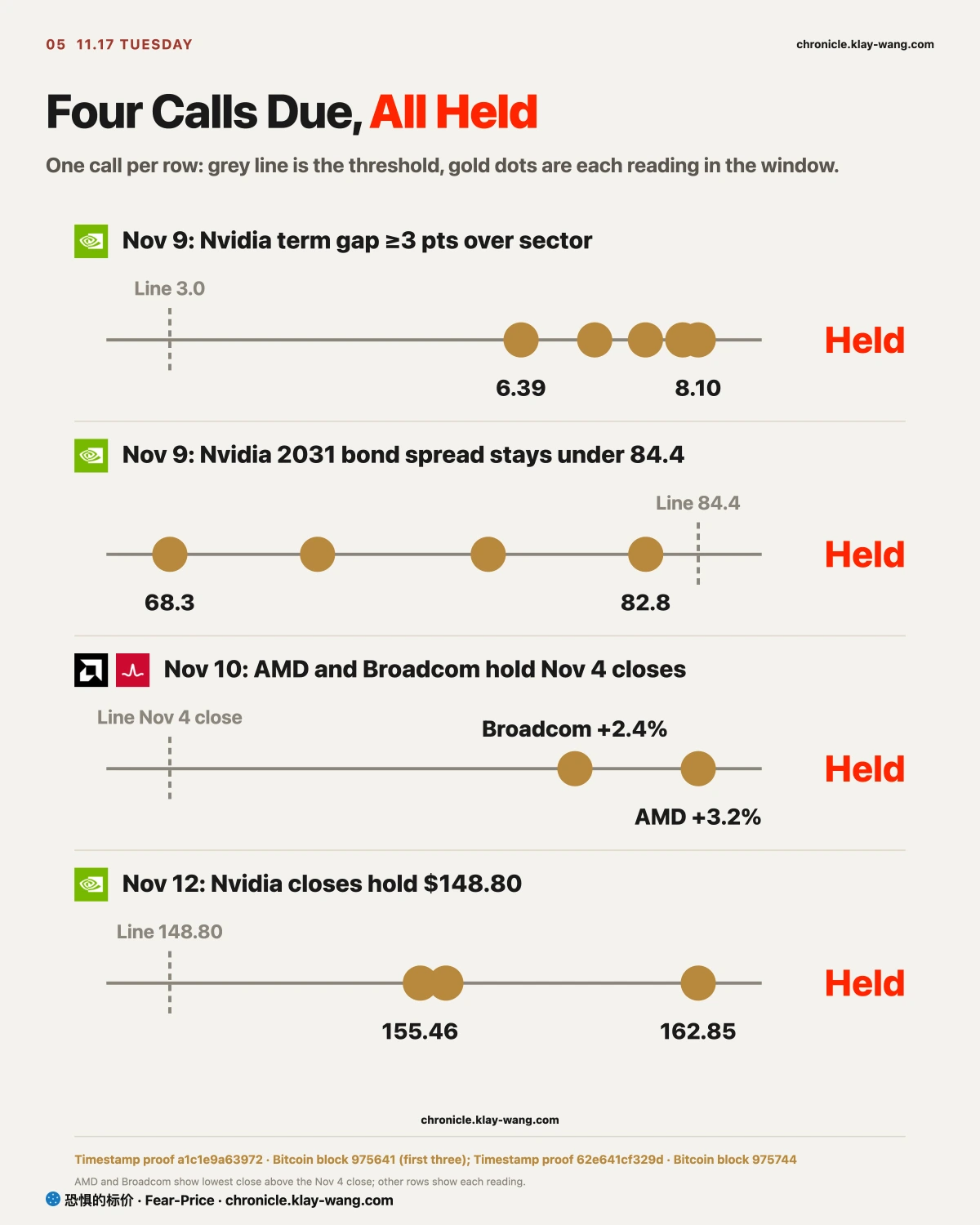
Scorecard: Four Calls Due, All Held
- November 9: before earnings, Nvidia term gap stays at least 3 points above the semiconductor ETF. All five readings from November 10 to 16 qualified. Held.
- November 9: the Nvidia 2031 bond spread does not stay above 84.4 basis points for 3 readings. The high was 82.8. Held.
- November 10: AMD and Broadcom stay above $488.78 and $325.48 before earnings. Their lowest closes were $504.28 and $333.40. Held.
- November 12: Nvidia does not close below $148.80 before earnings. The lowest close was $155.46. Held.
All four point the same way: the market priced the selloff as an Nvidia company issue, not a break in AI chip demand. The revenue and guidance fit that reading.
What This Means for What You Hold
For Nvidia, once front-month volatility drops, watch how far 30-day still sits above one-year. My call: the earnings premium leaves and the investigation premium stays. By the 3:45 p.m. reading on November 24, the Nvidia 30-day minus one-year gap falls below 10 points yet stays at least 3 points above the same gap for the semiconductor ETF. If the difference falls within 3 points, the market has stopped charging Nvidia separately, and the call is withdrawn.
For CoreWeave and Nebius, on November 12 we said Nvidia would tighten financing support and neoclouds would lag Nvidia through year-end. Since that close the two neoclouds are down about 15% on average against 6.5% for Nvidia. After hours the neoclouds rose more; whether the caution from Kress reaches contracts will show in the terms of the next neocloud financing.
For Microsoft, Salesforce and other software names, every strong Nvidia quarter enlarges their compute bill. Over the next quarter or two, watch whether AI revenue grows faster than inference cost.
For banks and long Treasuries, the 10-year remains above 5%; our November 12 rates call settles November 19. Whether the regional bank front-month premium fades is the most direct read this week on credit stress reaching banks.
Three Lines Worth Keeping
- Nvidia proved demand; adjusted for the extra week, next quarter grows about 4% per week.
- Slower collections and larger commitments mean Nvidia itself now carries more of the AI bills of the chain.
- Chips steadied; the pressure moved to software paying for compute and to financials and crypto that rely on cheap money.
Definitions: equity moves are November 17 regular-session closes versus November 16. After-hours prices are snapshots at about 6:48 p.m. ET. Stock and ETF implied volatility was sampled around 3:45 p.m. ET before earnings. Bond spreads are the last-trade yield of a single bond minus the same-day five-year Treasury, not a new-issue borrowing rate. Options volume does not identify trade direction.
No investment advice. No direction calls. No market timing.