Nvidia Sold Off After Earnings as Anthropic Priced an $81 Billion IPO Above Range
Three-Line Brief
- Nvidia opened higher on strong results and closed lower; AMD, Broadcom and Amazon rose.
- Anthropic priced an upsized $81.3 billion IPO above range. AI money did not leave; it changed seats.
- Hawkish Fed minutes did not lift long yields. Gold, silver and crypto took the hit.
Fear-Price Index at 91.9: Near-Term Protection Got Cheaper, One-Year Protection Did Not
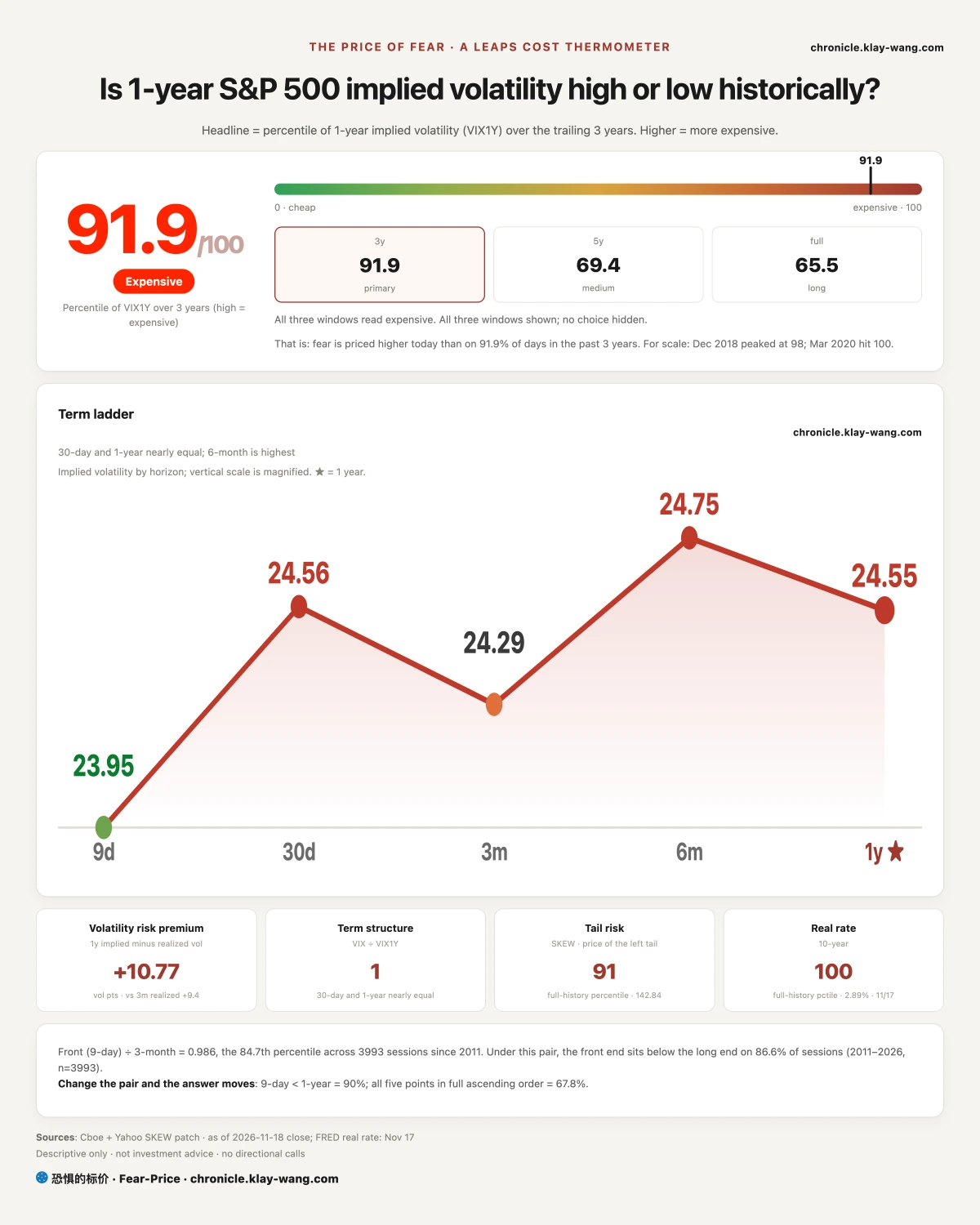
Fear-Price Index · 2026-11-18 · 91.9/100. One-year S&P 500 implied volatility (VIX1Y) was 24.55%, at the 91.9th percentile of the past three years, down from 92.9 on Tuesday. Higher means more expensive. Daily ledger and methodology: chronicle.klay-wang.com.
Once the earnings were out, the first premium to go was the one for the next few days. On Tuesday the nine-day S&P 500 volatility index stood at 26.70, above the three-month reading of 24.98. On Wednesday it fell to 23.95, now below the 30-day VIX of 24.56. The VIX itself eased from 25.46 to 24.56. With that hurdle cleared, the market stopped paying extra for it.
The K index was 1.002 (the sentiment input is provisional), below the final Tuesday reading of 1.019; The Tuesday issue carried a provisional 0.99 that has since been revised. The closer K is to 1, the more people are actually paying for protection. With the Wednesday fear and greed reading at 24.6, K falls below 1 if the VIX rises above 24.6, almost exactly where it closed on Wednesday. History: chronicle.klay-wang.com/kindex; index: chronicle.klay-wang.com/fear-price.
Further out, nothing eased. The December VIX future settled at 21.94 and the months after it sit around 22, so spot still trades above futures and near-term protection remains dearer than later protection. The one-year reading is still above the 90th percentile. For index-fund holders, the earnings premium is gone; options are still charging for two longer stories, rate hikes and AI financing.
Market: AI Money Stayed, and the Company Carrying the Bill Was Marked Down
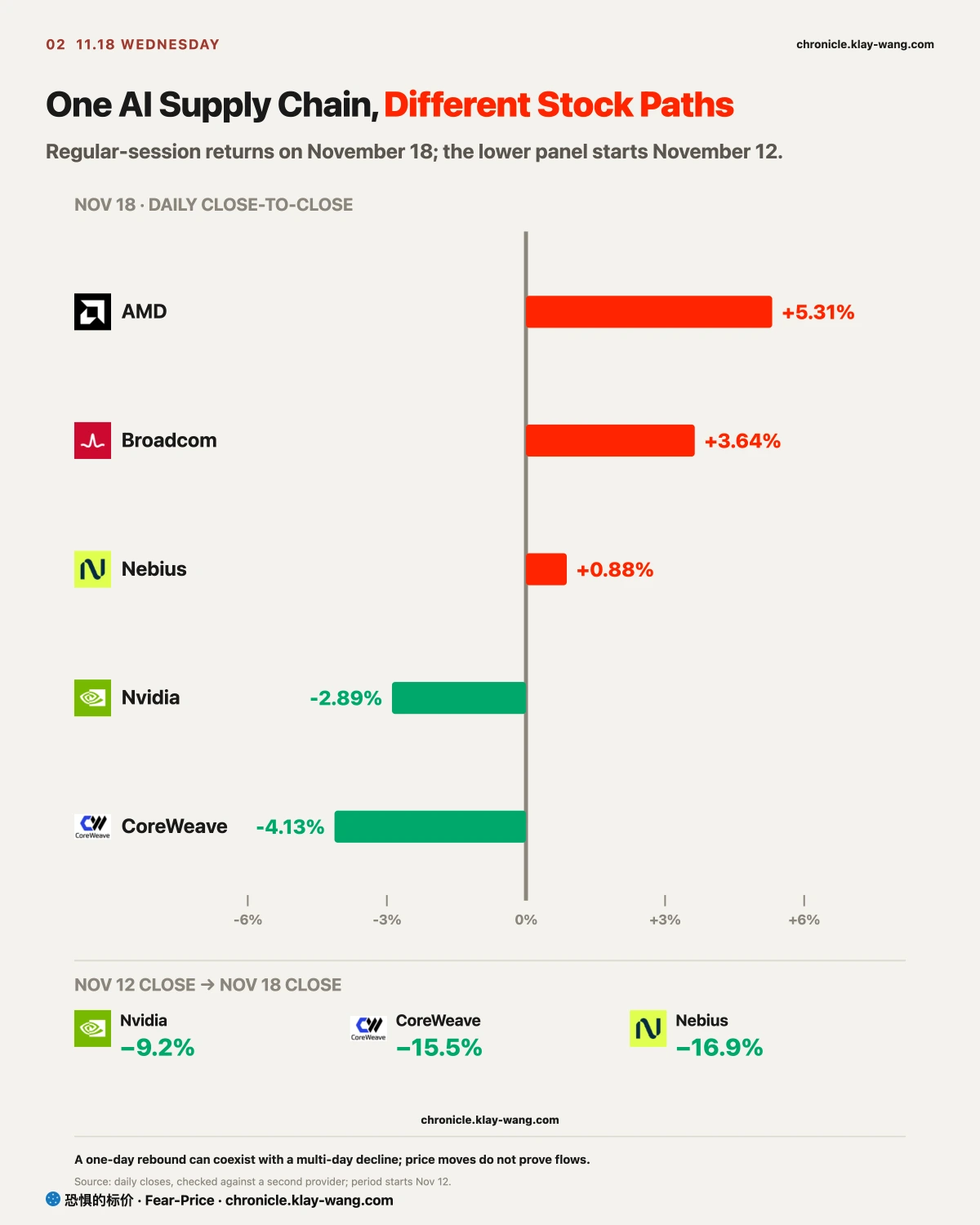
Nvidia opened at $159.19 on Wednesday, 2.4% above the Tuesday close, then sold off to finish at $150.96, down 2.89%. The intraday low of $150.40 was about 1% above $148.80, the November 12 level where heavy buying came in. AMD rose 5.31%, Broadcom 3.64% and Amazon 3.82%, while the semiconductor ETF was roughly flat. A strong report that opens higher and gets sold means the beat was priced in before the bell. What remained were questions that take time: adjusted for the extra week, next-quarter guidance implies only about 4% weekly growth, collections slowed, guarantees grew, and the CEO search is still open.
The evening news made the ranking clearer. Anthropic priced its IPO at $83 a share, 6.4% above the top of its $70 to $78 range, and raised the share count from 825 million to 980 million. The offering raised $81.3 billion, about $79.4 billion of it from new company shares, and the stock is expected to start trading on Nasdaq as ANT on Thursday. Based on the filing, Amazon and Google together are projected to own close to 30% after the IPO.
Nvidia is the seller in AI, and this quarter it is extending credit and guarantees to customers. Anthropic is a buyer; its prospectus lists a compute commitment to Microsoft alone of at least $47.2 billion running to 2033. On Wednesday investors paid up for buyers with fresh cash who can source compute beyond Nvidia, for Amazon as a holder of that buyer, and for AMD and Broadcom as alternative chip suppliers. Within hardware, Micron, SanDisk and Dell all fell, so the market was choosing names and did not add to the whole group. Stan Druckenmiller told the TomorrowX conference in Austin on Tuesday that he is taking a break from stocks: smaller long and short positions, low net exposure, and a priority on avoiding losses over chasing gains. He cited a Fed that has stopped cutting, falling commodities and wider credit spreads, and said the break could last from two days to six months. He also said he prefers companies that use AI over those building its infrastructure, the same direction the market took on Wednesday when it marked down the seller carrying the bill.
The memory decline fits: higher memory costs are why the Nvidia gross margin is moving from 74.9% to 71% to 72%. Part of what memory makers gained this year came out of the Nvidia margin, and with Nvidia itself being marked down, the parts that rose most are being repriced too.
Nobody questioned AI demand on Wednesday; what got repriced was who carries the bill. The $148.80 level is where buyers stepped in on November 12, and Nvidia came within 1% of it. Whether it holds will say more about the buyers than another read of the earnings.
Nvidia: The Report Answered Demand, Not Who Funds It First
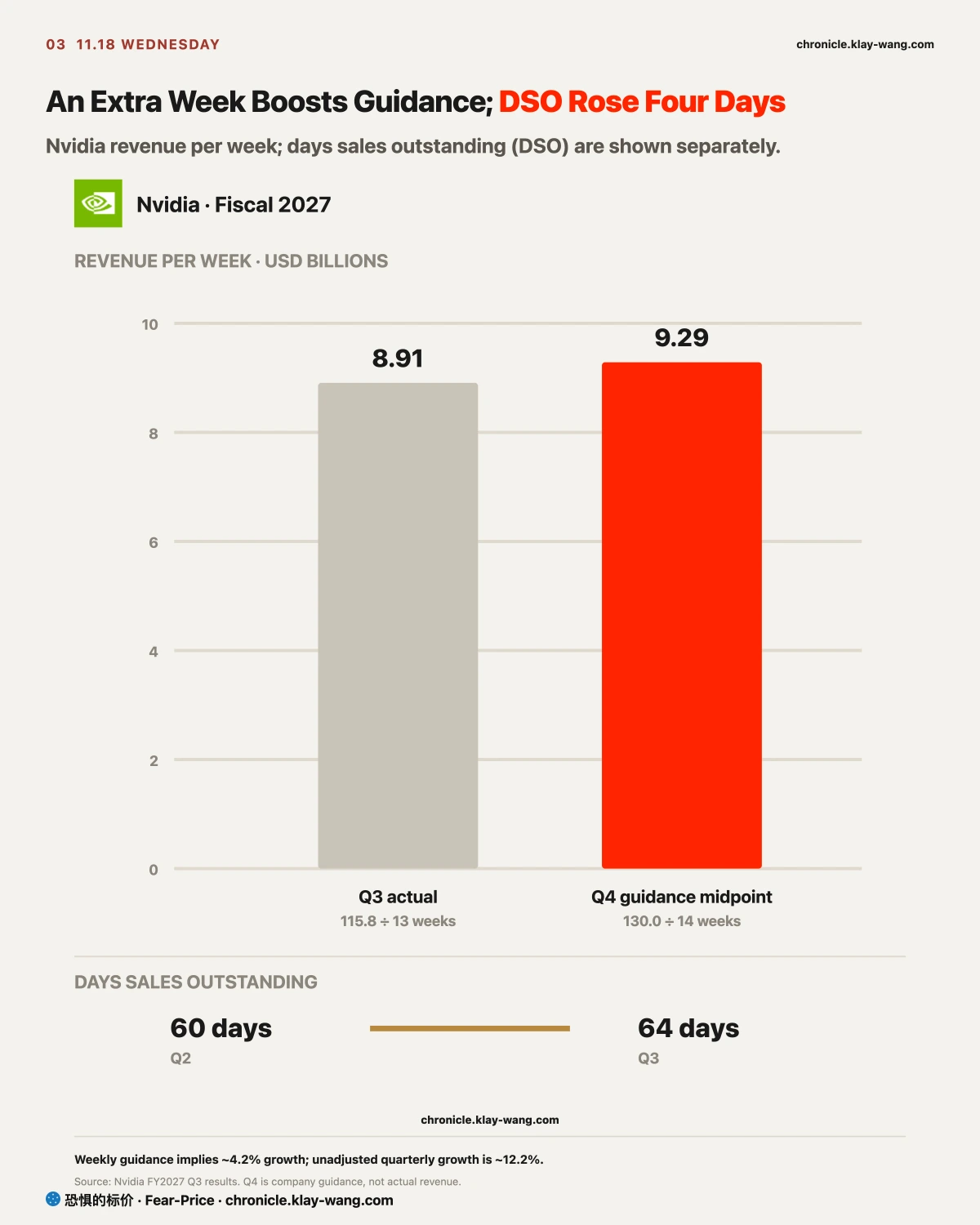
Nvidia reported quarterly revenue of $115.8 billion and guided next quarter to a $130 billion midpoint. That looks like 12% sequential growth, but next quarter has 14 weeks against 13, so revenue per week rises only 4.2%. Days sales outstanding rose from 60 to 64. The company cited the timing of Rubin shipments and longer payment terms on multiyear agreements with certain highly rated customers.
Longer terms for creditworthy customers carry little bad-debt risk; the cost is that cash arrives later. The conditional piece is a maximum guarantee exposure of $118 billion, mostly tied to a data-center project that takes effect in phases years from now, with nothing paid so far. Management said it will evaluate investments, commitments and guarantees more rigorously. Several issues sit outside the report: licensed Hopper sales to China brought in $2.4 billion last quarter, shipments have stopped and guidance excludes them; the quarterly 10-Q was not filed on results day; and Bill Ackman publicly criticized how the board handled the succession.
None of this changes demand. It changes how much balance sheet Nvidia must commit to win that demand. For Nvidia shareholders, profit turns into cash later, and so does the firepower for buybacks and dividends. The seller is now funding buyers just as one buyer raised $79.4 billion of new money. Receivable days next quarter will show where bargaining power is going: back below 60 means the extra credit was temporary; further lengthening means large customers are keeping their own cash and drawing on Nvidia credit instead.
Rates and Credit: Hawkish Minutes, Firmer Long Bonds, and Pressure on Assets Without Cash Flow
The October minutes, released Wednesday afternoon, said almost all participants judged further rate increases likely appropriate, and a couple said a hike larger than 25 basis points could be considered if inflation data were unfavorable. Fed Governor Christopher Waller said the same day that the Fed should either raise rates by 50 basis points in December or make clear that January will bring another increase. The bond market was not rattled: the two-year yield held at 4.80%, the 10-year fell from 5.10% to 5.07%, and the long Treasury ETF rose 0.84%.
The reason is that a 25 basis point December hike was already priced at about 95% before the minutes, so the short end had it covered. The long end traded inflation inputs: oil fell about 3%, and the gap between the 10-year nominal and real yields narrowed from 2.21% to 2.19%. The real yield barely moved, from 2.89% to 2.88%.
So the 3.2% drop in the gold fund and the 4.6% drop in silver, alongside declines in the bitcoin ETF and Strategy, cannot be explained by real rates. None of these assets produce cash flow; they depend on cheap money and risk appetite. On Tuesday we wrote that financials and crypto were falling. On Wednesday the financial ETF fell another 1.14% and Coinbase dropped too, two days running. The clearer the hiking path, the clearer the opportunity cost of holding them. For holders of gold and bitcoin, these two days had little to do with AI earnings; the size of the December 8 to 9 Fed hike is what matters.
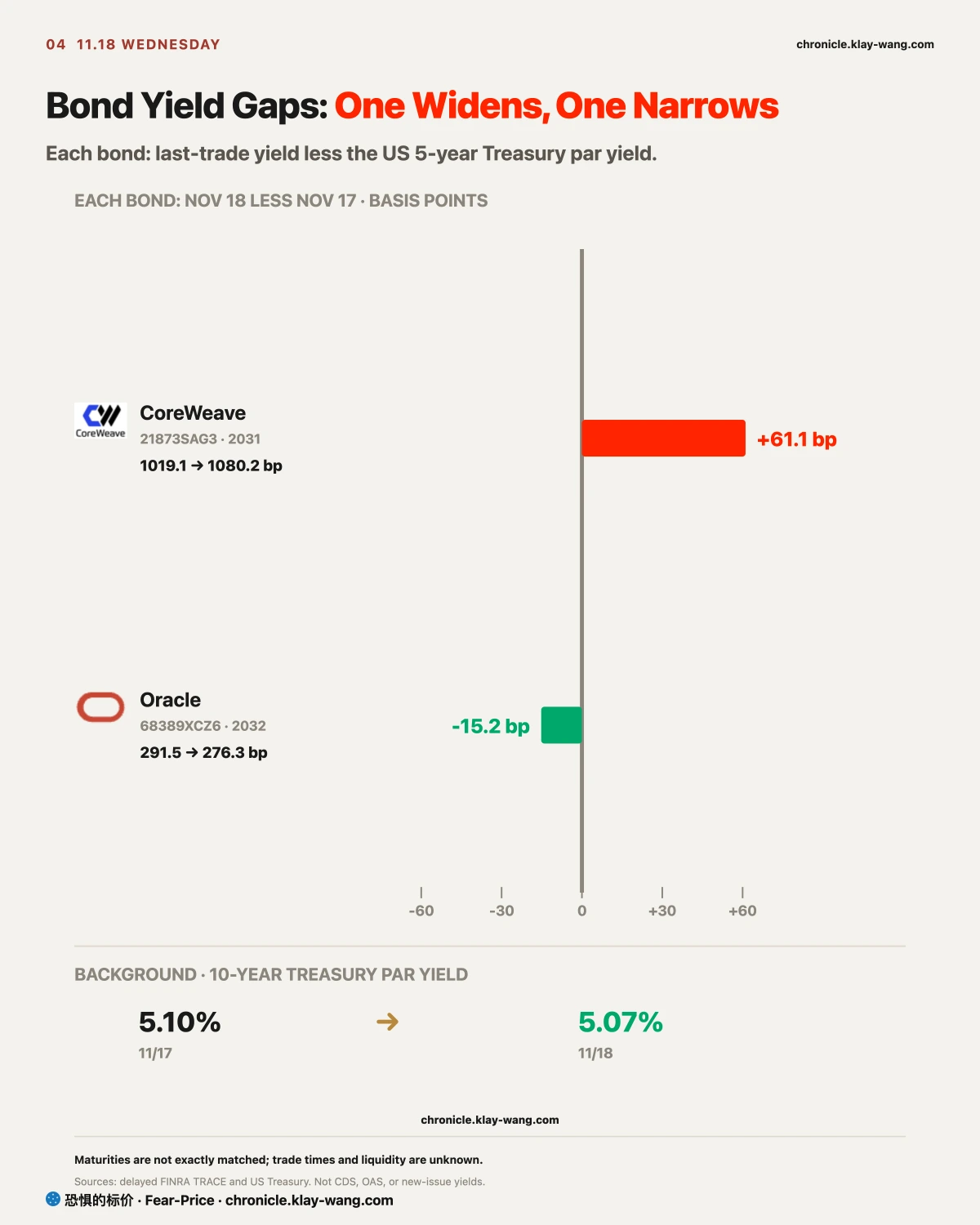
On credit, the minutes noted wider spreads for some high-risk and AI-related borrowers. The same day, the yield on a CoreWeave bond maturing in 2031 rose from 15.09% to 15.69%, and its gap over the five-year Treasury widened from 1019 to 1080 basis points, while the stock fell 4.13%. The comparable gap on an Oracle 2032 bond narrowed by 15 basis points. Lenders are pricing borrowers one by one: companies that borrow to build data centers and are still waiting on customer prepayments pay more. For CoreWeave shareholders, when lenders raise the price first, shareholders later face costlier financing or more new shares. On November 3 we made the call that the spread on this bond would stay above 900 basis points on every reading day through November 20. The Wednesday reading was 1080, with two reading days left.
Options: Near-Term Fever Broke, One-Year Pricing Held, and February Bulls Added
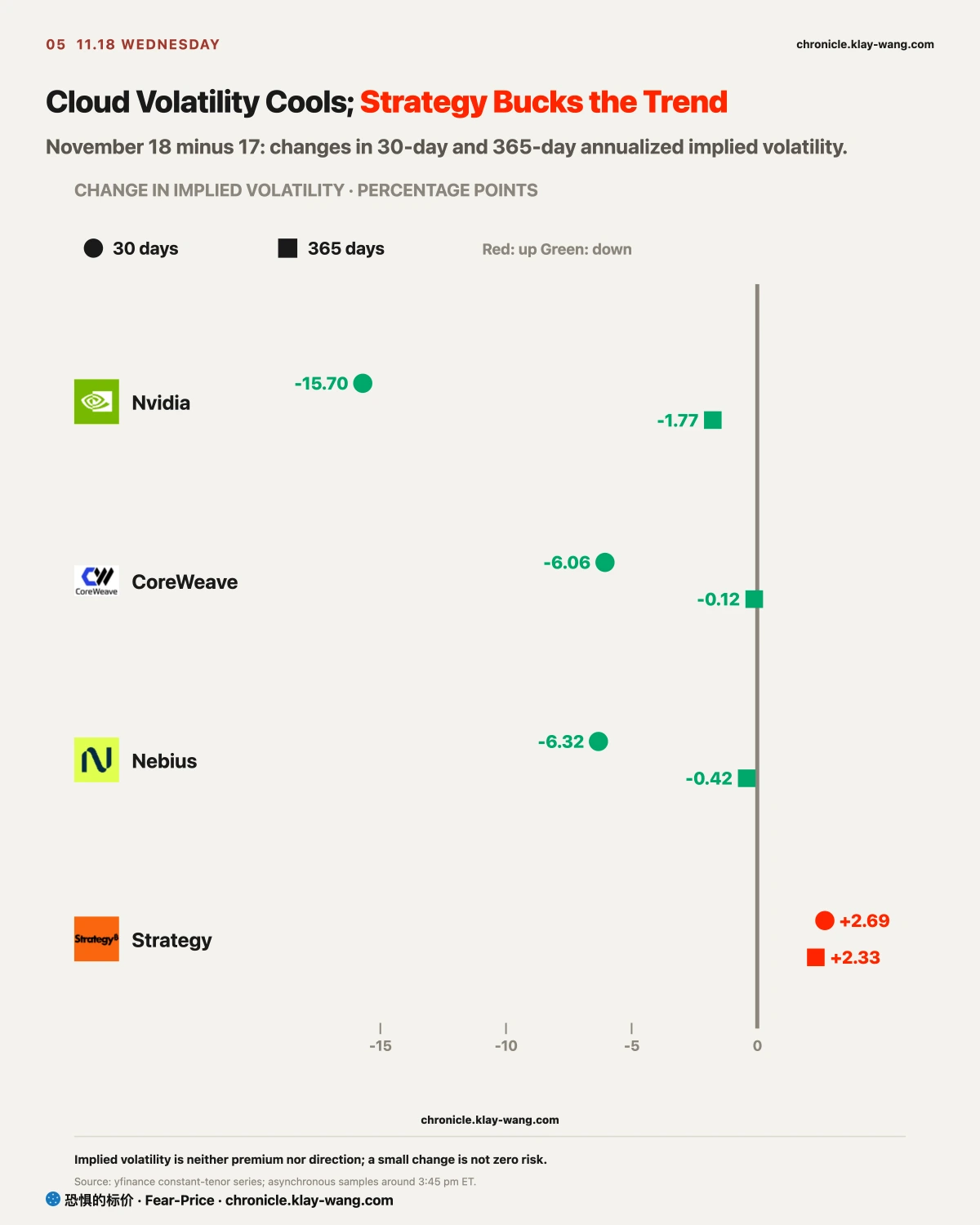
Once earnings passed, the price of near-term protection on Nvidia collapsed. Its 30-day implied volatility fell 15.7 points in one day to 50.94%, while the one-year reading fell less than 2 points, and at-the-money December 2027 options (LEAPS) also fell only about 2 points. CoreWeave and Nebius each saw near-term volatility fall about 6 points with one-year readings almost unchanged. The earnings premium is gone, but long-term risk pricing did not move: LEAPS buyers did not cut one-year-plus volatility for the AI leader because of one report. Strategy was the exception, with both 30-day and one-year volatility rising; crypto is following rate hikes, not AI earnings. For holders of long-dated Nvidia options, one-year protection barely got cheaper, so buying further out is not a bargain.
On Tuesday we said the earnings premium would fade while the governance premium would stay, judged by whether the Nvidia 30-day minus one-year gap on November 24 is at least 3 points above the semiconductor ETF gap. On Wednesday the Nvidia gap was 5.30 points and the ETF gap 7.92. The first half came true; the second half is currently falling short. Options are not yet charging Nvidia separately for governance.
Open interest in the Nvidia February $185 call doubled in a week, so the bulls betting on a rebound have stayed. Open interest is the number of contracts still held after each close. For the call expiring February 19, 2027, it rose from 53700 on November 11 to 110800.
On Wednesday that contract traded another 58300 contracts, and the $175 call with the same expiry traded a similar amount against open interest under 10000. The matching volumes look like a spread, buying the 175 and selling the 185, a bet that Nvidia is back above $175 in three months but not above $185. Volume does not show direction; open interest on Thursday morning will confirm. Our November 11 call tracks this $185 contract and is withdrawn only if open interest stays below 40000 for three straight trading days. It is far from that.
What This Means for What You Hold
For Nvidia, the question has shifted from how much it can sell to how much it must fund. Buyers stepped in at $148.80 on November 12; the Wednesday low was $150.40. My view: through the November 25 close, measured from the November 17 close, the average gain of AMD and Broadcom keeps beating Nvidia as the market keeps discounting the seller that carries the bill. If Nvidia first closes back above its post-earnings open of $159.19, the market is treating it again as the only way into AI, and this view does not hold.
For AMD, Broadcom and Amazon, none reported on Wednesday, so how much of the gain sticks depends on next-quarter orders and margins. The first day of Anthropic trading on Thursday is the first reading of how strong this demand is.
For CoreWeave and Nebius, bonds are speaking before stocks. The CoreWeave bond spread is at 1080 basis points and the Fed minutes flagged AI borrowers. Whether customer prepayments arrive on schedule matters more than headline order size.
For index-fund holders, near-term protection has become cheaper while one-year protection is still expensive. Our November 12 rate call is settled on Thursday: the 10-year was 5.07% on Wednesday, still above 5%.
For gold, silver and bitcoin, the Wednesday decline is hard to explain with real rates. It looks more like positions that relied on cheap money unwinding as the hiking path became clearer. Until the December Fed meeting, these assets will likely keep trading on rate-hike expectations.
Three Lines Worth Keeping
- The Nvidia report answered the demand question; the market moved on to who carries the bill, and marked down the seller that does.
- The upsized Anthropic $81.3 billion IPO shows AI money did not leave; it moved toward buyers with fresh cash.
- Hawkish minutes could not push long yields up; the pressure landed on gold, silver and crypto, assets without cash flow.
No investment advice. No direction calls. No market timing.