Nvidia Lost an Amazon, but the AI Bubble Has Not Burst Yet
Three-Line Brief
- Nvidia lost an Amazon-sized chunk of value in six weeks. The first to feel it were customers it had invested in: the CoreWeave bond spread widened 156 basis points in a day.
- Chip sellers and capacity borrowers fell more than 10%, while the big buyers of computing fell less than 6%. The bubble has not reached the people paying.
- Sentiment hit extreme fear, but money did not flee across the board: Treasuries rose, the dollar was flat, and high yield fell only 0.26%.
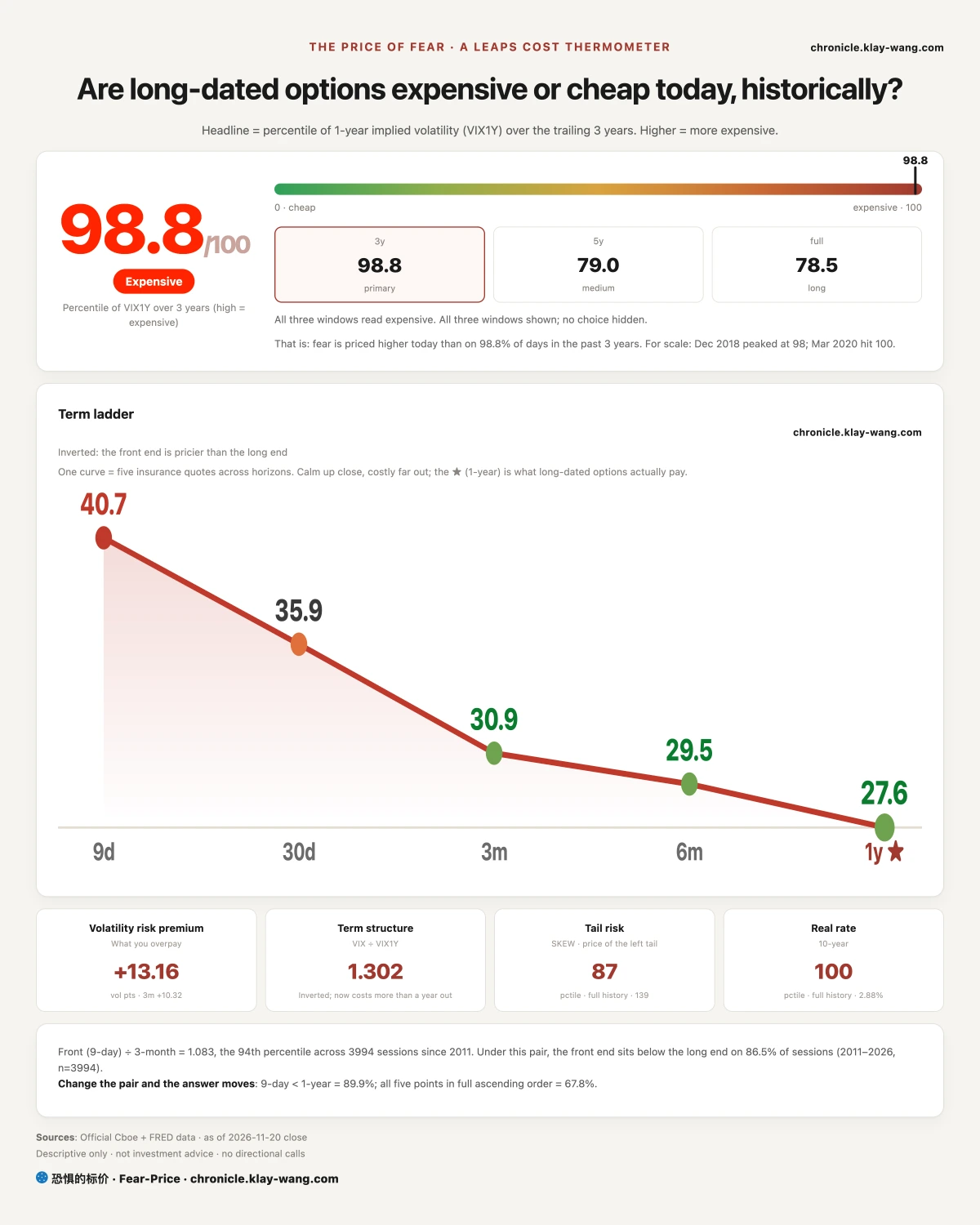
The Fear-Price Index Rises to 98.8: Not Just the Near Term, One-Year Cover Is Near a Three-Year Top
Fear-Price Index · 2026-11-20 · 98.8/100. S&P 500 one-year implied volatility rose to 27.57%, the 98.8th percentile of the past 756 trading days, up from 96.4 on Thursday. Daily history at chronicle.klay-wang.com/fear-price.
〖Figure 1: Card 1 Fear-Price〗
Wall Street got its Black Friday a week early. The VIX touched 40.03 intraday and closed at 35.89, up 7.45 points from Thursday. Mandy Xu of Cboe estimates that more than 80% of the jump came from the index falling, not from a scramble for protection. That holds only for the near term. SPY one-year implied volatility rose from 19.56% to 23.46% this week, so the risk for next year was repriced too. For index fund holders, one-year protection now costs about as much as it has at any point in three years.
The K index is 0.270 (provisional sentiment reading), below the final 0.558 on Thursday. The closer it is to 1, the more people are actually paying for protection. K fell below 1 on Thursday.
Today the CNN Fear & Greed reading is only 9.7 while the VIX is 35.89. At 0.270, paid-for protection is running far ahead of stated fear. At the current sentiment reading, K would return to 1 only if the VIX fell to 9.7, which is not in view this week. History at chronicle.klay-wang.com/kindex, the index at chronicle.klay-wang.com/fear-price.
Nvidia Lost an Amazon, but the Big Payers Are Fine for Now
What Nvidia lost is a funding source for the whole AI industry chain. In the six weeks since its October 6 peak, its market value fell from $5.76 trillion to $3.03 trillion. The gap is roughly one Amazon.
Nvidia works a bit like a central bank for AI. It sells chips to cloud companies and also invests in the companies that buy its chips. CoreWeave is one of them. The higher its stock, the more smoothly this borrow-to-buy-chips loop runs. With the stock cut in half, the link that leans most on borrowing gives way first.
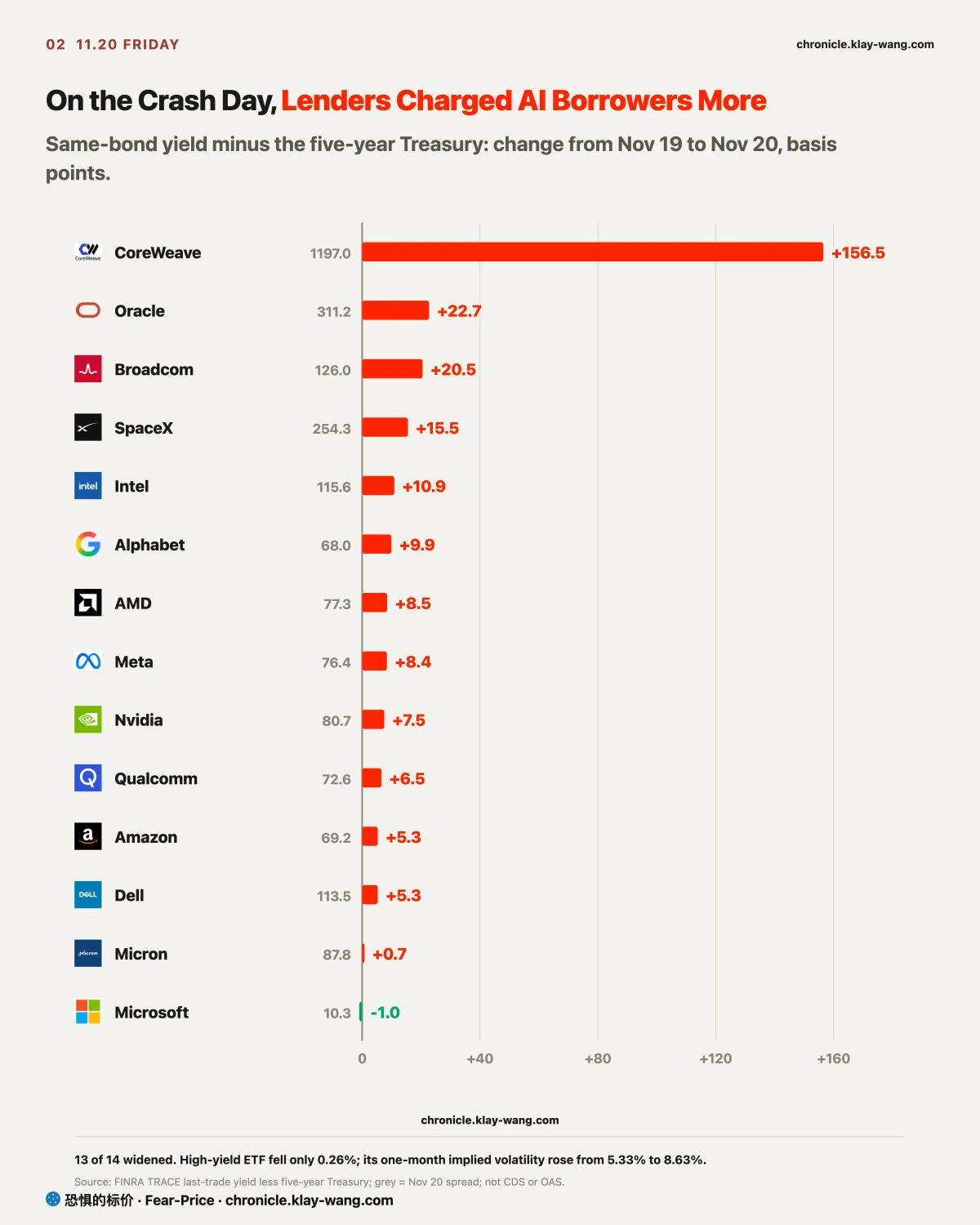
〖Figure 2: Card 2 Same-Bond Spreads in One Day〗
Lenders raised the price all week and hardest on Friday. The CoreWeave 2031 bond spread widened from 981.4 to 1197.0 basis points over the week, 156 of that on Friday alone from 1040.5, and Oracle and Broadcom each widened by more than 20 on Friday. The Microsoft spread actually tightened by 1 basis point from Thursday. Within AI, lenders charged much more only to the capacity builders that borrow. For the companies doing the borrowing, every extra dollar now costs more, and most for those that live on borrowing.
On Friday afternoon Reuters reported that the SEC probe of Nvidia is examining accounting issues. What exactly is under review was not disclosed. A probe does not mean wrongdoing, but it lands where investors most want clarity: how much Nvidia revenue comes from customers it helped fund.
For the AI bubble to truly burst, payers like Microsoft and Alphabet would have to start cutting their compute budgets. Friday stock and bond prices were not pricing that yet.
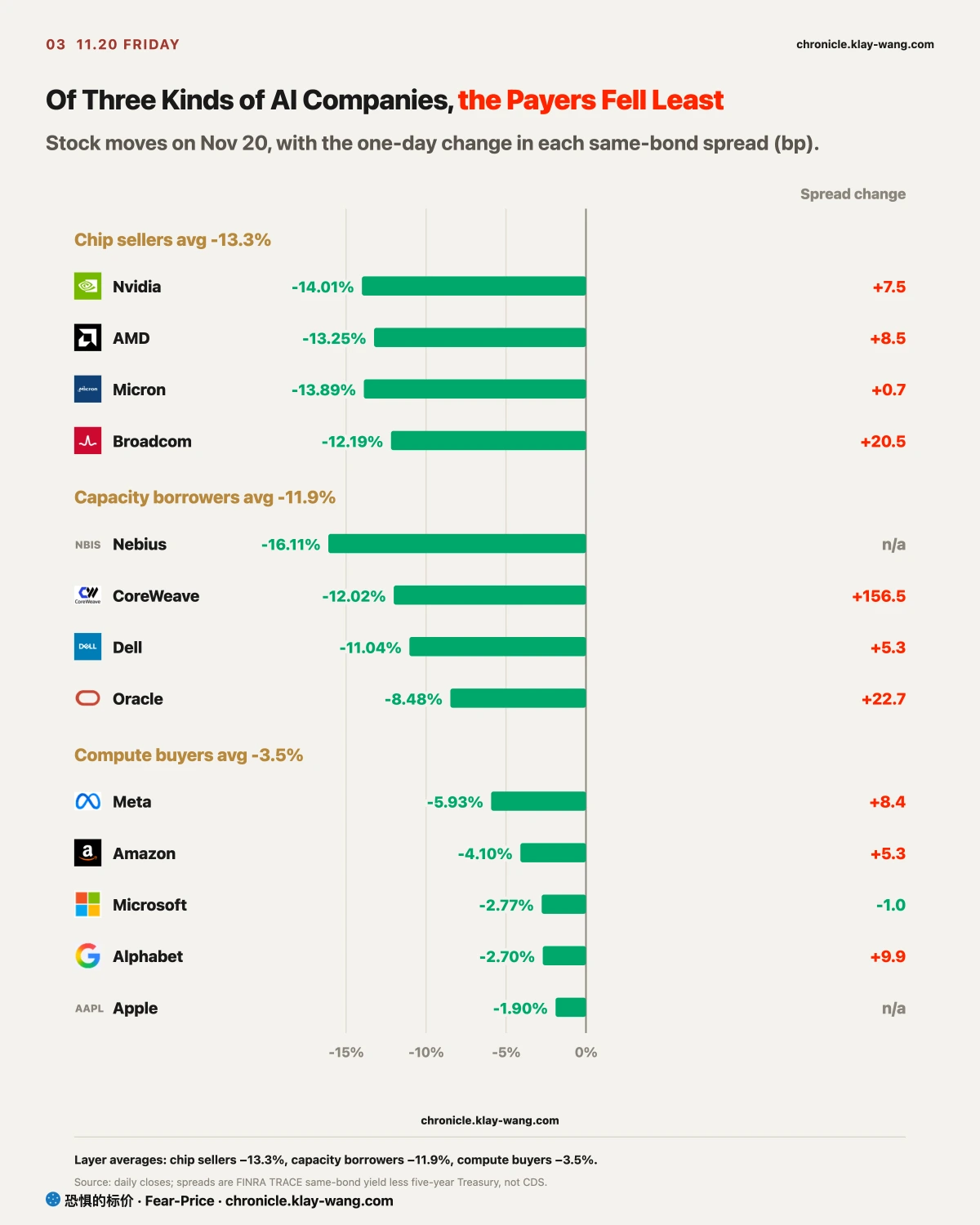
〖Figure 3: Card 3 Three Layers〗
We split the companies in the AI industry chain into three kinds. Chip sellers Nvidia, AMD, Broadcom and Micron fell 13% on average on Friday. Capacity borrowers CoreWeave, Nebius, Oracle and Dell also fell more than 10% on average. Compute buyers Microsoft, Alphabet, Amazon, Meta and Apple fell only 3.5% on average, and their bond spreads, where we have readings, widened by 10 basis points at most, more than 140 less than CoreWeave. The market is doubting seller margins and borrower repayment, not whether the buyers can still pay.
The best-known bear is positioned the same way. In a midday report, Michael Burry halved his semiconductor ETF and Nvidia puts but kept his Nasdaq 100 puts. He took half off the chip leg and is still betting on the index leg. On the same day, February 2027 TSMC 380 calls and Micron 780 calls each traded close to 10000 contracts or more. Someone was betting on the next earnings round on the day of the crash. Whether those were buys or sells will show in settlement open interest on Monday, the contracts still held after the close. For holders of the cloud giants, they were the steadiest this round.
My call: through December 4, none of the Microsoft, Amazon and Alphabet same-bond spreads will widen by more than 20 basis points from November 20. The reason: these three pay for compute mostly with cash from selling cloud services and ads, not with debt, so lenders would first have to doubt that cash flow. Friday was the most fearful day of this round, and the giants with readings widened by 10 basis points at most. 20 is twice that. If any one does, the big payers are starting to be doubted too, the bubble is moving toward the source, and this call is wrong.
Sentiment Is in Full Panic, but Money Has Not Fled
There are two kinds of panic: talk and money running for the exits. On Friday only the first was across the board.
The CNN Fear & Greed reading of 9.7, below 15.9 on Thursday, counts as extreme fear. Yet the money did not move like a systemic crisis, and three places show it.
Treasuries were bought. The 10-year yield fell from 5.04% to 4.92% in a day. Money from stock sales did not sit in cash. It went into Treasuries, a bet on a slower economy and lower rates. In a true systemic crisis even Treasuries get sold: in the second week of March 2020 the long Treasury ETF fell 7.71% in a week, because everyone wanted only cash.
The dollar fund barely moved. Many companies and banks around the world borrow in dollars. When the lending system seizes up, they scramble for dollars to repay debt and meet margin calls, and the dollar jumps. A flat dollar says nobody was forced to scramble.
The high-yield bond ETF fell only 0.26%, more than 3 points less than SPY. High yield lends to the weakest companies. Lenders did not run, so weak companies can still borrow, and the chain of forced defaults, layoffs and weaker spending does not start. The equal-weight S&P fell 1.67 points less than the cap-weighted index, so the selling was concentrated in the largest names.
The moves worth noting were in gold and bitcoin. The real yield fell 11 basis points, which should have helped them: neither pays interest, so the cost of holding them is the inflation-adjusted interest given up, and that cost shrinks when real yields fall. Instead the gold and bitcoin funds both fell more than SPY. They were used as cash machines: people who lost money on chips had to sell what was still in profit and easy to sell. That is what deleveraging looks like. It is not what a seized-up lending system looks like. For gold and bitcoin, next week depends on whether chip stocks stop falling, not on rates.
The headlines say Black Friday, yet those who bet on how long fear will last priced it far lower. The VIX closed at 35.89, while the December VIX future was only 28.46, 7.43 points below spot. That is the widest gap since our records began in July, up from 3.90 on Thursday. The July 2027 contract was only 23.63. A VIX future is a bet on where the VIX will be on its expiry day, so the money on the table expects much of this fear to fade within a month. For anyone with spare cash waiting for the fear to pass, watch this line: if the futures catch up with spot, traders are starting to bet the fear will last longer.
A Headline Broke 700, Yet Most of the Amplifier for Next Week Is Gone
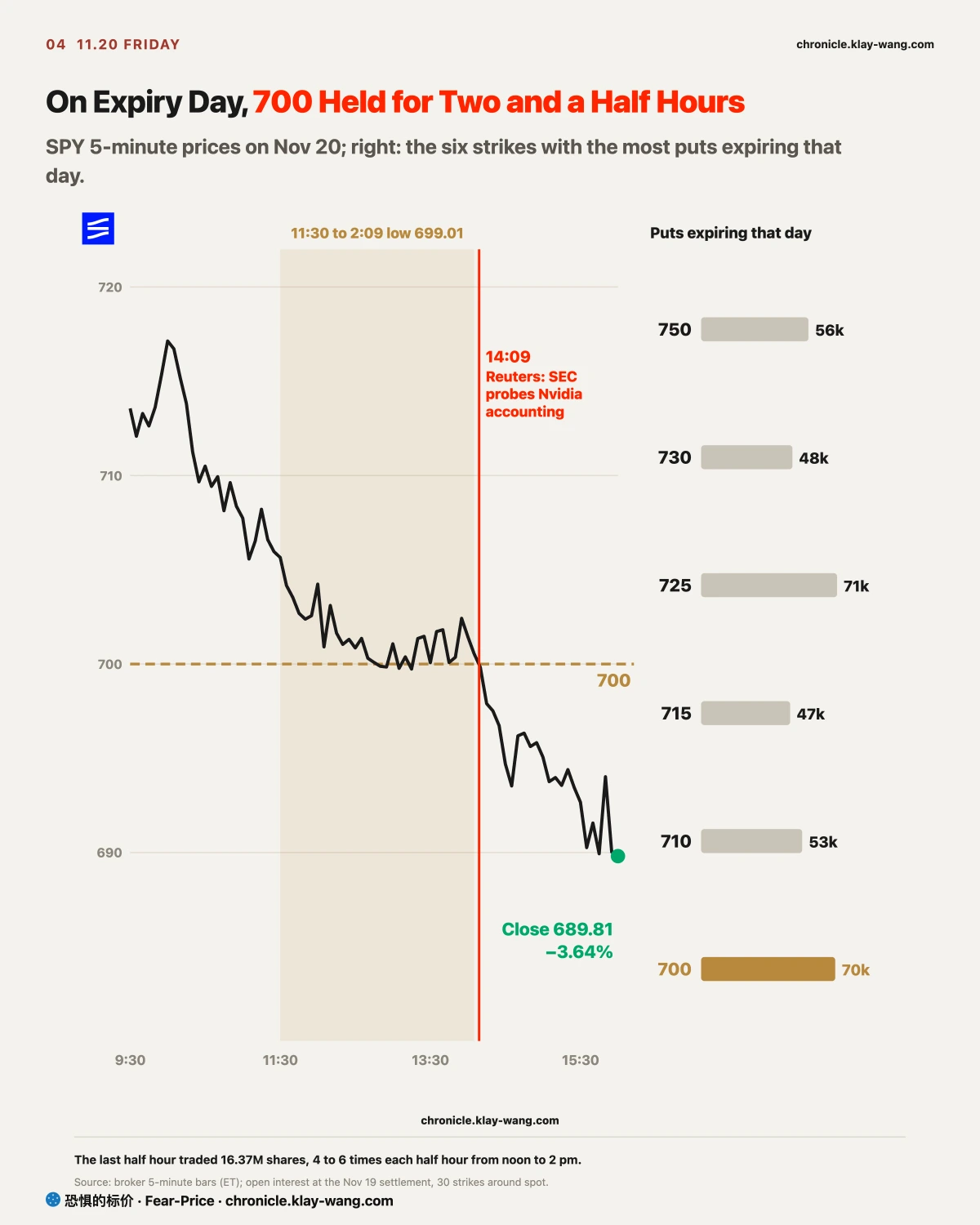
The expiry-day put wall was finally broken by a headline. Friday was November monthly options expiry. Based on settlement open interest held overnight after the Thursday close, the 700 strike alone held 70000 SPY puts expiring that day. At 700, those contracts cover about $4.9 billion of SPY. At the 689.81 close, that strike was worth about $72 million in the money at expiry. At the Thursday close it was worth nothing.
〖Figure 4: Card 4 The 700 Line on Expiry Day〗
From 11:30 a.m. to 2 p.m., the SPY low was 699.01, and it never truly broke 700. As soon as the Reuters story came out, 700 gave way. On the standard gamma estimate, these expiring options left dealers selling more as prices fell. Volume in the last half hour was four to six times each half hour between noon and 2 p.m., and SPY closed at 689.81.
On Monday most of that amplifier is gone. Negative gamma is the part of positioning that makes dealers sell more as prices fall. Each day we measure the four nearest expiries. After the Thursday close those were November 20, 23 and 24 and December 18, and the Friday batch accounted for about 80% of the SPY negative gamma across the four. But Goldman Sachs estimates that even if stocks go sideways next week, trend-following funds will sell about $65.8 billion of stocks, more than the $57 billion they sold over the past month. Next week is also Thanksgiving week, with Thursday closed and Friday a half day, so trading will be thin. For index funds, mechanical selling is lighter while trend selling continues, and thin trading can amplify both.
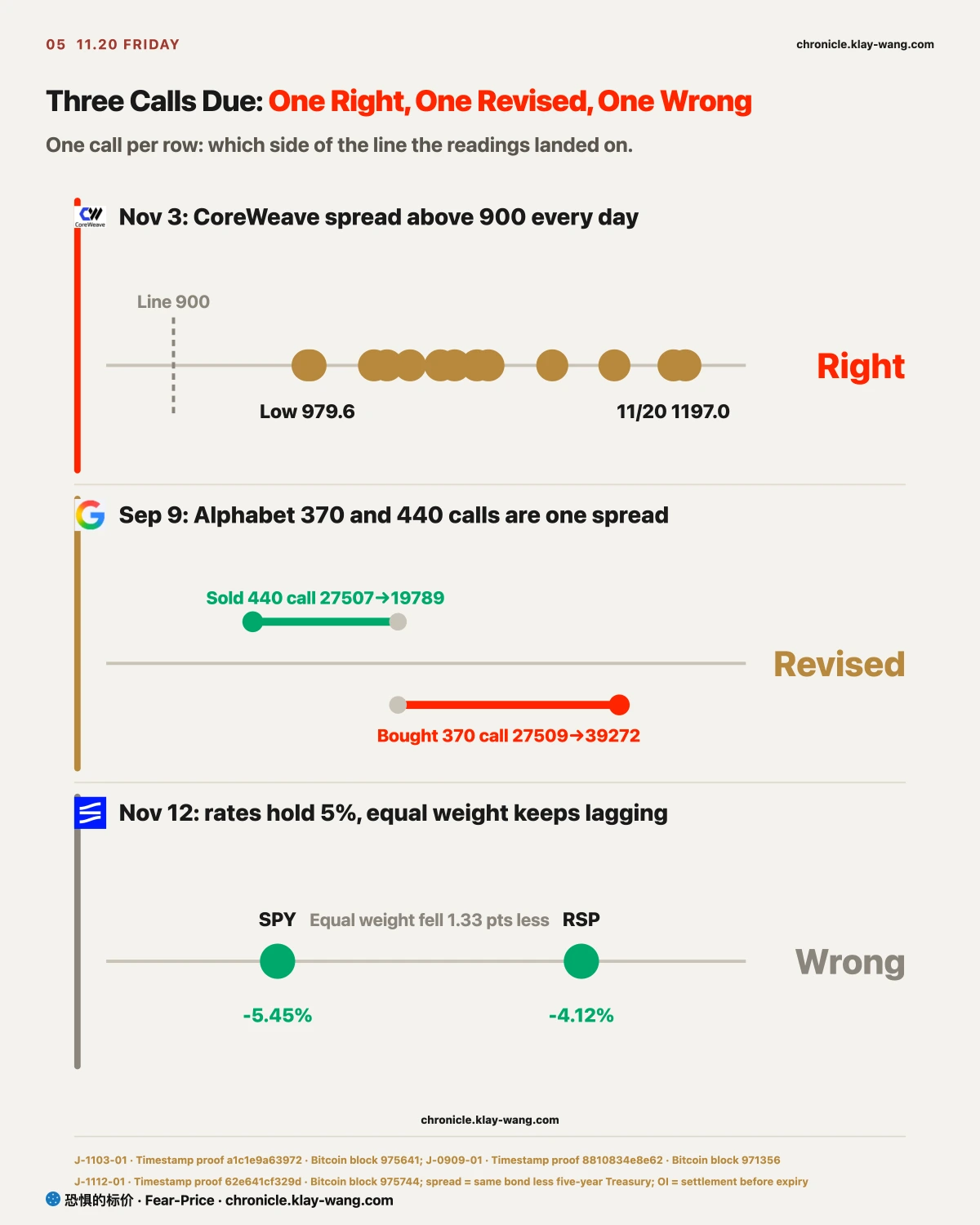
Scorecard: The CoreWeave Call Was Right, the Alphabet Reading Must Change
〖Figure 5: Card 5 Scorecard〗
- The CoreWeave 2031 bond spread stayed above 900 basis points on every reading day from November 3. Today the reading is 1197.0, and the low of the period was 979.6. Correct.
- The Alphabet 370 and 440 calls expiring today form one spread. Before expiry, the sold 440 leg lost about 7700 contracts while the bought 370 leg gained about 12000.
- Under the filing terms, that means the sold leg was bought back on one side, so the reading changes to a cap partly removed. Alphabet closed far below 370, and both legs expire worthless.
- On Thursday we asked whether AMD would hold 500. It closed at 424.39, 15% below 500, so it did not. We did not get settlement open interest for the small-cap ETF 265 put or the AMD 640 call and will report them next week.
What It Means for Your Holdings
For AI chip stocks, the market is repricing seller margins and the loop in which Nvidia funds its own customers. Nobody knows when the accounting probe will conclude, and that uncertainty will stay in the Nvidia price. On November 18, when we filed the call, we said AMD and Broadcom would outperform Nvidia through November 25. So far the two are down 13.29% on average, against 19.25% for Nvidia.
For the cloud and platform giants, they are the steadiest group in this round. Their stocks fell less and their bonds barely moved. Watching their spreads is how to watch whether the bubble moves toward the source of demand.
For the companies borrowing to build capacity, CoreWeave and Oracle spreads widened by tens to more than 100 basis points in a day. Shareholders and lenders raised the price on the same day. This is the most fragile group.
For Treasuries, they and the dollar were among the few assets that rose this week. The 10-year yield is 23 basis points below last Friday.
Three Lines Worth Keeping
- Nvidia lost more than stock value. It lost a funding source for the AI industry chain, and the customers it funded felt it first.
- Chip sellers and capacity borrowers fell more than 10%, while the big buyers fell less than 6% and their bonds held. The bubble has not reached the payers, so watch the spreads of the giants.
- Sentiment is in extreme fear, yet money is buying Treasuries and not scrambling for dollars. This is deleveraging, and expiry-day mechanical selling will be much lighter on Monday.
内部对账
模版:D4(〔主线〕);D6(这对你手里的票意味着什么)
- 11/20 Klay 改稿意见:不拆涨跌,回答是否全面恐慌、AI 泡沫破没破、蒸发一个亚马逊意味着什么、后市指引。原英伟达三段拆解卡弃用(生成器里改名 card3_nvda 保留)。
- 收盘:data/每日跳空.csv(券商 CLI 日线);SPY 5 分钟线 _work/spy_5m_1120.json。黄金、比特币、美元、必需消费、等权、HYG 为券商行情 11/20 收盘。三层平均:卖芯片 NVDA/AMD/AVGO/MU −13.34;借钱建算力 CRWV/NBIS/ORCL/DELL −11.91;付钱 MSFT/GOOGL/AMZN/META/AAPL −3.48。
- 市值 5.76 万亿到 3.03 万亿:Klay 转来的报道原文,正文写据报道。AMZN 市值约 2.6 万亿量级(246.82 美元),写差不多一个亚马逊。PitchBook 129 笔:Codex 新闻素材第 7 行(财联社、华尔街日报 11/19)。英伟达入股 CoreWeave 为公开持股事实。
- 利率:财政部名义与实际平价收益率日表。10 年 11/19 5.04、11/20 4.92;实际 10 年 2.88 到 2.77。卡1 实际利率格 2.88% 为 FRED 晚一天。
- 到期持仓:每日GEX分布.csv date=11/20 行(11/19 结算),700P 70452;负伽马 11/20 −9004、11/23 −356、11/24 −176、12/18 −1874,只用比例。
- 新闻:路透独家 11/20 19:09Z(资讯 306317742);伯里减仓快讯 16:56Z(306307632);高盛 CTA 与 Mandy Xu 见智通财经(306337274)。长天期大单:每日UOA长天期异常.csv 11/20 EOD,TSM 2027/02/19 380C 11910 张、MU 780C 9228 张。
- K 指数:站仓 data/kindex.json,11/20 暂定 0.27(CNN 9.7,VIX 35.89),11/19 定稿 0.558。
- 判断台账:J-1103-01 成立(11/20 读数 1197.0,成交日 11/20)。J-0909-01 按条款第二支(440C 27507 到 19789,370C 27509 到 39272)。11/20 晚 Klay 同意后写进台账(提交 8142b43da):J-1103-01 成立;J-0909-01 读法改;J-1112-01 错(补写)。存证号只上卡,不进正文。新判断立案 J-1120-01:到 12/04,MSFT、AMZN、GOOGL 同券利差均不比 11/20(10.3、69.2、68.0)走阔超过 20 个基点。
No investment advice. No direction calls. No market timing.