Huang Is Back. The AI Risk Is Still Here.
Three-Line Brief
- 346 of the S&P 500 members rose, yet the index fell. The selling sat in chips, memory and servers; rates and the dollar were calm.
- The extra near-term insurance premium that belonged to Nvidia alone is gone, and the premium on the whole chip sector rose again.
- The CoreWeave bond spread hit a record high in our data; Dell after-hours cash flow offered a counterexample for the server chain.
The Fear-Price Index at 95.6: One-Month Insurance Got a Little Cheaper, One-Year a Little Dearer
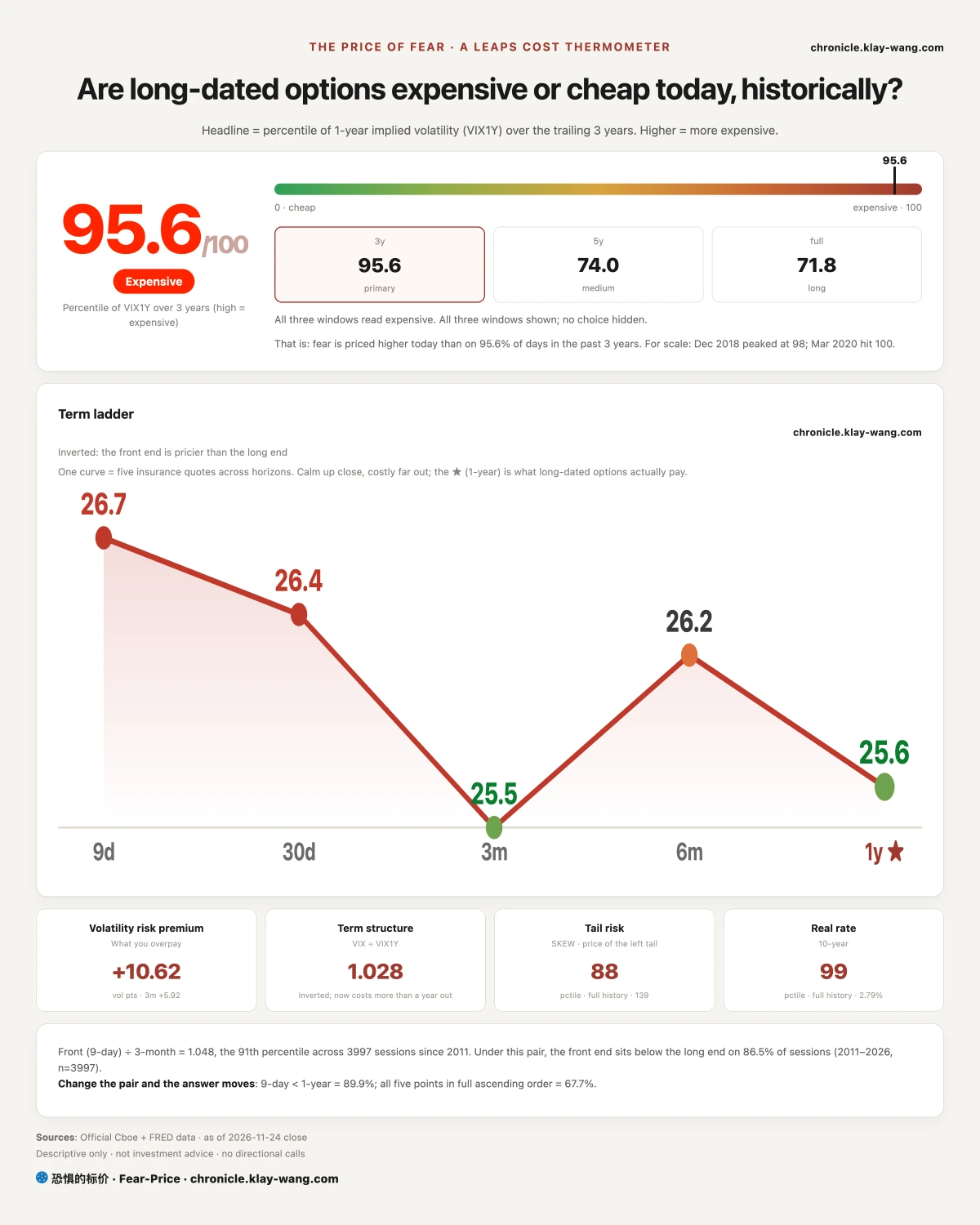
Fear-Price Index · 2026-11-24 · 95.6/100: one-year S&P 500 implied volatility was 25.64%, at the 95.6th percentile of the past three years, up from 94.7 on Monday; higher means historically more expensive. Daily ledger and methodology at chronicle.klay-wang.com/fear-price. Attribution: Fear-Price Index · Fear-Price.
The VIX, which measures the next 30 days, eased from 26.62 to 26.36, while the one-year reading rose from 25.47% to 25.64%. Next-month insurance got slightly cheaper and next-year insurance slightly dearer: the near-term risk to the index is receding, but the price the market charges for a year out has not come down. For you, one-year insurance on the index is still priced in the most expensive 5% of the past three years.
The K index was 0.661 (the sentiment reading is provisional), above the equally provisional 0.637 on Monday. The closer K is to 1, the closer the sentiment reading and the insurance price; K is still below 1. History at chronicle.klay-wang.com/kindex, daily unusual options activity at chronicle.klay-wang.com/options.
Seven in Ten S&P Stocks Rose. Only AI Hardware Fell.
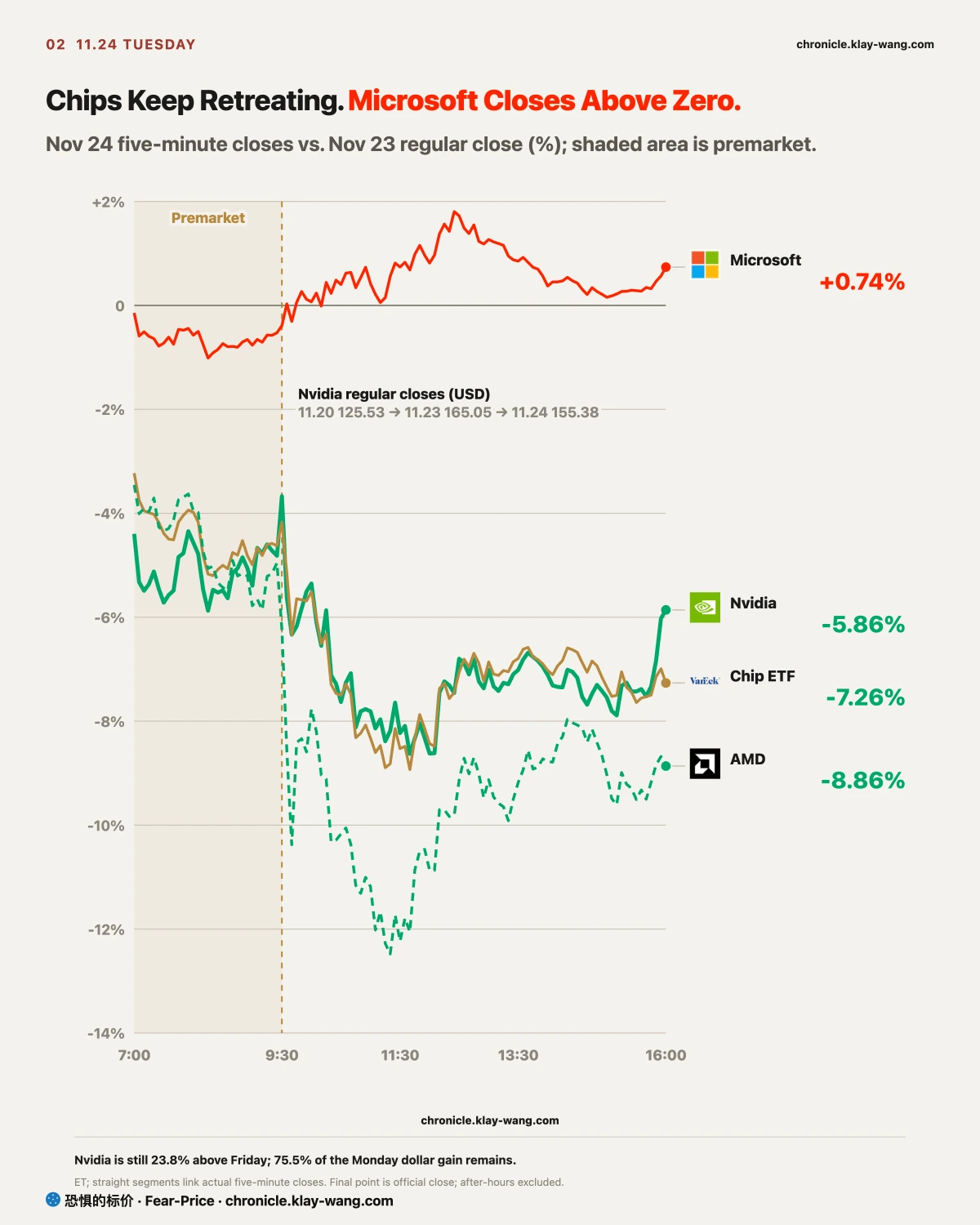
The S&P 500 ETF closed down 0.49% on Tuesday, yet 346 of 502 members rose, and the equal-weight S&P ETF and the small-cap ETF each gained about 0.5%. When the index falls while most stocks rise, the selling is usually concentrated in the heaviest weights. On Tuesday the concentration was plain: the semiconductor ETF fell 7.3%, Micron, Sandisk, Dell and CoreWeave each fell more than 11%, and Microsoft and Apple closed higher.
The joy over the return of Huang lasted one day. Measured from last Friday, Nvidia was still up 23.8% and kept three quarters of the market value it regained on Monday. The semiconductor ETF kept less than half, and AMD fell back below its Friday close. The reinstatement of Jensen Huang eased a management problem specific to Nvidia, so Nvidia held up best and its peers fell further. The selling on Tuesday was about more than Nvidia news.
Other markets offered a control. The two-year Treasury yield closed unchanged and the ten-year slipped one basis point. Minutes released in the afternoon showed that eight regional Fed boards had proposed raising the discount rate, and the two-year still did not move. The price of rate insurance, the MOVE index, fell from 100.9 to 98.8, the dollar slipped 0.5%, and the high-yield bond ETF was nearly flat. If rate hikes or a weaker economy were driving the selloff, rates, the dollar and credit would move together. On Tuesday they were all calm.
What fell with chips was the bitcoin ETF and gold, each down a little over 2%. On November 16 we wrote that bitcoin, silver and chips were falling together because money was cutting high-volatility assets at the same time, while bonds did not follow. Eight days later the same kind of assets fell together again, with the dollar and rates unchanged. The selling on Tuesday stayed in the stock market and reshuffled seats inside AI hardware: the further a company sits from end users and the more it relies on borrowing and inventory, the more it fell.
In AI, cloud providers and model companies are the end users. Upstream sit CoreWeave, which rents out computing power, server assemblers Dell and HPE, and further up memory and chips. Why did the upstream fall harder? Supply chain managers call it the bullwhip effect: when end demand slows a little, orders and inventory swing more at each step upstream, because every step orders against the one below it and adds a cushion.
When payment downstream slows, each step upstream carries more inventory and receivables, and companies that borrowed to build inventory still pay interest. On Tuesday Microsoft, on the paying end, closed higher, while the collecting and stocking end fell, in the same direction as the chain. For stocks outside AI hardware, the selling on Tuesday barely reached them.
Nvidia No Longer Carries Its Own Premium. The Chip Sector Costs More.
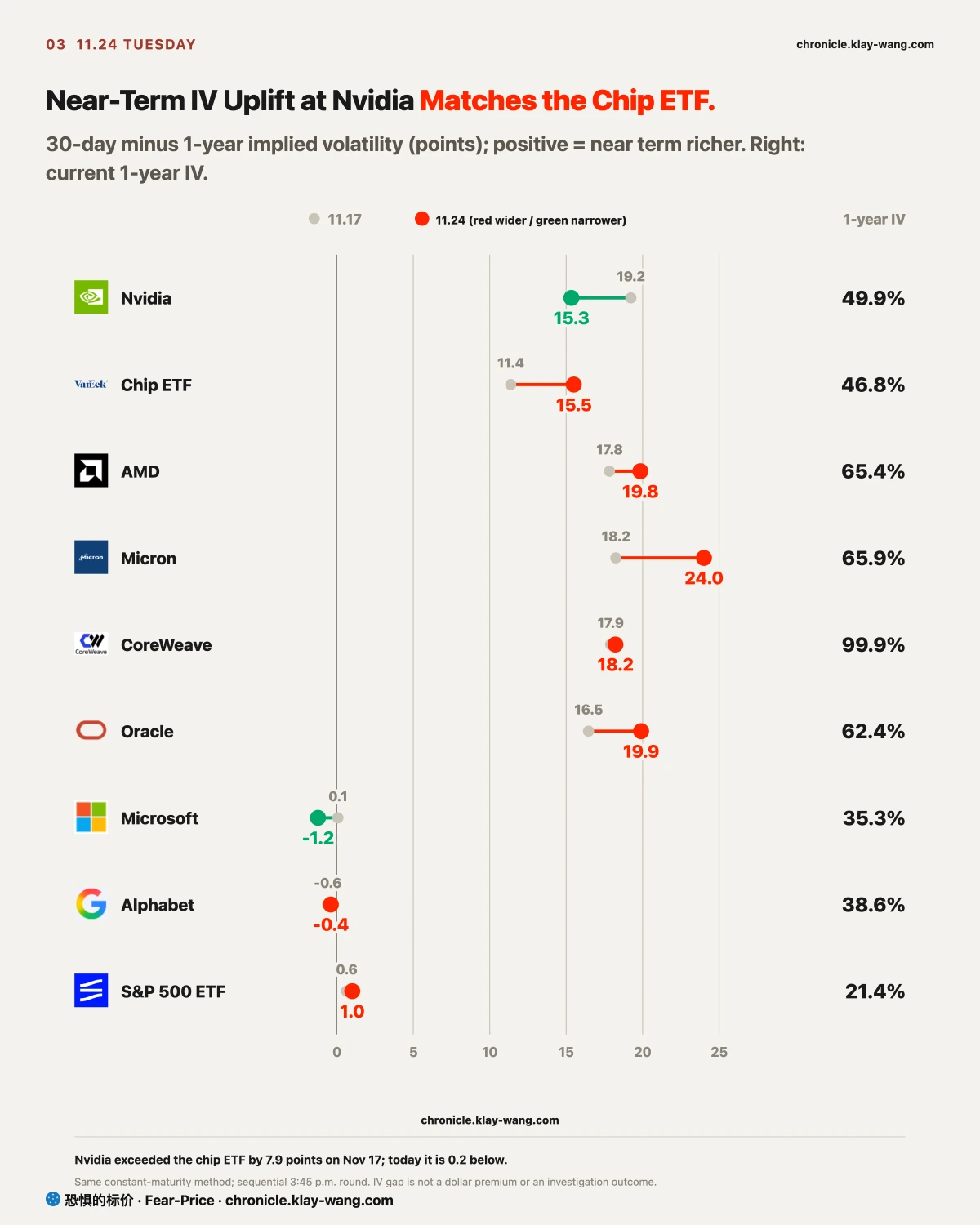
Every day before the close we record two premiums. The 30-day and one-year implied volatility of the same stock can be read as the annualized price of one-month and one-year insurance. Normally the far term is harder to predict and costs more. When the near term costs more, the market sees risk packed into the next few weeks.
On November 17, Nvidia near-term insurance cost 19.2 points more than one-year, and the semiconductor ETF 11.4 points more. The extra 8 points or so for Nvidia was a premium the market charged it alone. By Tuesday, Nvidia was at 15.3 points and the semiconductor ETF at 15.5. One-month insurance on Nvidia no longer costs more than on its peers.
On Tuesday alone, near-term premiums rose again across chips, memory and the cloud companies that rent out computing power: Micron up 9.2 points, CoreWeave 8.9, Nvidia 4.3. The same day, near-term premiums on bank, communications and health care ETFs fell 1 to 5 points, and the 30-day volatility index for the semiconductor ETF reached the 99.7th percentile of three years. The market pulled the next few weeks of risk out of the broad market and into AI hardware, and Nvidia is no longer the exception: it and its peers are priced as one question, how much customers can still pay for computing power and when. For Nvidia shareholders, one-month insurance is no dearer than for peers, so the stock will trade more with the whole sector.
Sandisk Says Demand Has No Downside. Memory Stocks Fell 11%.
Sandisk management told institutional investors on Monday that its AI data center flash demand forecast has no downside. This comes from a Citi note relayed by WallStreetCN; the forecast is about 1.2 zettabytes and excludes the high-bandwidth flash still in development. On Tuesday Sandisk fell 11.1% and Micron 11.0%. Sandisk is 73% below its June high, and Micron is down close to half.
Near-term insurance on memory costs 24 to 25 points more than one-year, the most expensive tier among the stocks we track. Micron one-year premium is also 13 points higher than on October 23. With both the near term and one year expensive, the market expects big swings beyond the next few weeks.
Bondholders were calm. The yield on the Micron bond due 2032 actually dipped on Tuesday, and its spread was only 7 basis points wider than last Friday. Bondholders do not doubt Micron can repay; shareholders are recalculating how long this round of price increases lasts. According to Yicai, a Goldman Sachs report the day before split memory into two stages: tight supply in 2027 and pressure from new capacity in 2028. Management spoke about total demand, while the share price reflects the length of the price cycle.
Why do memory stocks follow price, not demand? Put simply, ordinary memory and flash are close to standard products: Micron chips and Samsung chips are interchangeable, customers pick on price, and profit moves mostly with price. A new memory plant usually takes more than two years to build. When prices rise, every maker expands at once, new capacity tends to arrive at about the same time, and tight supply turns into a glut. Goldman puts the pressure in 2028 because that is when this round of new capacity comes online. For memory stocks, valuation depends on when memory prices peak, and no demand forecast, however confident, answers that.
Shareholders Kept the Rebound. Bondholders Gave All of It Back.
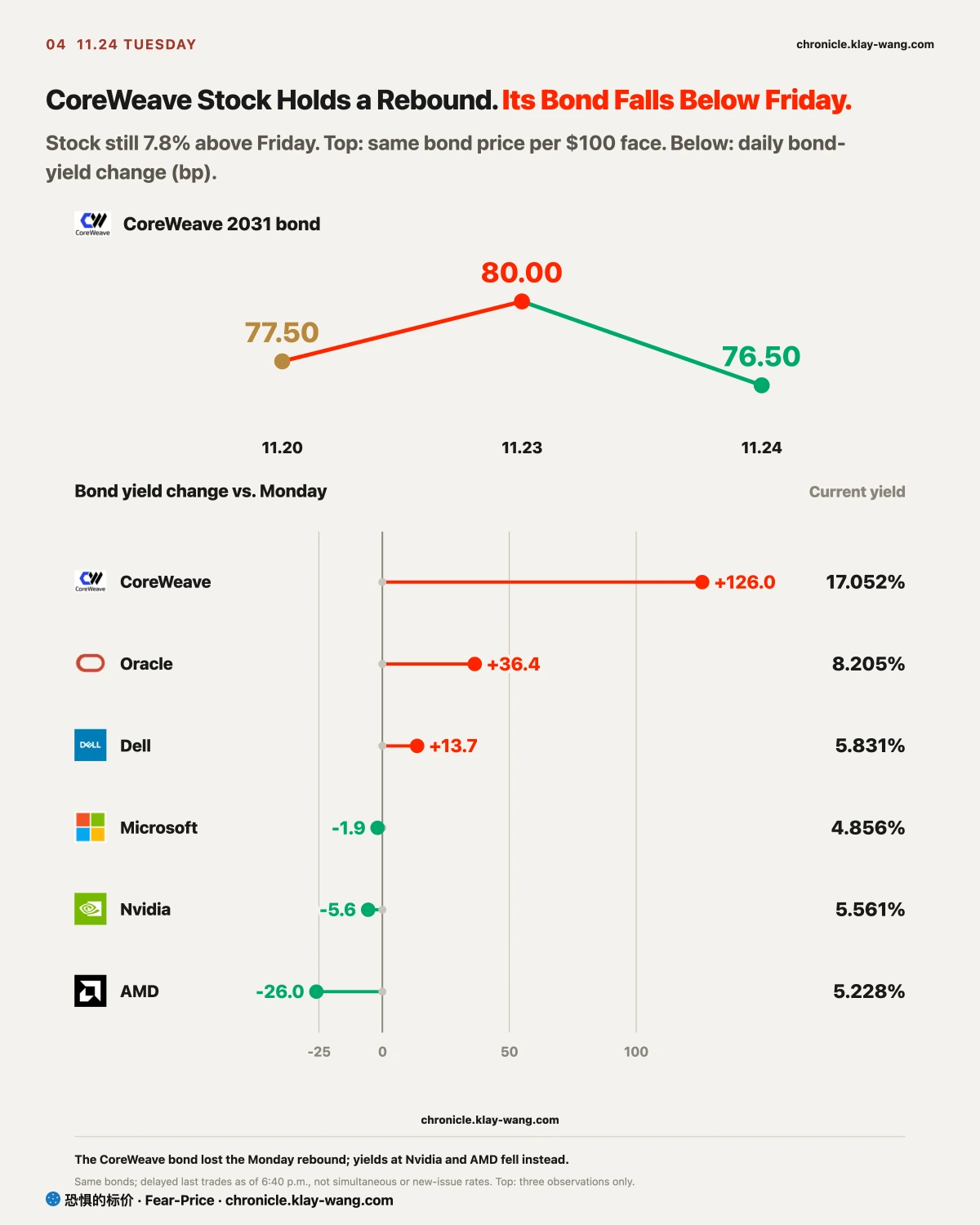
CoreWeave stock fell 11.9% on Tuesday but stayed 7.8% above last Friday. Its bond due 2031, priced per $100 of face value, rose from 77.5 on Friday to 80 on Monday, then fell to 76.5 on Tuesday, below Friday. The spread rose to 1236 basis points, the highest since we began recording in mid-September.
The spread is the bond yield minus the yield on Treasuries of similar maturity, the extra risk fee the market charges this company; 1236 basis points means paying about 12.4 percentage points a year more than the U.S. government. The Oracle bond spread, at 351.5 basis points, was also a record. The same day, Nvidia and AMD bond yields fell.
The yield on the CoreWeave bond rose to 17.05%, while a Nvidia bond of similar maturity yields 5.56%. Both are AI companies, yet the one that borrows to buy chips pays three times as much to borrow as the one that sells them. For companies that borrow to buy chips and build data centers, the next financing talk starts from here.
CoreWeave and companies like it borrow to buy GPUs and rent the computing power to model companies; they are large Nvidia customers. The more borrowing costs, the fewer chips the same money buys, and orders can slip. A steady Nvidia bond says Nvidia itself is not short of money. A dearer bond for its customers says part of the orders for next year depends on whether lenders keep lending. That is why Nvidia shareholders should watch this bond too.
Why do shareholders and bondholders of the same company part ways? The economist Robert Merton offered an explanation in 1974: a share is like a call option on the value of the company, with unlimited upside, while a bondholder collects fixed interest, and the more the company value swings, the greater the chance the principal is not repaid. CoreWeave near-term premium rose almost 9 points on Tuesday. Larger expected swings are an opportunity for shareholders and a risk for bondholders, so the stock kept its rebound while the bond gave all of it back. So when you see a stock rebound, check whether the bond of the same company followed.
Early this month, on November 3, we wrote that the CoreWeave stock had rebounded while its borrowing cost had not fallen. Three weeks later the same thing happened again, and the spread set a record. The return of Jensen Huang steadied Nvidia bonds; it did not make borrowing cheaper for the companies that borrow to buy Nvidia chips. Bondholders keep separating the big buyers of computing power: the Microsoft same-bond spread was 6 basis points wider than on November 20, and Amazon and Alphabet barely moved.
Dell Has the Orders and the Cash. HPE Cash Lags Its Revenue.
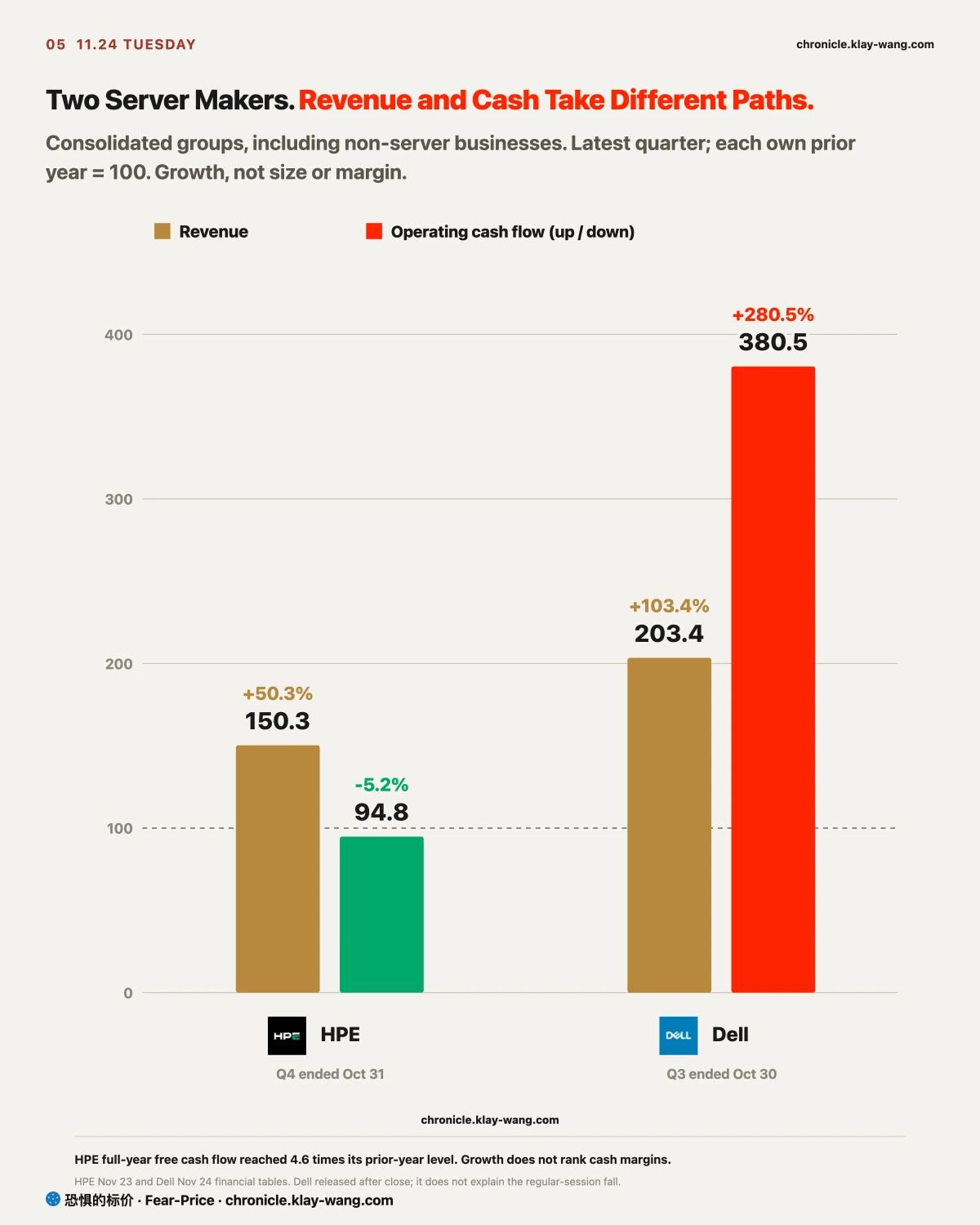
In its latest quarter HPE grew revenue 50.3% while operating cash flow fell 5.2%. The report came after the close on Monday, and the stock fell 16.3% on Tuesday. In the quarter Dell reported after the close on Tuesday, revenue grew 103.4%, operating cash flow grew 280.5%, new AI orders were $60.2 billion and the AI backlog reached $132.3 billion. As of a little after 6 p.m., Dell was up about 3.7% after hours.
Server makers buy GPUs and memory, assemble and deliver, then collect from customers. When revenue grows faster than cash, money is tied up in inventory and receivables; when cash grows faster than revenue, customer payments and supplier terms are keeping up.
Two companies in the same business, two paths for cash: the issue lies in the collections and inventory of each company. According to the Commercial Times in Taiwan on Tuesday evening, lead times for new Nvidia B300 orders have stretched to 26 to 40 weeks. Tight supply points the opposite way from shrinking demand. The selling on Tuesday hit the whole server chain; the Dell results show that what deserves a discount is the cash of individual companies, while AI server demand itself has not shrunk. For you, server makers need revenue and cash read separately; if Dell operating cash flow growth also falls below revenue growth next quarter, this view is wrong.
Scorecard: Two Nvidia Calls Withdrawn, the CoreWeave Call Not Overturned
The November 17 view on the Nvidia near-term premium is withdrawn. What we filed then: by Tuesday, the extra near-term premium on Nvidia would fall below 10 points while still exceeding the semiconductor ETF by at least 3 points. On Tuesday Nvidia was at 15.3, 0.2 below the semiconductor ETF. The view is withdrawn; the market left no separate premium on Nvidia for the investigation.
The view we filed on November 18: from November 17 to 25, the average gain of AMD and Broadcom would beat Nvidia, withdrawn if Nvidia closed above $159.19 on any day in between. Nvidia closed at 165.05 on Monday, so the view was withdrawn that day. A 30%-plus jump in one day was beyond what we had imagined.
From the November 17 close to Tuesday, AMD and Broadcom were down about 15% on average while Nvidia was roughly flat, so the direction was wrong too. Both calls went wrong in the same place: we treated the Nvidia problem as a problem of Nvidia alone. The reinstatement on Monday and the retreat on Tuesday show the market removing the discount specific to Nvidia while adding a premium to the whole chip sector. Why?
The two risks are different in kind. The extra premium on November 17 was about Nvidia itself: whether Jensen Huang could keep running the company and what the investigation would find. That kind of risk falls on one company, and switching to AMD or Broadcom avoids it, which is why we bet on the peers. When Huang was reinstated on Monday, that risk was removed. Nvidia rose 31.5% in a day while AMD rose 6.9% and Broadcom 3.0%, as if the money that had hidden in the peers went back to Nvidia.
What remains is shared by the whole sector: how much customers can still pay for computing power. The CoreWeave borrowing cost, the HPE cash and the memory price cycle all ask that question, and no chip stock avoids it. On Tuesday Nvidia fell 5.9% and the semiconductor ETF 7.3%. A decline that could once be blamed on Nvidia alone now has to be blamed on the industry, so option premiums rose across the sector. For chip shareholders, spreading across several chip companies protects against the trouble of one company, not against the trouble of the industry.
The CoreWeave call is still on the holding side. The view we filed on November 16: the average CoreWeave bond spread over the last five reading days of November would exceed 1026.7 basis points; both readings so far are above 1100.
The big-buyer call also holds. The view we filed on November 20: through December 4, none of the Microsoft, Amazon and Alphabet same-bond spreads would widen more than 20 basis points from November 20. The widest so far is 6.
What This Means for What You Hold
For the broad market, seven in ten stocks rose and rates, the dollar and credit were calm; the index decline came from the heaviest chip stocks. Watch whether the equal-weight S&P keeps beating the S&P 500. If it does, money is only cutting AI hardware, not leaving stocks. October PCE and the revised third-quarter GDP come out at 8:30 a.m. Wednesday; if the two-year yield moves sharply after them, this view is wrong.
For Nvidia shareholders, the premium specific to the company is gone, and the stock now trades with the chip sector. Sharp-drop risk for the sector fades when the semiconductor ETF near-term premium falls back below one-year.
For memory stocks, Micron bondholders are fine and the demand forecast has not been cut; the share prices are working out how long the price cycle lasts. With both near-term and one-year premiums expensive, chasing now is costly.
For CoreWeave and Oracle, watch the spread on the same bond first. A stock rebound while the spread keeps setting records lacks confirmation from bondholders.
For option buyers, near-term premiums on chip stocks are 15 to 25 points above one-year. The same money buys more time further out.
This describes mechanisms and conditions only and is not investment advice.
Three Lines Worth Keeping
- The index fell while seven in ten stocks rose; the selling stayed inside AI hardware and did not leave stocks.
- The return of Jensen Huang removed the discount specific to Nvidia; it did not make borrowing cheaper for companies that borrow to buy chips.
- Demand for memory and servers is still there; the market is pricing the length of the price cycle and the speed of collections.
内部对账
| 图位 | 中文图片 |
|---|---|
| 〖图1〗 | 卡1_恐惧的标价_纯中文.png |
| 〖图2〗 | 卡2_收盘分时对照_纯中文.png |
| 〖图3〗 | 卡3_公司与板块短期溢价_纯中文.png |
| 〖图4〗 | 卡4_股债反弹分歧_纯中文.png |
| 〖图5〗 | 卡5_服务器收入与现金_纯中文.png |
模版:D6(对账:英伟达两条判断收回,CoreWeave 那条还没被推翻);D4(戴尔订单和现金都在,慧与的现金跟不上收入)。
- 本稿为 Claude 接手改写(Klay 11/24 晚令:文案不满意直接接手,在顶层做)。Codex 原稿存
_work/文案_final_codex原稿.md;Codex 原夹codex 每日 digest/11 月/2026-11/24/未改动。 - 图卡沿用 Codex 五张,数据逐项复核与终表一致;按阅读顺序重编号:原卡3 收盘分时→卡2,原卡4 短期溢价→卡3,原卡2 股债反弹→卡4,卡5 不变。
- 主线改动:Codex 以 CoreWeave 股债分歧为主线。改后主线=标普 346/502 收涨而指数跌,卖盘只在 AI 硬件内部;用跨资产(2Y 持平、10Y −1bp、MOVE 100.91→98.84、UUP −0.50%、HYG −0.12%)排除宏观,用 IBIT −2.48%/GLD −2.27% 接 11/16〔跨资产〕读法;期权节用近月保费 11/23→11/24 的变化(MU +9.16、CRWV +8.94、NVDA +4.34;XLF −4.67、KRE −4.63、XLC −5.52、XLV −1.08;VXSMH 68.01 三年 99.7 分位)。
- 新增存储节:闪迪交流会(新闻素材第 32 条,Klay 晚间补链)对照 MU/SNDK 当日跌幅、近月减一年 24.01/25.09、MU 一年期 52.53→65.87(10/23→11/24)、MU 2032 债收益率 5.655→5.640、利差 87.8→95.0(11/20→11/24);高盛 2027/2028 取第一财经转述(第 13 条)。最贵一档:DELL 25.62、MRVL 26.54 与存储同档,故写最贵的一档不写最高。
- 信用节:CRWV 利差 1236.2 为 09/15 起 49 个读数的最大值;ORCL 351.5 同为序列最大值。默顿 1974(On the Pricing of Corporate Debt)作跨学科/理论解释,只解释股债分歧的方向,未声称量化。
- 对账:J-1117-01 收回(15.34−15.50=−0.16<3);J-1118-01 收回(11/23 NVDA 收 165.05 ≥159.19 触发收回条款;截至 11/24 AMD −17.91%、AVGO −11.86%,均值 −14.88%,NVDA −0.05%)。J-1116-01 进行中(11/23 1105.2、11/24 1236.2);J-1120-01 进行中(MSFT 16.6/基准 10.3,AMZN 69.7/69.2,GOOGL 62.4/68.0)。J-1118-01 收回行尚未写进判断台账,J-1117-01 开奖行 Codex 也未写,待 Klay 同意后一并补。
- 本稿未新立带日期的判断(规矩:Claude 自加判断须 Klay 点头);持仓节只写观察条件。
- 未用的素材:Anthropic 盘前破发(未核收盘与发行原件);伯里减持看跌(无原文);SpaceX/特斯拉合并谈判(与主线无关);模型安全争论、关税拟议、花旗信用卡、特朗普赦免表态(盘后,与盘面无可证关联);消费者信心(调查期早于本周);NVDA 1 月 80P/5 月 90P 大成交(买卖方向与开平未知,缺权利金无法折金额,明早结算持仓再看)。
- 数据源:每日跳空.csv、每日恒定期限IV.csv、每日AI发行人信用替代.csv、每日市场脉搏.csv、每日MOVE.csv、每日VX期限结构.csv、每日个股板块波动率快照.csv、每日收盘价.csv、_work/收盘研究输入.json(收盘与盘后 18:17 报价)、美债官方收盘曲线(新闻素材第 24 条)。
- 11/24 夜 Klay 改 v2(原样存
_work/文案_final_Klay改v2_原样.md)。Klay 亲改句保留,只动字面与事实:多余逗号;一天不到改只维持了一天;今天改周二;缓解和解决改缓解;还是是改还是;neocloud 改新兴云厂商;30% 改 30% 多(实为 31.48%)。事实修正一处:Klay 稿写周二 AMD 和博通平均跌了约 15%,实为 11/17 收盘到 11/24 的累计,周二单日只跌了 8.86% 和 3.98%,已改口径。 - Klay 在对账节问为什么,补两段:公司自身风险可被同行替代、复职后拿掉;行业共同风险换哪家都躲不开。另补三处为什么:牛鞭效应、存储看价格不看需求、英伟达股东为什么看 CoreWeave 的债。英文版同步,英文标题跟随新中文标题。
- 闸例外:㉛C 标题无判断词,标题为 Klay 亲定,保留。卡4 图例压线同前,误报。㉓ 全文末尾累计超 102400,站点入口在断点前,闸判通过;Gmail 读者要点开全文才能看到持仓节与三句话。
- 11/24 夜 Klay 改 v3(原样存
_work/文案_final_Klay改v3_原样.md):可推翻句统一为这个判断就是错误的,英文同步为 this view is wrong;为什么的位置打散(链条节放段中、CoreWeave 债放段尾、存储与默顿放段首、对账放段尾),避免整齐划一。
No investment advice. No direction calls. No market timing.