Payrolls Rose Only 29000. Why Did Rates Go Up Instead of Down?
Three Lines: The Bad News Was Priced on Thursday, and the Long End Still Wants Compensation; Gains Came Only at the Open
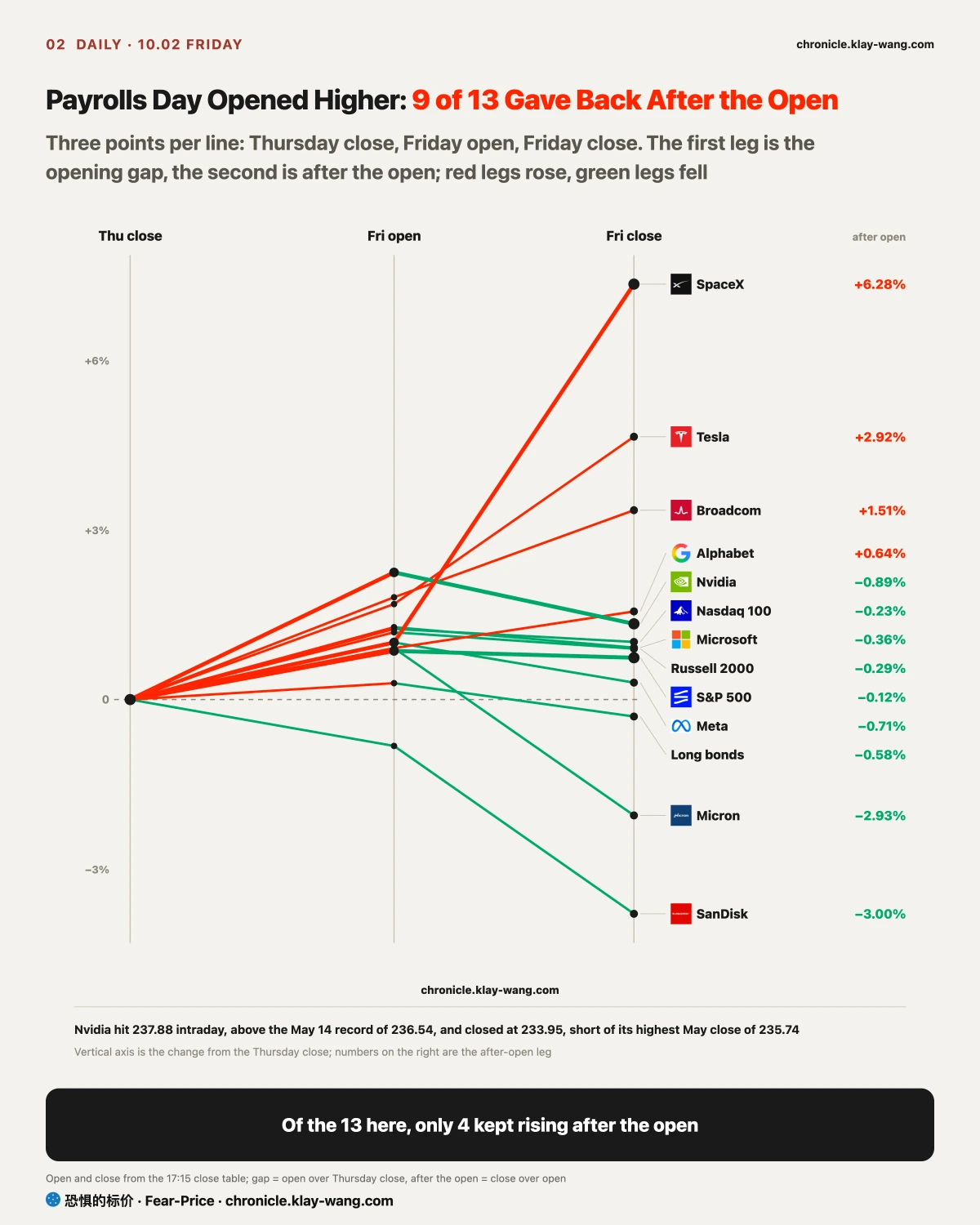
- September payrolls rose only 29000, yet the 2-year Treasury yield rose 5 basis points and the 10-year reached 5.28%: the bad news was priced on Thursday, and the compensation for lending long has not eased.
- The index gains all came at the open and faded during the day; Nvidia hit a record intraday and did not hold it at the close.
- One-month insurance got cheaper on 40 of 45 names, and SpaceX rose the most while its insurance got the dearest; further out, long-bond calls and deep out-of-the-money Nasdaq puts traded heavily.
Fear-Price Index 41.9: On Payrolls Day, Insurance a Year Out Fell Instead of Rising
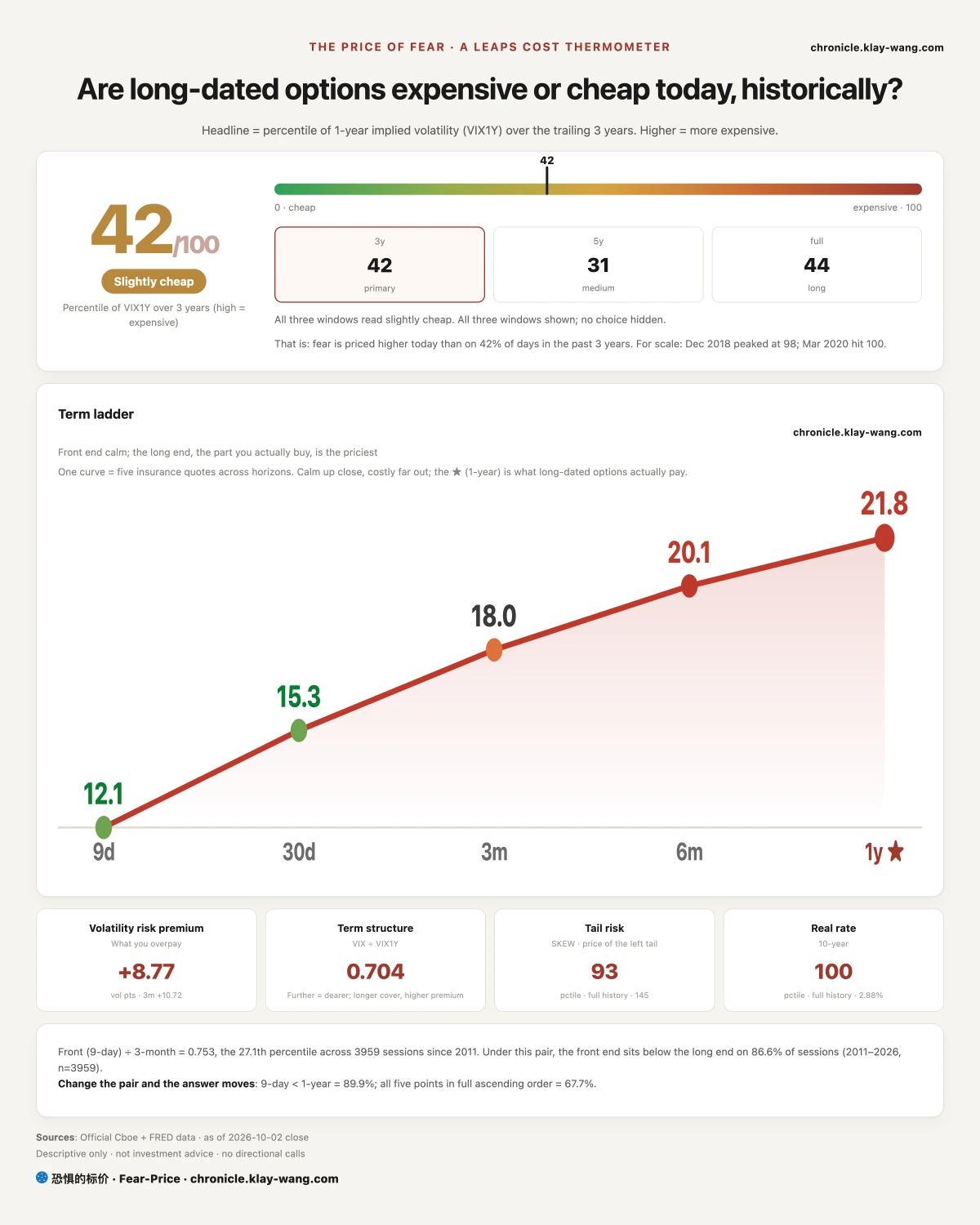
Fear-Price Index · 2026-10-02 · Reading 41.9/100: one-year volatility VIX1Y is 21.76, at the 41.9th percentile of the past three years; higher means more expensive. Daily ledger and method → chronicle.klay-wang.com · Please cite: Fear-Price Index
The cost of one-year insurance on US stocks fell from 46.4 to 41.9 on Friday (out of 100, higher is dearer), back below the 42.9 of Wednesday. The nearer the insurance, the more it fell: 9-day volatility went from 14.00 to 12.06, the one-month VIX from 16.39 to 15.31, and one year only from 21.93 to 21.76. With payrolls out of the way, the next few weeks lost one big event, so near-term insurance got cheaper while the risk a year out barely changed. For you, one-month protection on the S&P costs about 7% less than on Thursday; if you want protection through the earnings season at the end of October, Friday was cheaper than Thursday.
The K Index is 2.036, above the Thursday final of 1.764. The closer K is to 1, the more people are turning worry into money spent on protection; on Friday the Fear & Greed reading rose from 28.9 to 31.2 while the VIX fell more than a point, so the talk of worry eased a little and the money spent on protection eased more. On the current Fear & Greed reading, the VIX would need to rise above 31.2 for K to fall below 1. History at chronicle.klay-wang.com/kindex; the index at chronicle.klay-wang.com/fear-price.
[Call] Payrolls Were This Weak. Why Did Rates Rise? The Bad News Was Priced on Thursday
The 2-year did not fall this time because it had already fallen for this report on Thursday; the 10-year kept rising because the compensation for lending long has not eased, which has little to do with how hot or cold jobs are.
The Labor Department reported only 29000 new payrolls in September against 90000 expected; the two prior months were revised down by a combined 60000, and July now shows a loss of 10000. Unemployment rose to 4.2% while participation rose from 61.6% to 61.8%, so more people came back to look for work, which explains part of the rise. Hourly pay rose 3.0% over the year, below the 3.2% expected. Fewer jobs and slower pay are, by the usual logic, data that mean fewer hikes.
Prices reacted on the official Treasury table: On the official Treasury table the 2-year rose from 4.78% to 4.83% and the 10-year from 5.24% to 5.28%, with the 30-year at 5.63%; only maturities of two months or less fell, by 1 to 2 basis points. The long bond fund also opened higher and slid during the day, closing down 0.30%.
On Thursday the 2-year fell 10 basis points in a day, the most since the September hike: two Fed officials said there was no hurry, and odds of an October hike fell from nearly 70% to about 25% in a week. The market priced a cooling job market on Thursday; The Friday report only confirmed it, and the 2-year took back half of the Thursday drop. The 10-year is a different matter: it prices the compensation for lending for ten years. This week oil fell, inflation data came in light and jobs cooled, three things that should have pushed it down, and it rose from 5.17% last Friday to 5.28%. Mortgages and long-term company borrowing follow the 10-year, and cooler jobs did not make them cheaper.
Stocks took the same shape as long bonds: higher at the open, giving back during the day, with the S&P 500 ETF closing in the middle of its daily range. A gap up is the overnight buy orders filling all at once at the open, the first reaction to the data; where prices go after that depends on whether new buying shows up during the day. On Friday the indexes slipped after the open on volume close to Thursday, so no new money followed the opening move.
Nvidia was the clearest case: it reached 237.88 intraday, past the record high of 236.54 set on May 14, yet closed near the low of the day, on nearly 40% more volume than Thursday. Pushing higher on heavy volume and closing near the low usually means more people wanted to sell near the new high than to chase it. SpaceX went the other way: it opened only 1% higher, climbed all day, and closed near its high on 1.7 times the Thursday volume; rising all day and closing near the high usually means buyers kept coming in through the session. Nvidia is up only 4.3% over the month while AMD and Intel are each up more than 30%; why the money went around it is in the weekly review.
The bad news is priced, and the 2-year is unlikely to close back at 4.92% before October 9 (Friday). Since 2011, the 2-year has risen 9 basis points or more within five trading days about one time in five, and about 35% of the time since 2023; a return to 4.92% withdraws this call and would mean hike bets are back.
[Insurance] One-Month Insurance on 45 Names: Only 5 Got Dearer
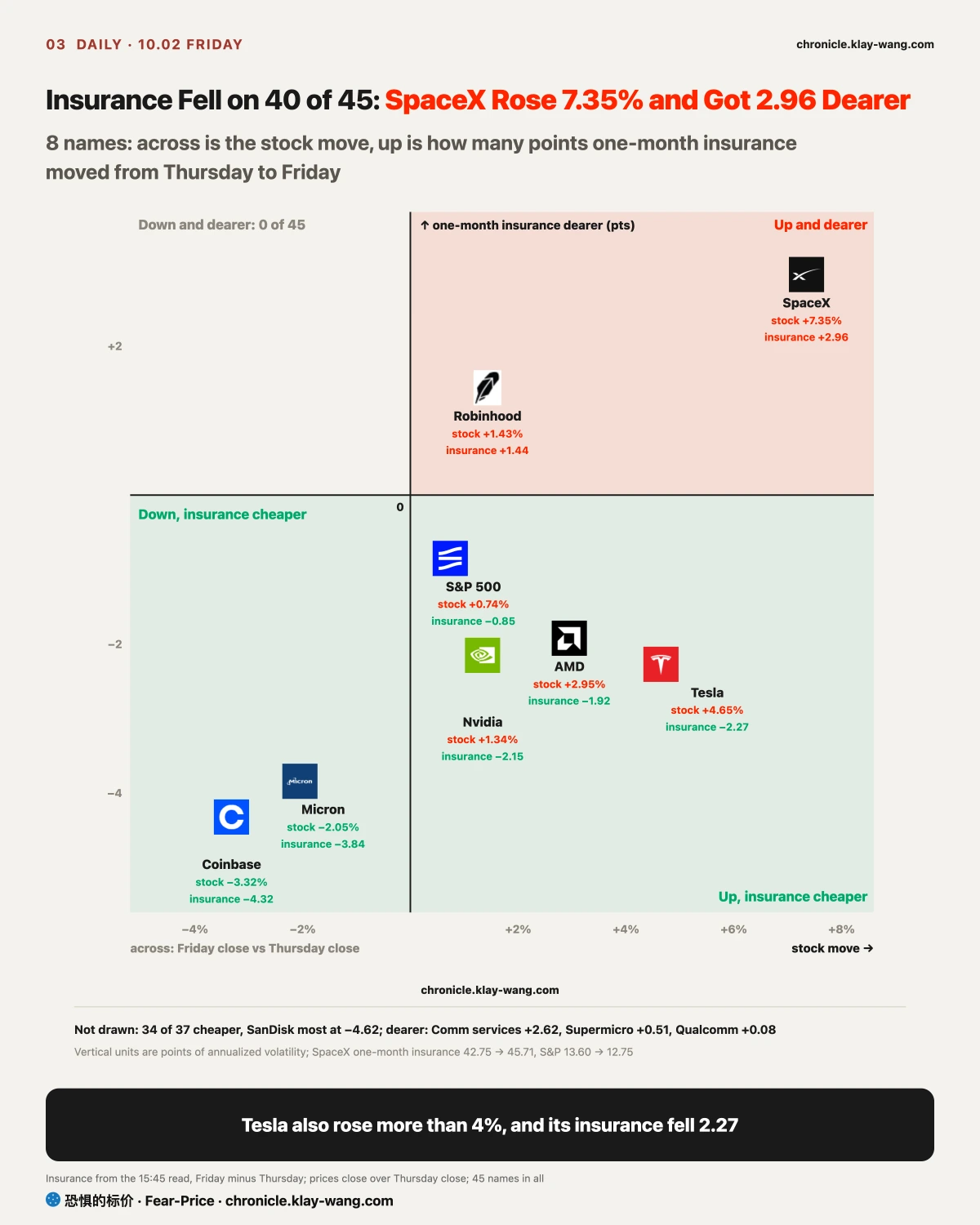
After payrolls, protection on stocks and on rates got cheaper together. Of the 45 names we track (big tech, chips, memory, banks, crypto-linked stocks and index funds), 40 saw one-month insurance get cheaper, with the S&P going from 13.60 to 12.75; protection on rates, the MOVE index, eased from 108.13 to 107.29. The 5 that got dearer were SpaceX (+2.96 points), the communication services sector (+2.62), Robinhood (+1.44), Supermicro (+0.51) and Qualcomm (+0.08).
SpaceX rose the most, and its insurance got the dearest: the stock rose 7.35%, almost all of it during the day, on more than 70% more volume than Thursday. Tesla and Nebius also rose more than 4%, yet their one-month insurance fell more than 2 points each. Rising while protection got dearer means its options were being chased. October 30 calls with a 172.5 strike traded 29800 contracts against open interest of about 500; January 2028 calls with a 330 strike traded 5404 against 124, a strike more than twice the price. Volume does not show who bought and who sold; Monday morning open interest will show how much stayed.
The four names whose insurance fell the most all closed lower: SanDisk down 4.62 points, Coinbase 4.32, MSTR 3.99 and Micron 3.84. Prices falling while protection got cheaper means no one rushed to buy cover on the way down. The falls differed: Micron traded only six tenths of the Thursday volume, a thin-volume drop with no one stepping in and no one rushing out; Coinbase opened 2.83% higher and fell 5.98% during the day on more than twice the Thursday volume, with sellers in a hurry.
Further out, trading was more concentrated than near in. Long bond fund calls expiring in more than a year traded about 87000 contracts across four strikes; the September 2027 86 calls opened on Thursday, 96% of which were still held on Friday morning, traded another 20400. These contracts pay only if long-term rates fall clearly within a year or two, and they kept trading on a day rates rose. Nasdaq puts expiring in 2028 with strikes below half the price traded 37000 contracts across ten strikes. Both kinds would pay together in one bad outcome: if the economy really weakens, long rates fall and stocks fall. Monday morning open interest will show whether these were new positions or rolls; if open interest on the ten Nasdaq strikes rises by less than half the volume traded that day, they count as rolls and the new-position reading is withdrawn.
[Settled] Three Calls Due: Two Hold, the Accenture Call Is Withdrawn
The retreat in hike bets is more than a one-day move: holds. The test was the official 2-year closing below 4.92% after payrolls; it closed at 4.83%. To be plain: the 2-year rose 5 basis points that day and is now only 9 short of the line, which is why a new call above runs to October 9.
The rate shock lands on regional banks first: holds, right at the line. Filed on September 25, the test was whether one-month insurance on the regional bank fund was still above the one-year at 15:45 on October 2. The reading was 27.47 against 27.26, only 0.21 above, against 0.73 on Thursday. One month priced above one year means the worry is about the next few weeks; it is now almost flat, so the worry about regional banks is fading. To be plain: on September 28 one-month insurance dipped below the one-year (25.95 against 26.40), and by the original wording the call should have been withdrawn that day; we then set the settlement on October 2 and did not count a one-day touch, and that change is recorded here.
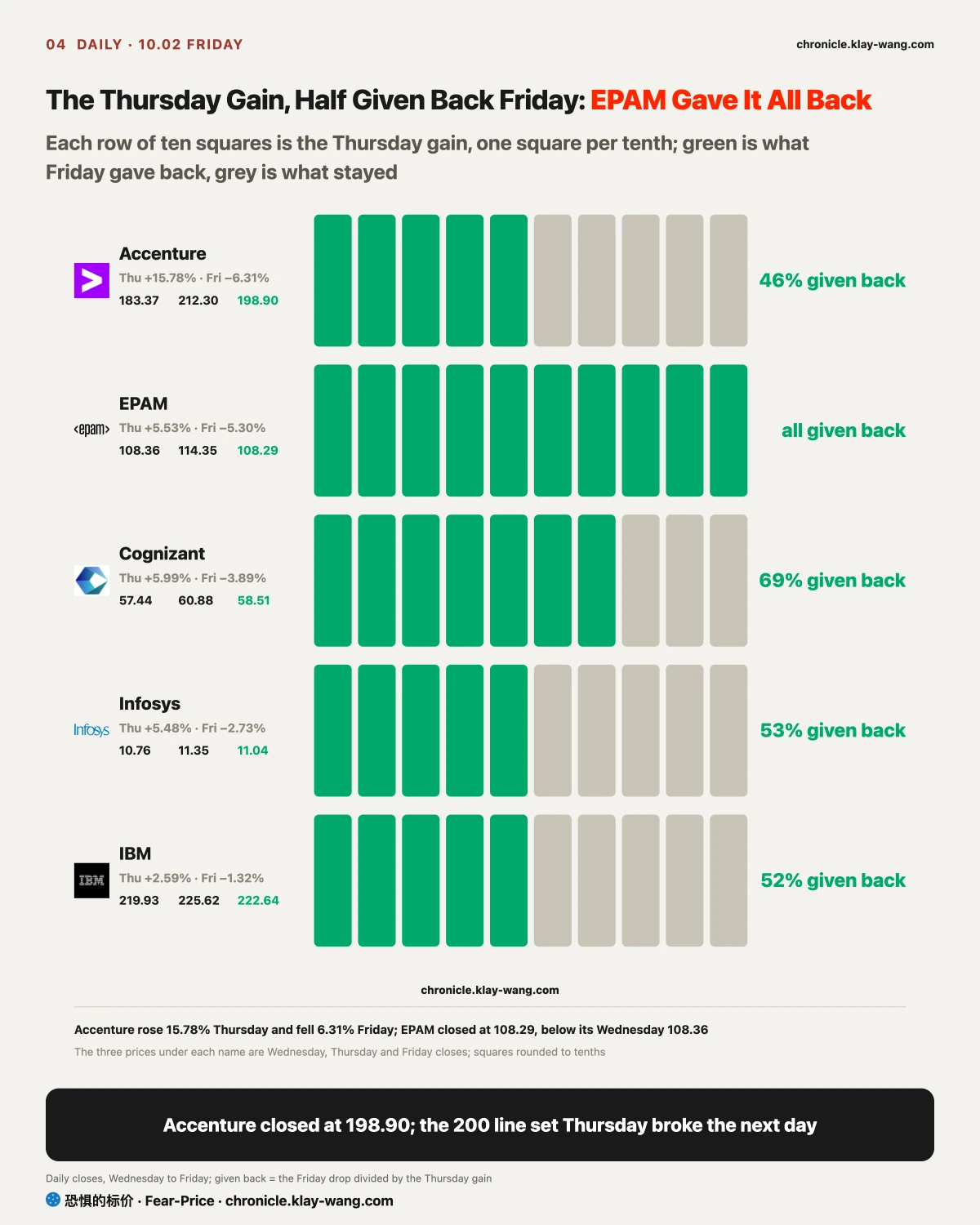
The Accenture repricing holds: withdrawn. The test was any close below 200 before October 16; it closed at 198.90 on Friday, down 6.31%, hitting the line the day after the call was filed. Of the Thursday gain, 46% was given back on Friday. Peer EPAM gave all of it back and closed below its Wednesday level; Cognizant gave back nearly 70%, and Infosys and IBM about half. The mistake was treating one set of large-deal numbers as a reason to reprice a whole group: it answered the fear of AI taking their work on Thursday, and the market did not fully accept it the next day. Over the past four years a drop this size happened about one time in four, and this was that time.
What This Means for What You Hold
If you hold long bonds or have a mortgage to renew: jobs cooled and the 10-year still rose to 5.28%, so counting on job data to push mortgage rates down is not realistic. Far-dated long bond calls are trading, a bet on where things stand a year or two out, and the bumps on the way remain.
If you hold an index ETF: the Friday gain came at the open and faded during the day. One-month protection costs about 7% less than on Thursday; if you want to protect what you hold, Friday was cheaper than Thursday.
If you hold big tech or chips: Nvidia hit a record intraday and did not hold it; next week, watch whether it closes above its highest May close of 235.74, which would be a closing high. What kept rising during the day were single stocks like Tesla and Broadcom; no one chased the index itself.
If you hold memory or outsourcing stocks: memory fell on thin volume while protection got cheaper, so nobody is rushing out; outsourcers gave back half of the Thursday gain the next day, EPAM all of it, and the large-deal count in the next report from the group matters more than one day of price moves.
Three Lines Worth Keeping
- If bad news was already priced the day before, prices will not follow it on the day the data come out.
- When a stock breaks to a new high during the day, what counts is whether it holds into the close; an intraday high that is not held does not count.
- When near-term protection is cheap, check whether deep out-of-the-money contracts far out are trading heavily; they pay only on a large move.
No investment advice. No direction calls. No market timing.