Nvidia and the Nasdaq at All-Time Highs, but More Than Half the S&P Is Still Below Its 200-Day Average
Three Lines: Nvidia Held Its High; Money Is Crowded Into the Strongest Few
- Nvidia closed at 238.90 and the Nasdaq 100 fund at 756.20, both all-time highs; SpaceX opened flat and rose 7.6% through the day to its highest close since June 18.
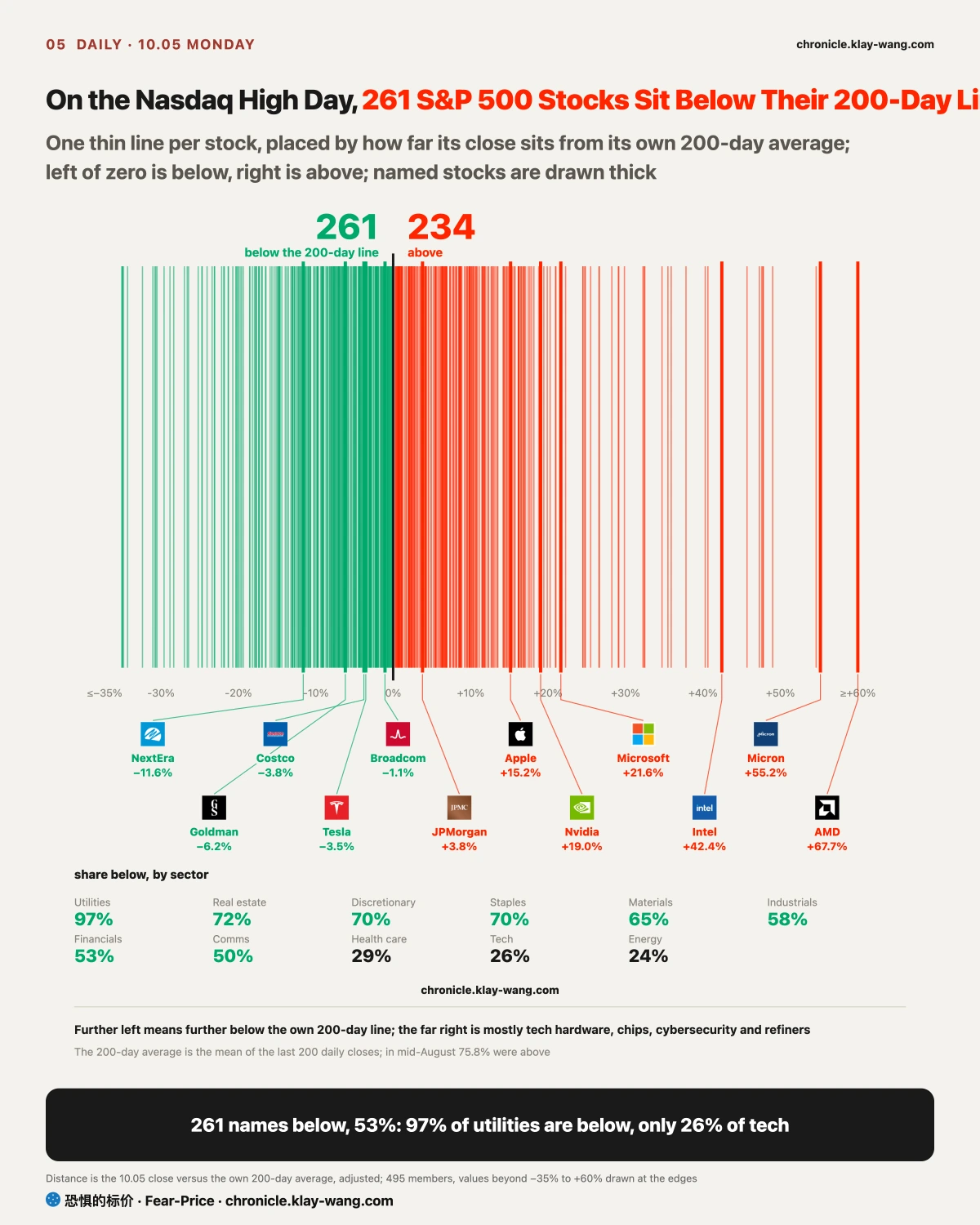
- Since September 3, tech is the only S&P sector that rose, and the share of members closing above their 200-day average fell from 75.8% in mid-August to 47.5%.
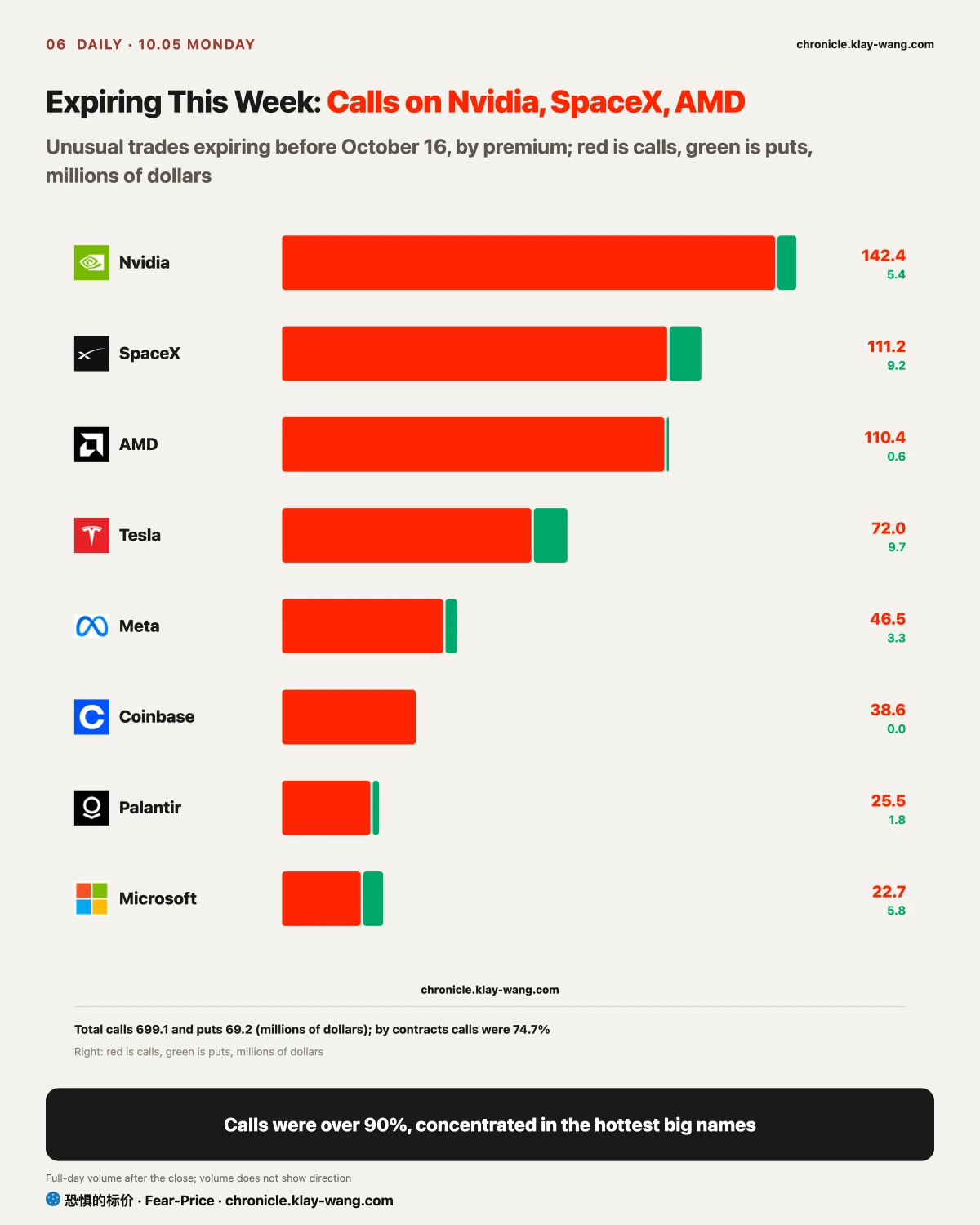
- Over 90% of premium in options expiring this week went to calls, while further out someone bought S&P puts that pay only on a fall of more than 13%.
Fear-Price Index 41.7: Spoken Worry Eased, the Price of Protection Did Not
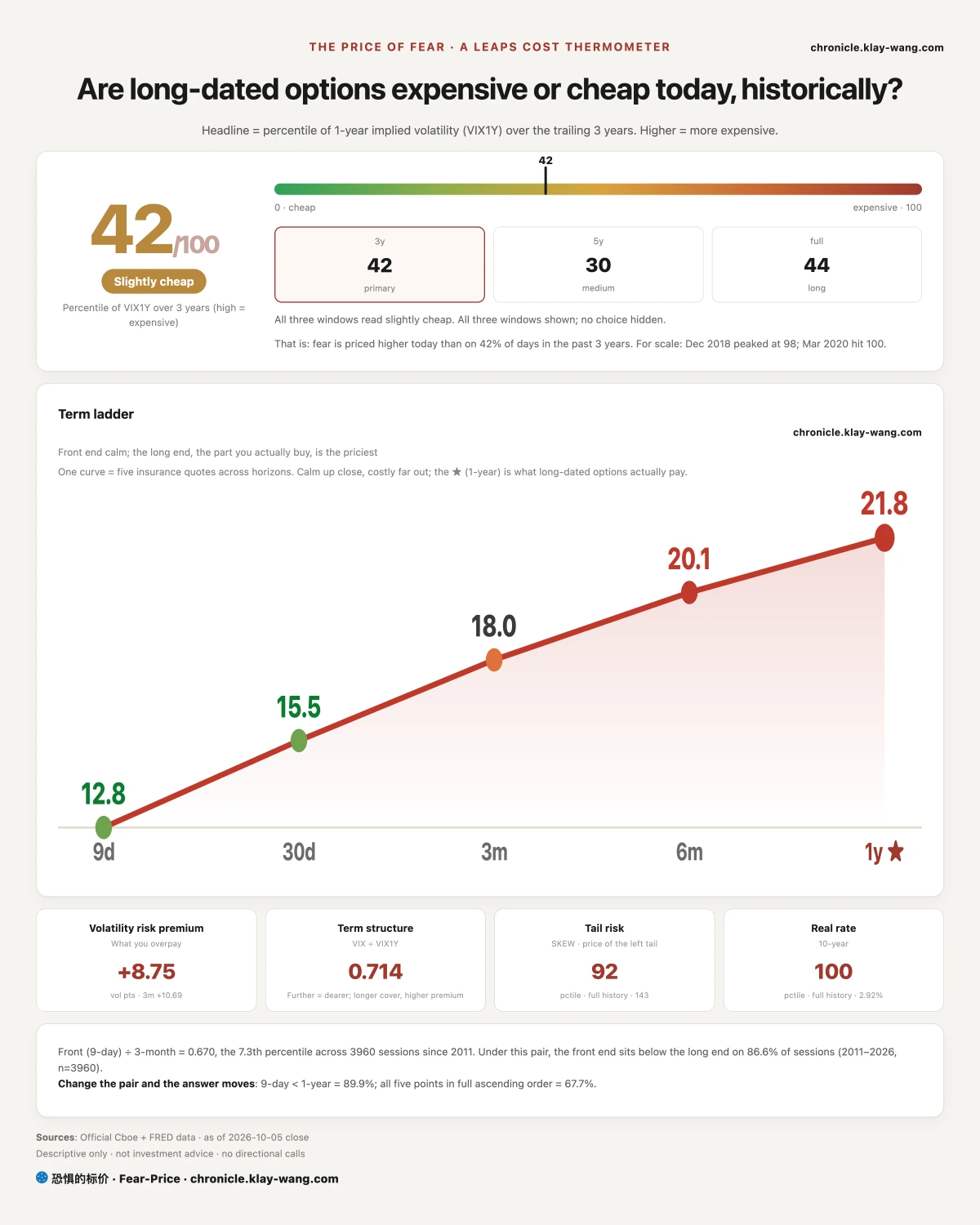
Fear-Price Index · 2026-10-05 · Reading 41.7/100: one-year volatility VIX1Y is 21.75, at the 41.7th percentile of the past three years; higher means more expensive. Daily ledger and method → chronicle.klay-wang.com · Please cite: Fear-Price Index
The cost of one-year insurance on US stocks barely moved on Monday, from 41.9 to 41.7 (out of 100, higher is dearer). The near end got slightly dearer: 9-day volatility rose from 12.06 to 12.85 and the one-month VIX from 15.31 to 15.52, while maturities beyond three months were flat or slightly lower. Stocks rose and near-term protection got a little dearer, while pricing of risk a year out did not change. For you, one-month protection on the S&P costs about 3% more than Friday and is still cheaper than Thursday.
The K Index is 2.78, above the Friday final of 2.611. The CNN Fear & Greed reading rose from 40.0 to 43.1 while the VIX still rose 0.2. The closer K is to 1, the more people are turning worry into money spent on protection; on Monday spoken worry eased a little, and not one fewer person paid for protection. On the Monday reading, the VIX would need to rise above 43.1 for K to fall below 1. History at chronicle.klay-wang.com/kindex; the index at chronicle.klay-wang.com/fear-price.
[Stocks] The High Nvidia Could Not Hold Friday, It Held Monday: Money Is Crowding Into the Strongest Few
Nvidia held an all-time high on Monday and SpaceX rose 7.6% in a day. The leaders were the biggest, hottest names, and most of their gains were bought during the session, not at the open. The two took two paths: one broke its prior high and finally held it, the other has climbed all the way back from its August low.
Nvidia is the clearest case. On Friday it broke its May high intraday but closed near the low of the day; on Monday it opened about 1% higher, gained another 1.2% during the session and closed at 238.90; both the close and the intraday high of 240.10 are all-time highs, on volume close to Friday. Friday it could not hold, Monday it did: selling near the high was absorbed within one trading day, and the October 2 reading that more people wanted to sell near the high than chase it lasted only a day.
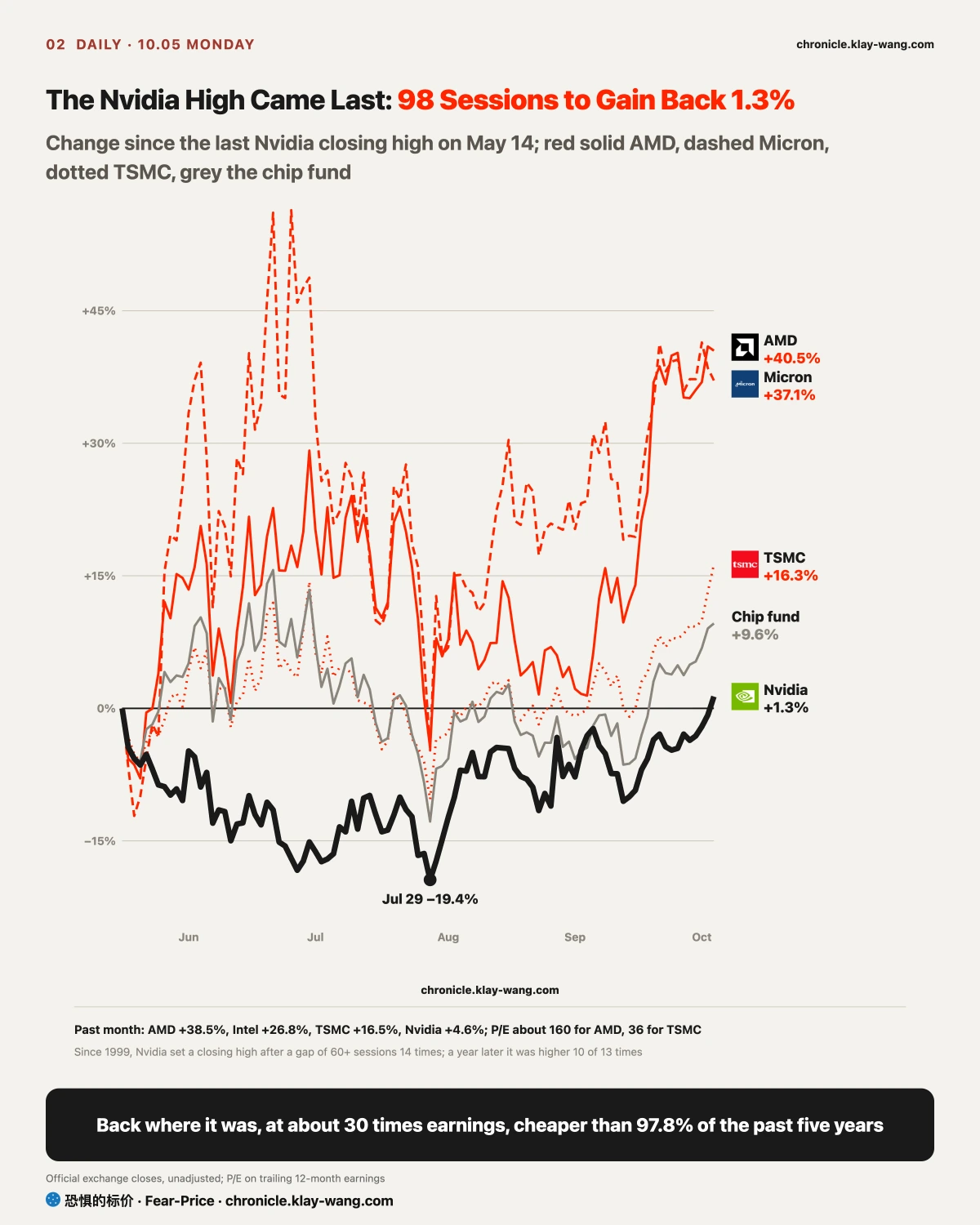
This high came slowly. The last Nvidia closing high was May 14, and it took 98 trading days to get back, at worst 19% below the high on July 29. Over the same span AMD and Micron each rose about 40% and TSMC 16%, while Nvidia gained back only 1.3%. Chip stocks fell together into late July; the difference was the rebound: over the past month AMD rose nearly 40% and Nvidia less than 5%, so money in chips went to the catch-up names first and reached the leader last.
The price is back where it was, and profits did not stop. Nvidia trades at about 30 times earnings, cheaper than 97.8% of the past five years; AMD is at about 160 times and TSMC about 36. Five months of flat prices with the multiple at a five-year low means this high was pushed up by profits, not by valuation, which is a different thing from a high bid up by enthusiasm. Its one-month insurance is 28.77, the cheapest among chips, against 52 for AMD and 65 for Intel, while its calls expiring this week drew more premium than any other name: money is chasing it and no one is rushing to insure it.
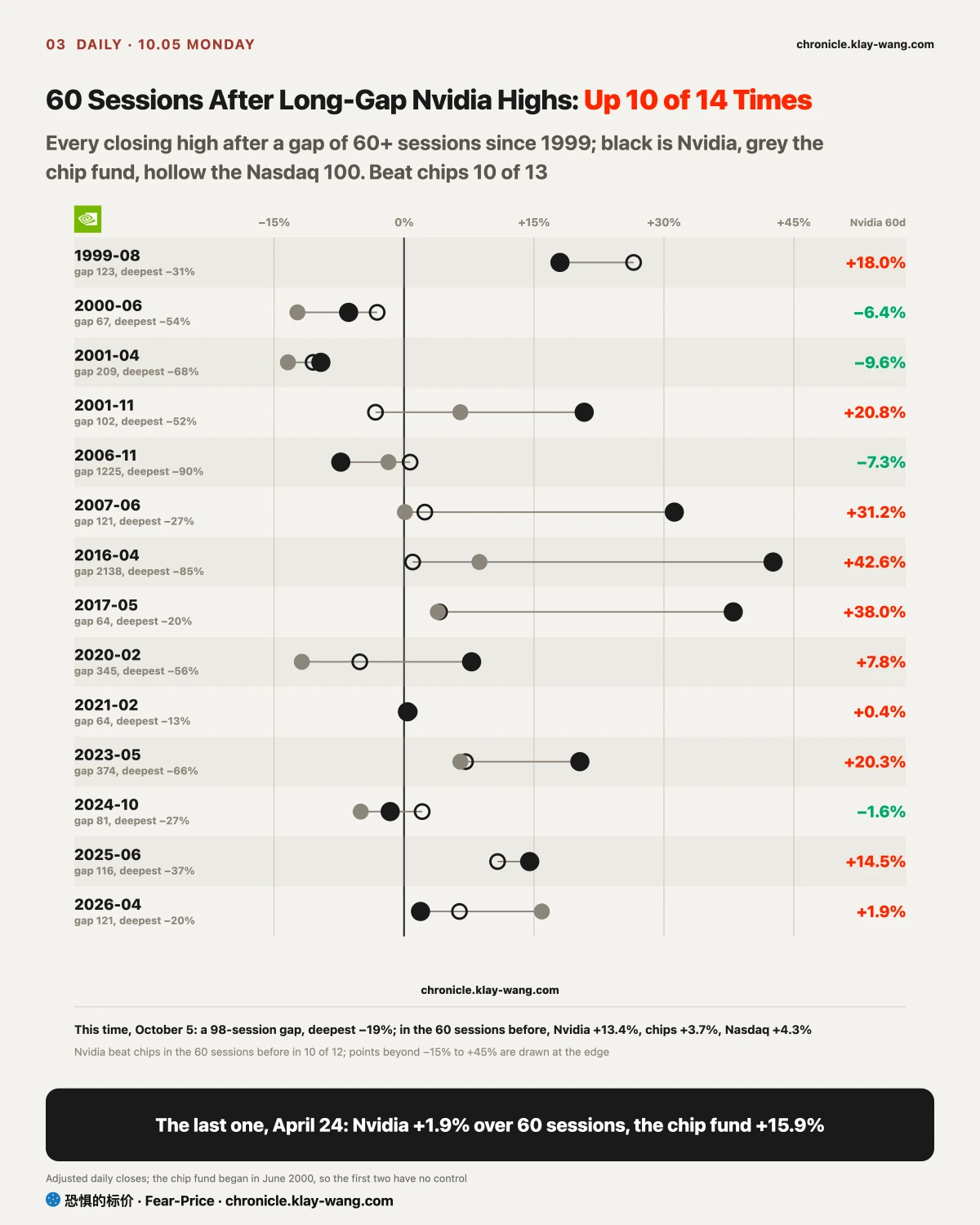
Set it against its own history. Since 1999, Nvidia has set a closing high after a gap of 60 or more sessions 14 times; 60 sessions later it was mostly higher and mostly ahead of the chip fund, 10 times each. The exception matters too: the last one was April 24 this year, after which Nvidia barely moved over 60 sessions while the chip fund rose about 15%, as money left it for its peers. This time Nvidia beat the chip fund by nearly 10 points in the 60 sessions before the high, which looks more like the majority of past cases. If you hold Nvidia, the Friday warning is out of date; before its next earnings report, watch whether it stays above its May high, and whether money rotates away from it again as it did in April.
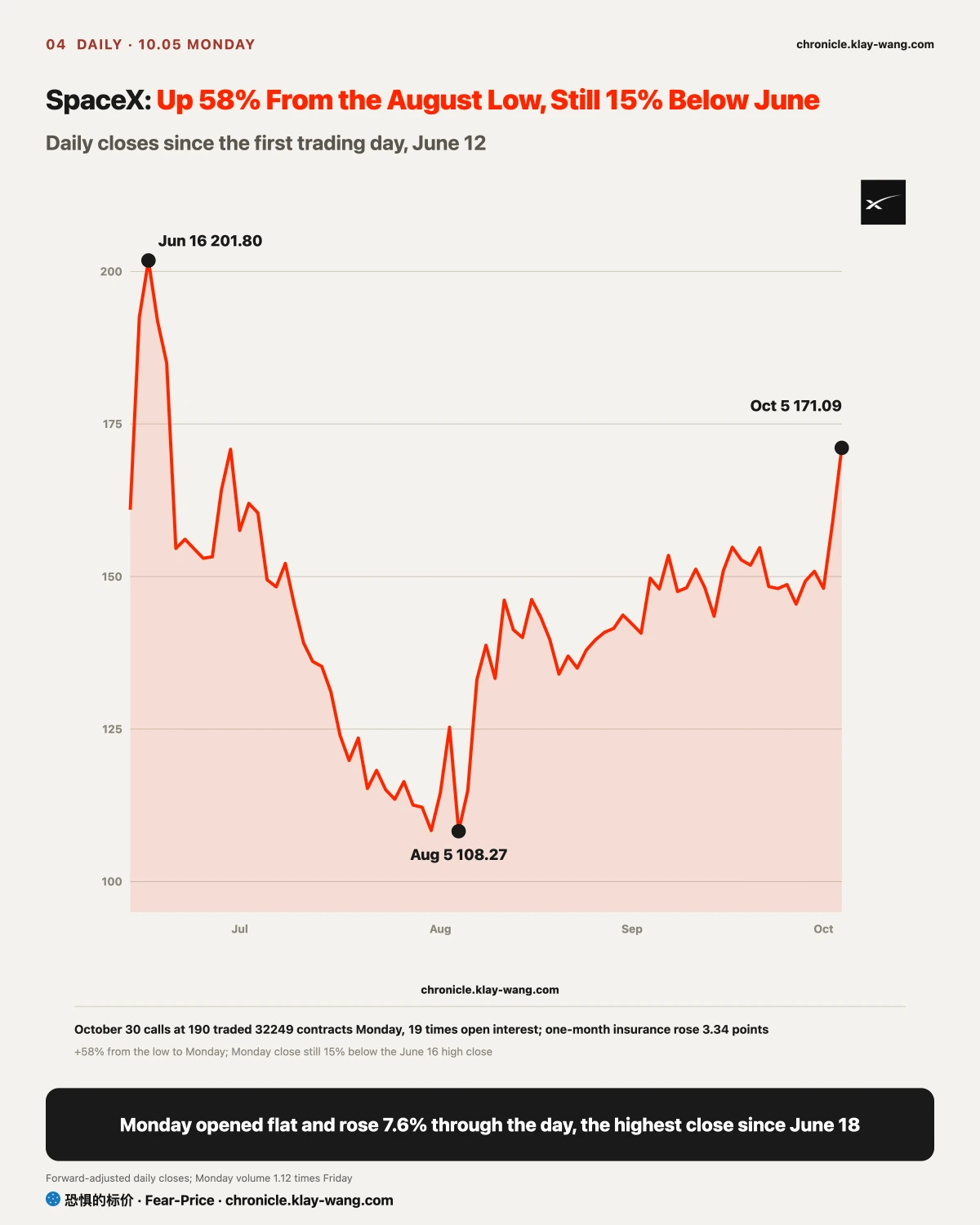
SpaceX opened almost flat on Monday and rose 7.63% through the day to its highest close since June 18, on volume about a tenth above Friday. Rising all day and closing near the high means buyers kept coming in through the session; a broker report on Sunday called it undervalued. Over a longer span, it is 58% above its August 5 low and still 15% below its June 16 high.
Money chasing it is betting on the next month: October 30 calls at 190 traded 19 times open interest, a strike 11% above the price, and its one-month insurance rose 3.34 points the same day, getting dearer as the stock rose, so its options are being chased. If you hold SpaceX, the cost of chasing is rising, and how many of the 190 calls stay by tomorrow morning will show whether anyone held this chase overnight.
[Call] Only Tech Rose Over the Month: The Index at a High, Half Its Members Below Their Long-Term Average
The Nvidia and Nasdaq highs are held up by a few big names; take the index apart and most stocks fell this month.
Split the S&P by sector and the divergence is clearer. In the month since the September 3 close, the tech sector rose 8.2% while the S&P rose only 0.5%, and all 8 other sectors we track fell, financials the most, and even consumer staples fell. If you hold financials or consumer stocks, the index high this month did not reach you.
The share of S&P members closing above their 200-day average was 75.8% in mid-August, fell to 42.1% on September 30 and was 47.5% on Monday. The index is near its all-time high while more than half of its members sit below their long-term average. The structure looks much like the six months before the March 2000 dot-com peak, when tech rose more than 40%, every sector other than tech and telecom fell, and consumer staples fell 30%. Monday split the same way: the only sector that fell was real estate, which borrows long to buy and rent out property and is among the sectors most exposed to long rates.
Behind the split is a bill for higher rates, which this issue does not take further than one paragraph: the official 10-year yield rose to 5.31% on Monday, the highest since 2002. A stock price is future profit discounted back at long-term rates; industry research expects third-quarter tech earnings per share to grow more than 60% from a year earlier, enough to absorb a few more basis points at the long end, while slow-growing companies that rely on borrowing cannot. On Monday real estate and regional banks fell and insurance on rates, the MOVE index, got nearly 6% dearer in a day, the other side of the same bill.
The shape of trading fits. The indexes opened almost flat on Monday with no gap, the whole gain came during the session, and they were bought steadily to close near the high of the day, the reverse of Friday when they gapped up and gave back during the day, so money was chasing during the session. But Nasdaq volume was only 0.74 times Friday, so not much money was chasing, and it was concentrated in a few names. Rising on lighter volume with gains ever more concentrated usually means money already in the market is switching from weak to strong, not new money coming in; how far this goes depends on whether earnings from those few big names can carry it.
On this logic, if the long end does not ease, money will keep crowding into the big names: on October 16 (Friday) the equal-weight to cap-weight S&P ratio closes below the Monday level of 0.2725. Since October 2022, the ratio has been lower nine trading days later about 56% of the time, and about 60% when starting from a 60-day low, so this is not a lopsided bet. If it closes at or above 0.2725 that day, money is returning to most companies and this call is withdrawn.
[Options] Chasing Near, Buying Crash Protection Further Out: Two Bets on Two Endings for the Same Stocks
Two flows ran in opposite directions on the same day: near-term money chased gains, while a month or more out someone paid for protection against a big S&P drop. What that protection guards against is exactly rates interrupting a run carried by a few big names.
The near-term chasing was concentrated in the hottest few names: three quarters of unusual trades expiring before October 16 were calls, and more than 90% by premium, with Nvidia, SpaceX and AMD each above 100 million dollars. That kind of chasing is a bet on the next month.
Going the other way were two S&P put strikes expiring November 30, 675 and 570, each trading about 75000 contracts against open interest of about a thousand, concentrated in the afternoon. Same expiry, equal counts: the shape of a put spread that starts paying if the S&P falls more than 13% by the end of November and stops adding beyond 26%. Buying that structure near a record costs little and pays only on a big fall, guarding against a large risk more than a month out. Further out still, Nvidia and TSMC puts expiring more than a year away with strikes about 10% below the price traded far above open interest; TSMC closed at a record on Monday.
Read together on one board: near-term money is chasing the strongest few, and further out someone is insuring those same few, two bets on two endings for the same stocks. Volume does not show who bought and who sold. If the S&P pair was opened new, open interest at 675 on Tuesday October 6 morning will be up by most of the volume; if it rises by less than half, they were closes or rolls and the new-position reading is withdrawn. These S&P puts are now filed and settle tomorrow morning. If you hold a concentrated position in big names, this kind of protection further out is cheaper than near-term, and the more concentrated the position, the more it is worth checking whether you share the same worry.
[Settled] Nasdaq 2028 Deep Out-of-the-Money Puts Were New: Withdrawn, One Day of Volume Is Not a New Position
The Nasdaq 2028 deep out-of-the-money puts were new positions: withdrawn. When filed on October 2, the test was the October 5 morning open interest across ten strikes rising at least 18394 above October 1; it rose only 15109, 82% of the bar. About 40% of the Friday volume stayed; the rest went in and out the same day or were rolls. The mistake was treating one day of volume as proof of new positions; far-dated deep out-of-the-money contracts roll a lot and only the next day open interest settles it, which is why the S&P trade above is held only to tomorrow morning.
The official 2-year closed at 4.84% on Monday, still 8 basis points from the 4.92% line, settling October 9.
What This Means for What You Hold
If you hold an index ETF: the Nasdaq 100 is at an all-time high and the S&P less than 0.4% below its highest close, their gains have leaned more and more on a few big names over three months, and more than half of S&P members sit below their 200-day average. Holders of the S&P are getting the moves of the big names; if their earnings do not hold up, the index will fall faster than the equal-weight one. One-month protection costs about 3% more than Friday and is still cheap.
If you hold Nvidia or chips: Nvidia held its high, so the Friday warning is out of date; its peers rose far more this month, the catch-up names carry dearer one-month insurance and will fall faster in a pullback. Before its next earnings report, watch whether Nvidia stays above its May high.
If you hold a hot name like SpaceX: it rose 7.6% in a day and its options are being chased, so the cost of chasing is rising. It is still 15% below its June high and the road there will be bumpy; how many 190 calls stay tomorrow morning is the first sign.
If you hold regional banks, small caps or consumer stocks: this was the side money left this month; financials, consumer discretionary and consumer staples each fell more than 4%. If the long end does not ease, this side will find it hard to outperform.
Three Lines Worth Keeping
- When the index hits a record, check whether the equal-weight index and the sectors keep up; if they do not, only a few names are rising.
- An intraday break of a prior high that is not held does not count, and holding it the next day does; by the same token, a reading built on not holding can be out of date the next day.
- On a day the index is at a record and near-term calls are chased, if someone piles into deep out-of-the-money puts further out, check how much open interest stays the next day.
No investment advice. No direction calls. No market timing.