Everyone Is Talking About Hot CPI and Rate Hikes, but the Real Market Mover Was Corporate Bonds
Three Lines: Wednesday Was Not a Rate Shock; the Push Came From Corporate Bonds in the AI Borrowing Chain
- The media story was hot CPI, rising hike bets and a tech selloff; yet the 10-year yield fell, protection against rate swings got cheaper, and Apple set another record.
- The push came from corporate bonds: the bonds CoreWeave itself issued fell to 81 cents, its spread widened to 1021 basis points, and the closer a company sits to the borrowing, the bigger its fall.
- We said on Monday and Tuesday that companies borrowing to build compute would be hit hardest; the pressure has not spread to the whole market yet, and three tests come next.
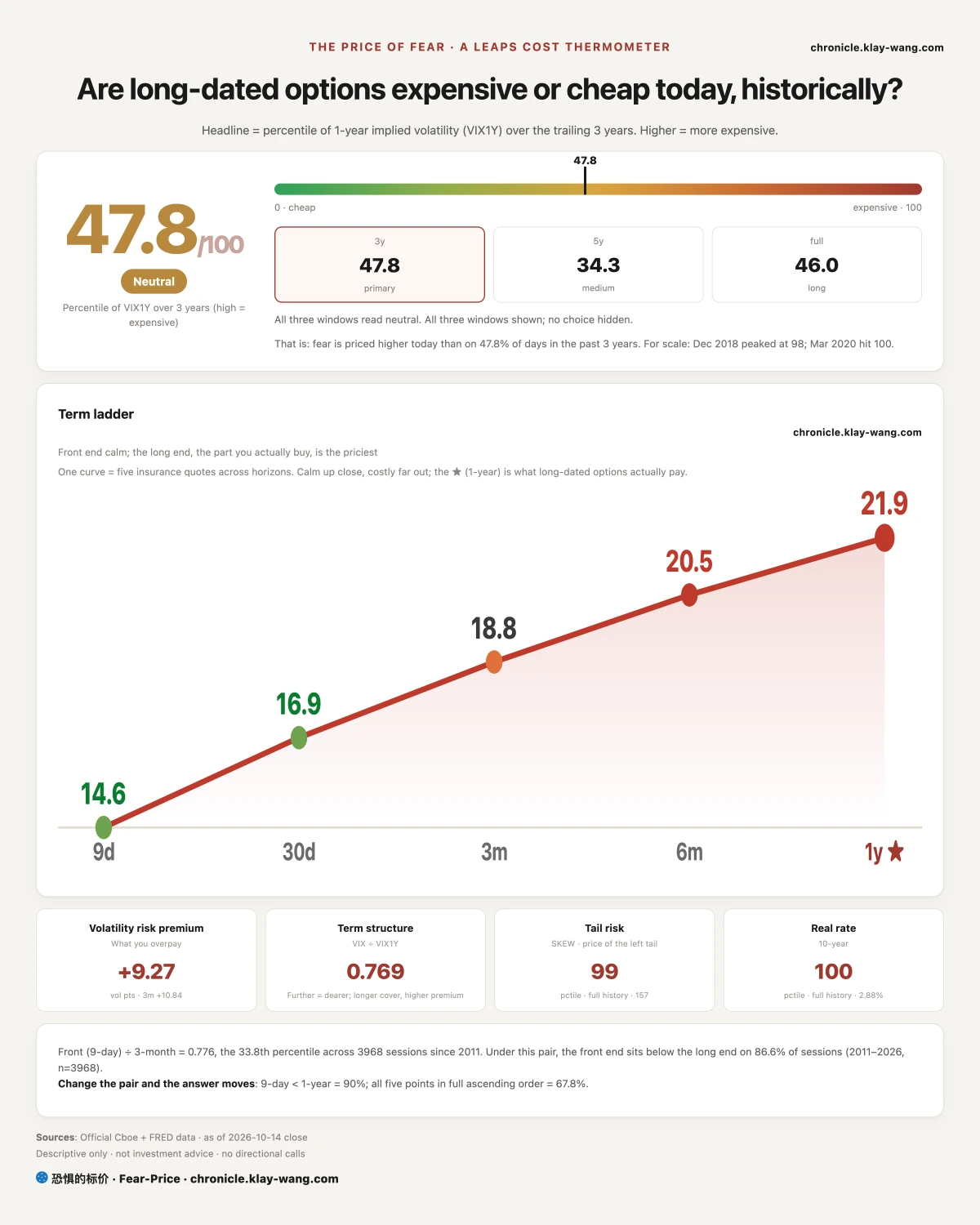
Fear-Price Index 47.8: The Percentile Jumped 7.6, While One-Year Protection Itself Rose Only 0.28 Point
Fear-Price Index · 2026-10-14 · Reading 47.8/100: one-year volatility VIX1Y at 21.94, in the 47.8th percentile of the past three years, where high means expensive. Daily ledger and definitions at chronicle.klay-wang.com · Please credit: Fear-Price Index · Fear-Price
The reading rose from 40.2 on Tuesday to 47.8, while one-year volatility itself went only from 21.66 to 21.94. The percentile jumped because many days of the past three years sit near this price, so a small move shifts the rank a lot. The near end rose faster: VIX went from 15.27 to 16.87, and nine-day volatility rose from 0.668 to 0.776 times the three-month reading. SKEW, the price of protection against a sharp index drop, was 157.3, still in the 98.8th percentile of its full history. These readings are provisional; the official Cboe data may revise them slightly once published.
The CNN Fear and Greed Index fell from 44.1 to 32.4. The K index is 1.92, below the final 2.89 for Tuesday. The closer it gets to 1, the more of the gloom in the sentiment reading has turned into money spent on protection; at the Wednesday sentiment reading, VIX would have to rise above 32.4 for K to fall below 1.
Correction: the K of 2.93 and sentiment of 44.7 in the Tuesday edition were provisional; the final figures are 2.89 and 44.1. History at chronicle.klay-wang.com/kindex, the index at chronicle.klay-wang.com/fear-price.
If you want one-year protection on US stocks, it costs about what it did on Tuesday, still mid-range for three years; what got dearer is protection for the next few weeks.
[Main Line] Everyone Talks About CPI and Rate Hikes; Our Data Say Wednesday Was Not a Rate Shock
The media explained Wednesday as rate hikes crushing valuations, and our data do not support that.
The standard story: September CPI came in a little hot, hike bets rose, and tech valued on far-off profits cannot take rising rates, so the S&P 500 had its worst day since July (Bloomberg).
First, sort out the bonds. The bond market is really two parts: Treasuries price interest rates, and corporate bonds price whether borrowers can pay back.
Bond prices and yields move in opposite directions, and rent makes it easy to see. A flat that rents for a fixed 50000 a year, bought for 1000000, returns 5%; if its price drops to 800000 and the rent stays at 50000, the buyer now earns 6.25%. A bond pays fixed interest each year too, so the lower its price, the higher the return to whoever buys it, and that return is the yield. A rate hike is like new flats coming on the market at higher rents; the old rent cannot change, so the old flat has to sell for less, which is why old bond prices fall and yields rise.
When hike bets rise, short-term Treasuries are the first to be sold and their yields go up. Future profits are brought back to today at long-term rates such as the 10-year, and only when those rise do tech valuations get marked down. So for the hike-crushes-valuations story to hold, long-term rates have to rise.
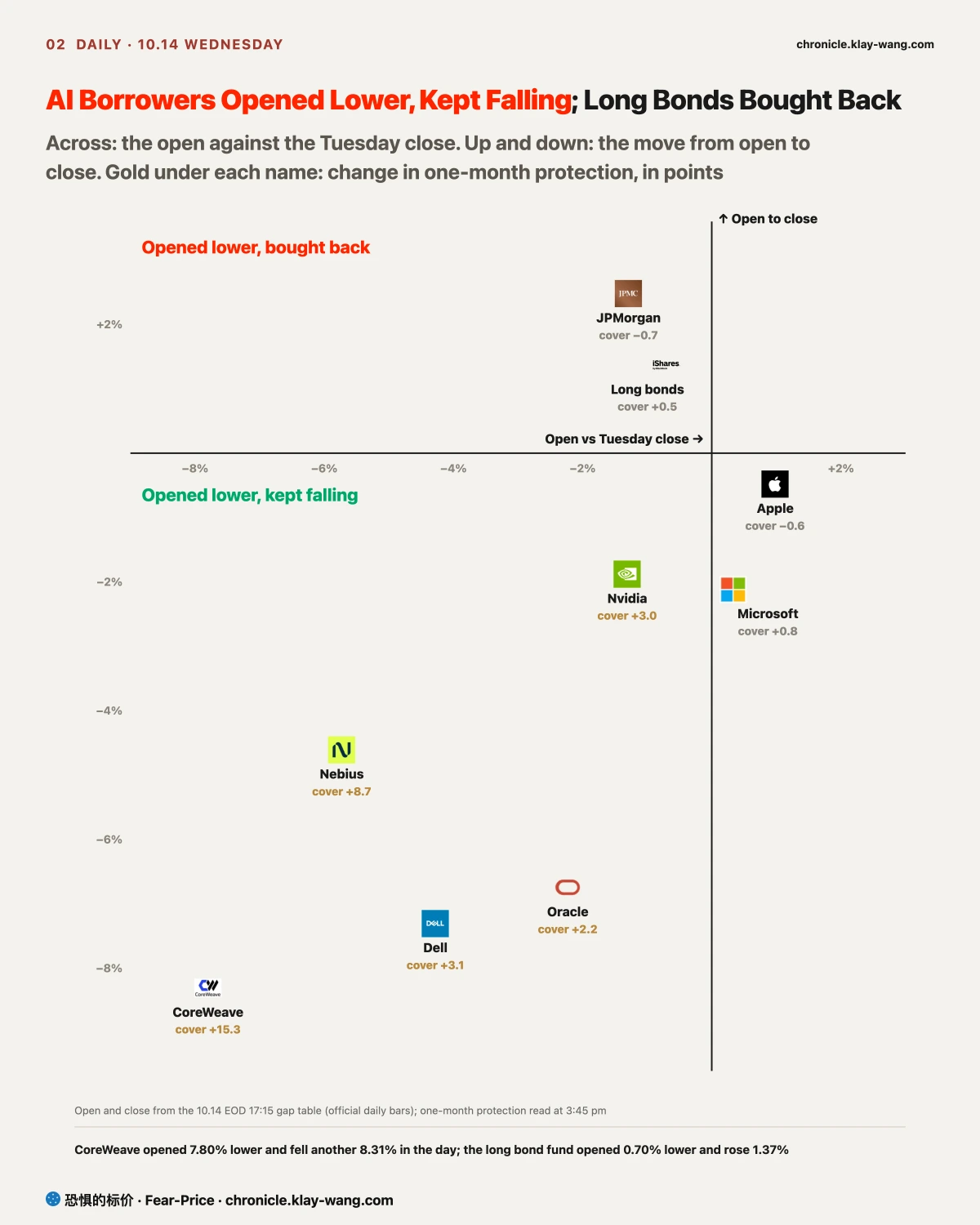
Long yields have been going the other way for over a month: the 10-year rose more than half a point in September, peaked on a closing basis last Monday and has not returned to that high; on a hot inflation print Wednesday it closed at its lowest in October, every yield from seven years out closed below Tuesday, and protection against rate swings got cheaper. The long-bond fund opened lower, was bought back during the session, closed in the upper part of its range, on volume 70% above Tuesday.
What rose was only the short end out to three years, the hike bets that CPI brought; the 5-year did not move, and everything from seven years out fell. There are two readings of why long bonds were bought: one is that the market thinks hikes will cool the economy and rates will have to come back down in a year or two; the other is that on a day stocks fell hard, money looked for a safe place. One day of data cannot tell which weighs more, and both say the long end did not treat this CPI as the start of hike after hike.
The second counterexample is in stocks. If future profits were really being marked down, the big stocks valued on them should fall the most; yet Apple closed at another record, and the big stocks overall fell far less than the borrowers. That says CPI only nudged near-term hike bets higher; what Wednesday actually priced was who needs to borrow and at what cost. When would this reading fail: if the 10-year starts rising with the short end and the big stocks fall more than the borrowers, that is a rate shock.
When you see a headline about hike fears crushing tech, compare it with whether the 10-year moved and whether the hardest-hit stocks are the ones that borrow the most.
[Credit] The Real Push Came From Corporate Bonds: The Closer to the Borrowing, the Bigger the Fall
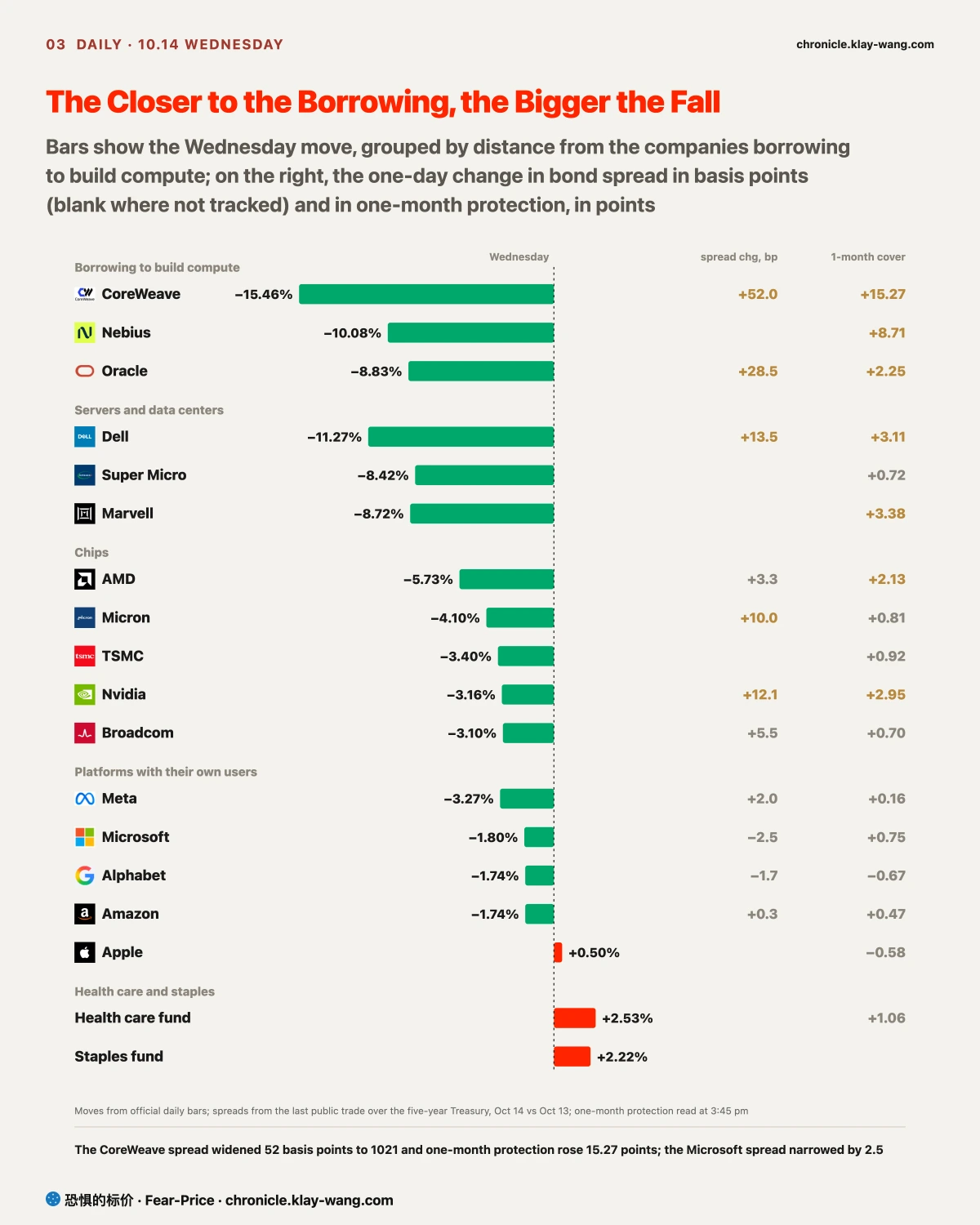
This time CoreWeave bonds fell first and the stock followed a day later. The extra interest the bonds CoreWeave itself issued pay over a Treasury of the same maturity (the spread) has widened all month. On October 8 it jumped 59 basis points in a day and the stock fell nearly 8% the same day, bonds and stock in step; over the following week the spread kept widening while the stock only drifted lower; by Tuesday its bond yield was close to 15%, while the stock had fallen just 5% over those two sessions. The 15% drop on Wednesday caught the stock up with a price the corporate bond market had set days earlier.
Bondholders care only whether the money comes back on time. CoreWeave borrows to buy GPUs and build data centers, then rents out compute to repay; its CEO wrote to staff on Wednesday that the backlog is enough to cover its debt (Reuters). The backlog answers whether anyone is renting; the bond price answers whether rent arrives ahead of interest. The reflexivity George Soros described is concrete here: it keeps needing new money, and its stock and bond prices set the price of the next loan, so prices fall, new money costs more, debt service gets harder, prices fall again. The same day Anthropic told investors its third-quarter revenue rose nearly 50% from the second quarter (Financial Times): the side paying to rent compute is growing, and the squeeze is on the middle link that borrows first and builds.
The selling moved up the chain the way the money flows. Compute renters borrow to buy servers, networking gear and chips; when borrowing gets harder, the nearest link loses orders first. We track the stock, the bond spread and one-month protection for each of these companies, and on Wednesday all three ranked them in the same order: compute renters fell most, servers and data centers next, chips after that, and the gatekeeper platforms least.
On Monday we left a reading: if one-month protection on Nvidia and TSMC also rose, the pressure had reached the chip sellers. Wednesday delivered half of it, with Nvidia protection up nearly 3 points and TSMC under 1. Nor did the order of the chain appear only on Wednesday: on October 7 we wrote that cash-rich giants were rising while those borrowing to rent compute were falling, and the review last week said the AI chain was being re-ranked by who repays; the semiconductor ETF has now fallen seven sessions in a row, its longest losing streak since May 2025 (Bloomberg).
If you hold companies borrowing to build compute, watch their bond price first; with CoreWeave, the stock fell after the bonds. When this reading fails: the CoreWeave spread falls back below 838 before Friday, October 16, which would mean Wednesday was a one-off sale.
[Whistle] We Said on Monday the Borrowers Building Compute Would Be Hit First; Three Tests Come Next
We said companies borrowing to build compute would be hit hardest before the drop on Wednesday. The Monday edition led with borrowing to build compute costing 11%, with the dearest borrowers hit hardest; the Tuesday edition said CoreWeave pays 969 basis points over Treasuries and money is leaving those borrowing to build compute.
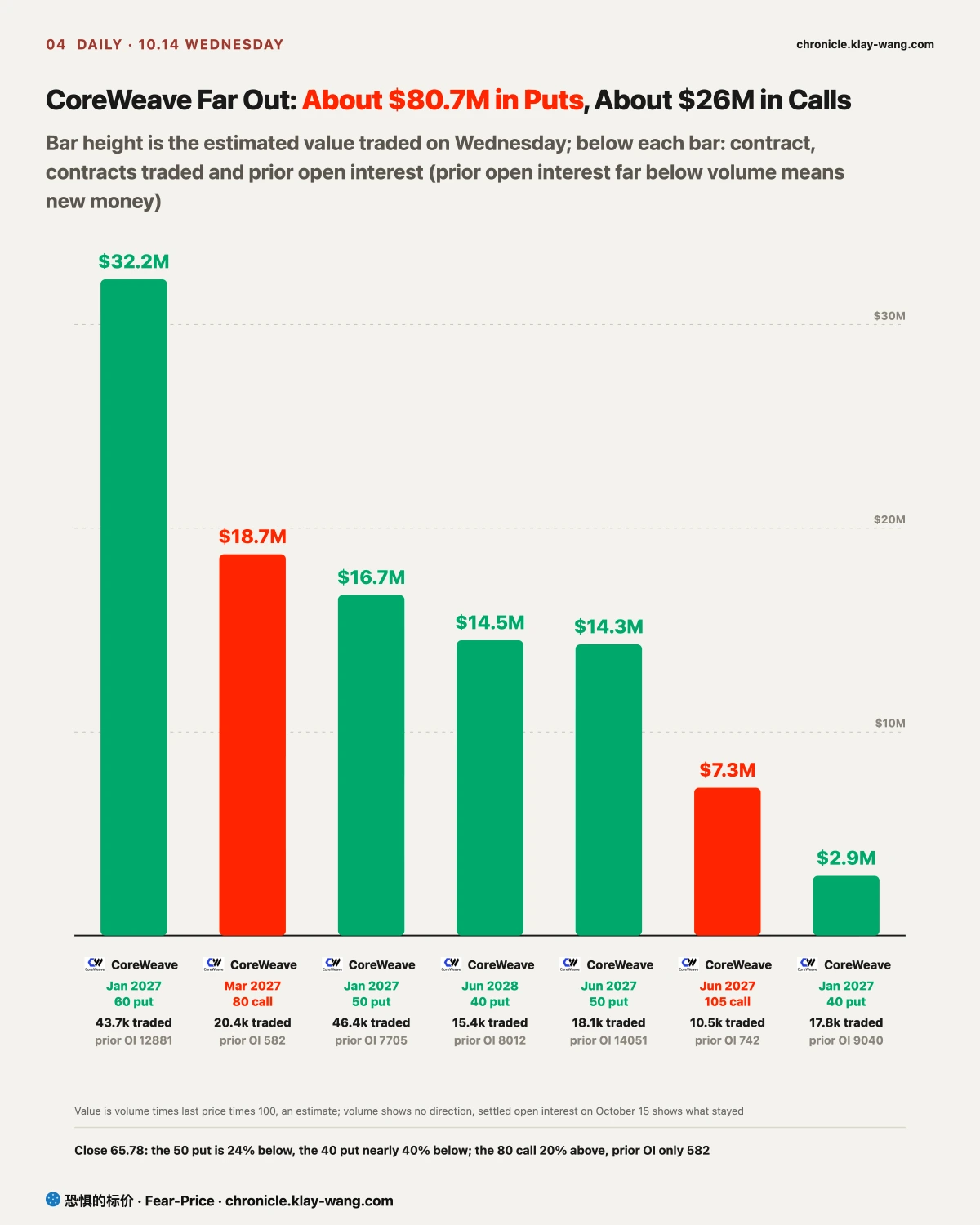
It has not spread to the whole market. In options, one-year money presses only on CoreWeave, where far-dated puts were three times the calls by value; one-year protection on the S&P 500 did not move, and high-yield bonds slipped only a little. Near-month money presses on the indexes: November small-cap and S&P 500 puts all run past the October 28 Fed meeting, matching a scenario of another leg down around it. The review last week said far index protection was all bought past October 28; on Wednesday November index puts and the hike odds in futures rose together, so that one held.
Three tests come next, each with its own reading:
- TSMC results on Thursday: its one-month protection barely rose the day before, so nobody is paying extra for it. Weaker guidance would carry the pressure from the borrowing link all the way up; steady guidance would say the problem is stuck in the middle, with those borrowing to build.
- Next Wednesday: one-year protection on the S&P 500 (18.10 this Wednesday) and high-yield spreads. If both rise together, it is no longer one chain.
- The Fed on October 28: the scenario behind those near-term puts gets its answer then.
What would prove us wrong: next Wednesday neither S&P 500 one-year protection nor high-yield spreads move, and the CoreWeave spread falls back below 838; then Wednesday was a one-off sale and we take this call back.
If you want to follow the far-dated puts, volume shows no direction; check whether open interest stayed the next morning first.
[Ledger] One Went Too Far, Two Were Wrong
The calls that held are in the sections above; here are the three that did not.
- The September review said that if core inflation beat again, a hike on October 28 was likely, and core did beat, but futures give only 33%, so likely went too far.
- The September review said long yields could hardly be said to have peaked, yet on a day inflation beat, long yields fell.
- The October 5 call that money keeps crowding into the biggest stocks (equal-weight to cap-weight below 0.2725 on Friday) moved away, as big stocks fell more than equal weight on the down day and the ratio rose to 0.2756.
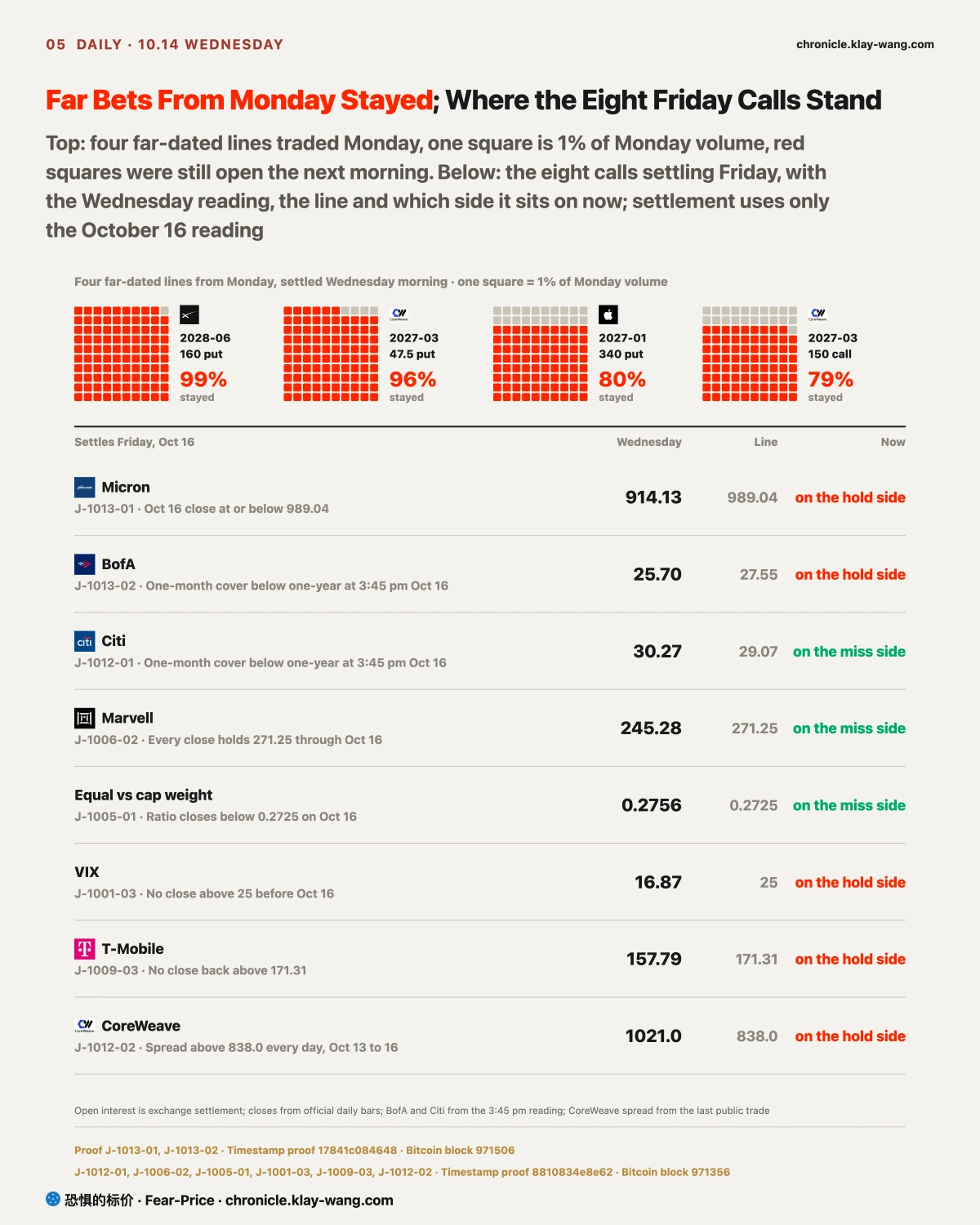
[Settled] Eight Calls Due Friday: Five on the Hold Side, Three Not Yet
These eight were filed between October 1 and 13 and settle on Friday, October 16. Where they stood on Wednesday:
- Micron closes at or below 989.04: Wednesday 914.13, on the hold side.
- Bank of America one-month protection below one-year: 25.70 against 27.55, on the hold side; only the Friday 3:45 pm reading counts.
- Citi one-month protection below one-year: 30.27 against 29.07, still on the miss side.
- Marvell holds 271.25 at every close: Wednesday 245.28, on the miss side.
- Equal-weight to cap-weight ratio below 0.2725: Wednesday 0.2756, on the miss side.
- VIX no close above 25: 16.87, on the hold side.
- T-Mobile no close back above 171.31: Wednesday 157.79, on the hold side.
- CoreWeave spread stays above 838: Wednesday 1021, on the hold side; every reading day must stay above 838.
What This Means for What You Hold
If you hold compute renters (CoreWeave, Nebius): the bonds have already priced it for the stock; watch the spread first, the stock second.
If you hold servers and chips (names like Dell, Oracle, Nvidia): the closer to the borrowing, the bigger the fall; TSMC results on October 15 will say whether chip demand has changed.
If you hold the big gatekeepers (names like Apple, Microsoft): they were the group that fell least on Wednesday and Apple set a record; they do not borrow to build compute, and if the 10-year does not rise, valuation pressure stays light.
If you hold banks: Bank of America fell nearly five points after earnings, yet its one-month protection dropped below one-year; the extra premium paid before earnings is gone, and what matters next is whether trading revenue holds up.
The Dates Ahead: Within a Month, the Fed on October 28 Matters Most
These calls cross-check guidance and supply and demand against volume, open interest and implied volatility; sudden news is outside what can be anticipated, and settlement counts either way. For you, the day to watch within a month is the Fed meeting on October 28.
This week
- Thursday, October 15: TSMC third-quarter results (early morning US Eastern), a read on whether chip demand has changed.
- Friday, October 16: monthly expiry; eight calls settle.
Within a month
- Wednesday, October 21: the two new calls from today settle.
- Wednesday, October 28: the Fed decides, with futures putting hike odds at 33% on Wednesday; the November 20 index puts run past this date.
- November: the next CoreWeave quarterly report (Cailianshe); the Anthropic listing is expected to start in November (Financial Times). One borrows to build and one pays to rent; put side by side, the two sets of numbers will show whether the middle link still adds up.
Three months and beyond
- January 15, 2027: the CoreWeave 50 and 60 puts expire together; watch how much of them stays.
- March 2027 to June 2028: the CoreWeave far-dated contracts. Spread and one-year protection falling together would mean the pressure is easing; one-year protection on the S&P 500 and high-yield spreads rising together would mean it is spreading.
Three Lines Worth Keeping
- Wednesday was not a rate shock: yields from seven years out all fell, protection against rate swings got cheaper, and what rose was the short end out to three years and the odds of an October hike.
- The push came from corporate bonds: CoreWeave bonds fell first and the stock followed, the closer to the borrowing the bigger the fall, and we said so on Monday.
- It has not spread yet: one-year money presses only on CoreWeave; one-year protection on the S&P 500 and high-yield spreads rising together would mean it is spreading.
No investment advice. No direction calls. No market timing.