404 S&P 500 Stocks Rose, but the Market Is Repricing AI Demand
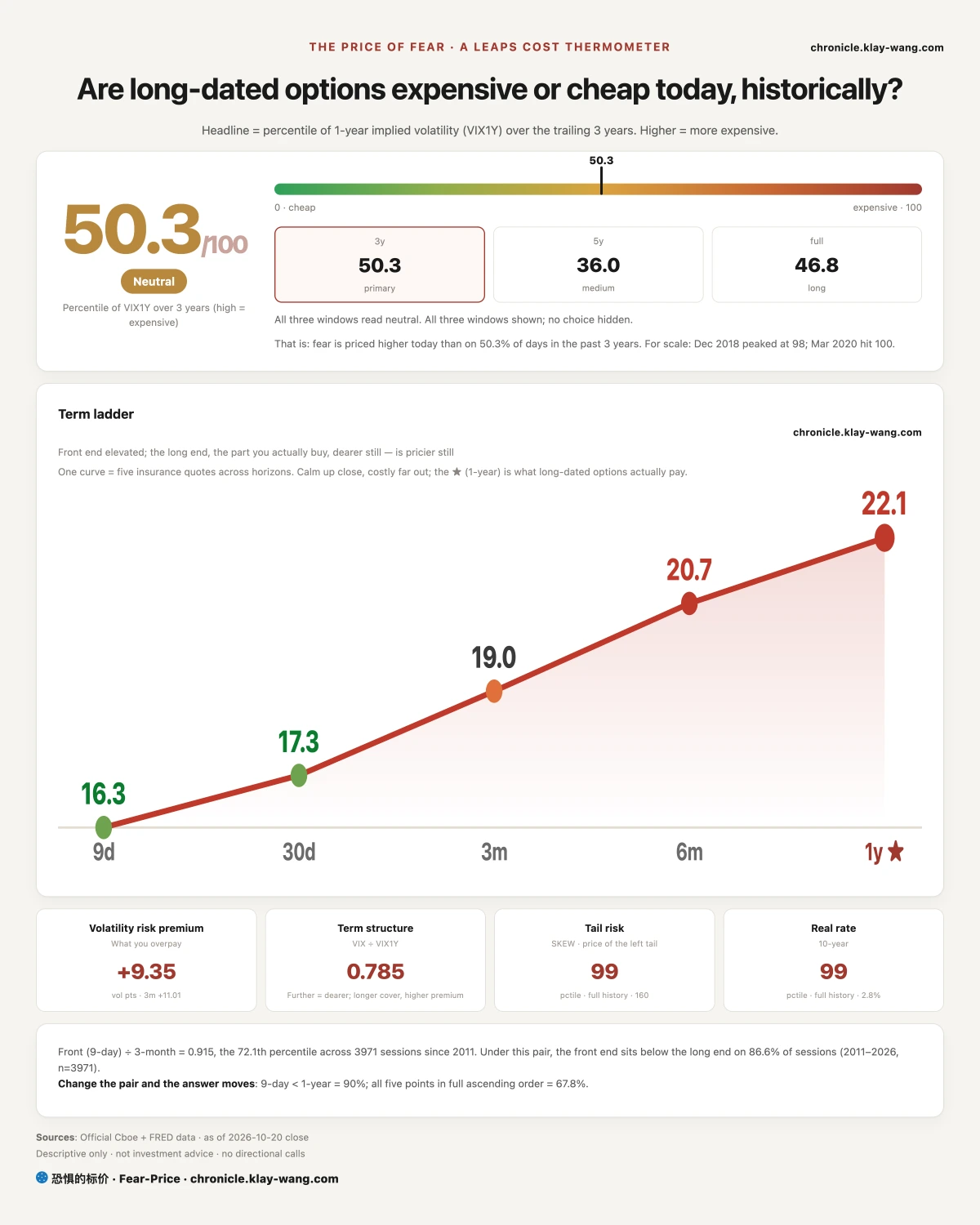
Fear-Price Index 50.3: One-Year Cover Returned to the Middle, but Crash Insurance Stayed Expensive
Fear-Price Index · 2026-10-20 · Reading 50.3/100: one-year volatility VIX1Y is 22.05, in the 50.3rd percentile of the past three years, where high means expensive. Daily ledger and definitions at chronicle.klay-wang.com · Please credit: Fear-Price Index · Fear-Price
Protection here means using options to insure against future volatility. The higher the implied volatility, the more expensive that insurance becomes.
The reading fell from 54.0 on Monday to 50.3, and VIX1Y fell from 22.30 to 22.05. Protection still became more expensive with maturity, from 17.31 at 30 days to 22.05 at one year.
SKEW rose to 160.4, in the 99.1st percentile of its full history, while the real rate was 2.8%, in the 99.3rd percentile. Ordinary one-year cover returned to the three-year middle, while deep downside insurance and the rate used to discount distant profits remained near historical extremes. The near term became calmer; tail risk and long-duration valuation did not ease with it.
The K Index was 1.571, above the Monday final reading of 1.128. A reading closer to 1 means more investors have turned a bearish view into paid protection. With Fear and Greed at 27.2, VIX would need to rise above 27.2 for K to fall below 1. History is at chronicle.klay-wang.com/kindex, and the index is at chronicle.klay-wang.com/fear-price.
[Market] Eight in Ten Stocks Rose, Yet Protection Became More Expensive for Six in Ten Tracked Names
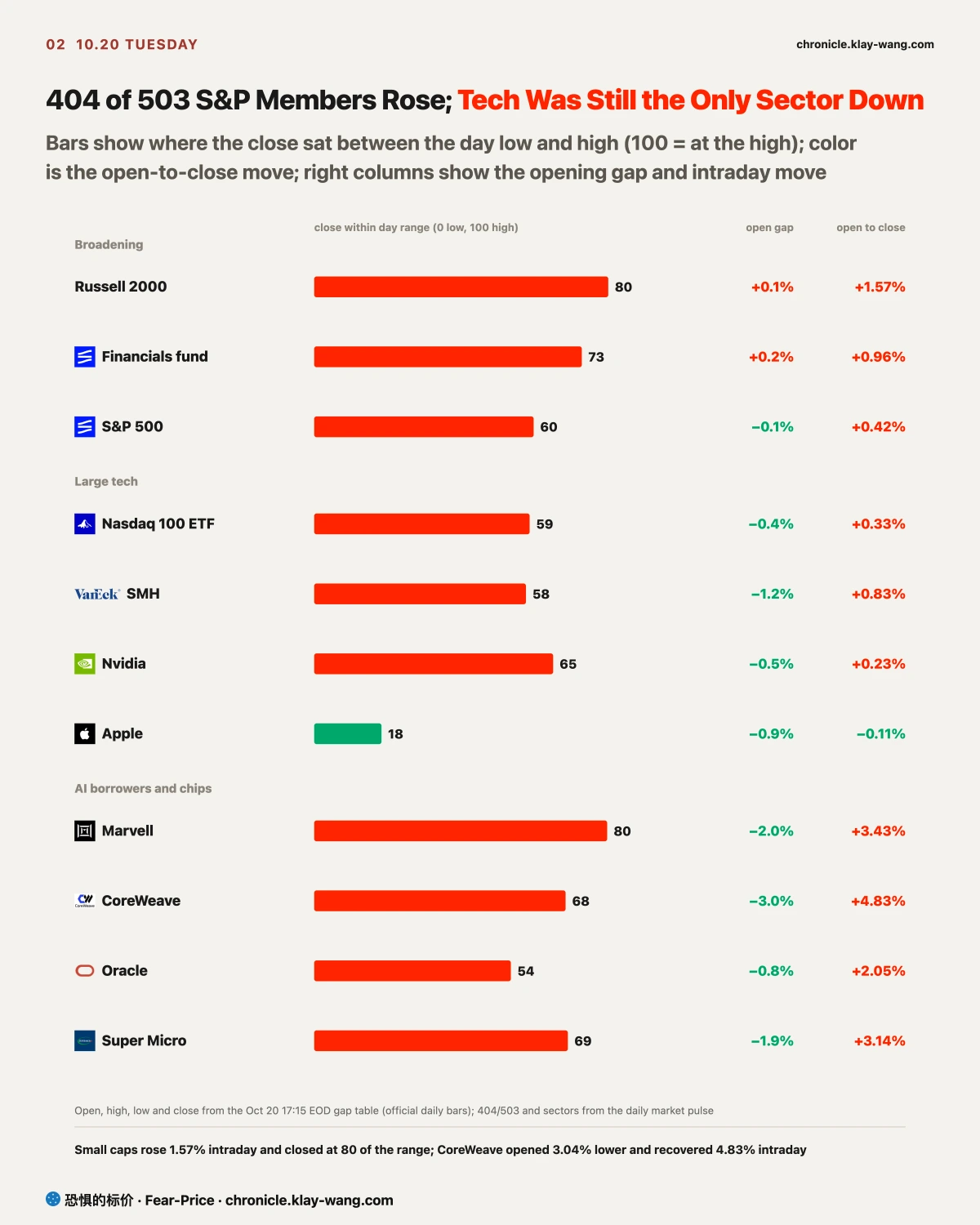
The S&P 500 rose only 0.28%, yet 404 of 503 members gained, up from 175 on Monday. Small caps and the Dow led, health care and financials topped sectors, and technology was the only S&P sector to fall. The Nasdaq and the semiconductor ETF also lagged.
Long Treasuries and the yen rose while the dollar fell. Copper and bitcoin gained, gold fell, and oil was almost flat. A recession trade would usually weaken copper and most equities, while an inflation shock would usually hurt long Treasuries. Neither pattern appeared. Tuesday looked like broader equity participation without renewed leadership from large technology.
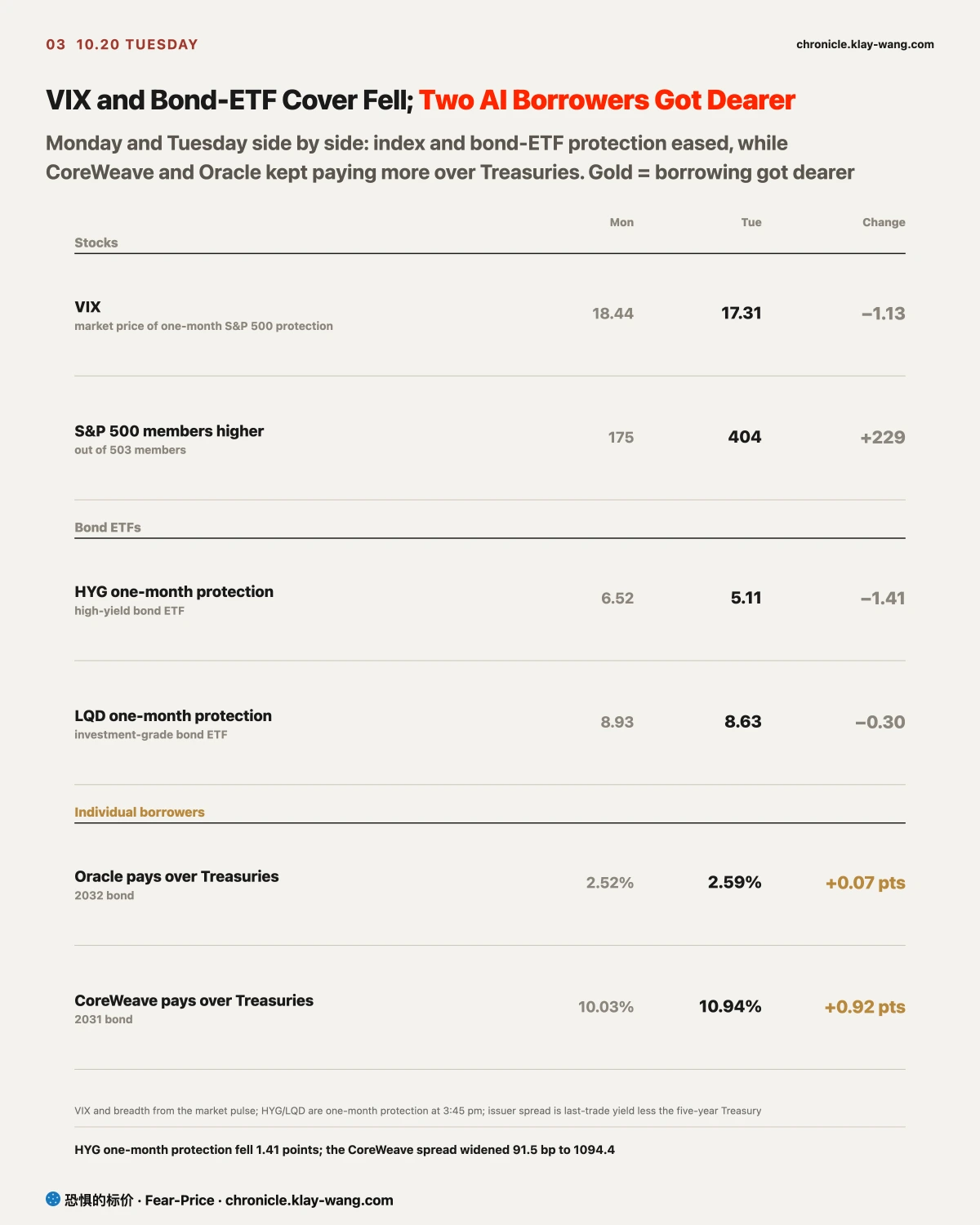
Options added another layer. One-month cover became cheaper for SPY, IWM, HYG and LQD, while it became more expensive for 29 of 45 tracked names. Nvidia, Super Micro, Marvell and Broadcom were among the largest increases. The first group insures an entire market or bond basket; the second insures individual companies. Breadth, index options, bond ETF options and issuer spreads measure different things, yet on Tuesday they pointed to the same split: insurance against a market-wide decline became cheaper while insurance against company-specific trouble became more expensive.
[One AI Dollar] The Same Spending Lands Differently on Three Balance Sheets
SpaceX reported third-quarter revenue of $14.58 billion and capital spending of $19.59 billion, including $16.44 billion for AI infrastructure. AWS was reported to be receiving about $5 billion of Nvidia GB300 racks, while Anthropic could spend up to $86 billion leasing Nvidia chips. Most of these reports arrived around or after the close, so they cannot explain each move during the Tuesday session. They do show that compute demand has not disappeared.
Capital spending was 1.34 times quarterly revenue. That ratio shows capital intensity, not a quarterly loss. Servers and data centers become assets used over several years and enter the income statement through depreciation. Cash and financing capacity are committed much earlier. Chip suppliers recognize revenue after delivery; platforms fund the buildout; debt-funded compute providers must also meet interest and refinancing terms.
The latest reported numbers make the split tangible. Nvidia had a 63.7% net margin and $28.5 of liabilities for every $100 of assets. CoreWeave more than doubled revenue but still lost $1.37 billion, with $93.5 of liabilities for every $100 of assets. Oracle sat between them: revenue and profit were still growing, its net margin was 26.4%, and liabilities were $77.8 for every $100 of assets.
Order growth answers whether demand exists. Public markets still need to know how much gross profit suppliers retain, how quickly platforms earn back the buildout, and whether leveraged builders generate cash before equipment depreciates. Revenue can grow quickly while the balance sheet becomes tighter at the same time. For AI companies, orders determine how quickly revenue can grow; interest expense determines how much profit is ultimately left for shareholders.
[Stocks and Bonds] Shares Recovered While Debt-Funded Expansion Was Still Charged Separately
One-month cover on high-yield bond ETF HYG fell from 6.52 to 5.11, while LQD fell from 8.93 to 8.63. Long Treasuries rose, yet MOVE remained at 101.69, in the 68th percentile of the past three years. Broad corporate credit did not deteriorate, and rate uncertainty did not return to calm.
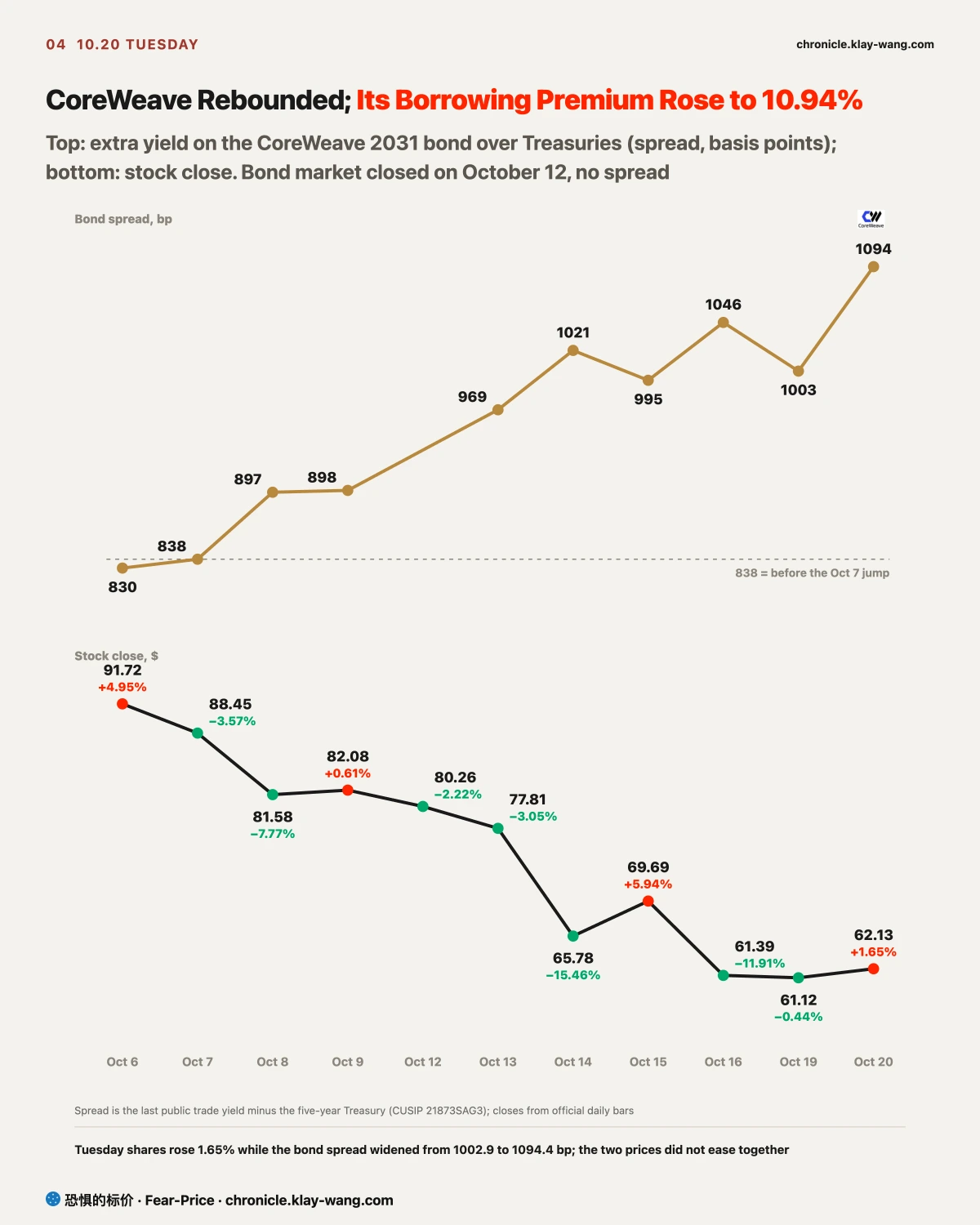
The yield a corporate bond pays above a Treasury of similar maturity is the extra interest charged to that borrower. The CoreWeave spread rose from 10.03 to 10.94 percentage points in one day. The Oracle spread rose from 2.52 to 2.59 points. Both stocks gained while bondholders did not lower the financing charge.
Both prices can be rational. Shareholders keep the upside when growth exceeds expectations. Bondholders receive principal and interest at best, while bearing losses if cash flow falls short. Strong compute demand can lift the value of future equity revenue. Debt-funded expansion can still make bond investors ask where repayment comes from. Equities price the ceiling on growth; bonds defend the floor under repayment. The same company can have a rising stock and a wider bond spread: growth expectations improved, but the cushion protecting repayment did not thicken with them.
Oracle is the important bridge. It remains profitable and net income is still growing, yet its bonds pay about 2.26 percentage points more than the median of Amazon, Google, Meta and Microsoft. This price does not say Oracle is unable to pay today. It charges for uncertainty around future data-center spending, liability growth and refinancing. Oracle bonds were also repriced, showing that the market has extended this scrutiny to mature corporate balance sheets; HYG and LQD have not joined that deterioration.
The October sequence now fits together. At the start of the month, long rates capped distant profits. CoreWeave bonds were repriced on October 12. Last week Meta and Broadcom spreads narrowed while debt-funded builders stayed expensive. Stocks rebounded on Monday without easier financing. On Tuesday 404 stocks rose and broad credit improved, yet CoreWeave and Oracle were still charged separately. The object being repriced has become more specific: first distant profits through long rates, then the credit of debt-funded builders, and now the balance sheet of each company. The same AI investment cycle now carries two prices: equipment sellers are paid for demand, while borrowers are charged for repayment capacity.
[Horizon] One Month Tests Profit, Three Months Test Credit, and the Long Run Tests Utilization
Over the next month, earnings must show that orders are becoming profit. Chip suppliers need gross margin and operating cash flow; platforms need revenue to catch up with capital spending; CoreWeave and Oracle need the extra bond interest to recede. Index protection became cheaper while protection rose for 29 of 45 tracked names. Earnings season now requires company-by-company underwriting; an AI label cannot replace profit and financing data.
Over three months, HYG and LQD mark the break point. If both remain stable while CoreWeave and Oracle spreads retreat, this remains an issuer problem. If broad credit and more large-platform bonds become expensive together, financing pressure has spread from a few balance sheets to the market.
Long-dated options, or LEAPS, expiring in 2027 and 2028 included Intel and CoreWeave calls as well as long-Treasury, Nasdaq and AMD puts. Both long-run outcomes were traded. Volume cannot reveal who initiated a trade or prove that a position stayed overnight. The next open-interest reading must rise before those trades count as persistent positions.
Farther out, utilization decides the result. A completed data center is not yet a profitable asset. Rental prices, occupancy, equipment refresh cycles and debt maturities must fit together. The chain holds while supplier profit converts, platforms can fund expansion from existing cash flow, and credit spreads on leveraged builders stop rising. The weak link is usually the company that must refinance repeatedly while its equipment keeps depreciating.
What This Means for What You Hold
If you hold indexes, small caps or financials: 404 gainers show that breadth genuinely improved. Watch whether the number of gainers stays high and whether small caps and financials retain the Tuesday gains. A quick reversal would make the move look like a one-day catch-up.
If you hold Nvidia, Marvell or chip suppliers: demand evidence remains strong, but valuation now needs profit conversion. After order growth, gross margin, inventory and operating cash flow matter more than another capital-spending headline.
If you hold Oracle: current profit is still growing while bond investors already price future financing. The stock and the bonds need to improve together before expansion returns clearly exceed the cost of capital.
If you hold CoreWeave or other debt-funded compute builders: revenue growth alone cannot show that shareholders keep the profit. Utilization, contract duration, interest coverage and refinancing costs must all pass the test.
If you hold corporate or long-duration bonds: HYG and LQD cover eased while MOVE remained in the 68th percentile. Broad credit did not deteriorate, while the rate path remained unsettled. These are separate risks.
Three Lines Worth Keeping
- Eight in ten S&P 500 stocks rose, yet protection became more expensive for 29 of 45 tracked names: insurance against a market-wide decline became cheaper while insurance against company-specific trouble became more expensive.
- For AI companies, orders determine how quickly revenue can grow; interest expense determines how much profit is ultimately left for shareholders.
- October repricing has moved in three steps: distant profits first, corporate credit next, and now company-by-company charges based on each balance sheet.
No investment advice. No direction calls. No market timing.