Meta Asked Shareholders for Money and Bondholders Relaxed; Is the Market Doubting Amazon Results This Week?
Three Lines: Shareholders Pay the AI Bill as Market-Wide Risk Recedes
- Meta announced a stock sale of about $35 billion. Its shares fell and its options got dearer, while its bond spread narrowed: The bill landed on shareholders.
- Market-wide insurance got cheaper, and 289 of the 503 S&P 500 members rose.
- Risk moved to three big earnings reports this week and to a ten-year yield stuck at 5%.
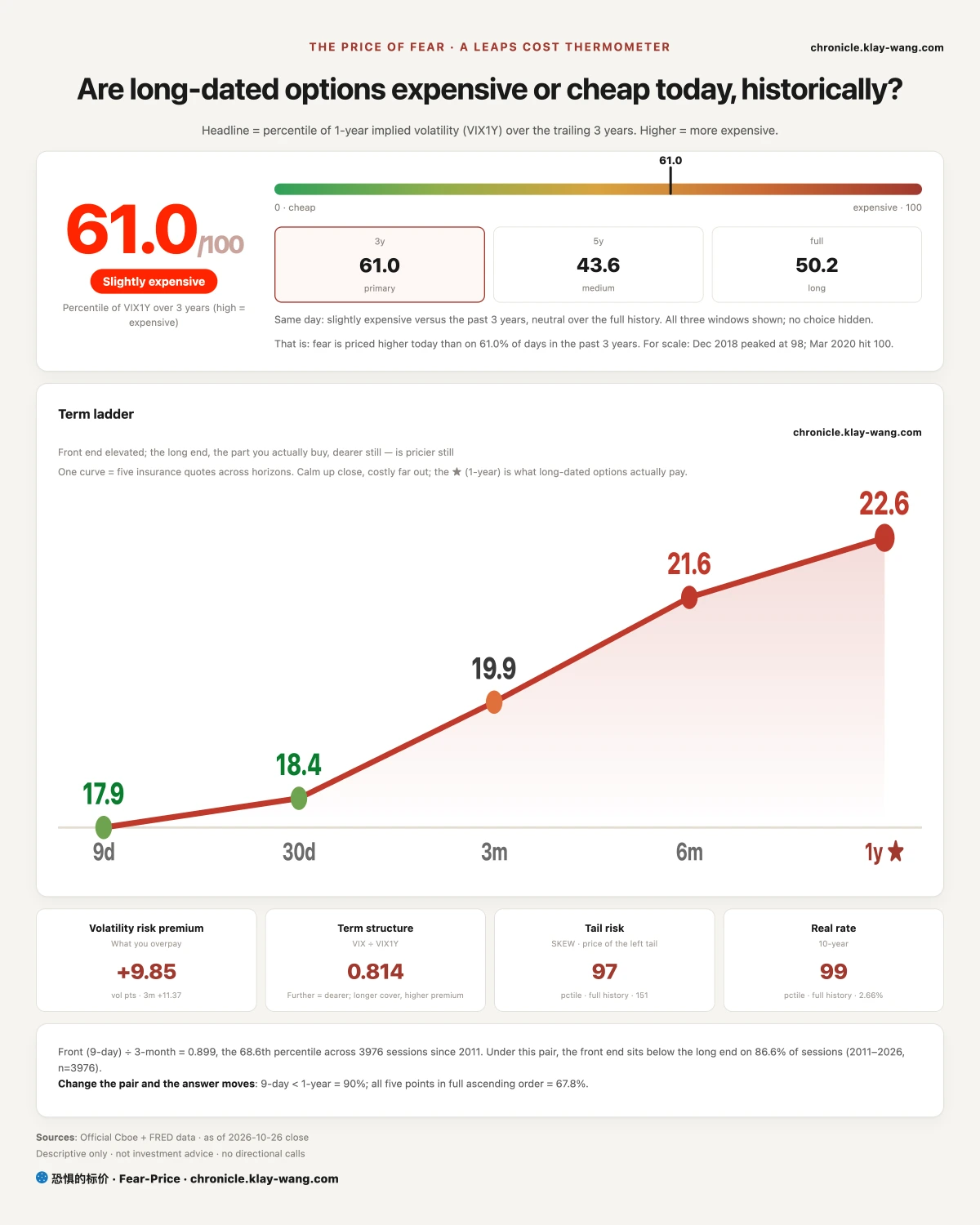
Fear-Price Index 61.0: Market-Wide Cover Got Cheaper; the One-Year Leg Is Still Slightly Expensive
Fear-Price Index · October 26, 2026 · 61.0/100. One-year implied volatility was 22.59%, at the 61.0th percentile of the trailing three years; higher means historically more expensive. Daily ledger: chronicle.klay-wang.com. Credit: Fear-Price.
The reading was 67.3 on Friday and fell 6.3 percentile points on Monday, as one-year implied volatility eased from 22.82% to 22.59%. The term ladder rose step by step from 17.92% at nine days to 22.59% at one year. Cheap near and dear far means the market was not paying for a sharp drop in the next few weeks; its worry sits further out.
The K Index divides the CNN Fear and Greed reading by VIX: sentiment over the price of protection. The late Monday reading of 27.1 over 18.39 gives a provisional 1.472. The final Friday value was 1.182, which replaces the provisional 1.079 in the Friday note after CNN revised its reading from 21.0 to 23.0. With Fear and Greed unchanged, VIX would need to rise above 27.1 for K to fall below 1, far from the Monday level. What followed each past break can be checked at chronicle.klay-wang.com/kindex, and the long-dated percentile at chronicle.klay-wang.com/fear-price.
Read together, index-level tension is fading: sentiment recovered faster than protection got cheaper. On Monday the most expensive risk sat in one company.
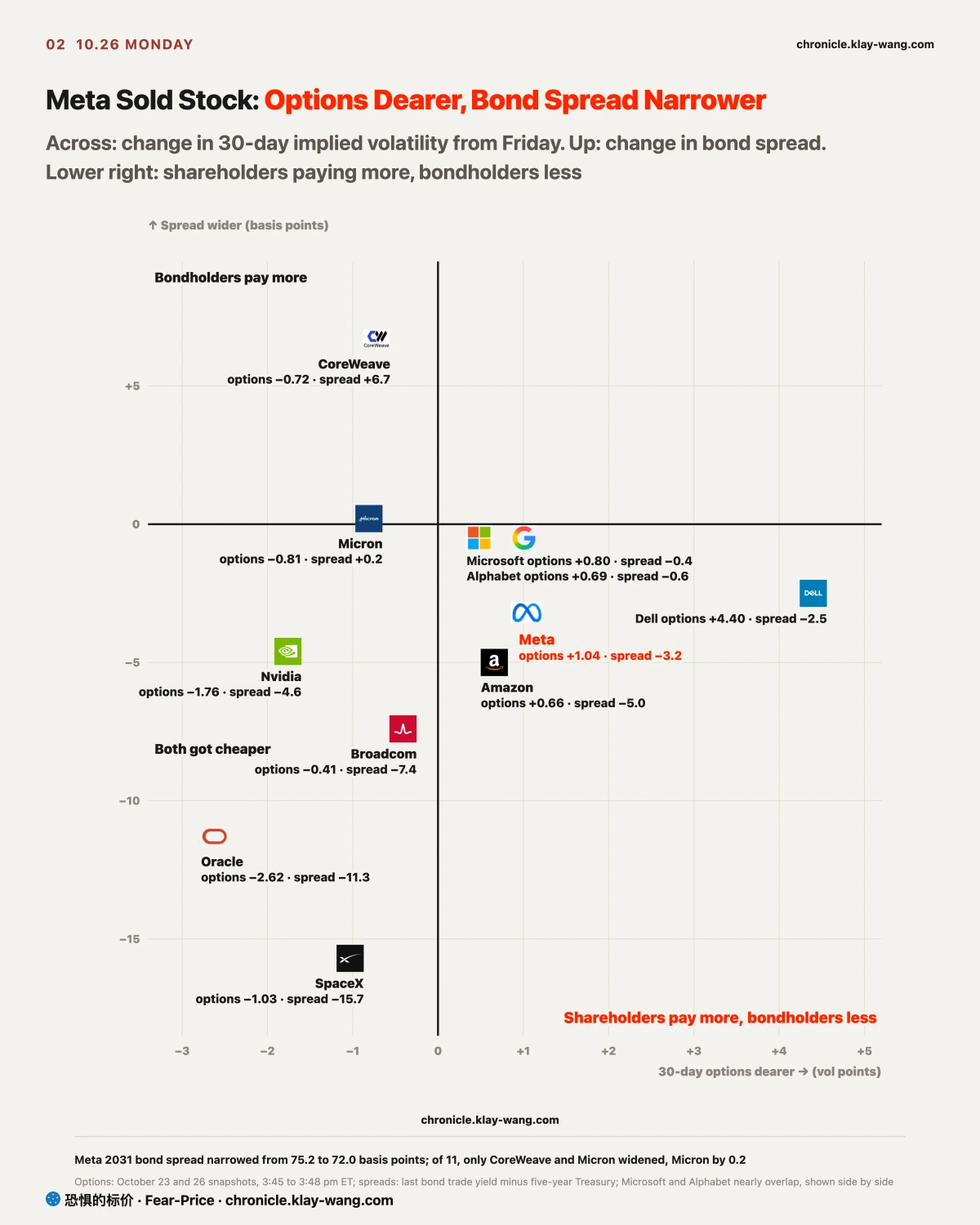
[Main Line] Meta Asked Shareholders for the Money: Its Stock and Options Got Dearer, Its Bond Spread Narrowed
On Monday Meta launched a public offering of about $35 billion: roughly $22.5 billion of common stock and $12.5 billion of preferred stock that must convert into common. Once its non-voting Class C shares begin trading, which the company expects in the first quarter of 2027 at the earliest, it plans an at-the-market program of up to $60 billion more, for a possible $95 billion in all. At the Monday close, the $35 billion converted entirely into common stock is about 2.2% of existing shares; the full $95 billion would be about 5.9%.
Why ask shareholders? Its own accounts answer. In the third quarter Meta spent $34.91 billion on capital projects, more than its $32.79 billion of operating cash flow. At the end of September it held $82.45 billion of cash and marketable securities against $80.92 billion of long-term debt, roughly even. More borrowing would leave its cash unable to cover its debt, so it chose equity. Equity and debt affect the two groups in opposite ways: if a company fails, bondholders are repaid first and shareholders last, so every extra dollar from shareholders adds a cushion under the bondholders. The cost is that future profit per share gets diluted.
Each price reacted on its own. The stock fell 1.88% on Monday and 9.60% over three sessions from the Wednesday close. Its 30-day implied volatility rose from 37.39% to 38.43% while the Nasdaq 100 ETF fell from 24.54% to 22.03%. Its 2031 bond spread over the five-year Treasury narrowed from 75.2 to 72.0 basis points on Friday to Monday. Shareholder insurance cost more and the interest bondholders demand fell: The market booked the Meta AI bill to its shareholders.
Meta was not alone. Of the 14 AI-related issuers we track with bond trades, 12 spreads narrowed. Only two widened: Micron by 0.2 basis points, barely moving, and CoreWeave from 1047.6 to 1054.3 basis points, still above 1000. CoreWeave lacks enough operating cash flow and must borrow to build computing capacity; Elon Musk said last weekend that new cloud providers without independent revenue face a shakeout. SpaceX completed a $40 billion GPU financing led by Apollo, and its spread narrowed from 225.3 to 209.6 basis points. The richer the company in cash, the more it can use shareholder money; those borrowing to build pay more interest. The bond market has not turned on AI; it has turned on the CoreWeave tier that borrows to build and earns little cash of its own.
A third way to raise money appeared after the close. At 4:16 pm ET, Bank of America, Blackstone, Citi and Morgan Stanley announced a $63 billion financing: a new special purpose vehicle will use bank and Blackstone loans to buy Broadcom AI accelerators and networking equipment and lease them to Anthropic, with deliveries starting in 2027. The key term is that Broadcom provides residual value support equal to the first-lien loans; if the chips later lose value, Broadcom covers the gap. In plain terms, Anthropic does not pay for the chips itself: banks buy them and lease them to it, and if the chips lose value and the loans cannot be repaid, Broadcom covers the loss. Meta asked shareholders, SpaceX borrowed from Apollo, and Broadcom is backstopping the lenders of its buyer. The risk has not disappeared; it moved from the Anthropic books to the Broadcom books. Broadcom rose 1.31% after hours, and the option and spread readings at the Monday close do not yet reflect the news.
[Horizons] Risk Moved From the Whole Market to Three Earnings Reports and Long-Term Rates
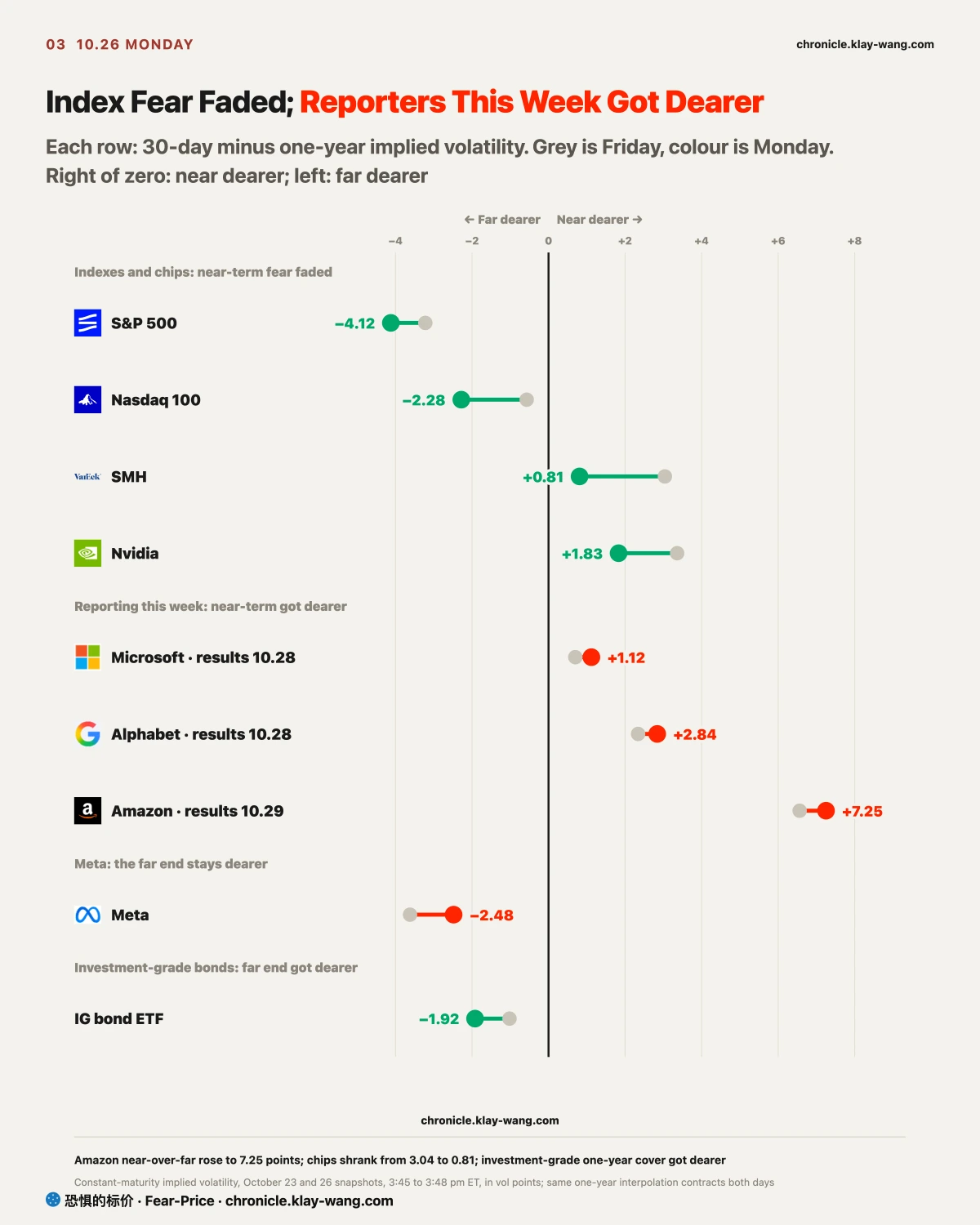
Start with indexes and chips. S&P 500 ETF 30-day implied volatility fell from 15.43% to 14.29%, and the semiconductor ETF from 41.61% to 38.73%. Its 30-day premium over one year shrank from 3.04 to 0.81 points: The near-term panic from the drop last Thursday had largely returned to normal. The same day Anthropic made its IPO filing public, showing first-half revenue of $16.286 billion and operating cash flow turning positive at $3.9 billion. The ultimate buyers of chips now have revenue that can be checked, which gave chip stocks a reason to rise.
Then the three reporting this week: Microsoft and Alphabet on October 28, Amazon on October 29. Amazon 30-day implied volatility rose from 43.58% to 44.24% against 36.99% at one year, a near-over-far premium of 7.25 points, up from 6.56 on Friday; Alphabet and Microsoft 30-day cover also rose. Options have packed these earnings into 30-day insurance; their risk is counted in weeks. Meta is the opposite, with one year at 40.91% above 30 days at 38.43%. Its question is counted in years: whether capital spending pays back takes years to show, and this stock sale pushes that test further out.
Finally, rates. The ten-year Treasury yield closed Monday at 5.00%, unchanged from Friday, after 5.13% last Tuesday and 4.96% on Thursday. The two-year eased from 4.69% to 4.68%. The MOVE index of bond volatility was 102.19, still above 95.94 last Tuesday. One-year insurance on the investment-grade corporate bond ETF rose from 9.57% to 10.24% while its 30-day cover fell. The Fed decides on Wednesday; the November fed funds future, on the final Friday values, was only 2.25 basis points above October. A certain quarter-point hike would separate them by more than 20, so almost nobody is betting on a hike; Reuters reported that the Fed is likely to hold, but perhaps not for long. Money for stock protection is leaving while money for rate protection is not, which shows the bond market is not yet at ease before the Fed. If MOVE falls back below 96 after Wednesday, bond tension has eased too and this reading must change.
[Earnings] Among the Three Cloud Providers, the Market Trusts Microsoft Most and Amazon Least
Microsoft and Alphabet report on October 28 and Amazon on October 29. Meta has just set the precedent: when capital spending exceeds the cash a company earns, it has to ask shareholders or lenders for money. These three reports answer the same question: does the cash they earn cover what they spend.
In the last quarter, through June, Microsoft spent $35.8 billion on capital projects, less than its $55.44 billion of operating cash flow. Amazon spent $54.21 billion, more than its $45.39 billion of operating cash flow. Alphabet spent $44.92 billion, also more than its $39.07 billion. Of the three, only Microsoft can pay for its spending from the cash it earns.
Amazon 30-day implied volatility sits 7.25 points above one year, the most of the three and still widening from Friday; Alphabet is 2.84 points and Microsoft only 1.12. Since the Wednesday close, Amazon shares fell 5.06%, Alphabet 5.37%, and Microsoft was roughly flat. Microsoft bonds yield 2.6 basis points less than the five-year Treasury, while Amazon and Alphabet spreads are about 57 basis points. Options, shares and bonds give the same order: the market trusts Microsoft most, Amazon least, and Alphabet sits in between.
On the cash-flow math, the Amazon gap is the largest, so its option price is not excessive. Alphabet shares are already 22.47% below their record, the deepest of the three; if the gap between its capital spending and cash flow stops widening, it is the one with the lowest expectations and the easiest to beat them. If you hold Amazon, protection before results is the most expensive of the three, and whether that gap narrows is the number that matters most.
[Cross-Asset] Crypto and High-Volatility Broker Stocks Did Not Join; Money Returned Only to Companies With Revenue
The Monday losers were exactly the tier that usually rises faster than the market. The spot bitcoin ETF fell 1.61%, the spot ether ETF 3.21%, Coinbase 2.95% and Strategy 4.24%. If risk appetite had returned across the board, this tier usually leads; its decline shows money returning only where revenue can be explained. Chips had revenue from Anthropic; crypto had no comparable news on Monday.
Commodities and currencies gave no new direction. The oil ETF fell 1.95%, the gold ETF rose 0.33% and the dollar ETF rose 0.17%, all small moves that did not line up with stocks or rates. The Monday story played out among stocks, options and corporate bonds.
[Long-Dated] Meta February 2027 Calls Traded Heavily; Direction Waits for Open Interest Tomorrow
On the day Meta announced its stock sale, two call strikes expiring February 19, 2027 suddenly traded heavily: 12674 contracts at $780 against open interest of only 918 (905 at Interactive Brokers), and 12064 contracts at $950 against only 134. The $780 strike is 23.7% above the Monday close and $950 is 50.7% above. The two volumes differ by only 610 contracts, so they look like two legs of one trade. Buying 780 and selling 950 bets Meta rises above 780 within four months but not past 950; the reverse means someone is selling that stretch of upside.
Volume alone cannot show who bought, who sold, or whether positions opened or closed. On the near-month side, Meta 30-day cover also rose on Monday. For these far-dated February 2027 contracts, settled open interest tomorrow, the contracts still held overnight, gives the first answer: only open interest of at least 7255 at $780 and 6166 at $950, each adding half the volume of the day, would count as new positions. If open interest does not rise, the trades were closing or same-day positions, and the directional reading fails. Until then, these trades only show that someone acted on the long-dated Meta options on the day of the stock sale.
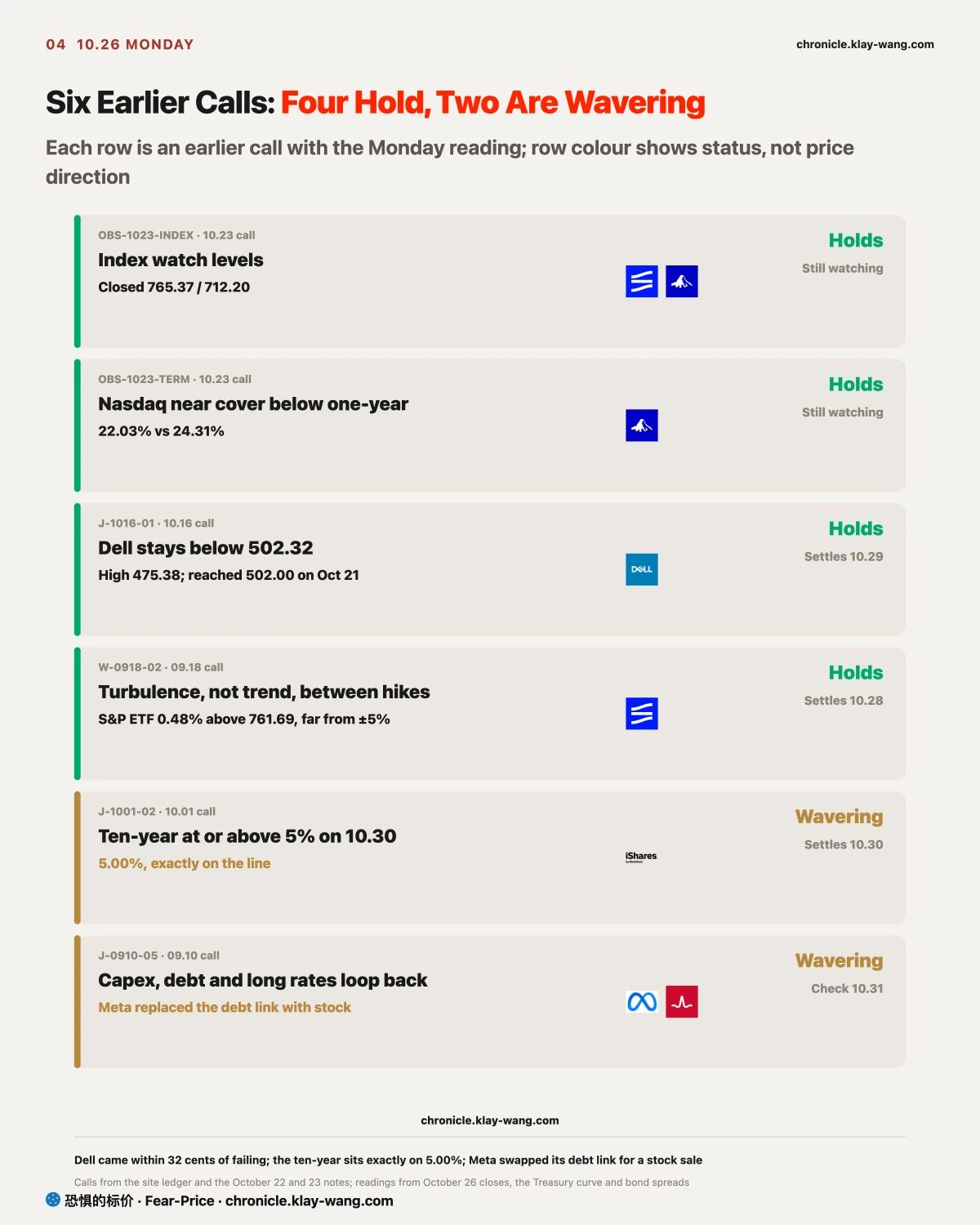
[Checkback] Six Earlier Calls: Four Hold, Two Are Wavering
Four still hold. Both levels written on Friday held: The S&P 500 ETF closed at 765.37, above 760, and the Nasdaq 100 ETF at 712.20, above 700. The other condition from the same note also held: Nasdaq one-month cover at 22.03% stayed below one year at 24.31%, so this pullback still looks more like rotation than a scramble for protection. The Dell call of October 16 required its intraday high to stay below 502.32 before October 29; the Monday high was 475.38, so it holds, but on October 21 it reached 502.00, only 32 cents short, and Dell 30-day cover jumped from 65.59% to 69.99% on Monday. Three sessions remain. The September 18 call that the stretch between hikes is turbulence and not a trend settles on whether the S&P 500 ETF stays within 5% of 761.69 before October 28; the Monday close was only 0.48% above. It settles after the Fed decision on Wednesday.
Two are wavering, and both come due this week. The October 1 call that the ten-year would still close at or above 5% on October 30, settling Friday, sits exactly on the line at 5.00%; one more basis point lower and it is withdrawn. The September 10 call that capital spending, bond issuance and long-term rates form a loop that comes back to the issuers themselves, due for review on October 31, saw its borrowing link replaced by a stock sale on Monday. Its withdrawal conditions have not been triggered, but this is no longer the only path. Nvidia, AMD and Broadcom expressed non-binding interest in buying up to $5 billion of Meta stock; if it happens, money flows from suppliers to the customer and back into supplier orders: The loop turns a different way.
[Next] For the Meta Bill, Watch the Spread First
My view: through November 20, The Meta 2031 bond spread over the five-year Treasury will not return above the 75.2 basis points of October 23. The stock sale adds a cushion under bondholders and holds their risk down. If the spread rises above 75.2, the market is worried the $95 billion will not all be raised and Meta will need to keep borrowing, and this view would fail.
First, watch Broadcom tomorrow. Its spread was 110.4 basis points on Monday. Backstopping chip residual value is a contingent liability tied to chip prices; if the bond market counts it, the Broadcom spread will widen, and if the spread keeps narrowing, the market reads it as orders being secured.
Further out, two things matter over three months. The $60 billion at-the-market program starts only once Class C shares trade, planned for the first quarter of 2027, and that is when dilution truly reaches shareholders. And the three earnings reports this week will show whether capital spending is outrunning operating cash flow, which decides whether the next company also turns to selling stock.
What This Means for What You Hold
Monday split risk into three layers: The whole market got cheaper, the companies reporting this week got dearer, and long-term rates stood still. What you hold decides which reading matters:
S&P 500 or Nasdaq 100 ETF holders: market-wide insurance is cheaper and the 760 and 700 levels held, but three earnings reports and the Fed decision fall within two days; cheap 30-day cover does not mean those two days are quiet.
Meta holders: you pay for the dilution, and bondholders are safer than you. Watch open interest tomorrow in the two February 2027 call strikes, then whether the spread returns above 75.2 basis points.
Chip and memory holders: a large customer raised money, which firms up orders, and revenue from Anthropic gives demand a figure that can be checked. But when suppliers buy shares of their customer and backstop the lenders of their customer, that money and risk come back to them; separate it from outside demand when reading results.
Holders of companies that borrow to build computing capacity, or of long-term bonds: The CoreWeave spread is still above 1000 basis points, the ten-year sits at 5.00%, and one-year cover on investment-grade bonds is rising. Pressure on this tier has not receded with stocks.
Three Lines Worth Keeping
- Meta funded AI by selling stock and did not borrow more; its shares and options priced the cost for shareholders while its bond spread narrowed.
- Market-wide insurance got cheaper; risk moved to three earnings reports counted in weeks and long-term rates counted in years, and both arrive this week.
- Two readings test whether this holds: open interest tomorrow in the long-dated Meta calls, and whether the Meta spread returns above 75.2 basis points before November 20.
No investment advice. No direction calls. No market timing.