Remarkable: Three Markets Gave Google, Amazon and Microsoft the Same Ranking?
Three Lines: Options Price the Earnings by Trust, and We Bet They Got It Wrong
- Options leave Microsoft 5.09% of movement for its earnings and Amazon 7.54%; the prices line up with how much the market trusts each company.
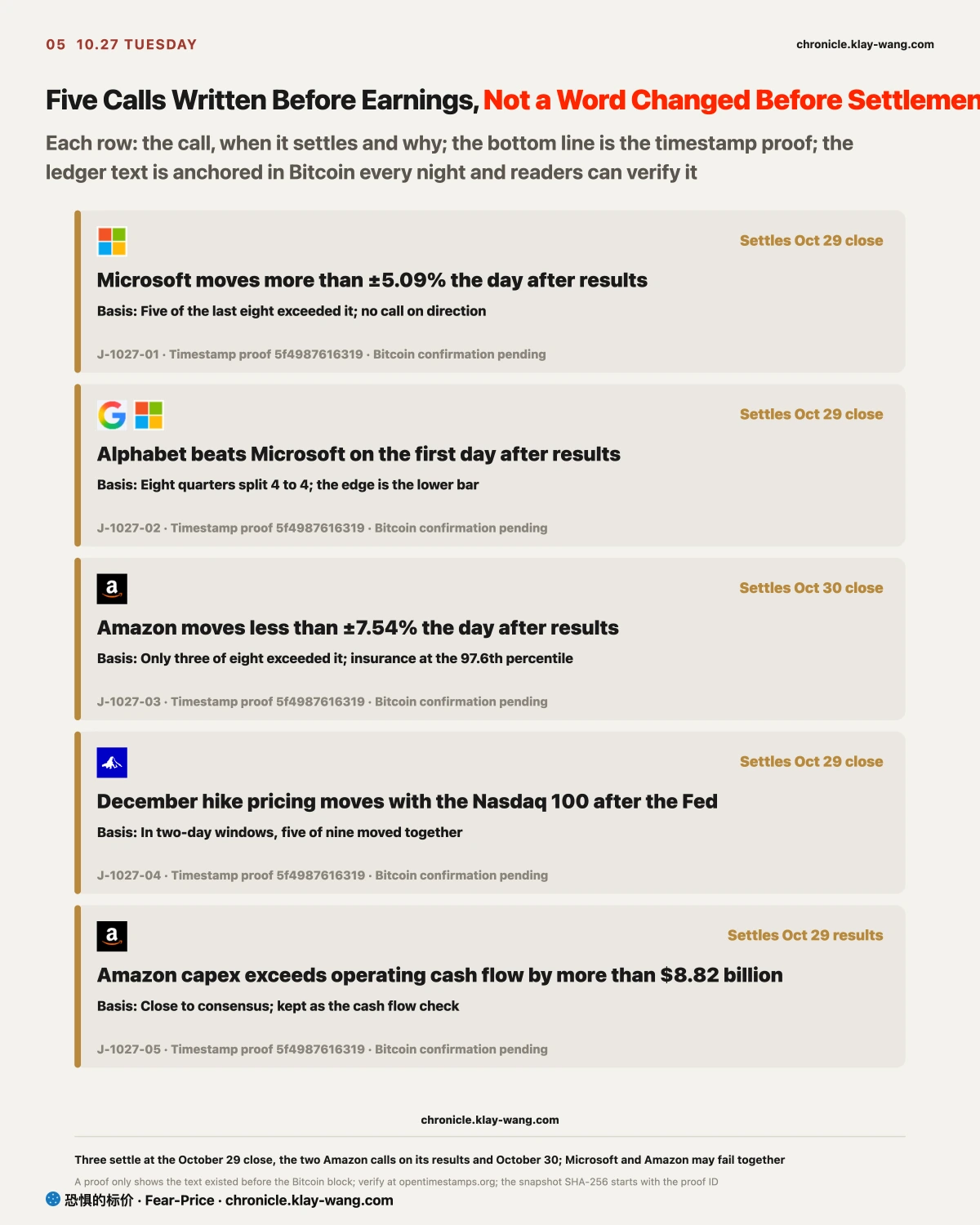
- We bet Microsoft moves more than its options price, Amazon moves less than its options price, and Alphabet does better than Microsoft after results.
- The Fed decides on Wednesday; a December hike is about 82% priced, and since last Wednesday that probability has moved with tech stocks.
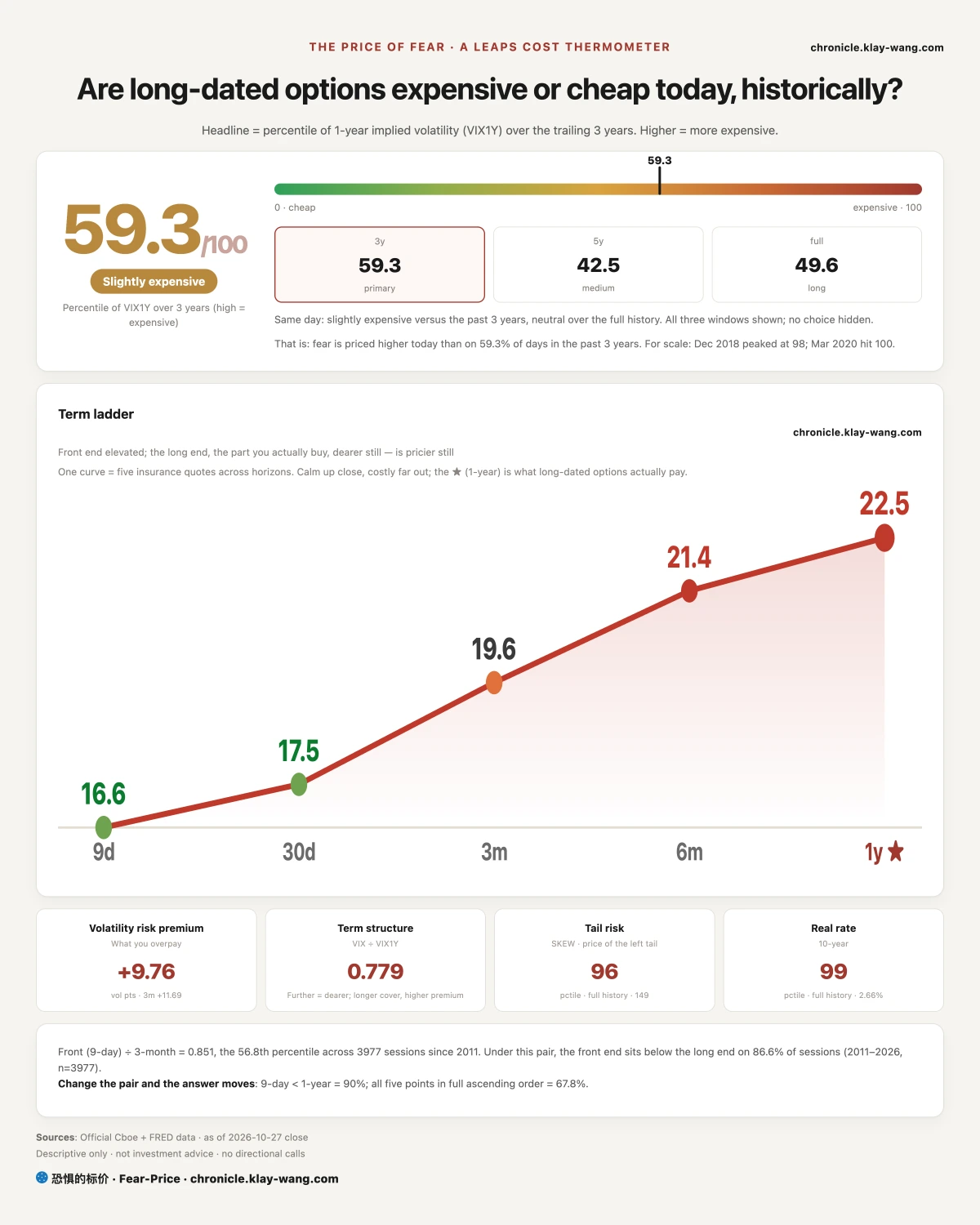
Fear-Price Index 59.3: Market-Wide Insurance Kept Getting Cheaper; the Expensive Cover Sits on Single Stocks Reporting This Week
Fear-Price Index · October 27, 2026 · 59.3/100. One-year implied volatility was 22.49%, at the 59.3rd percentile of the trailing three years; higher means historically more expensive. Daily ledger: chronicle.klay-wang.com. Credit: Fear-Price.
The Fear-Price Index fell from 61.0 on Monday to 59.3, and VIX from 18.39 to 17.52. The K Index read 1.918 late Tuesday (provisional), above the final Monday value of 1.622, as the CNN Fear and Greed reading rose from 29.8 to 33.6. The closer K gets to 1, the more people are turning worry into paying for protection, and on Tuesday it moved further from 1; with Fear and Greed unchanged, VIX would need to rise above 33.6 for K to fall below 1. What followed each past break of K below 1 can be checked at chronicle.klay-wang.com/kindex, and the long-dated percentile at chronicle.klay-wang.com/fear-price. S&P 500 ETF options through November 6 price only 1.92% of movement either way. In that window Microsoft, Alphabet and Amazon each report, yet index insurance is getting cheaper: it looks more like a bet that the three results go their own ways and offset each other, and not on the whole index moving sharply up or down. The Fear-Price Index fell to 59.3: index insurance is getting cheaper while insurance on the reporting stocks is getting dearer. If you hold an index fund, the price of downside cover is still falling.
[Main Line] Three Markets Gave the Three Cloud Providers the Same Ranking; the Ranking Is Right, but It Is Already Fully Priced
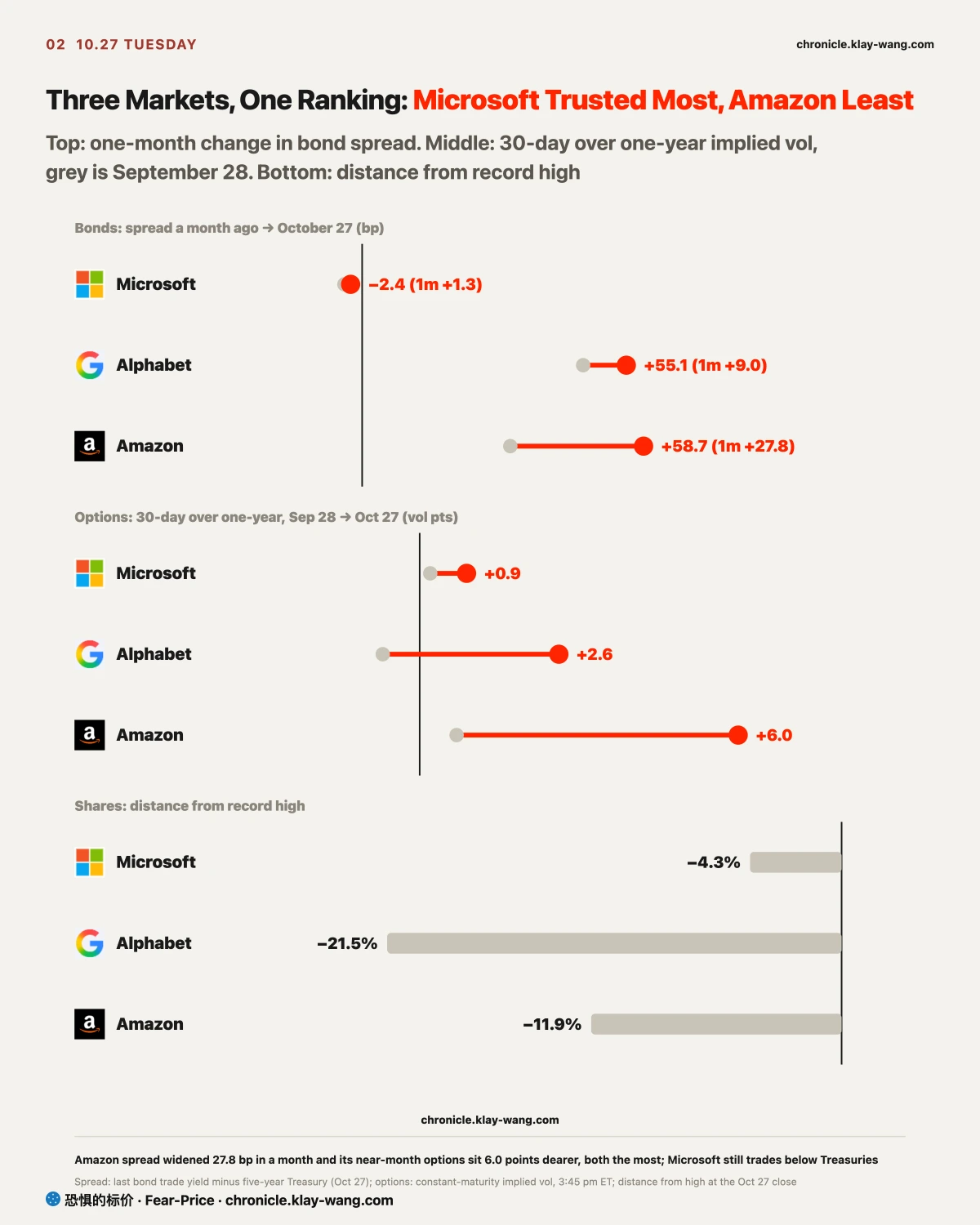
Microsoft and Alphabet report after the close on October 28, Amazon after the close on October 29. We track each company and its stock over time through options, rates and credit. Start with bonds. A Microsoft bond due 2030 yields 4.80%, 2.4 basis points below the five-year Treasury, and has moved only 1.3 basis points in a month. Alphabet yields 5.37%, a spread of 55.1 basis points, 9.0 wider in a month. Amazon yields 5.41%, a spread of 58.7 basis points, 27.8 wider in a month, the most of the three. All three borrow by issuing bonds; lenders to Microsoft ask for less interest than lenders to the US government, while lenders to Amazon have been demanding more compensation this month. The bond market has stated its view through spreads: on how comfortable it is with their current finances, Microsoft ranks first, Alphabet second and Amazon third.
Then options. Microsoft 30-day implied volatility is 32.48%, only 0.9 points above one year, so earnings have barely made its near-month options dearer. Alphabet is at 37.65%, 2.6 points above; Amazon is at 43.32%, 6.0 points above, up from 0.7 a month ago, and before the open on Tuesday its option price sat at the 97.6th percentile of the past year. Finally share prices: Microsoft is only 4.3% below its record high, Amazon 11.9% and Alphabet 21.5%. Each market does its own math and all three give the same order: Microsoft is trusted most, Amazon least, and Alphabet shares have fallen furthest.
Behind this ranking is the cash flow statement for last quarter. Microsoft spent $35.8 billion on capital projects, less than its $55.44 billion of operating cash flow, so it can pay from what it earns. Amazon spent $54.21 billion, $8.82 billion more than its $45.39 billion of operating cash flow. Alphabet spent $44.92 billion, also more than its $39.07 billion. The ranking makes sense; the trouble is that it is fully priced. Option sellers charge premiums by degree of trust, collecting the least from the trusted company and the most from the least trusted one. How far a stock really moves after results depends on how far results land from the estimate already in the price, which has no direct link to trust.
[Microsoft] It Rose 15.51% After the Last Report; This Bet Is on the Size of the Move, Not Its Direction
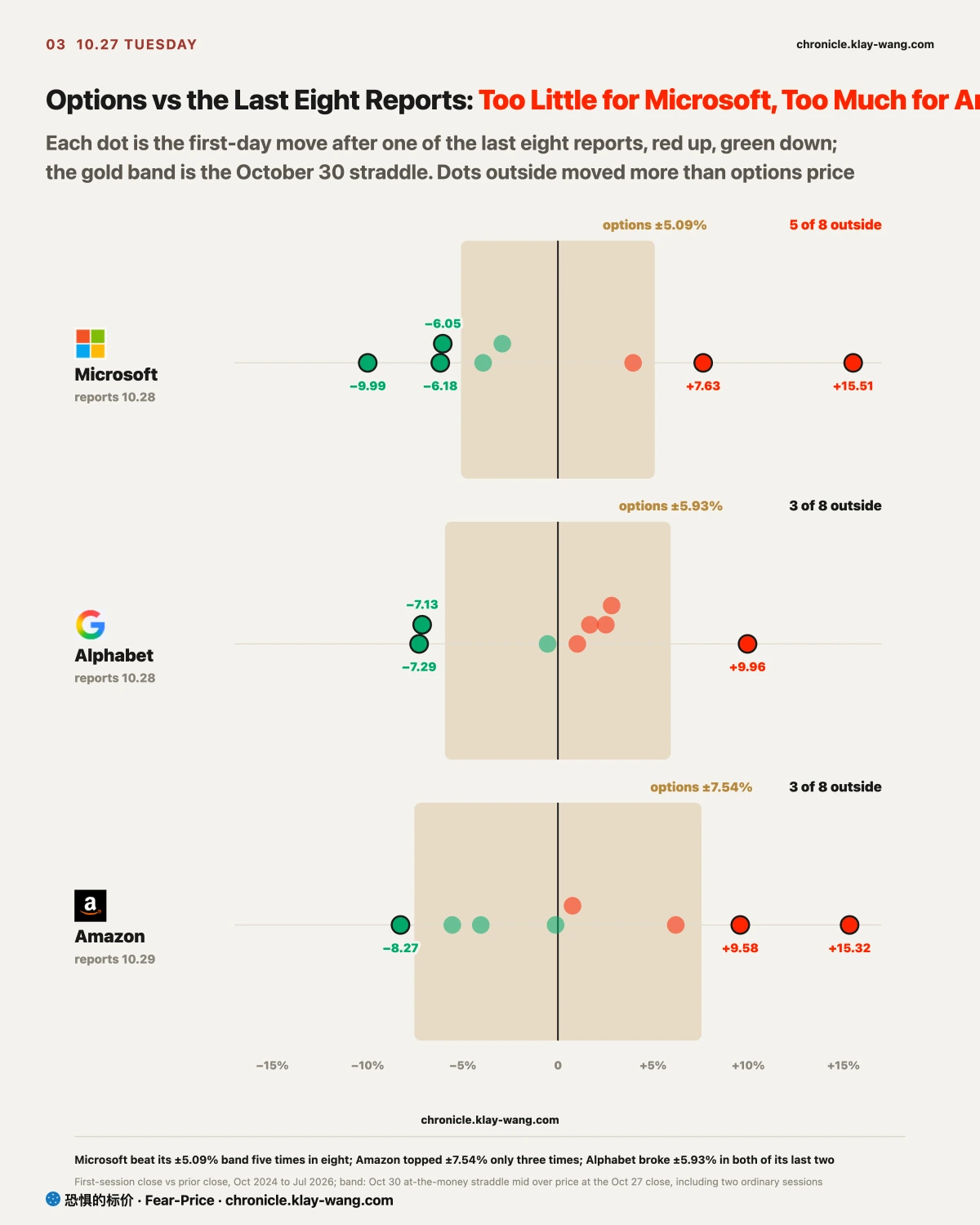
The market expectation for this Microsoft report is written into option prices. Microsoft rose 15.51% the day after its July 30 report and now trades at $531.33, only 4.3% below its record. The at-the-money straddle expiring October 30 closed at $27.05: options give Microsoft 5.09% of movement this week, meaning up or down about 5.09%. A straddle buys one call and one put at the current price; it pays off whichever way the stock moves far enough and expires worthless if it does not. That 5.09% also covers two ordinary sessions, October 28 and October 30; taking those out at one-year implied volatility leaves about 4.57% for the earnings day itself.
In the first session after each of its last eight reports, Microsoft moved more than 5.09% five times, the two largest a 9.99% fall on January 29, 2026 and a 15.51% rise on July 30, 2026; five of the eight reactions were declines and three were gains. The more a company is treated as a safe haven, the more concentrated its holders, and the more option sellers believe nothing will happen, so they charge less; yet once one number in the report misses high expectations, concentrated holders adjust at the same time and the move gets bigger.
We do not suggest betting on the direction of results alone; it can go very right or very wrong. Our own call from the market is that the absolute move in Microsoft from the October 28 close to the October 29 close exceeds 5.09%; if it is 5.09% or less, the call is withdrawn. Microsoft earnings insurance is the cheapest of the three, at only 5.09%.
[Alphabet] The Size of the Beat Does Not Decide the Stock; Alphabet Faces a Lower Bar Than Microsoft
Alphabet revenue beat expectations in each of the last five quarters, yet its next-day reactions over the last eight reports ranged from a 7.29% fall to a 9.96% rise: beats are routine, and the stock trades on what lies beyond the beat. On October 19 data, Alphabet traded at about 16 times earnings, cheaper than 99.6% of the past three years, and its shares are 21.5% below their record. Last quarter it spent $5.85 billion more on capital projects than it generated in operating cash flow; the market is checking whether its AI spending pays back. The bar for this report is already low: if the gap between capital spending and cash flow stops widening, it should pass. What I tell friends who hold Alphabet: this report is worth watching, look at that gap first, and how far revenue beats is secondary.
After the close on Tuesday, Oracle and Google announced that Google AI chips, TPUs, will be offered on Oracle cloud from 2027; separately, OpenAI was reported to plan to buy Google AI chips, and Alphabet rose 1.5% overnight. With new customers for its chips, AI capital spending gains another source of revenue, and the bar for Alphabet rose a little the night before results; the call below counts from the October 28 close, so the overnight gain is not included.
Options give Alphabet 5.93% of movement this week, meaning up or down about 5.93%. Its last two reports were followed by a 9.96% rise and a 7.13% fall, both beyond that range; its pattern of movement has changed. Microsoft and Alphabet report on the same evening, one facing a high bar and one a low bar. On results of similar quality, the stock with the lower bar reacts better. So for Alphabet, our own call is that on October 29 its one-day return beats that of Microsoft; if the Alphabet return is equal or lower, we got it wrong. The base rate needs saying: over the last eight quarters, compared report by report, Alphabet did better four times and Microsoft four times, an even split, so this call rests only on the difference in the two bars.
[Amazon] The Insurance Is Fully Bought; We Bet It Moves Less Than Its Options Price
The Amazon at-the-money straddle expiring October 30 closed at $19.08: options give Amazon 7.54% of movement this week, meaning up or down about 7.54%; taking out two ordinary sessions leaves about 7.06% for the earnings day itself, the highest of the three. In the last eight reports Amazon moved more than 7.54% in a day only three times: down 8.27% on August 1, 2025, up 9.58% on October 31, 2025, and up 15.32% on July 31, 2026. Its option price sits at the 97.6th percentile of the past year and its bond spread widened 27.8 basis points in a month. Those willing to pay up for protection before Amazon results have already paid; the uncertainty is fully in the price. Amazon holders chasing earnings insurance now pay more than on 97% of the days in the past year.
Our call on Amazon: the absolute move from the October 29 close to the October 30 close is less than 7.54%; if it is 7.54% or more, we got it wrong. It is the other side of the Microsoft call, the same view that options are priced by trust and not by real volatility, so the two may be right together or wrong together. One more call: the amount by which Amazon capital spending exceeds operating cash flow widens this quarter beyond the $8.82 billion of last quarter. The Monday note made that the number that matters most; the market broadly expects it too, so it carries little information and stands as the cash flow check.
[Fed] A December Hike Is 80% Priced and the Odds Move Only With Tech Stocks; Wednesday Afternoon and Evening Settle the Same Bet
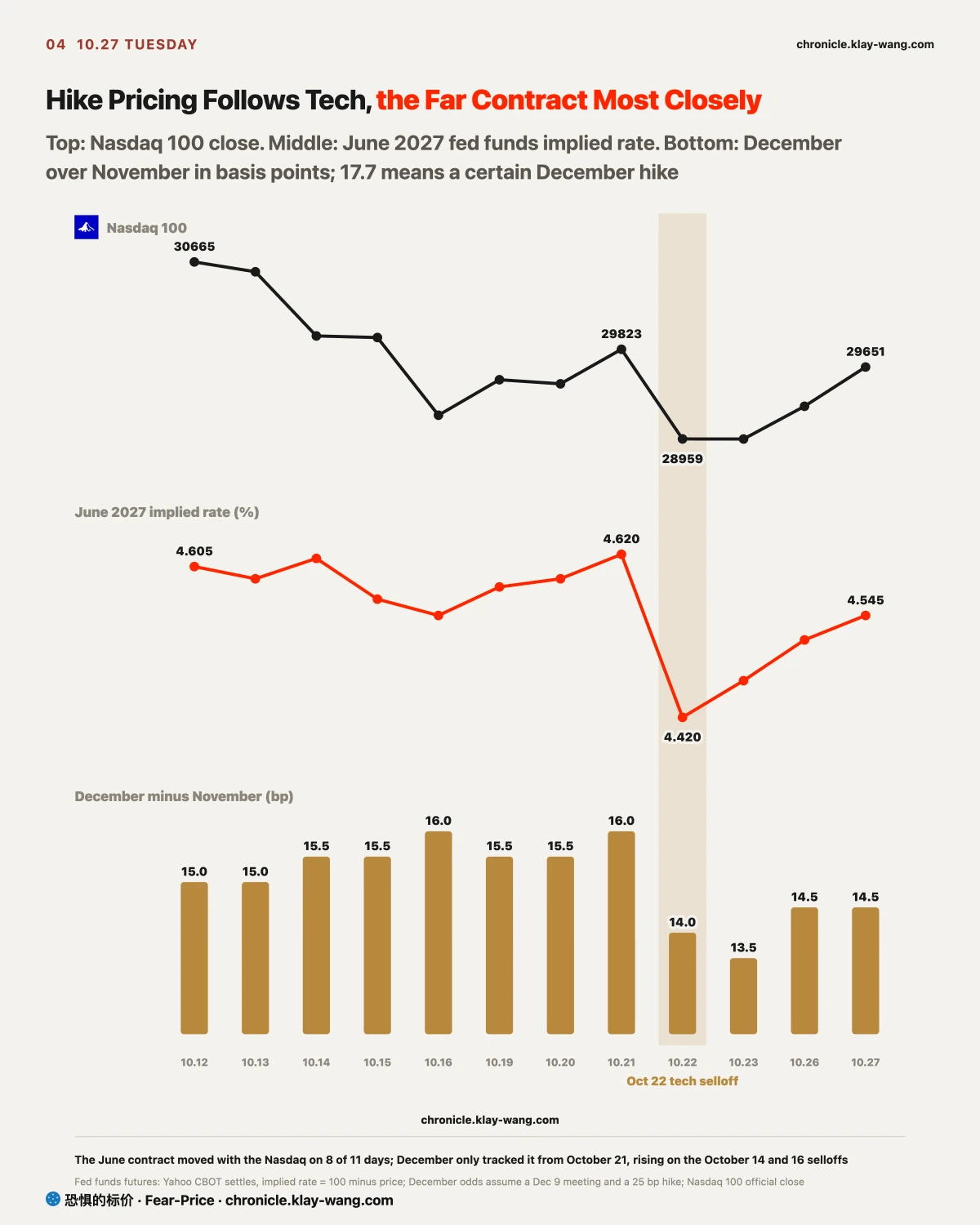
The Fed announces its decision at 2 pm on Wednesday. The November fed funds future implies 3.900%, so almost nobody is betting on a hike at this meeting. The December contract implies 4.045%, 14.5 basis points above November; assuming a December 9 meeting and a quarter-point hike, that is about an 82% probability. Since October 12 the gap has ranged from 13.5 to 16 basis points, its two lowest readings on October 22, the day tech stocks dropped sharply, and the day after. The June 2027 contract implied 4.620% on October 21 and fell to 4.420% on October 22, when the two-year Treasury yield fell from 4.81% to 4.65%, its biggest one-day decline this year; tech then rebounded, and the June contract was back at 4.545% on October 27, recovering more than half the drop.
The contract that tracks tech most closely is the further one: over the 11 sessions since October 12, the June 2027 contract moved with the Nasdaq 100 on 8 days, betting on fewer hikes when tech fell and more when it rose. The December contract tracked closely only after October 21; on October 14 and 16 the Nasdaq fell more than 2% and it rose. As the October 22 note put it, the tech selloff made the market reassess growth; a lower growth estimate weakens the case for further Fed hikes, and hike pricing falls with it. The Fed decides Wednesday afternoon and Microsoft and Alphabet report that evening. Weak results and falling tech would push rates down and cushion stocks; strong results with a Fed nod toward December would hurt most the companies borrowing to expand.
So on this meeting, our call is that the Fed does not hike this time, and that from the October 27 close to the October 29 close the implied-rate gap between the December and November contracts moves in the same direction as the Nasdaq 100; if it moves the opposite way or does not change, we got it wrong. The base rate needs saying: since October 12, in two-day windows, the December contract moved with the Nasdaq in only five of nine; we are betting the tight link of the past week carries past the Fed. The ten-year Treasury yield is 4.99%, and the MOVE index of expected rate volatility fell from 102.19 to 97.87, so the bond market eased somewhat ahead of the Fed. If you hold long bonds, the Wednesday evening reports matter as much as the Fed that afternoon.
[Mirror] Both Storage Makers Beat, Yet One Fell and One Rose; SK hynix Profit Is a Bill for the Cloud Providers
After the close on Tuesday, Seagate reported quarterly revenue of $4.233 billion, up 61% from a year earlier, and adjusted earnings of $7.68 per share, both above expectations, with next-quarter revenue guidance of $4.7 billion to $4.9 billion, also above expectations; yet its shares fell as much as 8.6% after hours (Benzinga).
On the morning of October 28 in Korea, SK hynix reported revenue of 104.6 trillion won and operating profit of 83.3 trillion won, an 80% operating margin, both above expectations; net profit of 39.8 trillion won, weighed down by an 11.6 trillion won foreign exchange loss, fell short of the 59.66 trillion won consensus. The US-listed SKHY was up 6.8% in overnight trading at 9:43 pm ET, and Micron up 3.1%. Both beat on revenue, one stock fell and one rose: a beat alone does not set direction, the same logic as for the three cloud providers.
The SK hynix report is also a bill for the three cloud providers. SK hynix said it has signed long-term supply agreements with 14 major customers, including global cloud providers, locking in more than half of its 2027 and 2028 capacity at prices that adjust with the market within agreed ranges; its own capital spending in 2027 will rise sharply from this year, and it expects supply to stay short of demand until 2030. Cloud providers book most of the memory they buy as capital spending, so part of the 80% SK hynix operating margin comes from what cloud providers pay for memory. SK hynix also said the AI revenue and cash flow of its main customers will improve and their investment burden will ease; that is a supplier judging its customers, to be checked against the three cash flow statements. For the call that the Amazon gap between capital spending and operating cash flow keeps widening, rising memory prices are one force pushing it wider.
New cloud and server stocks led on Tuesday, with CoreWeave up 7.94%. Its spread fell from 1054.3 on Monday to 1000.0 basis points but is still 181.4 wider over a month; its 30-day implied volatility is 18.1 points above one year, against 5.6 points below a month ago. The shares are rebounding, the bonds have recovered only a small part, and options are still getting dearer for the next month.
[Checkback] Three Earlier Calls: The Dell Call No Longer Holds, the Ten-Year Call Slipped Below Its Line
The Dell call filed on October 16 required its intraday high to stay below 502.32 before October 29. Dell rose 7.47% on Tuesday with an intraday high of 507.39, hitting the withdrawal condition; this call was wrong and will be formally recorded as withdrawn on October 29.
The September 18 call that the stretch between hikes is turbulence and not a trend settles on whether the S&P 500 ETF stays within 5% of 761.69; it closed at 769.66 on Tuesday, only 1.05% above, and settles after the Fed decision on Wednesday.
The October 1 call that the ten-year would still close at or above 5% on October 30 saw it close at 4.99% on Tuesday, one basis point below the line, with settlement on Friday.
What This Means for What You Hold
Option prices for the three have fully priced the trust of the market; who moves more after results depends on how far results land from the estimate already in the price.
Holding Microsoft: options price the smallest earnings move of the three at 5.09%, and five of the last eight reactions exceeded it. Pre-earnings insurance is cheapest; if you want cover against a big drop after results, this is the cheapest protection of the three.
Holding Amazon: premiums sit at the 97.6th percentile of the year, so protection before results is the most expensive. Only three of the last eight reactions exceeded the 7.54% options price; chasing insurance now most likely means overpaying.
Holding Alphabet: valuation is near its lowest in three years and the bar is the lowest; if the gap between capital spending and cash flow stops widening it passes, and by the height of the bar it is the easiest of the three to beat expectations.
Holding companies that borrow to build computing capacity, or long bonds: the CoreWeave spread widened 181.4 basis points in a month, and the share rebound has repaired only a small part of the bonds. If the Fed backs a December hike on Wednesday, companies borrowing to expand carry the heaviest interest burden.
Three Takeaways
- Bonds, options and share prices rank Microsoft the safest and Amazon the least trusted, and options charge premiums by that ranking: the least for Microsoft earnings insurance, the most for Amazon.
- We bet the ranking is mispriced: Microsoft moves more than 5.09% after results, Amazon less than 7.54%, and Alphabet, facing the lowest bar, does better than Microsoft.
- December hike odds moved with tech stocks this week; with the Fed on Wednesday afternoon and reports that evening, three of the five calls settle at the October 29 close, and the two Amazon calls settle on its results and the October 30 close.
No investment advice. No direction calls. No market timing.