Google 跌倒,微软吃饱? · 10.26-10.30
Three Lines: Both Clouds Are Growing, but Cash Comes Back at Different Speeds
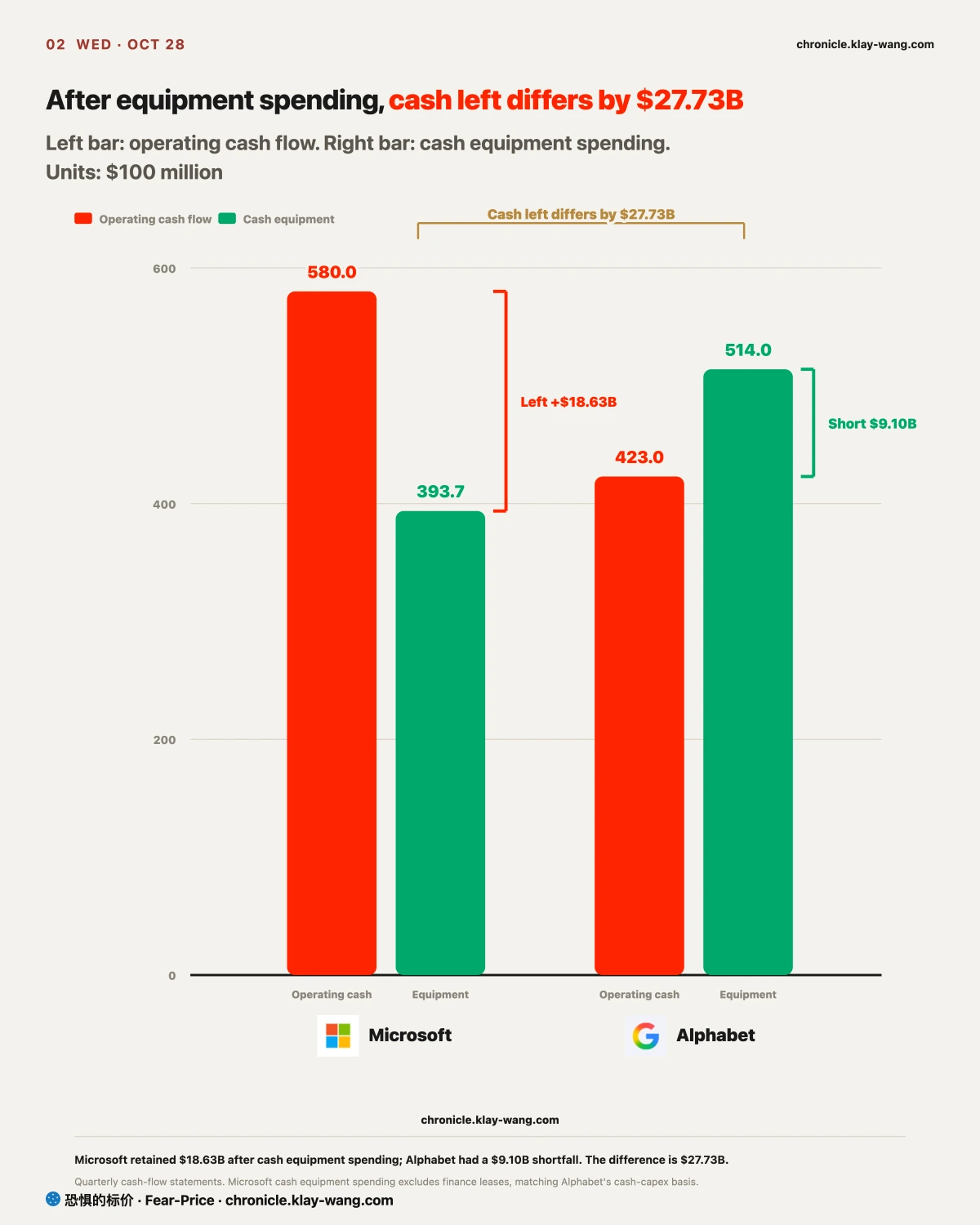
- Microsoft had $18.63 billion left after paying for cash equipment purchases this quarter. Alphabet had a $9.10 billion shortfall. Both cloud businesses are profitable, but their cash cycles have separated.
- Microsoft can allocate the same server pool across Azure, workplace software and developer tools, while using leases to defer part of the bill. Alphabet rents cloud computing and also sells complete TPU systems, which requires earlier inventory spending.
- Microsoft rose 2.90% after hours while Alphabet fell about 10%. The market rewarded faster cash recovery, not just faster revenue growth.
Fear-Price Index: Market-Wide Insurance Got Cheaper While Earnings Insurance Stayed Expensive
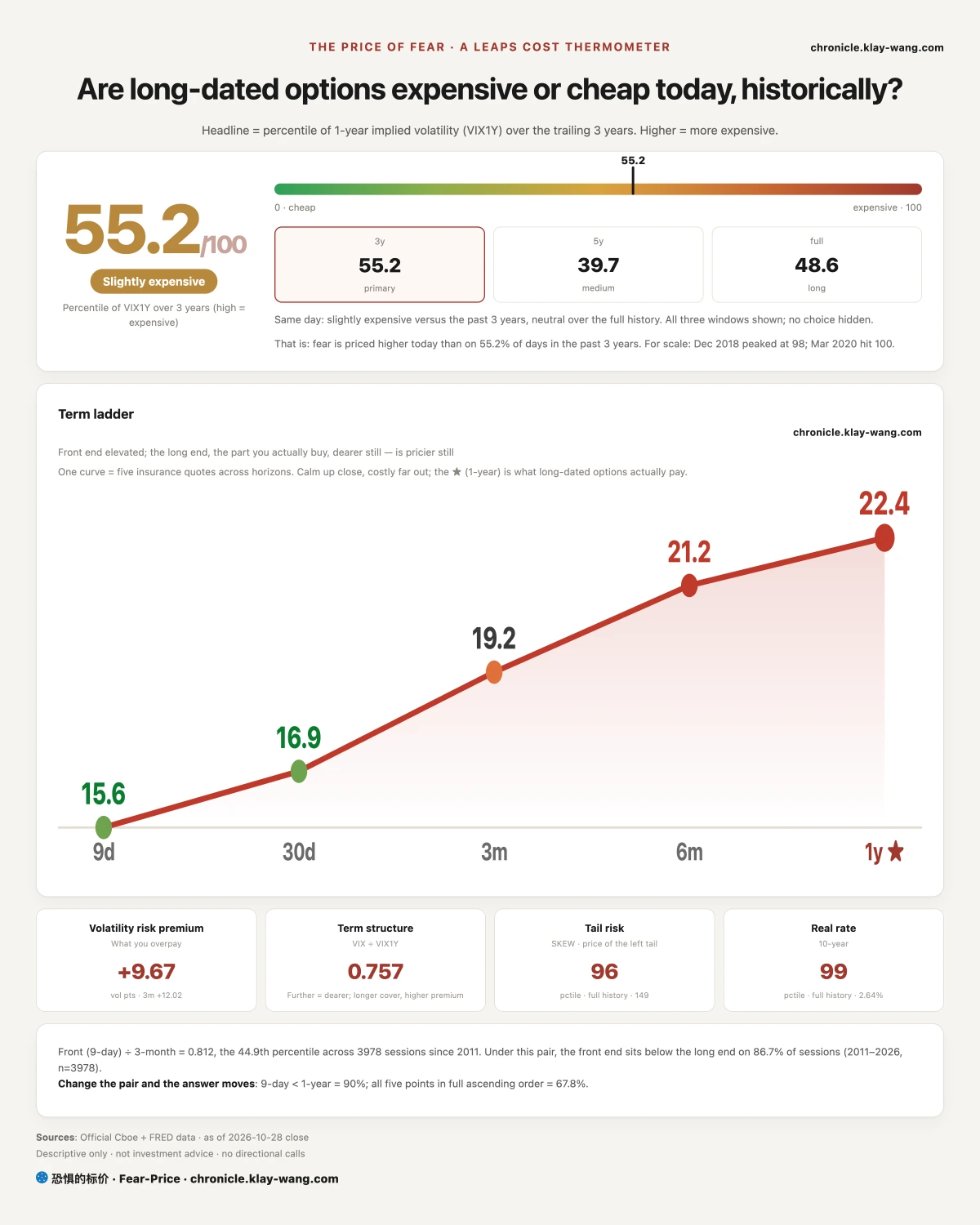
Fear-Price Index · October 28, 2026 · 55.2/100. One-year insurance pricing sits near the middle of its trailing three-year range; a higher reading means it has historically been more expensive. Daily ledger and methodology: chronicle.klay-wang.com. Credit: Fear-Price Index · Fear-Price.
The Fear-Price Index fell from 59.3 to 55.2, while VIX declined from 17.52 to 16.91. Long-dated insurance and short-term volatility fell together, so the price of broad-market protection kept getting cheaper.
The S&P 500 ETF rose 0.34% on Wednesday and the Nasdaq 100 ETF gained 0.60%, but advancing and declining constituents were almost evenly split. The indexes kept rising without most stocks joining them, leaving demand concentrated in a small number of heavyweights.
The K Index increased to 2.12 from the Tuesday final reading of 1.877. It compares how pessimistic the market sounds with how much investors are actually paying for downside protection; the closer it gets to 1, the closer those two measures are. The Wednesday reading moved further from that threshold, so investors were not rushing to buy broad-market protection.
[Main Line] Revenue Is Growing at Both Companies; the Difference Is How Quickly Equipment Spending Comes Back
Microsoft rose 2.90% after hours and Alphabet fell about 10%. Both cloud businesses are profitable, yet the stocks moved in opposite directions. The market moved past revenue growth and started asking how long each dollar of equipment spending takes to return as cash. Microsoft was rewarded because its path from expansion spending back to cash is clearer today.
Microsoft had $18.63 billion left after cash equipment purchases. Azure, AI infrastructure, workplace software and developer tools sit in the same reporting segment. One shared computing pool means those products can draw from the same servers, with capacity directed toward the businesses with the most urgent orders and highest returns. Commercial bookings fell 12%, while management said large contracts signed last year raised the comparison base and customer demand still exceeds available supply. Capital spending including leases reached $45.2 billion. A lease lets Microsoft use equipment now and pay in installments later, improving cash flow in the current period while leaving rent, interest and debt for future periods.
Alphabet had a $9.10 billion shortfall after cash equipment spending. Search advertising grew 12%, but each query in AI Mode still earns less advertising revenue than a traditional search. At the same time, Google is taking TPUs that it has long used internally and rented through the cloud and turning them into complete systems sold to outside customers. Apple is using TPUs to train foundation models, Meta is developing TorchTPU with Google, and Oracle and Crux AI have delivery partnerships. Nearly 100 customers now use TPUs. Google signs a contract, buys components and builds inventory before it delivers the system, issues an invoice and receives cash. The European Commission fine also consumed cash this quarter, while lower investment values reduced earnings per share. Google is moving from a cash-rich advertising platform toward a company spanning advertising, cloud services and complete AI systems. The $9.10 billion gap reflects a more capital-intensive growth path.
Microsoft depreciation rose 56% from a year earlier and depreciation at Alphabet rose 49%, while Google Cloud posted a 36.2% operating margin. Depreciation spreads the cost of equipment across several years and starts hitting the income statement after the equipment enters service. Capital spending in the current period becomes a fixed cost in coming years. Next quarter, watch whether depreciation grows more slowly than cloud revenue and whether Google Cloud can hold its margin as depreciation rises.
Before the report, Alphabet traded at roughly 16 times earnings and 21.5% below its record high, yet that lower valuation did not prevent the after-hours decline. The current market judgment is clear: Microsoft has shown that expansion can still leave cash behind, while Google must prove that TPU deliveries, search monetization and cloud margins can make its equipment earn a return. That judgment loses support if Google inventory falls, operating cash flow turns positive and the cloud margin holds while depreciation rises.
[Options] Microsoft One-Month Insurance Is Close to One Year; New Cloud Companies Cost Much More
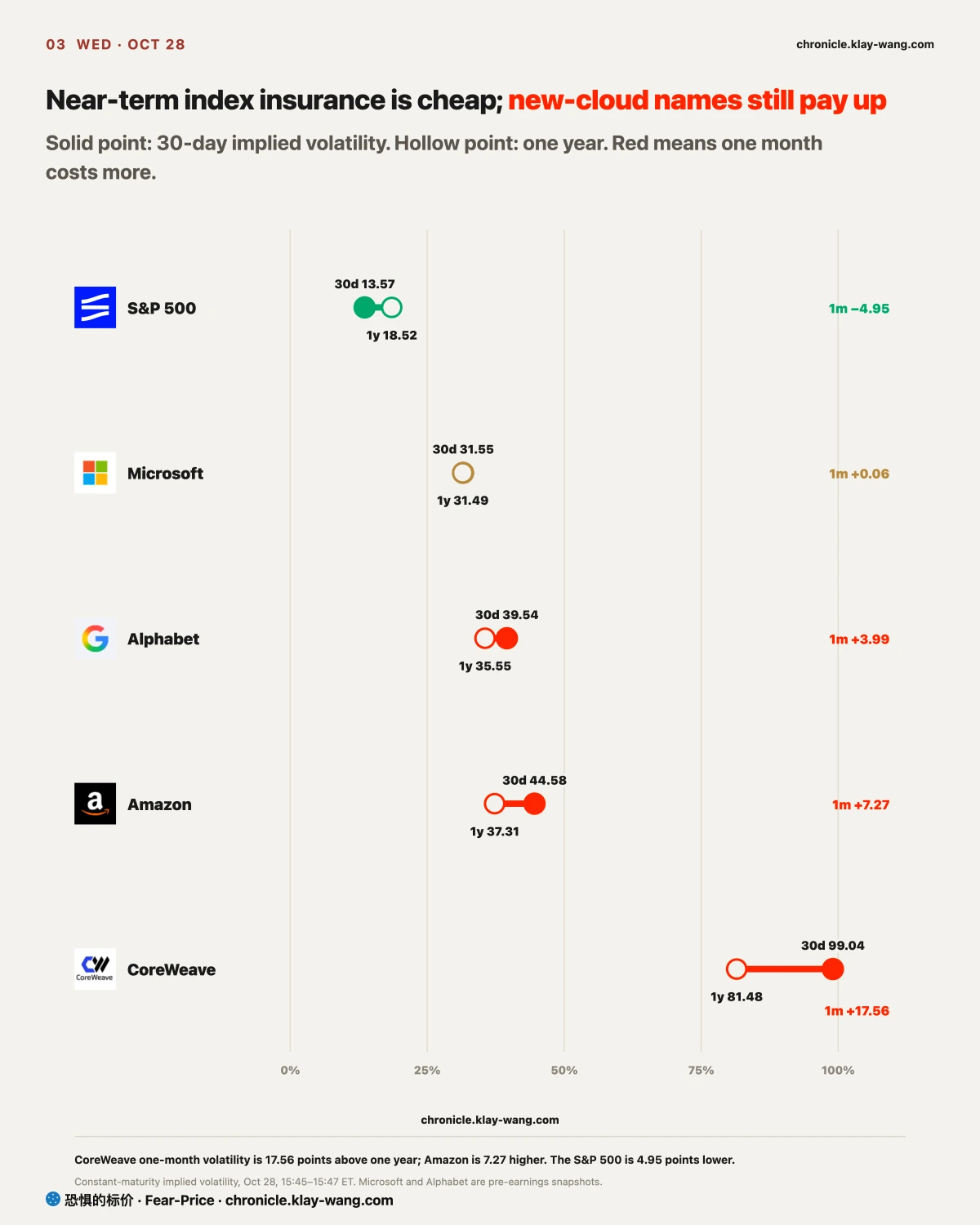
Before the reports, one-month implied volatility for Microsoft was only 0.06 point above one year. Alphabet was 3.99 points higher and Amazon 7.27 points higher. The amount by which one month exceeds one year is the extra insurance premium charged for the next several weeks. A larger gap means investors pay more to wait through the near-term event.
Microsoft closed the after-hours session up 2.90%, still below the 5.09% settlement line in the original call. The after-hours decline in Alphabet exceeded the move priced by an at-the-money call and put bought before results. Those prices show the progress of both calls, but formal settlement remains the October 29 close.
CoreWeave one-month volatility exceeds one year by 17.56 points, Nebius by 10.10 and Dell by 7.58. These companies must both buy equipment and keep raising money, making near-term delivery and financing harder to judge. The market is willing to wait for growth but charges much more for the next month. The highest premium sits in the period when deliveries and financing must first be tested; next-morning positions and later financing activity will provide the next evidence.
[Supply Chain] Customer Capital Spending First Becomes Supplier Revenue
Microsoft and Alphabet spent more than $90 billion in cash on equipment this quarter, and that spending is already appearing in three types of supplier results. SK hynix has long-term agreements covering more than half of its 2027 and 2028 capacity, while organic orders at Vertiv more than doubled. Seagate generated the highest quarterly free cash flow in company history and continued paying down debt. Long-term contracts, data-center power and cooling orders, and disciplined storage supply are three different ways cloud expansion becomes supplier revenue and cash. Suppliers receive orders first; cloud providers later absorb depreciation, leases and interest; shareholders receive what remains.
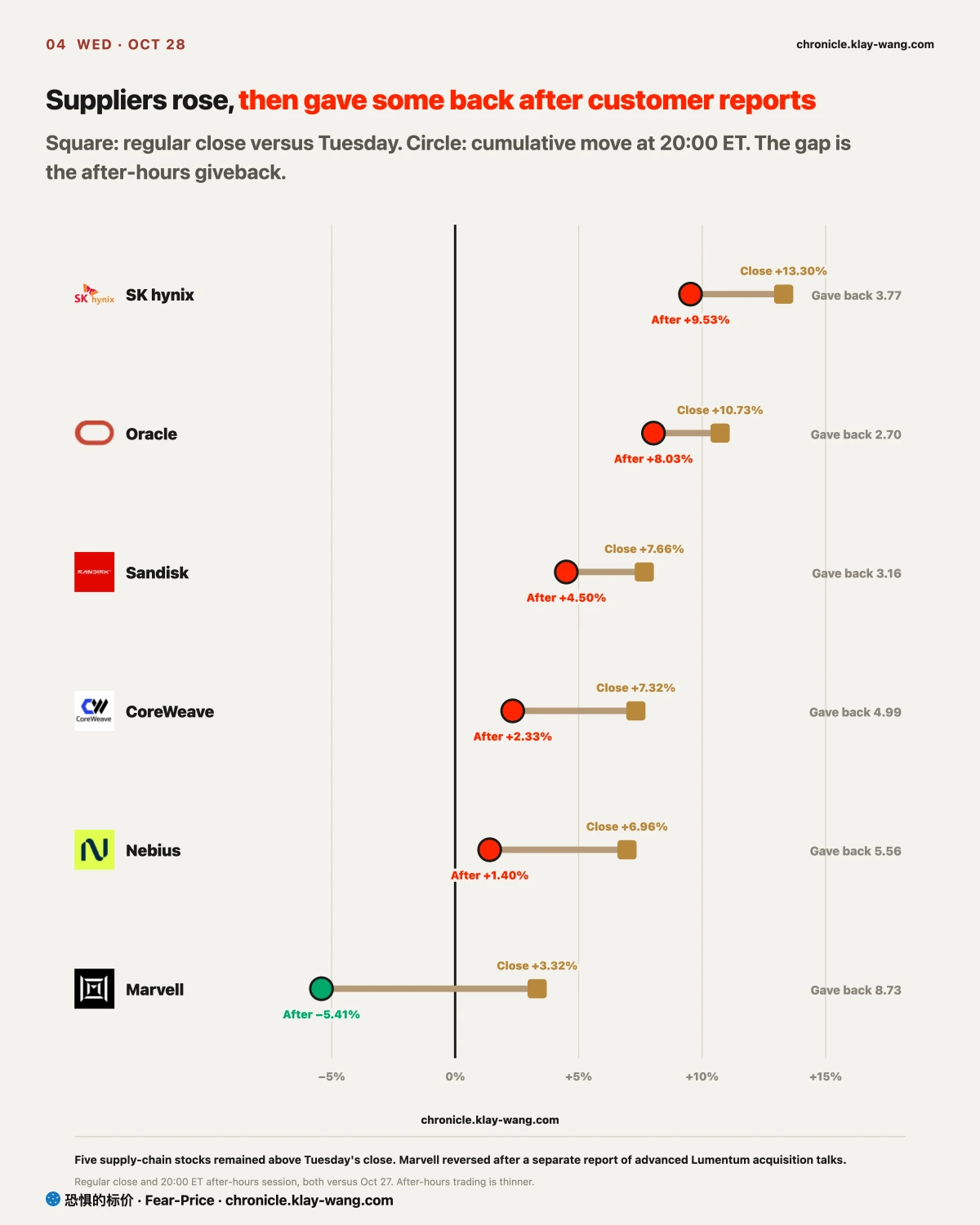
After the customer reports, Nebius and CoreWeave gave back more of their regular-session gains. Their orders did not disappear, but companies that depend on a few large customers and still need outside financing are more exposed if those customers slow spending. The durability of supplier orders ultimately depends on whether cloud providers can sell the added computing capacity and pay on time.
Marvell moved from a gain to a loss after hours. A separate report said the company was in advanced talks to acquire Lumentum, with no final agreement reached. Any acquisition still has to explain the price, the funding method and how the two businesses will be combined. The reversal shows that investors are not yet assigning value to the potential deal.
[Rates and Credit] Bondholders Ask Whether Google Can Pay; Shareholders Ask What Remains After Expansion
The Federal Reserve did not raise rates, leaving its target range at 3.75% to 4.00%, while the long-term Treasury ETF fell 0.78%. The policy rate stayed unchanged, but long-term borrowing costs did not become cheaper. When a company spends today and expects profits years later, a higher discount rate lowers the value of those future profits and makes the payback period on capital spending more important.
Alphabet shares fell nearly 10% after hours, while the company bond spread remained below 40 basis points and narrowed over the past month. Bondholders first ask whether the company can pay interest and principal on time. Shareholders receive the profit left after equipment and interest are paid. The bond market still accepts the ability of Alphabet to service its debt, while the stock market is debating the return on new capital.
Alphabet also issued common shares for about $12.4 billion of net proceeds and senior unsecured notes for about $28.7 billion in the same quarter. The company lists general corporate purposes as the use of proceeds, so the filing does not tie each dollar directly to AI expansion. Its funding mix has nevertheless broadened from operating cash flow to new equity and debt. New shares dilute each existing share and new debt adds interest and future repayment. Bond investors are willing to finance the buildout; shareholders want Google to prove more quickly that the equipment can earn a return.
Oracle and CoreWeave bond spreads are wider and continued widening over the past month. A wider spread means the company must pay more to borrow. Revenue can rise with orders while financing costs determine how much is left for shareholders. Supplier shares can rise while their bond spreads widen because stock investors look at orders and bond investors look at the ability to repay debt.
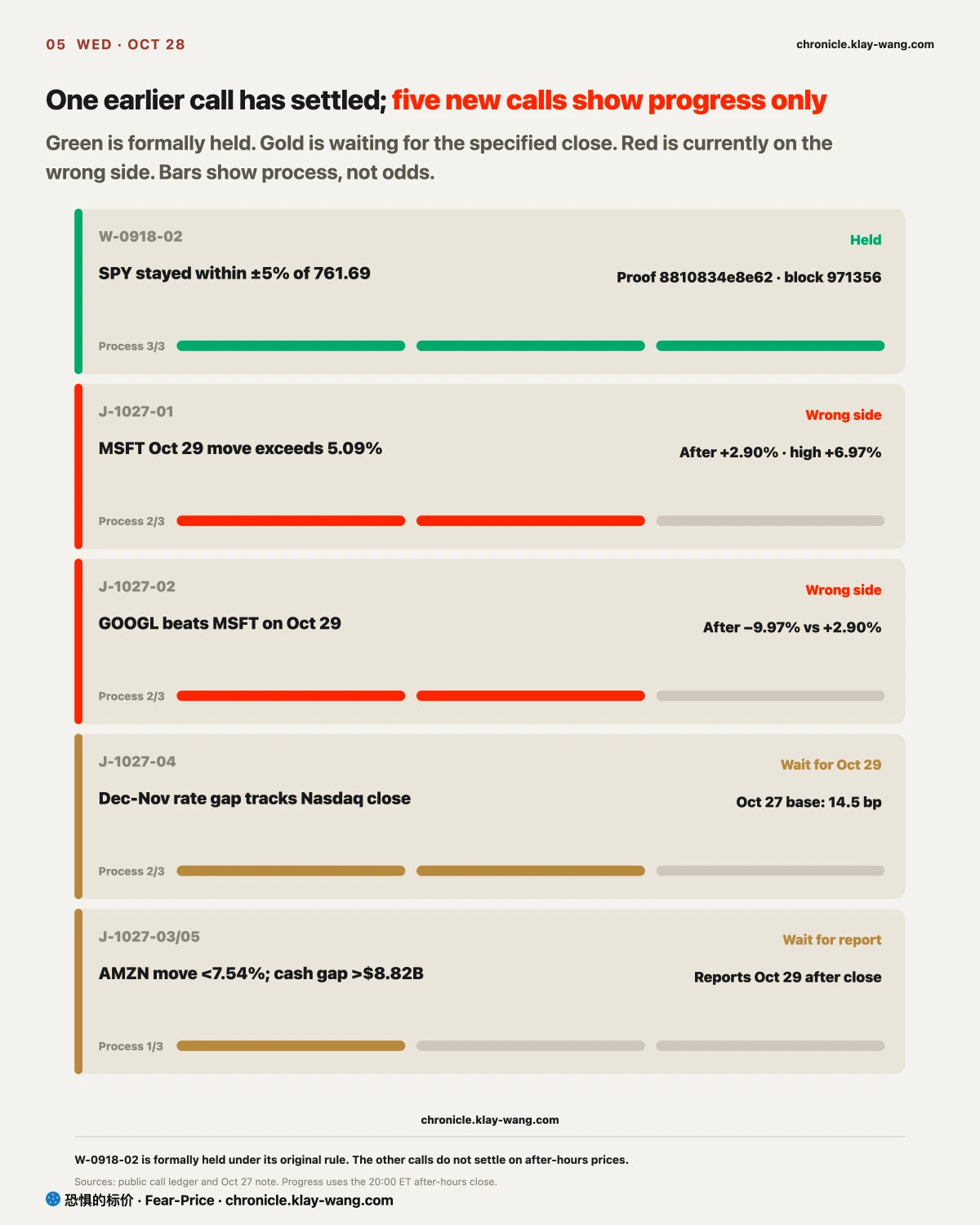
[Ledger] The S&P 500 ETF Never Broke Out; the Earlier Call Formally Held
W-0918-02 used $761.69 for the S&P 500 ETF as its reference price. From filing through settlement, the highest official close was 2.28% above that level and the lowest was 0.23% below it. The path never touched the original 5% withdrawal line.
The ETF finished the settlement date 1.39% above the reference price, so the call is recorded as held. The public proof identifier appears on Card 5. Newer calls still settle at the October 29 or October 30 official close; after-hours prices are progress, not settlement.
On October 27, we called for Alphabet to outperform Microsoft after their reports. After-hours trading has placed that call on the wrong side. The premise was that the quality of the two reports would be broadly similar and the cheaper stock would react better. Earnings per share at Alphabet came in roughly 30% below consensus, so that premise failed. Formal settlement remains the October 29 close. A correct call does not deserve celebration; a wrong call requires the premise to be taken apart.
What This Means for What You Hold
For Microsoft, track Azure growth, depreciation and lease payments together next quarter. The current cash advantage can continue if cloud revenue grows faster than depreciation and lease payments. If the fixed bills grow faster, they will gradually consume the cash left today.
For Alphabet, including my own position, track inventory, operating cash flow, total depreciation and the cloud margin together. Falling inventory, recovering operating cash and a stable cloud margin would show that TPU systems are turning earlier spending back into cash. Faster depreciation and a lower margin would show that equipment costs are rising faster than the equipment can earn money. I remain comfortable with the long-term position of Google and expect a better result next quarter.
For chip, storage, power and cooling suppliers, as well as new cloud companies, the size of an order only tells us whether customers are buying today. Its durability depends on whether cloud providers have cash to pay and whether borrowing costs keep rising. Contract coverage, accounts receivable and the bond spreads of major customers tell us more about payment capacity than one day of share prices.
Three Takeaways
- Google is turning TPU from internal infrastructure into an external platform. Apple, Meta and Oracle are now in its customer or partnership network; contracts come first, followed by inventory spending and cash outflow.
- SK hynix locks in capacity, Vertiv locks in orders and Seagate has already converted demand into free cash flow. Cloud equipment spending is reaching the supply chain in different forms.
- Alphabet issued both stock and debt in the same quarter. Bond investors are willing to wait, while shareholders want to see returns sooner.
No investment advice. No direction calls. No market timing.